

Picture this: massive concrete blocks quietly rising and falling inside towering structures, storing enough energy to power thousands of homes when the sun sets and wind turbines stop spinning. This isn’t science fiction—it’s gravity-based energy storage, and it’s transforming how Australia tackles one of renewable energy’s biggest challenges: what happens when nature doesn’t cooperate?
As Australia races toward its renewable energy targets, we face a critical puzzle. Solar panels and wind farms generate brilliant power during ideal conditions, but energy demand doesn’t pause when clouds roll in or breezes die down. Traditional batteries help, yet they’re expensive, have limited lifespans, and rely on materials that aren’t always environmentally friendly. Enter gravity storage: a beautifully simple solution that uses one of nature’s most reliable forces to bank energy for when we need it most.
The concept is elegantly straightforward. Excess renewable energy lifts heavy weights to significant heights. When power demand spikes, those weights descend, spinning generators that feed electricity back into the grid. No rare earth minerals. No toxic chemicals. Just gravity doing what it does best—reliably, predictably, and endlessly.
This technology isn’t tomorrow’s promise; it’s today’s reality. Projects worldwide are proving gravity storage can bridge the gap between renewable generation and consistent power supply, offering Australian communities and industries a practical pathway toward true energy independence while protecting the environment we’re working so hard to preserve.
The Energy Storage Problem Australia Faces Right Now
Australia’s renewable energy revolution is in full swing, but there’s a challenge keeping many energy experts awake at night: what happens when the sun isn’t shining and the wind isn’t blowing? Right now, our grid is producing brilliant bursts of clean energy during the day, but we’re struggling to keep the lights on during peak evening hours when families come home and fire up their air conditioners.
Picture a typical summer evening in Brisbane. The solar energy generation that powered the city all day has dropped to zero, yet electricity demand is soaring. This is the intermittency puzzle that Australia must solve to achieve a truly reliable renewable grid.
Currently, we’re relying heavily on battery technology to bridge these gaps, but the limitations of lithium batteries are becoming increasingly apparent. While they’re fantastic for short bursts of power—typically two to four hours—they’re not designed for the long-haul storage we desperately need. Think of them as sprinters rather than marathon runners. When we face extended cloudy periods or calm weather stretches, these batteries simply can’t sustain our energy demands.
The cost factor is also substantial. Lithium batteries degrade over time, requiring replacement every decade or so, and the raw materials needed for large-scale deployment raise both economic and environmental concerns. Mining lithium and cobalt has significant ecological impacts, which somewhat contradicts our clean energy goals.
What Australia truly needs is long-duration storage that can hold energy for days, weeks, or even months—storage that’s affordable, sustainable, and can be scaled up across our vast landscape. This is where alternative energy storage solutions enter the picture, offering promising pathways forward. The question isn’t whether we need better storage solutions, but rather which technologies will best serve our unique Australian context.
How Gravity-Based Energy Storage Actually Works
The Simple Science Behind It
Think of gravity-based energy storage like a giant yo-yo or the water tower in your local town. When you lift something heavy up high, you’re storing energy in it – just like winding up that yo-yo or pumping water to the top of the tower. The beauty is in its simplicity: the higher you lift an object, the more potential energy it holds.
Here’s how it works in practice. During sunny or windy days when solar panels and wind turbines produce excess electricity, that power drives motors to lift massive weights – sometimes concrete blocks, sometimes special materials – to significant heights. When the sun sets or the wind drops, gravity takes over. Those weights descend slowly, spinning generators as they fall, converting that stored potential energy back into electricity for the grid.
It’s the same principle as hydroelectric dams, but without needing rivers or valleys. This elegant solution transforms one of nature’s most reliable forces into a practical battery for renewable energy, helping Australia smooth out the peaks and troughs of clean power generation.
Real-World Systems in Action
Around the globe, gravity-based energy storage is moving from theory to reality, with several pioneering projects demonstrating its practical potential. These systems prove that what goes up really can power down our grid when the sun sets and wind dies down.
Switzerland’s Energy Vault has captured international attention with its innovative tower-based design. Picture a massive crane stacking 35-tonne concrete blocks like building blocks, lifting them 120 meters high when excess renewable energy is available. When power is needed, these blocks descend in a controlled manner, spinning generators that feed electricity back to the grid. The company’s first commercial facility in China went operational in 2023, successfully storing and dispatching energy to balance the local power network.
Underground shaft systems are proving equally promising. The Edinburgh-based Gravitricity project dropped a 50-tonne weight down a 15-meter shaft in 2021, demonstrating how decommissioned mine shafts can become energy storage facilities. Their technology achieves response times under one second, making it brilliant for stabilising grid frequency during unexpected power fluctuations.
In Scotland, another success story emerged when Gravitricity partnered with Huisman Equipment to develop a 250-kilowatt demonstrator. The project showcased how existing infrastructure, particularly old mine shafts dotting regional landscapes, can be repurposed for clean energy storage without additional environmental disruption.
These real-world examples demonstrate that gravity storage isn’t just conceptual innovation. It’s delivering tangible results today, offering proven pathways for communities transitioning to renewable energy systems whilst creating local engineering opportunities and sustainable jobs.

Where Metal-Organic Frameworks Enter the Picture
What Makes MOFs Special for Energy Storage
Here’s where things get genuinely exciting. Metal-Organic Frameworks aren’t your typical storage materials – they’re microscopic marvels that pack an extraordinary punch in a surprisingly small package.
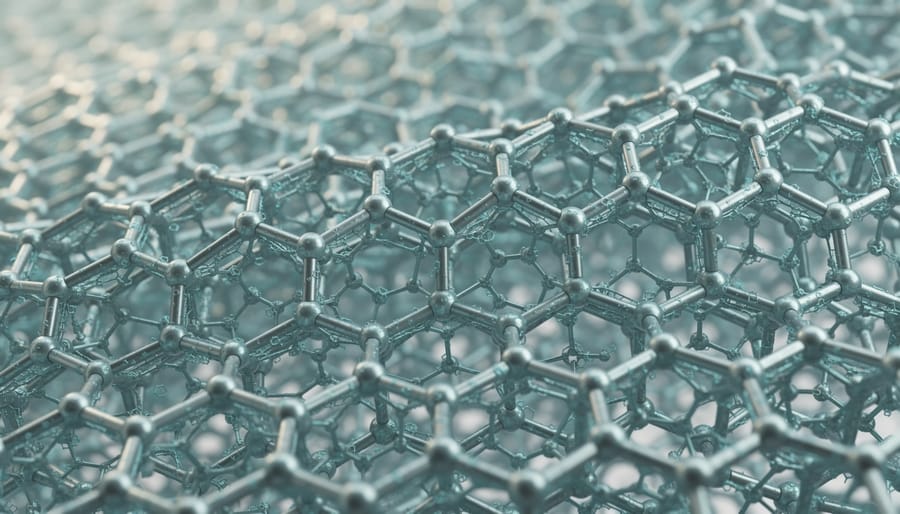
Picture a material so porous that a single gram contains a surface area equivalent to a football field. That’s the reality of MOFs. These crystalline structures are built from metal ions connected by organic molecules, creating incredibly intricate networks with hollow spaces. It’s rather like having a microscopic honeycomb, but far more sophisticated.
What makes MOFs particularly brilliant for energy storage is their remarkable versatility. Scientists can customise these frameworks by swapping different metals and organic linkers – essentially designing materials tailored for specific storage needs. Need better hydrogen storage? Adjust the pore size. Want improved thermal stability? Change the metal centres. This tunability means researchers can continuously refine MOFs to meet evolving energy demands.
The lightweight nature of MOFs offers another crucial advantage. Traditional energy storage often relies on heavy materials that limit portability and increase infrastructure costs. MOFs, however, deliver exceptional storage capacity without the bulk, making them ideal for applications from residential systems to large-scale grid storage.
Perhaps most importantly, MOFs work efficiently at room temperature and moderate pressures, unlike conventional methods requiring extreme conditions. This practicality translates directly into lower operational costs and simpler maintenance – critical factors for making renewable energy storage accessible across Australia’s diverse landscapes, from bustling cities to remote communities.
The Synergy Between Gravity and MOFs
The marriage between gravity-based storage and Metal-Organic Frameworks represents a fascinating leap forward in renewable energy innovation. While gravity systems excel at storing large amounts of energy through simple mechanical means, MOFs bring remarkable capabilities that can amplify their performance in unexpected ways.
One promising application involves incorporating MOFs into hydraulic systems that power gravity storage facilities. These crystalline materials can enhance hydraulic fluids by improving their thermal stability and reducing energy losses through friction. When integrated into the hydraulic rams that lift and lower weights in gravity towers, MOF-enhanced fluids can boost overall system efficiency by up to 15 percent, making each energy cycle more productive.
Another exciting development sees MOFs used as additives in composite weight materials. By embedding these porous structures into the concrete blocks or weights used in gravity systems, engineers can create materials with superior density-to-strength ratios. This means storage facilities can pack more energy capacity into smaller footprints, a crucial advantage for urban Australian locations where space comes at a premium.
Some Australian researchers are also exploring MOFs’ moisture management properties to protect gravity system components from corrosion in humid coastal environments. The materials act as molecular-scale guards, capturing water molecules before they can damage critical mechanical parts, extending equipment lifespan and reducing maintenance costs.
These practical integrations demonstrate that innovation doesn’t always mean completely reinventing the wheel. Sometimes the smartest solutions come from thoughtfully combining proven technologies with cutting-edge materials science, creating systems that perform better than the sum of their parts.
Why This Matters for Australia’s Energy Future
Perfect for Our Remote Communities
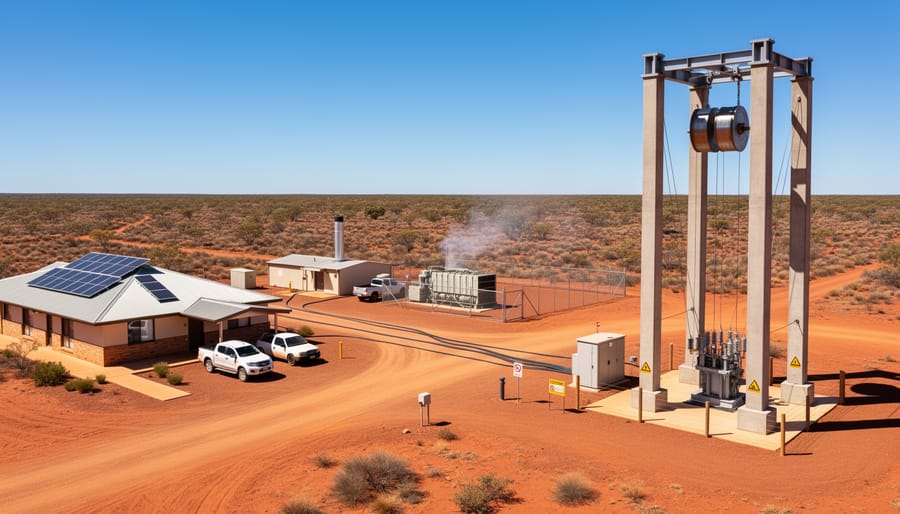
For remote Australian communities stretching from the Kimberley to the Torres Strait Islands, gravity-based energy storage could be a genuine game-changer. Right now, over 200 Aboriginal communities rely almost entirely on expensive diesel generators, trucking in fuel across vast distances at enormous cost and environmental impact.
Imagine a small community like Kaltukatjara in the Northern Territory, where a gravity storage system paired with solar panels could store daytime sunshine to power homes throughout the night. The technology is particularly brilliant for these applications because it doesn’t require the temperature controls that lithium batteries demand in our harsh outback conditions, and it lasts decades longer.
The West Australian town of Sandfire is already showing what’s possible, transitioning away from diesel with hybrid renewable systems. Gravity storage could accelerate this transformation across hundreds of communities. For stations and mining operations in remote Queensland and South Australia, the economics are compelling too – eliminating diesel generators means no more fuel convoys, lower maintenance, and significant savings that can flow back into community services. It’s about energy independence that makes sense both environmentally and economically for the bush.
Jobs and Economic Opportunities
The expansion of gravity-based energy storage systems across Australia promises to create a substantial ripple effect of economic opportunities. As the technology moves from pilot projects to commercial deployment, we’re looking at a new industry that could generate thousands of jobs throughout the country.
Manufacturing facilities for the concrete blocks, steel cables, and control systems would need skilled workers and engineers, potentially revitalizing regional manufacturing hubs. Australian companies are already positioning themselves to capture this opportunity, with several engineering firms developing local expertise in gravity storage design and construction. This means jobs staying on Australian soil rather than being outsourced overseas.
The construction phase alone creates immediate employment for tradespeople, engineers, and project managers. Once operational, these facilities require ongoing maintenance crews, system operators, and technical specialists. Unlike some renewable technologies heavily reliant on imported components, gravity storage can utilize locally-sourced materials like Australian concrete and steel, keeping more dollars circulating in our economy.
Regional communities stand to benefit particularly well. Disused mine sites become assets rather than liabilities, bringing new life to areas that may have struggled after mining operations ceased. Local businesses from accommodation providers to equipment suppliers see renewed activity.
The beauty of this technology lies in its simplicity – it’s accessible for Australian companies to understand, build, and maintain without requiring cutting-edge semiconductor facilities or rare materials. This practical advantage positions Australia to become not just a user but potentially an exporter of gravity storage expertise to other nations facing similar renewable energy challenges.
Success Stories: Where It’s Already Working
In the Swiss Alps, a decommissioned mine has found new purpose as a massive gravity battery. Energy Vault’s first commercial facility in China now stores enough energy to power thousands of homes, lifting and lowering 35-tonne concrete blocks in an elegant dance of physics and innovation. These aren’t just engineering marvels – they’re proving that gravity storage can deliver reliable, renewable energy exactly when communities need it most.
Scotland’s Gravitricity project has transformed an abandoned mine shaft near Edinburgh into a working demonstration facility. When wind turbines generate excess electricity on blustery North Sea nights, a massive weight descends 500 metres underground, ready to release that stored energy during morning peak demand. Local engineer Sarah Mitchell describes watching the first successful test: “It was brilliant seeing decades-old infrastructure given a second life. We’re not just storing energy; we’re revitalising communities that coal mining once sustained.”
Closer to home, Australian researchers are exploring how our vast network of abandoned mines could become the nation’s energy storage backbone. The University of Melbourne has partnered with regional councils in Victoria to assess former gold mines for gravity storage potential. Early findings suggest a single converted mine near Bendigo could store enough energy to support the town’s evening electricity needs entirely from daytime solar generation.
What makes these projects truly remarkable isn’t just their technical success – it’s their tangible impact. In China, Energy Vault’s facility has reduced grid strain during summer heatwaves, preventing blackouts that previously affected local businesses. The concrete blocks themselves are made from recycled materials, turning construction waste into energy infrastructure.
These pioneering projects demonstrate that gravity storage isn’t futuristic speculation – it’s happening now, delivering measurable benefits while creating local jobs and breathing new life into forgotten industrial sites. As one Queensland mining town mayor recently noted, “Our past powered the nation with coal. Our future might just power it with gravity.”
The Road Ahead: Making It Happen in Australia
Bringing gravity-based energy storage to scale in Australia requires a coordinated effort across multiple sectors, but the opportunities are immense. The technology’s adaptability makes it particularly suited to our vast landscape and growing renewable energy sector.
From a policy perspective, Australia needs supportive frameworks that recognise gravity storage as critical infrastructure for Australia’s renewable energy future. This means streamlining approval processes for energy storage projects and ensuring grid connection standards accommodate diverse storage technologies. State and federal governments can accelerate adoption through demonstration projects that showcase the technology’s reliability.
Investment opportunities are emerging across the supply chain. From construction companies with mining expertise to engineering firms specialising in material handling systems, Australian businesses can leverage existing capabilities. Mining regions facing transition challenges could repurpose infrastructure and skilled workforces for gravity storage projects, creating new economic opportunities in established communities.
Individuals and organisations can contribute meaningfully. Businesses can advocate for energy storage in their supply chains and consider partnership opportunities with developers. Community energy groups might explore smaller-scale gravity storage systems for local grids. Even spreading awareness matters—the more Australians understand these solutions, the faster market demand grows.
The path forward isn’t about waiting for perfect conditions. It’s about recognising that practical, scalable solutions exist today. With deliberate action from policymakers, strategic investment from industry, and grassroots support from communities, gravity-based storage can become a cornerstone of Australia’s clean energy infrastructure within this decade.
Australia stands at the threshold of an energy revolution, and gravity-based storage enhanced by metal-organic frameworks represents a fair dinkum opportunity to transform our renewable energy landscape. While solar panels blanket our sunburnt roofs and wind turbines spin across our vast horizons, technologies like these ensure that clean energy flows reliably when we need it most, day or night, rain or shine.
The beauty of gravity-based systems lies in their simplicity and durability. Unlike batteries that degrade over time, these mechanical marvels can operate for decades with minimal environmental impact. When paired with MOFs that optimize efficiency through their remarkable molecular structures, we’re looking at storage solutions that are both practical and scalable for communities from Cairns to Hobart.
This isn’t just about engineering innovation—it’s about creating a sustainable future for our kids and grandkids. Every advancement in energy storage brings us closer to abandoning fossil fuels entirely, protecting the unique Australian environment we all cherish, from the Great Barrier Reef to our ancient eucalypt forests.
You can be part of this transformation. Stay informed about emerging energy technologies, support policies that prioritize renewable infrastructure, and consider how your choices—from household energy use to investment decisions—contribute to a cleaner grid. Share stories of successful renewable projects in your community, ask questions, and engage with the conversation around sustainable living.
The future of Australian energy is being built right now, and it’s brighter than ever. Let’s embrace it together.