
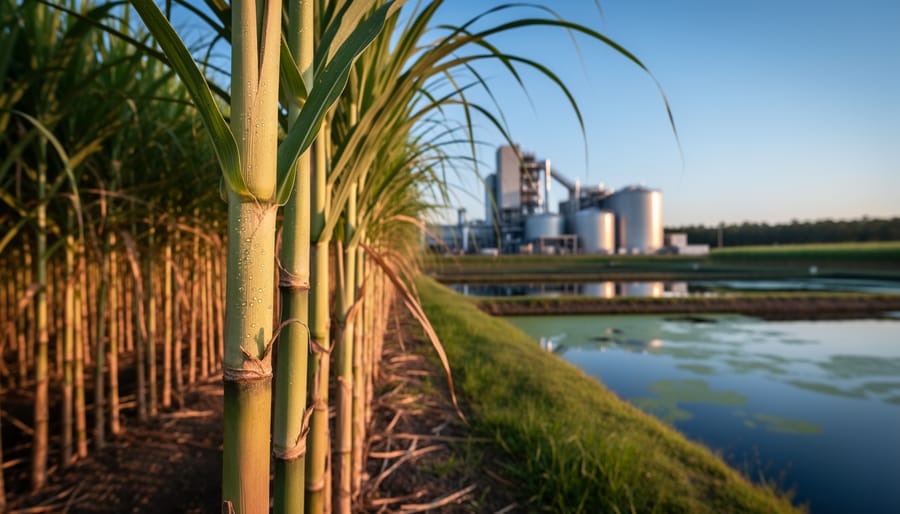
Green biotechnology is revolutionizing how we grow crops for fuel, food, and a sustainable future—and the proof lies in fields across Australia and beyond. From sugarcane engineered to produce 40% more biomass for ethanol production to drought-resistant switchgrass thriving in marginal lands unsuitable for food crops, these innovations demonstrate practical pathways toward energy independence and reduced carbon emissions.
Consider the breakthrough at Queensland University of Technology, where researchers developed genetically modified sugarcane varieties that divert more energy into stalk production rather than sugar content. This single modification increases biofuel yields per hectare while maintaining the crop’s natural resilience to Australian growing conditions. Similarly, modified eucalyptus trees now grow 30% faster with reduced lignin content, making them ideal for both biomass energy and paper production without compromising forest ecosystems.
These aren’t laboratory curiosities—they’re commercial realities transforming agricultural landscapes. Brazilian farmers have cultivated GM sugarcane for bioethanol since 2017, reducing their nation’s petroleum dependence by 45%. Australian trials of salt-tolerant energy crops promise to unlock thousands of hectares of previously unproductive coastal land, turning environmental challenges into opportunities for renewable energy generation.
The applications extend beyond traditional biofuel crops. Scientists have engineered algae strains that double their oil content for biodiesel production, microbes that convert agricultural waste into biogas with 60% greater efficiency, and grasses that require minimal water while delivering maximum energy output. Each innovation addresses specific barriers—land availability, water scarcity, production costs—that previously limited bioenergy adoption.
What makes green biotechnology particularly compelling is its dual benefit: these crops actively remove carbon dioxide during growth while providing renewable alternatives to fossil fuels, creating a positive environmental cycle that conventional energy sources cannot match.
What Green Biotechnology Really Means for Bioenergy
Green biotechnology is transforming how we produce renewable energy from plants, and it’s simpler than you might think. At its heart, this field uses nature’s own toolkit—genes, cellular processes, and plant biology—to create crops that are brilliant at converting sunlight into usable fuel. Think of it as giving plants a purposeful upgrade to do what they already do naturally, just more efficiently.
In practical terms, green biotechnology for bioenergy means developing crops that grow faster, produce more biomass per hectare, and thrive in challenging conditions. Scientists identify specific genetic traits that make certain plants exceptional energy producers, then enhance these characteristics through various biotechnological methods. The result? Crops that need less water, fewer chemicals, and can grow on marginal land that wouldn’t support traditional agriculture—all while producing significantly more feedstock for biofuel production.
This innovation is particularly relevant to bioenergy’s role in Australia, where our unique climate presents both challenges and opportunities. With vast landscapes, variable rainfall, and ambitious renewable energy targets, we need crops that can deliver reliable energy production without competing with food crops or straining precious resources.
The beauty of green biotechnology lies in its precision. Rather than the broad-brush approach of traditional breeding that might take decades, biotechnological innovations can target specific improvements—whether that’s developing sugarcane varieties with higher sugar content for ethanol production, or creating drought-tolerant grasses for biomass in Queensland’s drier regions.
For Australian farmers and energy producers, this means viable new income streams from underutilised land. For communities, it represents local energy security. For our environment, it offers a pathway to reduce fossil fuel dependence while potentially sequestering carbon in the soil. Green biotechnology isn’t about creating something unnatural—it’s about harnessing plants’ existing potential and channelling it toward sustainable energy solutions that address real-world challenges we’re facing right now.
High-Yield Sugarcane: Australia’s Sweet Success Story
How Scientists Made Sugarcane Work Harder
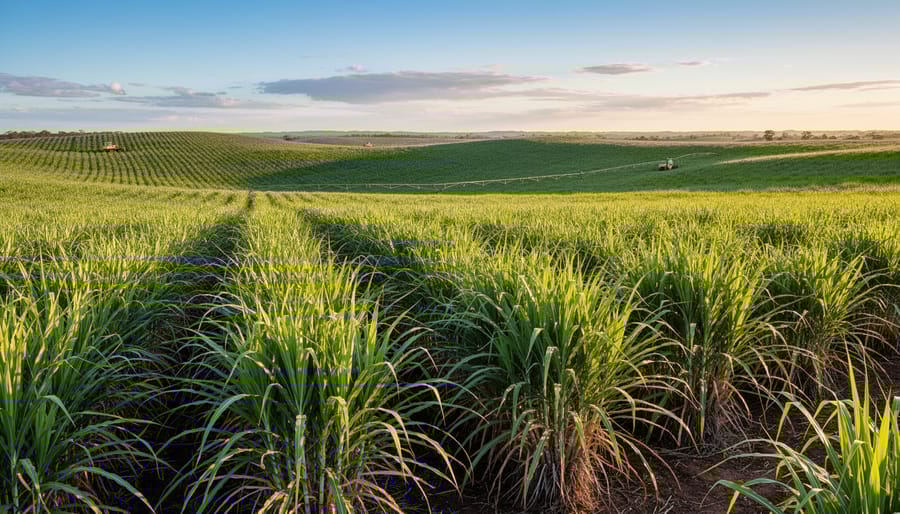
Australian scientists have achieved remarkable breakthroughs in making sugarcane one of the most efficient bioenergy crops on the planet. These innovations tackle three key areas that directly impact how much energy we can harvest from each hectare.
The first game-changer involves supercharging photosynthesis. Researchers discovered that by introducing specific genes, they could help sugarcane capture sunlight more efficiently and convert it into plant material faster. Think of it like upgrading from a standard solar panel to a high-efficiency model. The result? Cane that grows more vigorously and produces significantly more biomass for conversion into biofuels.
Drought tolerance represents another brilliant success story. Scientists have developed varieties that maintain productivity even when water becomes scarce, which is particularly valuable across Queensland’s cane-growing regions where rainfall can be unpredictable. These resilient varieties achieve this by managing water use more efficiently at the cellular level, keeping their growth engines running during dry spells.
The third innovation focuses on boosting cellulose content within the plant’s fibrous material. Higher cellulose means more feedstock for producing advanced biofuels like ethanol. By fine-tuning the genes responsible for cell wall formation, researchers have created sugarcane varieties with up to 30 percent more convertible material.
What makes these advances truly exciting is they’re not laboratory curiosities. Field trials across northern Australia have demonstrated these enhanced varieties perform brilliantly in real-world conditions, delivering tangible results for growers while strengthening our renewable energy capacity. The clever bit? These improvements often work together, creating sugarcane that’s simultaneously more productive, resilient, and energy-rich.
From Field to Fuel Tank: Real Australian Applications
Across Queensland’s sugar regions, farmers are already reaping the rewards of biotechnology-enhanced sugarcane varieties. The Mackay region has become a standout success story, where growers are cultivating advanced biofuel crops that produce 30% more fermentable sugars than traditional varieties. This translates directly into more ethanol per hectare and better returns for farming families.
Local mill operations have integrated these improved varieties into their processing systems, creating a seamless paddock-to-pump supply chain. One Bundaberg farmer, who switched to enhanced sugarcane three years ago, reports increased profitability while maintaining the same land footprint. His crop now supplies both sugar production and the regional bioethanol facility, diversifying income streams and reducing market vulnerability.
The economic ripple effects extend beyond individual farms. Regional bioenergy projects are creating new jobs in processing and logistics while reducing Australia’s reliance on imported fossil fuels. These practical applications demonstrate that green biotechnology isn’t just laboratory theory, it’s putting money in farmers’ pockets while delivering cleaner fuel to Australian motorists.
Engineered Eucalyptus: Fast-Growing Fuel from Native Trees
Why Eucalyptus Makes Perfect Bioenergy Sense for Australia
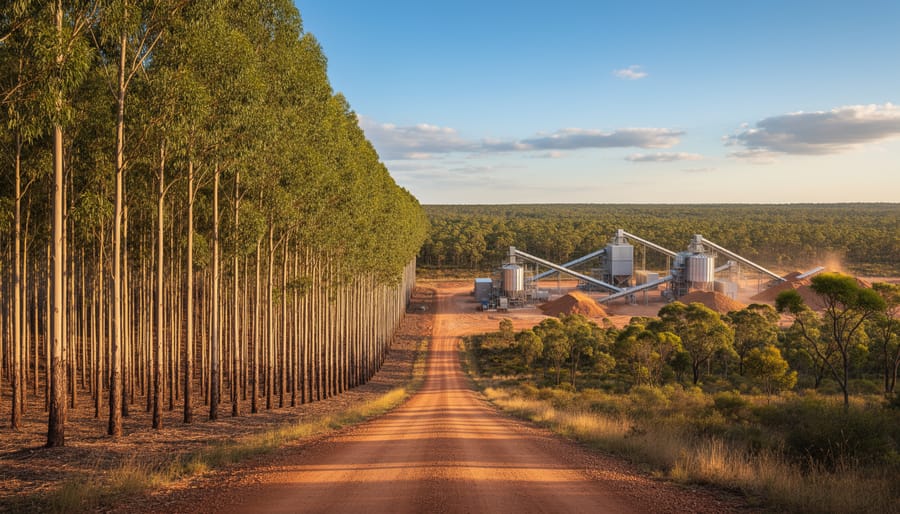
Australia’s eucalyptus trees present an extraordinary opportunity for bioenergy development, and it’s not hard to see why. These iconic natives have evolved over millions of years to thrive in our unique climate, from scorching summers to periods of drought. They’re naturally fast-growing, require minimal water compared to many crops, and don’t compete with food production for prime agricultural land.
What makes eucalyptus particularly brilliant for Australian bioenergy is that we’re working with what nature has already perfected. Through green biotechnology, researchers are enhancing these trees’ natural advantages rather than introducing foreign species that might disrupt local ecosystems. Scientists are identifying genetic markers that boost growth rates and increase the energy content of eucalyptus biomass, making them even more efficient fuel sources.
The beauty of this approach is its inherent safety. We’re fine-tuning a species that belongs here, one that local wildlife and ecosystems have coexisted with for millennia. There’s no risk of introducing invasive plants or creating ecological imbalances. In fact, strategically planted eucalyptus plantations can provide habitat corridors for native fauna while simultaneously producing renewable energy.
Several Australian pilot projects have demonstrated remarkable success, with biotechnology-enhanced eucalyptus varieties producing up to thirty percent more biomass while maintaining drought tolerance. This means more energy from less land, using less water—a winning combination for our sunburnt country.
Breakthrough Varieties Ready for Commercial Use
Australian researchers have brought several promising eucalyptus varieties to the cusp of commercial reality. The most advanced is a cold-tolerant Eucalyptus nitens variety developed through CSIRO’s research program, which has completed field trials across Tasmania and Victoria with impressive results. These trees demonstrate 30% faster growth rates whilst maintaining the robust wood density essential for bioenergy production.
In Western Australia, a drought-resistant Eucalyptus globulus variety has entered advanced pilot trials on marginal farmland near Esperance. Early results show these trees thrive with minimal irrigation, producing viable biomass yields even during extended dry periods—a game-changer for regions facing water scarcity.
Queensland’s success story involves a pest-resistant eucalyptus hybrid now being planted in demonstration plots spanning 500 hectares. This variety naturally repels common insect threats, dramatically reducing the need for chemical interventions whilst maintaining productivity. Local landholders report harvest cycles shortened by nearly two years compared to conventional varieties.
The Southern Tree Breeding Association has released three commercially-ready varieties specifically optimised for biomass production. These trees produce up to 40% more usable material per hectare, transforming the economics of dedicated bioenergy plantations. Several energy companies are already establishing commercial-scale plantings, with the first significant harvests expected within three years, demonstrating how laboratory innovations translate into real-world renewable energy solutions.
Supercharged Sorghum: The Drought-Tough Energy Crop
Making Sorghum Work in Tough Australian Conditions
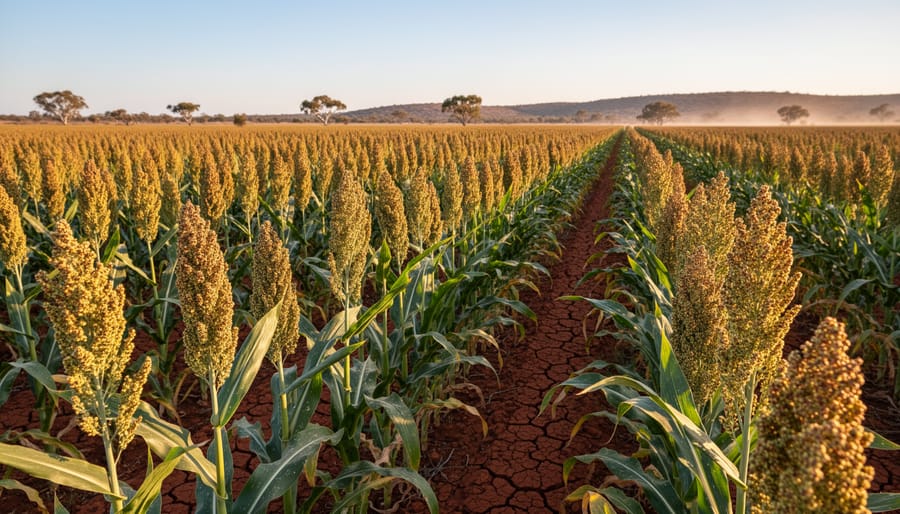
Australian researchers have achieved remarkable success making sorghum a champion performer in our demanding climate. Through selective breeding and genetic mapping, scientists have developed varieties that produce impressive biomass yields with roughly half the water needed by traditional crops, making it a genuine game-changer for regions facing persistent drought conditions.
The breakthrough centres on identifying genes that help sorghum maintain growth during dry spells while keeping protein levels high for stock feed and cellulose content optimal for bioethanol production. Queensland farmers are already seeing the benefits, with improved varieties delivering consistent harvests even when rainfall falls short of historical averages.
What makes this particularly exciting is the dual-purpose potential. These enhanced sorghum varieties serve as both livestock feed and bioenergy feedstock, giving farmers flexibility in tough seasons. Recent field trials across northern NSW and Queensland demonstrated that genetically improved sorghum lines maintained 85 percent productivity with 40 percent less irrigation, proving that smart biotechnology can create crops perfectly suited to Australia’s variable climate whilst supporting our renewable energy goals.
Success Stories from Regional Australia
In Queensland’s Darling Downs region, local growers are leading the charge with biotech sorghum varieties that thrive in challenging conditions. Farmer James Mitchell from Dalby reports that drought-tolerant sorghum has kept his property productive through three tough seasons, providing reliable feedstock for the nearby Millmerran bio-ethanol facility. “It’s a game-changer for our district,” he explains. “When wheat crops struggle, the sorghum keeps going.”
Further north, the Mackay community has embraced high-biomass sorghum alongside traditional sugarcane operations. The local cooperative now supplies renewable feedstock to regional power stations, creating twenty new jobs and reducing transport costs by processing crops locally. These varieties require less irrigation than conventional options, making them perfect for Australia’s variable climate.
In western New South Wales, the Griffith agricultural hub has established a successful pilot program where biotech sorghum supports both livestock feed and biofuel production. This dual-purpose approach has strengthened farm resilience during market fluctuations, proving that innovation can deliver practical benefits right across regional Australia while supporting our transition to cleaner energy sources.
Next-Generation Algae: Tiny Organisms, Massive Energy Potential
Imagine microscopic powerhouses floating in shallow ponds, quietly converting sunlight and carbon dioxide into energy-rich oils at rates that make traditional crops look sluggish. That’s the promise of next-generation algae, and Australian researchers are making it reality through clever biotechnological innovations.
Algae might be tiny, but they pack an enormous punch when it comes to biofuel potential. Unlike conventional crops that need fertile land and fresh water, these aquatic organisms thrive in conditions unsuitable for food production, including brackish coastal waters and even wastewater. The real game-changer comes from genetic modifications that supercharge their natural abilities.
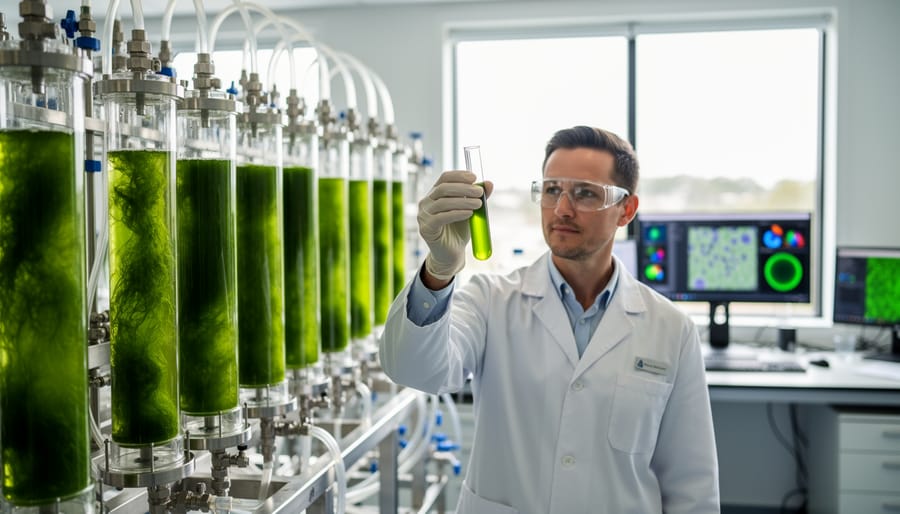
Scientists have successfully engineered microalgae strains with dramatically increased lipid production, the oils that become biodiesel. Some modified strains now produce up to 60 percent of their body weight in oils, nearly double that of unmodified varieties. These enhanced algae also grow faster, reaching harvest maturity in days rather than weeks, making them remarkably efficient solar-powered oil factories.
Australia’s diverse climate offers unique opportunities for algae cultivation. Researchers at the University of Queensland have developed strains adapted specifically to Queensland’s subtropical conditions, while others focus on species that tolerate the higher salinity found in South Australian coastal waters. This regional customization ensures optimal performance across different environments.
The cultivation methods are equally innovative. Open pond systems stretch across marginal land near Port Augusta, while enclosed photobioreactors in Western Australia protect strains from contamination and optimize growing conditions. Some facilities even integrate with existing infrastructure, using waste heat from power stations to maintain ideal temperatures and capturing carbon emissions to feed the algae, creating a closed-loop system that turns pollution into fuel.
One particularly exciting success story comes from a pilot facility in northern New South Wales, where genetically enhanced macroalgae, commonly called seaweed, is grown offshore on submerged lines. These larger algae species require no fresh water, no fertilizers, and actively improve ocean health by absorbing excess nutrients. After harvest, they’re converted into bioethanol and other valuable bioproducts.
The beauty of algae biotechnology lies in its scalability and minimal environmental footprint. As production costs continue falling and genetic improvements accelerate, algae-based biofuels are transitioning from laboratory curiosity to commercial reality, offering Australians a genuinely sustainable energy alternative.
How These Innovations Slash Carbon While Creating Jobs
These biotechnology breakthroughs aren’t just laboratory curiosities—they’re delivering measurable environmental wins while pumping life into regional economies across Australia. The numbers tell a compelling story of transformation.
Consider the carbon equation first. When farmers switch to biotech-enhanced miscanthus or switchgrass on marginal land unsuitable for food production, they’re effectively creating carbon sinks that work year after year. Research from the CSIRO shows that perennial bioenergy crops can sequester between 3 to 5 tonnes of carbon dioxide equivalent per hectare annually in their root systems alone. Scale that across just 100,000 hectares—a modest target for Australia’s vast landscape—and you’re removing up to 500,000 tonnes of CO2 from the atmosphere each year. That’s equivalent to taking roughly 108,000 cars off the road.
The land efficiency gains are equally impressive. Traditional fossil fuel extraction requires extensive infrastructure and leaves environmental scars. By contrast, biotech crops produce more energy per hectare while actually improving soil health. Drought-tolerant sugarcane varieties now yield 15-20% more biomass using 30% less water—crucial credentials for our sunburnt country.
But here’s where it gets really exciting for communities: the jobs flowing from these innovations are diverse and distributed. Unlike centralised coal operations, bioenergy crop production creates employment right where it’s grown. A single biomass processing facility typically generates 40-60 direct jobs in harvesting, transport, and processing, plus another 100-150 indirect positions in equipment maintenance, logistics, and support services.
Regional towns from Queensland’s cane belt to Victoria’s agricultural heartland are eyeing these opportunities. Early adopters in Bundaberg and the Riverina are already training workers in biomass handling and processing techniques. The export potential sweetens the deal further—Asian markets are hungry for sustainable biomass, positioning Australian producers as premium suppliers.
When paired with renewable energy integration strategies, these biotech crops become part of a resilient, diversified energy system that creates lasting prosperity while healing the land.
What This Means for Your Farm, Business, or Community
Whether you’re running a grain property in the Riverina, managing agricultural policy in Canberra, or exploring sustainable business opportunities, green biotechnology in bioenergy crops offers tangible pathways forward.
For farmers and landholders, the first step is connecting with organisations already pioneering these crops. The CSIRO runs collaborative research programs seeking growers for field trials of biotechnology-enhanced varieties. Regional universities including the University of Queensland and University of Adelaide offer extension programs and workshops on transitioning to bioenergy crops. Many farmers are integrating these crops into existing rotations, creating additional income streams while improving soil health. The Australian Oilseeds Federation provides resources on carinata cultivation, including market connections and agronomic guidance.
Industry professionals and businesses can tap into Australia’s growing bioeconomy through partnerships with research institutions. Grainco and other agricultural cooperatives are establishing bioenergy supply chains, creating opportunities for processors, logistics providers, and technology suppliers. The Clean Energy Finance Corporation offers funding for commercial-scale bioenergy projects, while the Australian Renewable Energy Agency supports innovative pilot programs. Companies exploring innovative bioenergy technologies can access grants through the Cooperative Research Centres program.
Community groups and local councils have opportunities to champion regional bioenergy hubs. The Sustainable Energy Association of Australia provides templates for feasibility studies and community engagement strategies. Regional Development Australia offices offer advice on securing funding for community-scale bioenergy projects that convert locally grown biotechnology crops into power and heat for towns and industries.
Policymakers can accelerate adoption by supporting targeted incentives similar to successful schemes in Queensland’s biofutures framework. Agricultural extension services need sustained funding to help farmers navigate new crop options confidently.
Start by identifying your role in this transformation. Visit the AusBiotech website for networking opportunities and conferences. Subscribe to updates from the Australian Bioenergy Network for the latest research breakthroughs and commercial opportunities. Remember, every significant agricultural shift began with early adopters willing to trial new approaches. Green biotechnology in bioenergy crops represents not just environmental progress but genuine economic opportunity for regional Australia. The infrastructure, knowledge, and support networks exist today to make your involvement meaningful and achievable.
The promise of green biotechnology is no longer confined to research laboratories or distant futures. Right across Australia, from Queensland’s sugarcane fields to Victoria’s agricultural heartlands, these innovations are taking root and reshaping our energy landscape. The examples we’ve explored demonstrate that biotechnology isn’t just a theoretical solution to our energy challenges—it’s a practical, proven pathway that’s already delivering results.
What makes this particularly exciting for Australia is that we’re not starting from scratch. We’ve got the agricultural expertise, the land, the climate, and increasingly, the biotechnology know-how to become a global leader in sustainable bioenergy production. The farmers partnering with researchers, the enterprises scaling up production, and the communities embracing locally-produced biofuels are all writing chapters in Australia’s clean energy story.
The journey toward energy independence doesn’t require a complete overhaul overnight. Instead, it’s built on incremental progress—each improved crop variety, each optimized conversion process, and each successful pilot project moves us closer to a sustainable future. These biotechnology innovations prove that environmental responsibility and economic viability can go hand in hand.
Now it’s time to ask yourself: what role will you play in this transformation? Whether you’re a policymaker who can support enabling regulations, an industry professional exploring sustainable feedstocks, or simply someone passionate about Australia’s environmental future, there’s a place for you in advancing green biotechnology. The seeds of change have been planted—let’s nurture them together.