
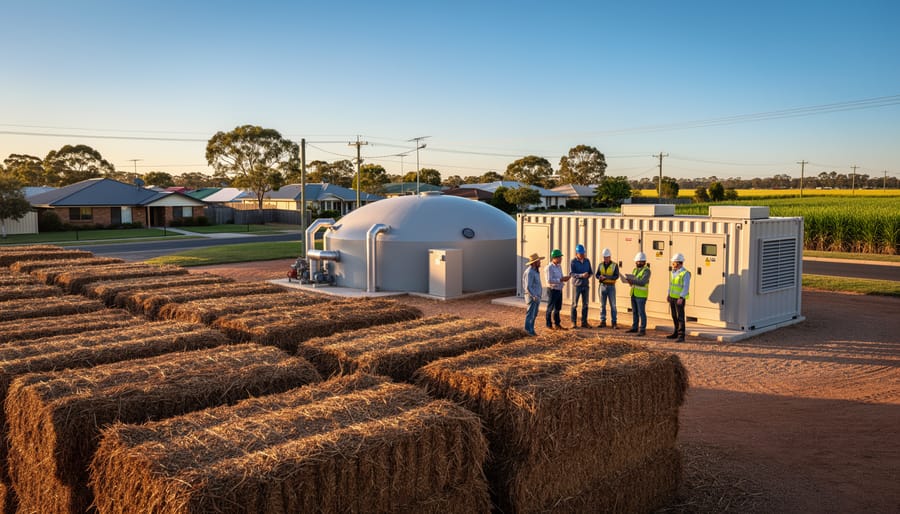
Across Australia, communities are taking their energy future into their own hands, transforming local waste into clean power and proving that the transition to renewable energy doesn’t have to wait for top-down solutions. From country towns powering themselves with agricultural residues to coastal communities converting waste into electricity, community-led bioenergy initiatives are delivering tangible results: lower energy bills, new local jobs, and significant reductions in carbon emissions.
These projects succeed because they’re designed by the people who understand their region’s unique resources and needs. A dairy farming community in Gippsland might harness methane from manure, while a sugar-growing region in Queensland could convert cane waste into electricity. The beauty of community-led bioenergy lies in its flexibility and local relevance.
What makes these initiatives particularly powerful is their ripple effect. When one community demonstrates success, neighbouring regions take notice and adapt the model to their circumstances. Economic benefits stay local, technical knowledge spreads through networks, and communities gain energy security while reducing their environmental footprint.
The pathway to establishing your own community bioenergy project is more accessible than many Australians realize. With the right coalition of motivated locals, understanding of available resources, and practical implementation steps, communities can move from concept to operation within a realistic timeframe. The success stories emerging across the country prove that community-led solutions aren’t just viable – they’re essential for Australia’s renewable energy future.
What Makes Community-Led Bioenergy Different
When a local community decides to take control of its energy future, something remarkable happens. Unlike traditional corporate energy projects where decisions are made in distant boardrooms and profits flow to shareholders, community-led bioenergy puts power—literally and figuratively—into the hands of locals.
At its heart, community-led bioenergy is built on three fundamental pillars: local ownership, shared benefits, and democratic decision-making. This means residents aren’t just passive consumers; they’re active participants who have a genuine say in how their energy system operates.
Local ownership transforms the entire dynamic. Instead of paying energy bills to faceless corporations, communities invest in their own infrastructure. Whether through cooperative structures, community trusts, or shared bioenergy models, the equipment and facilities belong to the people they serve. This means profits stay local, funding schools, sports clubs, or community improvement projects rather than disappearing into distant accounts.
The shared benefits extend well beyond financial returns. Communities gain energy security, knowing their power supply isn’t vulnerable to distant market fluctuations. Local jobs are created in construction, maintenance, and ongoing operations. Agricultural waste that once posed disposal problems becomes a valuable resource, creating additional income streams for farmers.
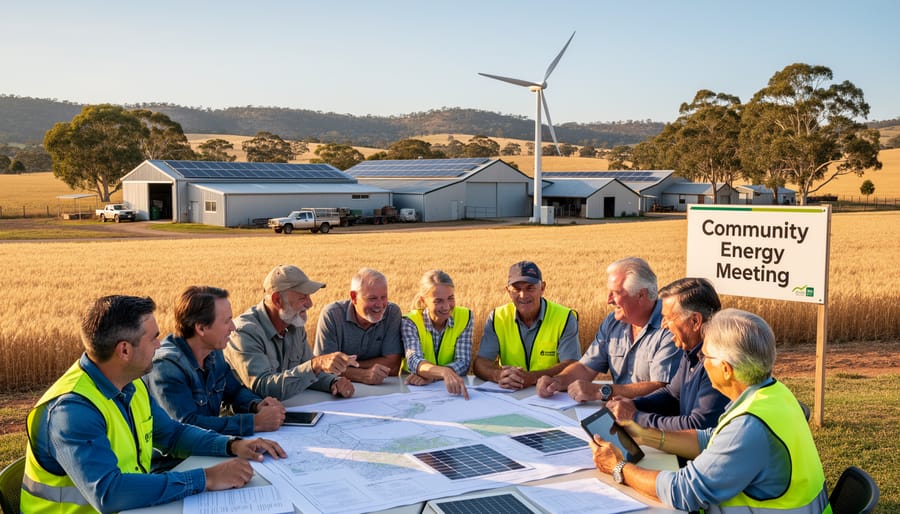
Perhaps most importantly, democratic decision-making ensures everyone has a voice. Communities hold regular meetings where members discuss fuel sources, expansion plans, and how surplus revenue should be spent. This transparency builds trust and ensures projects genuinely reflect community values and priorities.
This grassroots approach creates something corporations rarely achieve: genuine community buy-in and pride. When locals own and operate their energy systems, they’re invested in success, creating resilient projects that strengthen entire communities while protecting the environment.
Real Communities, Real Results
The Queensland Cane Farming Co-op That Powers Its Town
In the heart of Queensland’s sugar country, the Mackay region has turned what was once waste into a powerful community asset. Local cane farming co-operatives have partnered with sugar mills to transform bagasse—the fibrous residue left after crushing sugarcane—into renewable electricity that powers thousands of homes.
The Racecourse Mill in Mackay exemplifies this approach brilliantly. During crushing season, which runs from June to November, the mill generates enough electricity from bagasse to power the entire operation plus feed surplus energy back into the local grid. That’s enough clean power for roughly 20,000 homes, all from what would otherwise end up as waste.
What makes this initiative particularly special is how it strengthens the entire community. Cane farmers gain an additional revenue stream from their bagasse, while the mill reduces operating costs and creates local jobs in bioenergy operations. The region has slashed its reliance on coal-fired electricity, cutting carbon emissions by approximately 350,000 tonnes annually—equivalent to taking 75,000 cars off the road.
The economic benefits extend beyond the mill gates too. Local tradies maintain the bioenergy equipment, while agricultural scientists work on optimising bagasse yields. It’s a genuine closed-loop system where nothing goes to waste and everyone benefits.
This model proves that rural communities don’t need to choose between economic prosperity and environmental responsibility. The Queensland cane farmers have shown that with a bit of ingenuity and cooperation, agricultural communities can lead Australia’s renewable energy transition whilst strengthening their local economies.
From Dairy Waste to Energy Independence in Victoria
In Victoria’s Gippsland region, a group of dairy farmers decided they’d had enough of watching their biggest waste product literally going down the drain. What started as casual conversations at the local pub turned into one of Australia’s most inspiring community-led bioenergy projects.
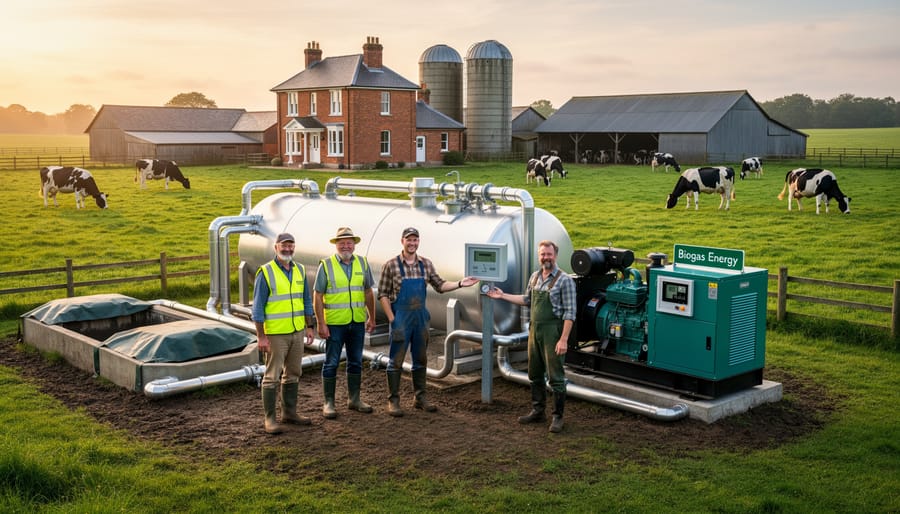
Ten dairy farmers pooled their resources in 2019 to establish a shared biogas facility that processes manure from their combined 3,000 head of cattle. Rather than each farm investing in individual systems they couldn’t afford, they created a cooperative model that made financial sense for everyone involved. The facility now converts approximately 80 tonnes of dairy waste daily into clean, renewable energy.
The results have exceeded expectations. The cooperative generates enough electricity to power all ten farms plus 150 nearby homes, with surplus energy sold back to the grid. This arrangement has slashed each farmer’s energy bills by around 60 percent while creating a new revenue stream that’s brought in over $400,000 annually for the group. The biogas cogeneration benefits extend beyond financial gains too.
The environmental impact has been equally impressive. The project eliminates methane emissions from manure lagoons, equivalent to taking 800 cars off the road each year. The digestate byproduct has become a valuable organic fertiliser, reducing the need for expensive synthetic alternatives.
Local farmer Sarah Mitchell, one of the cooperative’s founders, reckons it’s changed everything. “We’ve gone from waste managers to energy producers. It’s given our community real independence and shown other farming regions what’s possible when you work together.”
A Regional Town’s Timber Mill Transformation
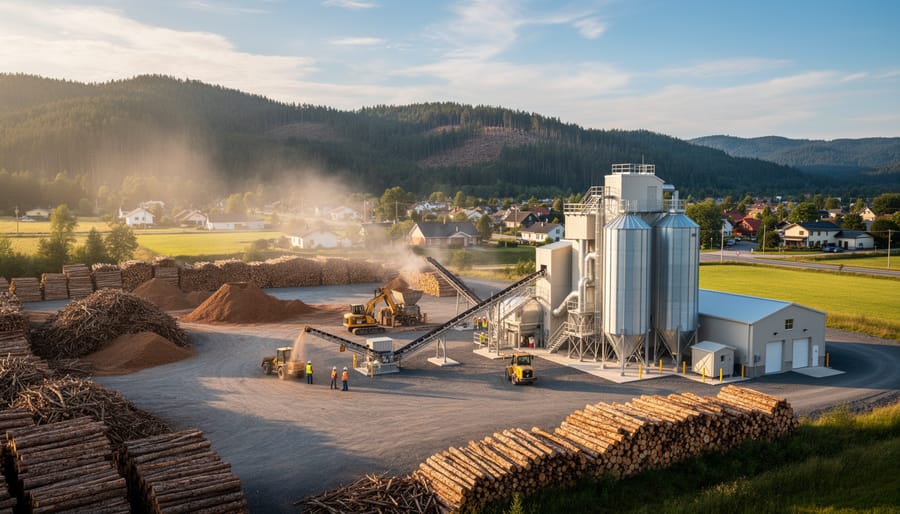
When the timber industry downturn hit the regional town of Heyfield in Victoria’s Gippsland region, residents refused to let their community fade away. Facing mill closures and mounting job losses, local leaders saw opportunity in what others considered waste. The mountains of timber residue and sawdust that once piled up beside the mill became the foundation for a renewable energy project that’s now powering hundreds of homes.
The community established Australian Sustainable Hardwoods, which transformed wood waste into electricity through a bioenergy facility. Rather than sending residue to landfill or leaving it to rot, the mill now converts roughly 40,000 tonnes of timber by-products annually into clean energy. This grassroots initiative created thirty new jobs in a town that desperately needed them, proving that environmental solutions and economic prosperity can grow together. The project’s success sparked similar interest across regional Australia, demonstrating how communities can turn local challenges into sustainable advantages while keeping skills and employment close to home.
Why Communities Choose Bioenergy Over Other Renewables
For rural and regional communities across Australia, bioenergy offers something that solar panels and wind turbines simply can’t match—the ability to transform local agricultural waste into reliable, round-the-clock power while keeping money circulating within the community.
Unlike solar and wind energy that depend on weather conditions, bioenergy provides consistent baseload power. This reliability matters enormously for rural industries like dairy processing, abattoirs, and grain handling facilities that operate 24/7. When the sun sets and the wind drops, bioenergy keeps humming along, powered by the very waste products these communities generate.
The real game-changer is how bioenergy builds on existing infrastructure rather than requiring entirely new systems. Farming communities already collect agricultural residues, manage livestock waste, and transport bulk materials. Converting these existing processes into energy generation feels like a natural extension rather than a foreign imposition. A dairy farmer dealing with effluent management suddenly has an asset instead of a liability.
This creates what economists call a circular economy—waste becomes fuel, fuel generates power, and the byproducts return to the land as fertiliser. Money that would have flowed out to distant energy companies stays local, supporting jobs in collection, processing, and maintenance. The Yackandandah community in Victoria discovered this firsthand, with their biomass cogeneration systems creating employment while solving waste management challenges.
Communities also appreciate the tangible, visible nature of bioenergy projects. Everyone can see the connection between local resources and local power. There’s something deeply satisfying about a system where yesterday’s crop stubble powers today’s homes—it makes sense at a gut level that resonates with rural values of self-reliance and resourcefulness.
For communities considering their renewable energy options, bioenergy offers more than just clean power. It provides energy security, economic development, waste solutions, and community ownership—all wrapped into one practical package that works with existing agricultural systems rather than against them.
Getting Your Community Started
Step One: Assessing Your Community’s Biomass Potential
Before launching a community bioenergy project, you need to understand what’s available in your backyard. Start by surveying local agricultural operations – farms often have crop residues like sugar cane bagasse, wheat straw, or nut shells that currently go unused. Visit nearby food processors, breweries, and abattoirs to discuss their organic waste streams. These businesses frequently pay for waste disposal, so they might welcome an alternative solution.
Don’t overlook municipal sources either. Council green waste collections, street tree prunings, and wastewater treatment biosolids represent significant untapped potential in most Australian towns. Connect with your local council’s waste management team to understand collection volumes and seasonal variations.
Conduct a simple stocktake by mapping all potential feedstock sources within a reasonable transport distance. Remember, hauling biomass long distances undermines the environmental and economic benefits. As a rule of thumb, aim for sources within 50 kilometres of your proposed facility.
Engage directly with potential suppliers early. Their enthusiasm and commitment will prove just as valuable as the biomass itself. Several Australian communities have discovered that combining multiple smaller waste streams creates the critical mass needed for a viable bioenergy project.
Building Your Community Coalition
Building a strong coalition is the cornerstone of successful community energy projects. Start by identifying key stakeholders across your community, including local councils, businesses, farmers, Indigenous representatives, and environmental groups. Host open community meetings to gauge interest and gather diverse perspectives from the get-go.
Establish a transparent governance structure that gives everyone a fair say. Many Australian initiatives adopt cooperative models where members have equal voting rights, ensuring decisions reflect community values rather than individual interests. Consider forming a steering committee with representatives from different sectors to guide the project through its early stages.
Inclusive participation means actively reaching out to underrepresented groups and removing barriers to involvement. Offer meetings at accessible times and locations, provide plain-language information, and consider cultural sensitivities. Create working groups focused on specific areas like site selection, financing, or community education, allowing people to contribute according to their skills and availability.
Regular communication keeps momentum strong. Share progress updates through newsletters, social media, and community events, celebrating small wins along the way to maintain enthusiasm and build trust.
Funding and Support Available in Australia
Good news for Aussie communities eager to launch their own bioenergy projects: plenty of financial support is available to turn your vision into reality. The Australian Renewable Energy Agency (ARENA) provides substantial grants specifically for community-scale renewable energy initiatives, including bioenergy projects that convert organic waste into power. Many successful projects have kicked off with ARENA backing, proving that government support genuinely makes a difference.
State-based programs complement federal funding, with Victoria’s Sustainability Victoria and Queensland’s Climate Action Grants offering tailored support for local energy ventures. The Clean Energy Finance Corporation also provides low-interest loans designed specifically for community energy cooperatives, making expensive infrastructure more accessible.
Beyond government funding, community energy projects can tap into crowd-funding platforms and cooperative membership models, where locals invest directly in their energy future. Local councils increasingly offer in-kind support through land access, technical expertise, and streamlined approval processes. Several regional development organizations provide mentoring and feasibility study assistance, helping communities navigate the initial planning stages. Remember, most successful community bioenergy projects combine multiple funding sources, creating a robust financial foundation that spreads risk and strengthens community ownership. The key is starting the conversation early with potential funders who understand your community’s unique needs.
The Ripple Effects Beyond Energy
Community bioenergy projects create value that extends far beyond kilowatts and renewable energy certificates. These initiatives are transforming rural communities through multiple interconnected benefits that strengthen local economies and social fabric.
Job creation stands as one of the most tangible benefits. In regional Victoria, a farm-based biogas facility created twelve permanent positions ranging from plant operators to agricultural technicians, keeping young people in town who might otherwise have moved to cities. These aren’t just any jobs either—they’re skilled roles that offer genuine career pathways in emerging green industries.
Skill development naturally follows. Communities involved in bioenergy projects gain expertise in renewable energy systems, waste management, and sustainable agriculture. At a cooperative near Tamworth, farmers who once only grew crops now understand anaerobic digestion, energy grid connections, and carbon accounting. This knowledge becomes a community asset that residents share with neighbouring towns.
Waste reduction provides another crucial advantage. Agricultural waste that once created disposal problems or methane emissions now becomes valuable feedstock. A piggery in Queensland transformed its waste management challenge into an energy solution, eliminating odour complaints whilst generating power for 200 homes.
The agricultural innovation sparked by these projects often surprises participants. Farmers discover that digestate from biogas plants makes exceptional fertiliser, reducing their chemical inputs and improving soil health. Some have diversified into growing dedicated energy crops, creating additional income streams.
Perhaps most importantly, these projects strengthen community bonds. When neighbours collaborate on shared energy infrastructure, they build trust and cooperation that extends into other community initiatives, creating resilient, connected places where people genuinely want to live and invest their futures.
Common Hurdles and How Communities Overcome Them
Let’s be honest—launching a community-led bioenergy project isn’t always smooth sailing. Many groups across Australia face similar hurdles when getting started, but the good news is that communities before you have blazed the trail and found practical solutions.
One of the biggest roadblocks is securing initial capital. Bioenergy infrastructure requires upfront investment, which can seem daunting. However, successful Australian projects have cracked this through creative financing models. The Hepburn Wind community raised funds through community shares, allowing locals to invest small amounts while building collective ownership. Others have tapped into government grants, partnered with local councils, or combined bank loans with crowdfunding to spread the financial load.
Technical expertise gaps also trip up many enthusiastic communities. Not everyone knows the ins and outs of anaerobic digesters or biomass systems, and that’s perfectly fine. Communities in regional Victoria and South Australia have overcome this by partnering with universities, engaging retired engineers as volunteers, or hiring consultants for the initial setup while training locals for ongoing operations. Think of it as building capacity from day one.
Navigating regulatory requirements can feel like wading through treacle. Grid connection approvals, environmental permits, and safety standards require patience and persistence. Successful projects recommend getting your local council on board early—they can become powerful allies in cutting through red tape. Several communities have also benefited from joining state renewable energy networks, where experienced project leaders share templates, contacts, and hard-won advice that saves months of frustration.
The story of community-led bioenergy in Australia isn’t just about renewable energy infrastructure or waste management solutions. It’s about communities taking control of their environmental future, creating local jobs, and building resilience while tackling climate change head-on. From regional towns converting agricultural waste into electricity to urban councils transforming landfill gas into community assets, these initiatives prove that sustainable energy solutions can emerge from the ground up.
The transformation happening across Australian communities today offers a blueprint for tomorrow’s energy landscape. Whether you’re part of a farming cooperative exploring ways to turn crop residues into value, a council member investigating options for organic waste, or simply a concerned citizen wondering how to make a difference, the time to act is now.
Start by having conversations in your community. Connect with local councils, farming groups, or environmental organizations already working in this space. The success stories we’ve explored demonstrate that with collaboration, determination, and the right support, any community can harness bioenergy’s potential. Australia’s sustainable energy future isn’t being built in distant boardrooms—it’s taking shape in communities just like yours, driven by people ready to turn vision into reality.