
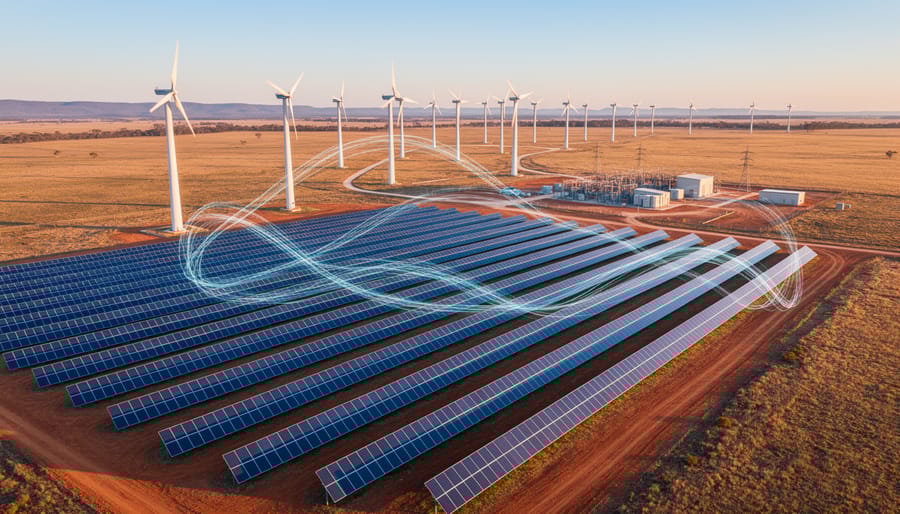
Australia’s renewable energy sector is undergoing a remarkable transformation, and artificial intelligence is the catalyst driving this change. Right now, AI systems are predicting wind patterns with 95% accuracy, adjusting solar panel angles in real-time to capture maximum sunlight, and balancing grid loads across thousands of energy sources simultaneously—tasks that would be impossible for human operators to manage at scale.
The technology isn’t theoretical anymore. Across Australia, from Queensland’s solar farms to Tasmania’s wind installations, AI-driven optimization is delivering measurable results: 20-30% efficiency gains, reduced energy waste, and significantly lower operational costs. These systems learn from millions of data points every hour, identifying patterns invisible to traditional monitoring systems and making split-second adjustments that compound into substantial performance improvements.
What makes this particularly exciting for Australia is our unique energy landscape. We have some of the world’s best renewable resources—abundant sunshine, strong coastal winds, and growing bioenergy potential—but we’ve also faced challenges in making these intermittent sources reliable. AI optimization solves this puzzle by coordinating diverse energy sources, predicting demand fluctuations, and ensuring stable power delivery even when the sun sets or winds drop.
For environmentally conscious Australians, this represents more than technological advancement. It’s proof that renewable energy can be both sustainable and dependable. Industry professionals are discovering that AI optimization isn’t just about environmental benefits—it’s a smart business decision that delivers rapid returns on investment. Policymakers are recognizing AI’s role in meeting ambitious emissions targets without compromising energy security.
The question is no longer whether AI-driven optimization works, but how quickly we can implement it across Australia’s renewable energy infrastructure.
The Hidden Problem: Why Renewable Energy Isn’t Living Up to Its Promise
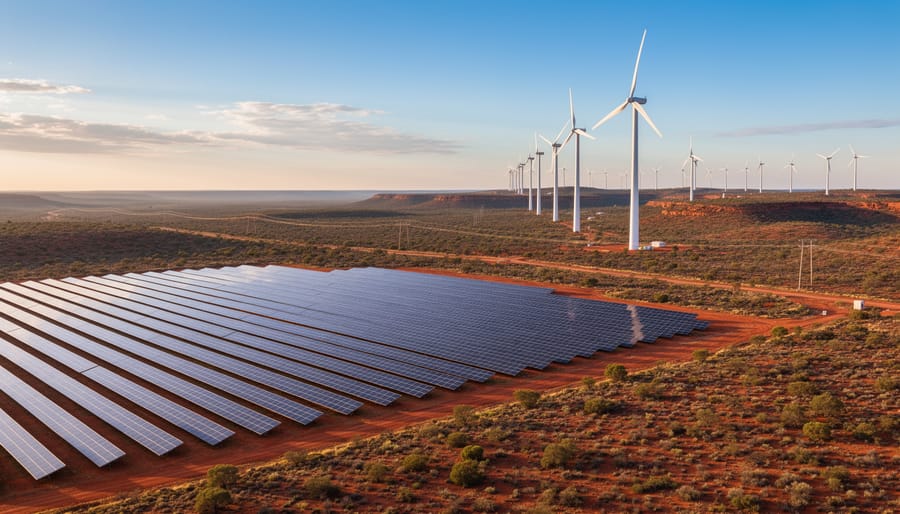
When the Sun Doesn’t Shine and the Wind Doesn’t Blow
Picture this: It’s 6pm on a still winter evening in Melbourne. Solar panels across the city have stopped generating power hours ago, and there’s barely a breath of wind to turn the turbines. Yet this is precisely when everyone arrives home, flicks on the lights, cranks up the heater, and starts cooking dinner. Energy demand skyrockets just as renewable supply plummets.
This is the intermittency challenge, and it’s the Achilles heel of renewable energy. Traditional energy management has relied on a simple approach: fire up fossil fuel power stations when renewables can’t keep up. It’s reliable, but it defeats the purpose of going green in the first place.
For years, energy providers have tried managing this gap with basic forecasting and battery storage, but without sophisticated coordination, batteries often charge at the wrong times or discharge too quickly. The result? Wasted renewable energy when the sun’s blazing at midday, and a scramble for backup power during peak evening demand.
This mismatch isn’t just inefficient; it’s expensive and creates unnecessary emissions. In Queensland, for instance, some solar farms have had to curtail their output during the day because the grid simply couldn’t handle the surplus, while coal plants remained online for evening peaks. It’s like having a full rainwater tank but still using town water because nobody thought to connect the taps properly. Clearly, we needed a smarter solution.
The Grid Balancing Act That Wastes Power
Australia’s renewable energy sector faces a significant challenge: our solar farms generate peak power at midday when demand is often lower, while evening energy needs spike just as the sun sets. This mismatch creates a frustrating paradox where clean energy gets curtailed—essentially thrown away—because the grid can’t absorb it all at once.
Traditional grid infrastructure wasn’t designed for the variable nature of wind and solar. When supply exceeds demand, grid operators must either store excess power, export it, or simply switch off renewable generators. Meanwhile, energy storage limitations mean we can’t always bank that surplus for later use.
This balancing act becomes even trickier across our vast continent, where weather patterns vary dramatically from Queensland’s sunny coast to Tasmania’s wind-swept highlands. Without effective smart grid management, we’re leaving clean energy potential untapped while sometimes resorting to fossil fuel backup during peak periods.
The good news? Innovative solutions are emerging that promise to solve this puzzle and unlock renewable energy’s full potential.
What AI-Driven Optimization Actually Means (Without the Tech Jargon)
Smart Forecasting: Teaching Machines to Predict the Weather Better Than Meteorologists
Think of weather forecasting, but for energy. Just as meteorologists analyse atmospheric patterns to predict tomorrow’s conditions, AI systems now examine vast datasets to forecast how much electricity solar panels and wind turbines will generate days or even weeks ahead. The difference? These digital forecasters are achieving accuracy rates that consistently outperform traditional methods.
The secret lies in pattern recognition. AI algorithms process years of historical data—solar radiation levels, wind speeds, cloud movements, temperature fluctuations—and identify subtle patterns that human analysts might miss. When South Australia’s Hornsdale Power Reserve integrated AI forecasting into its operations, the system learned to predict wind generation with 95% accuracy up to 72 hours in advance. That’s a game-changer for grid operators who previously struggled with renewable energy’s variable nature.
This precision transforms how Australia manages its energy grid. When AI accurately predicts a sunny afternoon in Queensland or a windy evening in Tasmania, grid operators can confidently reduce reliance on fossil fuel backup systems. Energy retailers can offer better pricing to consumers, and renewable installations become significantly more valuable investments.
The technology isn’t theoretical anymore—it’s working right now across Australian renewable projects. These smart forecasting systems continuously learn and improve, becoming more accurate with every passing season. For businesses considering renewable investments, this AI-enhanced predictability means solar and wind installations deliver far more reliable returns than ever before.
Real-Time Decision Making That Never Sleeps
While we sleep, AI-powered systems are working around the clock, making thousands of tiny adjustments that squeeze every possible kilowatt from renewable installations across Australia. This isn’t future technology – it’s happening right now at renewable energy facilities from Queensland to Tasmania.
Think of AI as the ultimate multitasker that never needs a coffee break. Every few milliseconds, these systems analyse incoming data from weather stations, grid demand monitors, equipment sensors, and market price signals. They’re simultaneously tracking cloud movements that might reduce solar output in thirty seconds, adjusting battery discharge rates to match afternoon peak demand, and determining whether to store excess energy or sell it back to the grid at premium rates.
At a bioenergy facility in regional New South Wales, AI monitoring detected a subtle efficiency drop in one digester at 2:47 AM on a Tuesday. Before the morning shift arrived, the system had already adjusted temperature controls and feeding schedules, preventing what could have been a 15% production loss for the week. The plant manager described it as having “an expert engineer watching every gauge, every second of every day.”
The speed matters enormously. Traditional control systems might check conditions every few minutes and make adjustments hourly. AI operates in real-time, responding to changes before humans would even notice them. During a sudden weather shift last summer, an AI system at a solar farm recalibrated panel angles and storage protocols in under three seconds, capturing an extra 8% energy yield that would have otherwise been lost. That’s the difference between reactive management and predictive optimisation – and it’s transforming how efficiently we harness nature’s power.
Success Stories: Australian Projects Already Reaping the Benefits
How One South Australian Wind Farm Increased Output by 20% Without Adding a Single Turbine
In the heart of South Australia’s Mid North region, the Collgar Wind Farm faced a challenge familiar to many renewable operators: how to squeeze more performance from existing infrastructure without the massive expense of expansion. The answer came through an innovative partnership with Australian tech firms specialising in artificial intelligence and wind farm optimization.
The project began in 2022 when operators noticed their 111 turbines weren’t performing consistently. Some days they’d hit targets beautifully, while other days output would mysteriously drop despite similar wind conditions. Traditional maintenance schedules weren’t catching the problems before they impacted generation.
Enter machine learning algorithms that could predict component failures weeks before they occurred. The AI system analysed thousands of data points from each turbine every second, including vibration patterns, temperature fluctuations, and blade pitch angles. Within six months, the system identified subtle patterns invisible to human operators.
The results were remarkable. By conducting maintenance precisely when needed rather than on fixed schedules, the farm reduced downtime by 35%. The AI also optimised each turbine’s positioning and blade angles in real-time, adjusting for wake effects from neighbouring turbines and changing atmospheric conditions.
The outcome? A 20% increase in overall energy output without adding a single new turbine. This translated to powering an additional 8,000 South Australian homes and significant cost savings that made the technology investment pay for itself within 18 months.
The farm’s success demonstrates how smart technology transforms existing renewable infrastructure into peak performers, proving that innovation doesn’t always require expansion, just smarter thinking about what we already have.
The Solar Farm That Learned to Store Smarter, Not Bigger
In South Australia’s Riverland region, a mid-sized solar farm faced a challenge that’s becoming increasingly common across the country. Their battery storage system was draining faster than expected, costing them potential revenue and wearing out equipment years ahead of schedule. The solution didn’t involve buying bigger batteries or installing more panels. Instead, they turned to artificial intelligence to work smarter with what they already had.
The solar farm partnered with a Melbourne-based tech company to deploy an AI system that continuously learns from weather patterns, grid demand, and battery performance data. Rather than following rigid charging and discharging schedules, the AI predicts the optimal moments to store energy and when to release it to the grid. This might mean holding onto stored power during low-demand periods and releasing it during peak evening hours when prices soar.
The results have been nothing short of remarkable. Within twelve months, battery efficiency improved by 23 percent, and the projected lifespan of the storage system extended by an estimated four years. The farm now captures an additional 180 megawatt-hours annually, enough to power roughly 30 typical Australian homes year-round. More importantly, they’re maximizing returns without additional capital investment.
What makes this success story particularly relevant for solar-plus-storage systems nationwide is its scalability. The AI doesn’t require massive infrastructure changes or specialist staff on-site. It works quietly in the background, constantly adjusting to conditions and learning from each cycle. For renewable energy operators across Australia, this represents a straightforward pathway to better performance and stronger returns, proving that sometimes the best upgrade isn’t hardware, but intelligence.
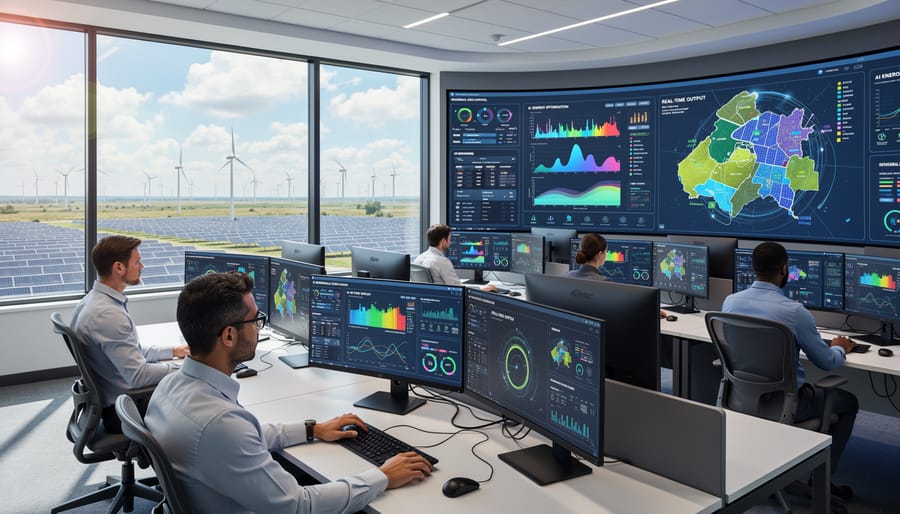
The Bioenergy Advantage: Where AI Optimization Shines Brightest
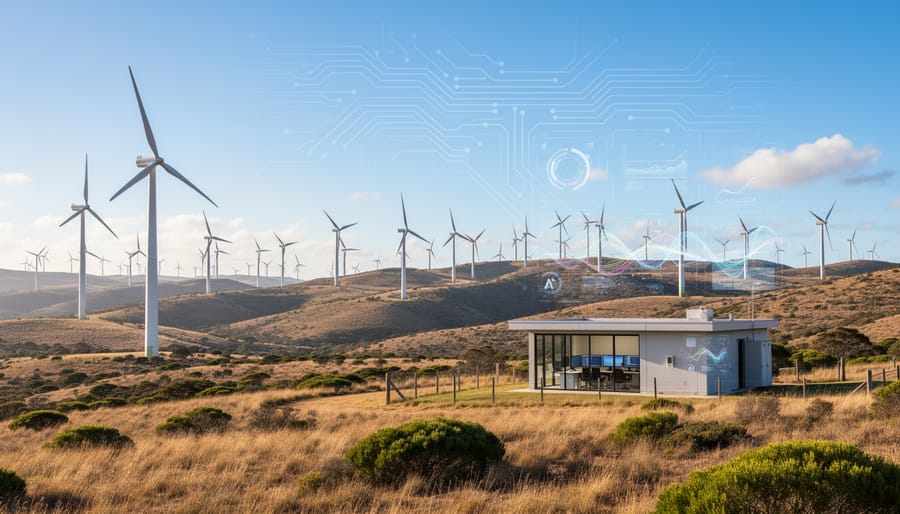
Optimizing the Burn: Getting More Energy from Every Tonne of Biomass
Getting the most energy from biomass isn’t just about burning more material – it’s about burning smarter. This is where artificial intelligence transforms a traditionally straightforward process into a precision operation that squeezes every possible joule from each tonne of feedstock.
Think of AI as the masterchef of combustion. Traditional biomass plants operate with fixed parameters, but biomass quality changes constantly – moisture levels fluctuate, particle sizes vary, and different agricultural residues have distinct burning characteristics. AI systems monitor these variations in real-time, adjusting air flow, temperature, and feed rates hundreds of times per hour to maintain optimal combustion conditions.
The results are impressive. Queensland’s biomass facilities using AI-driven combustion controls have achieved efficiency improvements of 12-18 percent compared to conventional operations. That means significantly more electricity generated from the same amount of sugarcane waste or forestry residues. Better still, optimized combustion dramatically reduces harmful emissions – particulate matter drops by up to 40 percent when AI fine-tunes the burn.
One Victorian timber mill transformed its waste management challenge into an opportunity by implementing smart combustion technology. The AI system learned to predict the ideal conditions for different wood types, automatically adjusting as the fuel mix changed throughout the day. The outcome? They now power their entire operation plus export surplus electricity to the grid, turning a disposal problem into a revenue stream while keeping emissions well below regulatory limits.
Smart Scheduling: Matching Bioenergy Production to Grid Demand
One of the most clever applications of AI in renewable energy is helping bioenergy facilities know exactly when to fire up their operations. Think of it like having a smart conductor orchestrating different instruments in a symphony. When the sun sets and solar panels go dark, or when the wind drops on a still afternoon, AI systems signal bioenergy production facilities to increase output, ensuring grid stability without relying on fossil fuel backup.
These intelligent systems analyse real-time weather data, grid demand patterns, and renewable generation forecasts to predict energy gaps hours or even days ahead. This means bioenergy plants can prepare their operations efficiently, ramping up production during peak demand periods when solar and wind can’t quite meet community needs.
A practical example comes from regional Queensland, where a sugarcane mill now uses AI to coordinate its biomass electricity generation with nearby solar farms. During summer afternoons when air conditioners blast across the state but clouds roll in, the mill automatically increases output. The result? Consistent, reliable renewable power that’s there when Australians actually need it most.
This smart scheduling approach transforms bioenergy from a constant baseload into a flexible, responsive partner that fills the gaps left by variable renewables, creating a more resilient and entirely clean energy system that works around the clock.
What This Means for Your Energy Bills and Carbon Footprint
Here’s where renewable energy optimization stops being abstract and starts hitting home – literally. For the average Australian household, AI-driven optimization of renewable systems can slash electricity bills by 20 to 40 percent. That’s not pocket change; we’re talking about hundreds of dollars back in your wallet each year, money that stays in your community rather than disappearing into grid inefficiencies.
Businesses see even more dramatic results. A manufacturing facility in regional Victoria recently cut energy costs by $180,000 annually after implementing smart optimization systems that predict energy demand and adjust renewable supply accordingly. These aren’t futuristic projections – this is happening right now across the country.
Your carbon footprint benefits too. When renewables run at peak efficiency, every solar panel and wind turbine delivers maximum clean energy, displacing more fossil fuels from the grid. A typical optimized household renewable system prevents roughly 4 tonnes of carbon dioxide emissions yearly – equivalent to taking a petrol car off the road for 12 months.
Beyond individual savings, optimization creates tangible economic opportunities. Australia’s clean energy sector is experiencing a jobs boom, with over 26,000 positions created last year alone. These aren’t just engineering roles either – we’re seeing demand for technicians, data analysts, project managers, and community liaison officers. Regional areas particularly benefit, with new opportunities emerging in towns that traditionally relied on coal mining.
For communities, optimized renewable systems mean reliable, affordable energy that insulates residents from volatile international fuel prices. The township of Yackandandah in Victoria has become nearly energy self-sufficient through community-owned renewable projects enhanced by smart optimization, keeping energy dollars circulating locally while building resilience.
The transformation extends to schools, hospitals, and local councils discovering they can afford comprehensive solar installations because optimization guarantees better returns on investment. When renewable energy works smarter, everyone wins – from your monthly budget to the planet we’re protecting for future generations.
Getting Started: Practical Steps Toward AI-Optimized Renewable Energy
For Homeowners and Communities
You don’t need a massive solar farm to join the renewable energy revolution. Right here in Australia, homeowners are making smart choices that optimise their energy use while cutting bills and emissions.
Start with a smart solar system paired with battery storage. Modern systems use intelligent software that learns your household patterns, storing excess energy when the sun’s shining and releasing it during peak evening hours. This means you’re maximising every ray of sunshine that hits your roof.
Installing a smart energy management system takes things further. These affordable devices monitor your energy use in real-time, automatically switching appliances on when renewable energy is abundant and cheapest. Some clever Aussie families are even timing their dishwashers and pool pumps to run during the sunniest hours.
Community solar projects offer another pathway. If rooftop panels aren’t feasible, you can invest in shared renewable installations and receive credits on your power bill. It’s renewable energy optimisation made accessible for renters and apartment dwellers.
For those keen on going further, small-scale bioenergy systems can convert household organic waste into usable energy. While still emerging in the residential space, these technologies represent an exciting frontier for truly circular home energy systems.
Every small step multiplies when communities act together, creating resilient local energy networks that benefit everyone.
For Businesses and Industry
Australian businesses are discovering that renewable energy optimization isn’t just good for the planet—it’s brilliant for the bottom line. Companies across the country are already reaping the rewards of AI-driven energy systems that slash costs while boosting their green credentials.
Take Melbourne’s manufacturing sector, where several facilities have cut energy waste by up to 30% through smart optimization systems. These platforms analyse production schedules, weather patterns, and energy prices in real-time, automatically adjusting when equipment draws power from solar panels or the grid. The result? Substantial savings and reduced carbon footprints that resonate with increasingly eco-conscious customers.
For organizations ready to make the leap, implementation needn’t be daunting. Start small with energy audits that identify optimization opportunities specific to your operations. Many Australian energy providers now offer consultation services and even co-investment programs that reduce upfront costs. Regional businesses in Queensland and New South Wales have partnered with local councils to access grants specifically designed for renewable energy upgrades.
The investment case is compelling. Most businesses see payback periods of three to five years, with ongoing savings extending decades beyond. More importantly, optimization systems scale beautifully—whether you’re running a small warehouse in regional Victoria or managing multiple sites nationally.
Industry leaders also report unexpected benefits: improved equipment lifespan, enhanced operational efficiency, and stronger brand reputation. As one Sydney-based logistics company discovered, their commitment to optimized renewable energy became a powerful recruitment tool, attracting talented workers who value sustainability.
The transformation of Australia’s renewable energy landscape through AI optimization isn’t some distant possibility waiting on the horizon—it’s already happening in solar farms across Queensland, wind facilities in South Australia, and bioenergy plants throughout the country. Every day, intelligent systems are making our renewable infrastructure more efficient, more reliable, and more capable of powering the sustainable future we’re building together.
What makes this moment so exciting is that we’re still in the early stages. The success stories we’re seeing today represent just the beginning of what’s possible when we combine Australian innovation with cutting-edge technology. From reducing energy waste by predicting weather patterns hours in advance to optimizing battery storage systems that keep the lights on when the sun sets, AI is solving the practical challenges that once made renewable energy seem unreliable.
The beauty of this technology is that it creates a ripple effect. When renewable energy systems become more efficient and cost-effective, more businesses invest in them. When more organizations make the switch, the technology improves further, prices drop, and the next wave of adoption becomes even easier. We’re in that virtuous cycle right now, and momentum is building across the continent.
You don’t need to be a tech giant or energy company to participate in this transformation. Whether you’re a homeowner considering solar panels, a business leader evaluating renewable options, or simply someone who wants to support Australia’s clean energy future, your engagement matters. Start by researching renewable solutions for your circumstances, connect with local providers already using optimized systems, and join the conversation about sustainable energy in your community. The future we’re creating isn’t just cleaner—it’s smarter, and it’s within reach.