
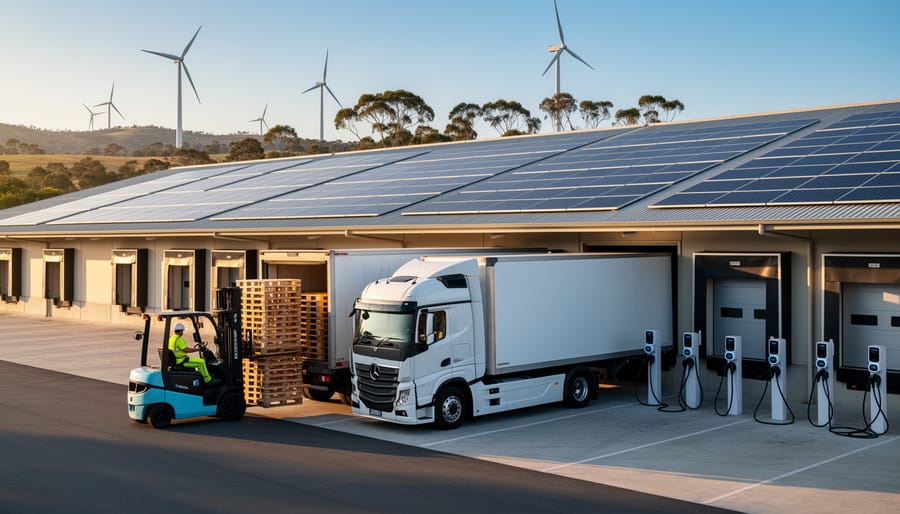
The global supply chain industry generates nearly 6 billion tonnes of carbon emissions annually, yet forward-thinking Australian businesses are proving that profitability and environmental responsibility can walk hand in hand. Sustainable supply chain solutions represent more than an ethical choice—they’re becoming a competitive necessity as consumers, investors, and regulators demand transparency and action on climate impact.
Traditional logistics models, built on fossil fuel dependency and linear “take-make-dispose” thinking, are rapidly losing ground to circular economy approaches that redesign how goods move from production to consumption. Companies implementing sustainable practices are discovering reduced operational costs, enhanced brand reputation, and improved resilience against supply disruptions. The transformation involves rethinking transportation methods, optimizing warehouse energy use, selecting suppliers based on environmental credentials, and embracing renewable energy sources throughout the distribution network.
Australia’s unique position as both a resource-rich nation and a climate-vulnerable continent makes this transition particularly urgent and opportune. Businesses across sectors—from agriculture to manufacturing—are pioneering innovative approaches that reduce waste, cut emissions, and create regenerative systems. The shift isn’t happening overnight, but practical frameworks and proven technologies already exist to guide organizations through each stage of transformation.
This article explores actionable strategies for building sustainable supply chains that deliver measurable environmental and economic outcomes. Whether you’re a small enterprise taking first steps toward greener operations or a large corporation refining existing sustainability programs, the solutions examined here demonstrate how Australian businesses can lead the way in creating supply chains fit for a carbon-conscious future. The journey toward sustainability starts with understanding what’s possible, learning from those who’ve succeeded, and taking deliberate action today.
What Makes a Supply Chain Truly Sustainable?
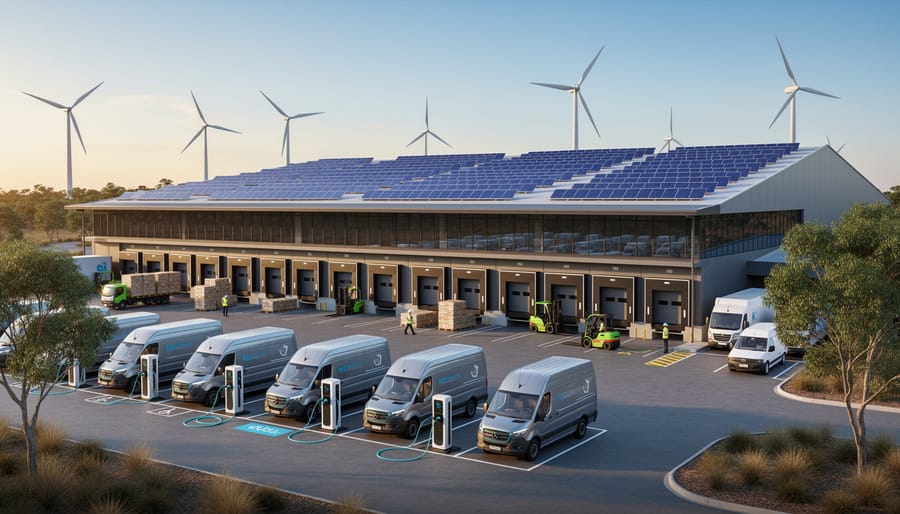
Beyond Green Washing: Real Sustainability Metrics That Matter
True sustainability requires moving beyond feel-good statements to embrace metrics that genuinely measure environmental impact. For Australian businesses committed to supply chain sustainability, three core measurements provide the foundation for meaningful change.
Carbon footprint tracking has become the cornerstone of transparent supply chains. Companies like Linfox, Australia’s largest logistics provider, now monitor emissions across their entire fleet operations, reporting reductions of over 15% through route optimisation and renewable diesel adoption. By measuring emissions at every stage—from raw material extraction through to final delivery—businesses can identify hotspots and implement targeted improvements.
Lifecycle assessments take this further by examining the complete environmental journey of products. When Melbourne-based packaging company Visy conducted lifecycle assessments, they discovered that switching to recycled materials and bioenergy-powered facilities reduced their overall environmental impact by 40%. These assessments reveal hidden impacts that simple carbon counting might miss, including water usage, biodiversity effects, and waste generation.
Renewable energy sourcing represents perhaps the most tangible metric. Progressive Australian manufacturers are increasingly powering their operations and transport networks with solar, wind, and bioenergy solutions. For instance, Australia Post’s renewable energy commitment now sees over 20% of their operational energy sourced from clean alternatives, with clear targets for reaching 100%.
The good news? These metrics aren’t just theoretical—they’re driving real transformation across Australian supply chains. By adopting recognised frameworks like the Global Reporting Initiative or Science Based Targets, businesses create accountability whilst building trust with environmentally conscious customers who increasingly demand proof, not promises.
The Bioenergy Advantage in Sustainable Logistics
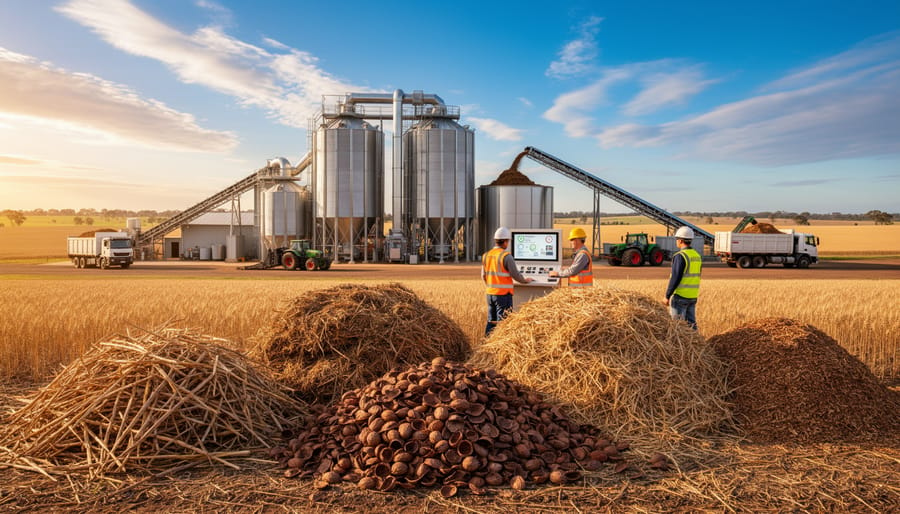
From Farm to Fuel: How Australian Biomass Closes the Loop
Across Australia, innovative businesses are transforming what was once considered waste into valuable fuel, creating sustainable supply chain solutions that benefit both the environment and the bottom line. These circular economy success stories demonstrate how agricultural waste can become a powerful resource rather than a disposal problem.
Take the sugar industry in Queensland, where mills are converting bagasse – the fibrous residue left after crushing sugarcane – into renewable energy. This waste product now powers operations and feeds electricity back into the grid, cutting energy costs by up to 40% while eliminating disposal expenses. It’s a fair dinkum win-win that’s being replicated across the nation.
In Western Australia, a barley processing facility has partnered with a local transport company to fuel delivery trucks with biomass-derived biodiesel made from their own grain husks. The closed-loop system reduces transportation emissions by 65% and creates a reliable, locally-sourced fuel supply that’s not subject to international oil price fluctuations.
The Victorian dairy sector offers another inspiring example. Several cooperatives now collect animal waste and crop residues to produce biogas, which powers refrigeration systems and processing equipment. One mid-sized operation reports saving over 200,000 dollars annually in energy costs while diverting 3,000 tonnes of waste from landfill.
These practical applications prove that sustainable supply chains aren’t just environmentally responsible – they’re economically smart. By viewing waste as a resource waiting to be harvested, Australian businesses are reducing costs, strengthening energy security, and building resilience against supply disruptions. The circular economy isn’t a distant dream; it’s happening right here, right now, on farms and facilities throughout the country.
Technologies Revolutionizing Sustainable Supply Chains
Smart Tracking Systems That Cut Emissions While Saving Money
Digital tracking systems are revolutionising how Australian businesses move goods while slashing both emissions and costs. These clever technologies use GPS data, artificial intelligence, and real-time analytics to work out the most efficient routes, reducing unnecessary kilometres and fuel consumption in one go.
Take Melbourne-based logistics company Linfox, which implemented smart fleet management systems across its operations. The results speak for themselves: a 15% reduction in fuel use, saving roughly $2 million annually while cutting carbon emissions by over 3,000 tonnes. The system monitors everything from driver behaviour to vehicle maintenance schedules, ensuring trucks run at peak efficiency.
Route optimisation software has become a game-changer for smaller operators too. Brisbane’s Green Freight Solutions reduced their delivery distances by 22% simply by using intelligent routing algorithms that consider traffic patterns, delivery windows, and vehicle capacity. What’s brilliant is that customers actually received their goods faster whilst the company burned less diesel.
These systems also track idling time, a surprising culprit in wasted fuel. Sydney-based transport operator Toll Group discovered their trucks were idling for an average of 45 minutes daily. After installing monitoring technology and training drivers, they cut idling by 60%, saving approximately $800,000 yearly in fuel costs.
The beauty of smart tracking isn’t just the environmental wins. Companies typically see return on investment within 18 months through reduced fuel bills, improved vehicle longevity, and better customer service. It’s proof that going green and staying profitable aren’t mutually exclusive goals, but rather two sides of the same sustainable coin.
Renewable Energy Hubs: Powering Distribution Centers Sustainably
Australian warehouses and distribution centers are transforming into clean energy powerhouses, proving that sustainability and efficiency can go hand in hand. Across the country, logistics facilities are harnessing abundant sunshine and innovative bioenergy solutions to slash emissions while cutting operational costs.
Leading the charge is Linfox, whose Melbourne distribution center installed a 1.3-megawatt solar array that now generates roughly 30% of the facility’s energy needs. The system has reduced annual carbon emissions by over 1,500 tonnes while saving approximately $200,000 in energy costs each year. The results speak volumes about the business case for renewable energy integration in logistics operations.
Beyond solar, Australian facilities are exploring bioenergy from organic waste streams. Several cold storage warehouses in Queensland now use biogas systems that convert food waste into electricity, powering refrigeration units around the clock. This approach tackles two challenges at once – waste management and energy security.
The real beauty of these renewable energy systems lies in their scalability. Smaller distribution centers are starting with rooftop solar installations paired with battery storage, allowing them to operate during peak demand periods without drawing from the grid.
Success metrics paint an encouraging picture. Facilities implementing comprehensive renewable strategies report 40-60% reductions in grid dependency, with payback periods typically ranging from five to eight years. As more Australian logistics operators share their experiences, renewable-powered distribution centers are becoming the new standard rather than the exception.
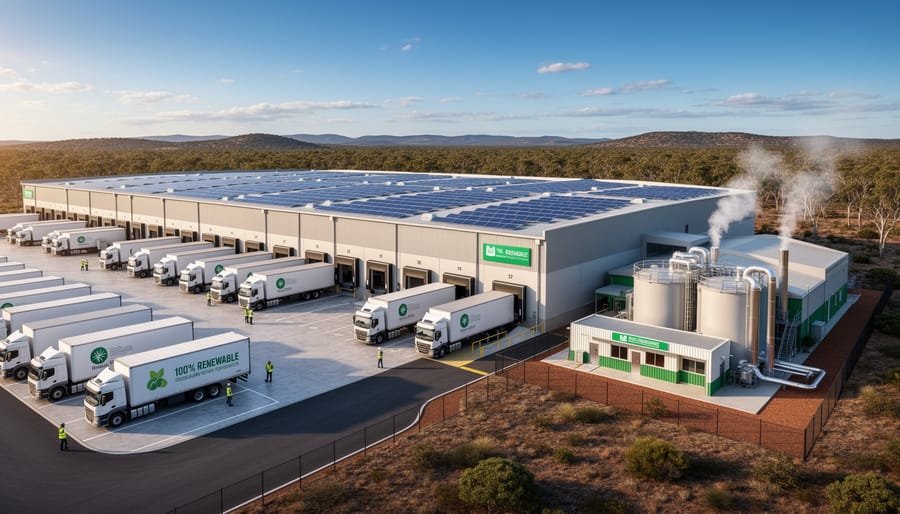
Australian Success Stories: Supply Chains Leading the Charge
Across Australia, innovative companies are proving that sustainability and profitability can go hand in hand, with supply chains leading the transformation toward a cleaner future. These success stories demonstrate how bioenergy integration creates real-world benefits for communities, businesses, and the environment.
In regional Victoria, Australian Paper’s Maryvale mill has become a remarkable example of circular economy principles in action. The facility transformed its supply chain by converting waste products from paper manufacturing into renewable energy, now generating 60 percent of its electricity needs from biomass. This shift eliminated 200,000 tonnes of carbon emissions annually while creating 85 new green jobs in the Latrobe Valley, a region transitioning away from coal dependency. Workers previously employed in fossil fuel industries found meaningful employment operating bioenergy facilities and managing sustainable forestry operations. The mill now sources wood fibre exclusively from certified sustainable plantations within a 300-kilometre radius, dramatically reducing transport emissions while supporting local forestry communities.
Queensland’s sugar industry offers another inspiring transformation. Mackay Sugar has revolutionised its operations by converting bagasse, the fibrous residue left after crushing sugar cane, into clean electricity. What was once considered waste now powers the entire milling operation, with excess renewable energy exported to the grid, supplying electricity to approximately 35,000 homes. The closed-loop system means nothing goes to waste, every part of the sugar cane contributes value. This innovation has strengthened relationships with local growers, who receive better prices for their crops, and created specialised technical positions for engineers and environmental managers. The measurable impact speaks volumes: a reduction of 150,000 tonnes of greenhouse gas emissions each year, equivalent to taking 32,000 cars off the road.
Western Australia’s wine industry is also making waves. Several Margaret River wineries have partnered to establish a shared bioenergy facility that converts grape marc, stems, and pruning waste into energy and high-quality compost. This collaborative approach reduced individual capital costs while delivering collective environmental benefits. The initiative has cut diesel consumption by 40 percent across participating vineyards, lowered waste management costs by nearly half, and enhanced soil health through nutrient-rich compost application. Additionally, the project attracted eco-conscious wine tourists, boosting regional tourism revenue.
These success stories share common threads: they turned waste into opportunity, created meaningful local employment, strengthened regional communities, and delivered measurable environmental wins. Most importantly, they prove that sustainable supply chains aren’t just good for the planet; they’re smart business strategy that positions Australian companies as global leaders in the renewable energy transition.
Making the Transition: Practical Steps for Australian Businesses
Starting Small: Quick Wins That Build Momentum
Transforming your supply chain doesn’t require a complete overhaul from day one. Smart Australian businesses are finding that small, strategic changes deliver impressive results whilst building the business case for larger investments.
Start with a supply chain audit to identify your biggest environmental hotspots. A Brisbane-based food distributor discovered that simply optimising delivery routes reduced fuel consumption by 18% within the first month—a quick win that paid for itself almost immediately.
Packaging presents another accessible entry point. Switching to biodegradable or recyclable materials often costs less than you’d expect, particularly when sourcing locally. Melbourne’s craft brewery scene has embraced this approach, with several producers now using recycled cardboard and plant-based alternatives that resonate strongly with their eco-conscious customers.
Consider partnering with suppliers who share your sustainability values. Even substituting one or two conventional suppliers with those using renewable energy or sustainable practices creates positive momentum. These partnerships often reveal additional opportunities you hadn’t considered.
Digital tools offer low-cost solutions too. Inventory management software reduces waste by improving demand forecasting, whilst digital documentation eliminates unnecessary paper trails. These changes improve efficiency whilst demonstrating your commitment to sustainability—creating a positive feedback loop that motivates teams and impresses stakeholders alike.
The journey toward sustainable supply chains isn’t just good for our planet—it makes sound business sense too. Companies embracing these practices are discovering reduced operational costs through improved efficiency, enhanced brand reputation, and stronger connections with environmentally conscious consumers. For Australia, this transformation couldn’t come at a better time. As we accelerate toward a renewable energy future, sustainable supply chains will serve as the backbone supporting our transition, ensuring that the bioenergy and clean technologies we develop reach communities with minimal environmental footprint.
The economic advantages are compelling. Businesses that have adopted sustainable logistics report significant savings through optimized routes, reduced waste, and lower energy consumption. Meanwhile, the environmental benefits—reduced carbon emissions, preserved ecosystems, and cleaner air—create a healthier future for all Australians. These aren’t distant possibilities; they’re happening right now across the country, from Melbourne to Cairns.
What’s particularly encouraging is how achievable these changes are. Whether you’re a small business owner, a corporate sustainability manager, or a policymaker shaping tomorrow’s regulations, you have the power to drive meaningful change. Start by assessing your current supply chain, identify quick wins like route optimization or local sourcing, and gradually build toward more comprehensive solutions.
The time for action is now. Australia has everything needed—renewable resources, innovative spirit, and growing commitment to sustainability—to lead the way in sustainable supply chains. Let’s work together to make this vision our reality. Your next step could transform not just your business, but contribute to a thriving, sustainable Australia for generations to come.