
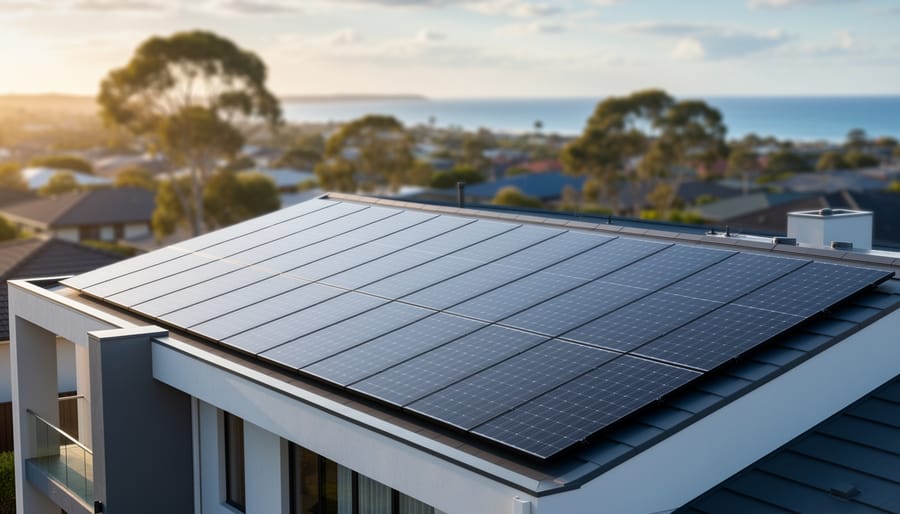
The short answer is yes—perovskite solar cells have entered commercial markets, but with significant caveats that matter for your solar investment decisions today.
While traditional silicon panels dominate rooftops across Australia, perovskite technology is making its commercial debut through niche applications and hybrid products. Companies like Oxford PV and Microquanta have begun limited commercial production, primarily targeting specialty markets rather than residential installations. You won’t find standalone perovskite panels at your local solar retailer yet, but the technology is transitioning from laboratory promise to real-world deployment faster than many predicted.
This distinction matters enormously if you’re weighing solar options now. Perovskite cells offer tantalising advantages—lighter weight, flexible form factors, and potential for lower manufacturing costs—yet face crucial hurdles around longevity and large-scale production that silicon has already conquered over decades. The current commercial reality sits somewhere between breakthrough and widespread adoption.
For environmentally conscious Australians considering solar investments, understanding where perovskite technology stands today helps you make informed decisions. Should you wait for perovskite panels, or invest in proven silicon technology now? Can these emerging cells integrate with existing renewable energy systems? What timeline should you realistically expect before perovskite becomes a genuine alternative?
This article cuts through the hype to deliver practical answers about commercial availability, real-world applications already happening, remaining challenges, and most importantly—what this means for your renewable energy choices in the present moment.
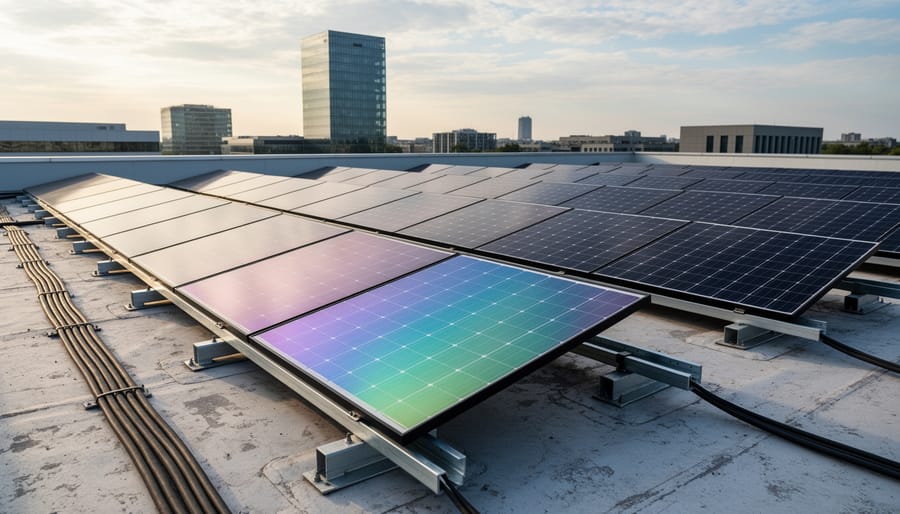
The Current State of Perovskite Solar Cells in the Market
Who’s Selling Them Today
Several pioneering companies have moved perovskite solar cells from the laboratory to real-world applications, marking an exciting turning point for renewable energy.
Oxford PV in the United Kingdom stands at the forefront, having begun commercial production of perovskite-silicon tandem solar cells in 2024. Their panels achieved a remarkable 26.9% efficiency rating, surpassing traditional silicon-only panels. The company has partnered with European manufacturers to scale up production, with panels now being installed in pilot projects across Germany and the UK.
China’s Microquanta Semiconductor has taken bold steps by establishing the world’s first mass production line for perovskite modules. They’re already delivering panels for commercial building installations throughout Asia, demonstrating that perovskite technology can work at scale in real-world conditions.
Swift Solar in the United States has developed lightweight, flexible perovskite panels particularly suited for unconventional applications like vehicle-integrated solar and portable power solutions. Their products are currently available through pilot programs with select commercial partners.
For Australians eager to embrace this technology, the pathway remains emerging but promising. While perovskite panels aren’t yet widely available through standard solar retailers here, several Australian research institutions are collaborating with international manufacturers to accelerate local adoption. The CSIRO has established partnerships aimed at bringing perovskite production capabilities to Australia within the next few years.
Industry watchers anticipate that by 2026-2027, Australian consumers may begin seeing perovskite options through progressive solar installers, particularly for specialized applications where their unique advantages shine brightest.
What You Can Actually Buy Right Now
While you can’t yet pop down to Bunnings for perovskite panels, several exciting applications are emerging worldwide. In Europe and Asia, Oxford PV has begun supplying its tandem perovskite-silicon cells to select commercial partners, primarily for pilot projects and demonstration buildings. These aren’t available for residential purchase, but they’re proving the technology works in real-world conditions.
Building-integrated photovoltaics represent the most accessible entry point. Companies like Saule Technologies in Poland are producing flexible perovskite films for architectural applications—think solar-generating facades and roofing materials. However, Australian availability remains limited, with most products still in European markets.
For specialty applications, the picture brightens considerably. Indoor photovoltaics using perovskites are powering IoT sensors and smart home devices in some markets. These niche products demonstrate the technology’s versatility, particularly in low-light conditions where traditional silicon struggles.
The honest assessment? Average Australian homeowners and small businesses can’t purchase perovskite panels for standard installations yet. The technology remains primarily accessible to research institutions, large corporations partnering with manufacturers for trials, and specific commercial projects willing to invest in cutting-edge solutions.
If you’re planning a solar installation today, silicon panels remain your practical choice. However, forward-thinking businesses involved in construction or development might explore partnerships with emerging perovskite manufacturers for future projects. The commercial landscape is shifting rapidly—what’s unavailable today could become mainstream within a few years as Australian regulations adapt and local partnerships develop.
Why Perovskite Cells Matter for Australia’s Energy Future
Efficiency That Changes the Game
Here’s what makes perovskite technology truly exciting: tandem cells are smashing efficiency records that seemed impossible just a few years ago. Think of tandem cells as a solar power tag team – they stack perovskite layers with traditional silicon, capturing different parts of the light spectrum that single-layer panels miss.
The recent 33% efficiency breakthrough means these cells convert a third of sunlight into usable electricity, compared to around 22% for standard silicon panels. For Australian homeowners and businesses, this translates directly to more power from less roof space – a game-changer in urban areas where every square metre counts.
Imagine generating the same electricity from your rooftop using 30% fewer panels. That’s fewer materials, lower installation costs, and more flexibility in panel placement. For farmers and remote communities across the country, this efficiency boost means viable solar installations in locations previously considered marginal.
When combined with innovations like quantum dot technology, these efficiency gains aren’t just laboratory curiosities – they’re reshaping what’s possible for Australia’s renewable energy landscape, making solar power accessible to more people in more places than ever before.
The Environmental Win
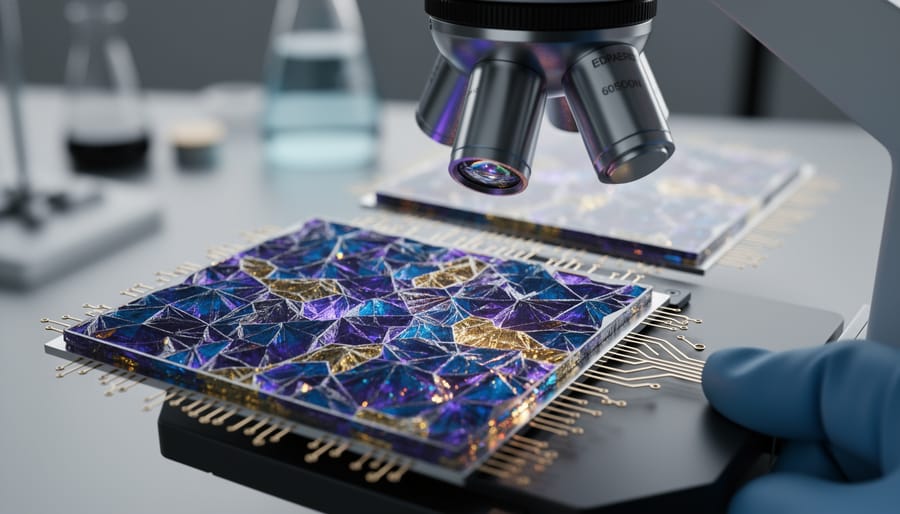
Perovskite solar cells represent a genuine game-changer for Australia’s climate commitments. These innovative panels can slash the carbon footprint of solar manufacturing by up to 40% compared to traditional silicon production. Why? They require significantly lower processing temperatures—around 150°C versus silicon’s energy-intensive 1,400°C—meaning less fossil fuel consumption during manufacturing.
For a sun-drenched nation like Australia, this matters enormously. Our net-zero by 2050 target demands rapid renewable energy deployment, and perovskites could accelerate this timeline. Their lightweight design reduces transportation emissions, whilst their potential for rooftop retrofitting means we can upgrade existing infrastructure without wasteful replacements.
The real environmental win extends beyond the panels themselves. When paired with emerging energy storage solutions, perovskites could enable truly sustainable off-grid communities across remote Australia, reducing diesel generator dependence in outback areas.
Manufacturing considerations remain important. Current research focuses on eliminating toxic lead components and improving recyclability—essential for genuine sustainability. Australian researchers at institutions like Monash University are leading this charge, developing lead-free alternatives that maintain efficiency whilst protecting our environment.
The message is clear: perovskites aren’t just about better performance; they’re about smarter, cleaner energy production that aligns perfectly with Australia’s environmental responsibilities.
The Roadblocks Holding Back Mass Adoption
The Durability Question
The biggest hurdle keeping perovskite solar cells from your rooftop isn’t efficiency—it’s durability. While these cells perform brilliantly in laboratory conditions, they’ve historically degraded when exposed to moisture, oxygen, heat, and UV light. Think of it like leaving a newspaper in the sun; traditional silicon panels age gracefully over 25-30 years, but early perovskite cells deteriorated within months.
However, researchers worldwide have made remarkable strides in solving this challenge. Scientists have developed protective encapsulation techniques and modified perovskite chemical compositions to create more stable structures. Recent breakthroughs include adding protective layers and using mixed-ion formulations that significantly extend operational lifetimes.
In 2023, Oxford PV achieved a milestone by demonstrating perovskite-silicon tandem cells maintaining over 95% of their initial efficiency after rigorous accelerated aging tests simulating years of real-world exposure. Australian research institutions, including UNSW Sydney, are contributing innovative solutions using local conditions to test stability under our harsh climate.
The realistic timeline? Most experts project commercially viable perovskite panels with 20-25 year lifespans arriving between 2025 and 2028. Some manufacturers are already offering products with 10-15 year warranties for specific applications, proving the technology is rapidly maturing.
This progress matters because once stability matches silicon’s proven track record, perovskite’s superior efficiency and lower manufacturing costs will revolutionize solar accessibility. For Australians evaluating solar investments today, understanding these developments helps time your decisions wisely—whether jumping on current silicon technology or waiting for perovskite’s imminent commercial breakthrough.
Scaling Up Production
Moving from laboratory breakthroughs to commercial-scale production presents significant hurdles, but the momentum is building. The main challenge? Creating manufacturing processes that can produce perovskite cells consistently, affordably, and at the massive scale needed to compete with established silicon panel factories.
Traditional silicon solar manufacturing requires billion-dollar facilities, and while perovskite production promises to be less capital-intensive, companies still need substantial investment to develop reliable production lines. The delicate nature of perovskite materials means manufacturers must perfect techniques like inkjet printing, slot-die coating, and vapour deposition to ensure every panel meets quality standards.
Here’s the encouraging news: commercial players are making genuine progress. Oxford PV in the United Kingdom has established the world’s first volume manufacturing line for perovskite-silicon tandem cells, with production capacity ramping up progressively. Polish company Saule Technologies has begun producing flexible perovskite panels for building integration, demonstrating that niche applications can pave the way for broader adoption.
Australian researchers are contributing too, with teams at universities collaborating with international partners to refine manufacturing processes suited to our climate conditions. Investment is flowing into the sector, with venture capital and government funding recognizing perovskite’s potential to revolutionize renewable energy.
The journey from benchtop to rooftop takes time, but each milestone brings us closer to affordable, efficient perovskite panels becoming a mainstream reality. The foundation is being laid today for tomorrow’s solar revolution.
Success Stories You Can Learn From
Early Adopters Making It Work
While full-scale commercial deployment remains on the horizon, several pioneering projects are proving perovskite solar cells work in real-world conditions. In Poland, Saule Technologies has installed perovskite panels on building facades and bus shelters, demonstrating how the lightweight, flexible cells excel in vertical applications where traditional panels struggle. These installations are generating reliable power while showcasing the technology’s versatility in urban environments.
Closer to home, Oxford PV’s pilot production facility in Germany is manufacturing tandem perovskite-silicon cells that have achieved record efficiencies above 26 percent in field testing. Their first commercial panels are now powering demonstration sites across Europe, providing valuable performance data in diverse climates.
In Japan, Panasonic has integrated perovskite cells into building materials for residential projects, where the technology’s adaptability allows seamless integration with architectural design. These early adopters report encouraging results, though they emphasize the cells are still being monitored for long-term durability.
Perhaps most tellingly, these pilot projects are revealing practical insights about installation methods, maintenance requirements, and performance in humidity and temperature variations – challenges particularly relevant for Australian conditions. While not yet available for your rooftop, these real-world tests are accelerating the path to broader commercial release, with many participants expecting market-ready products within the next few years.
What Australian Innovators Are Doing
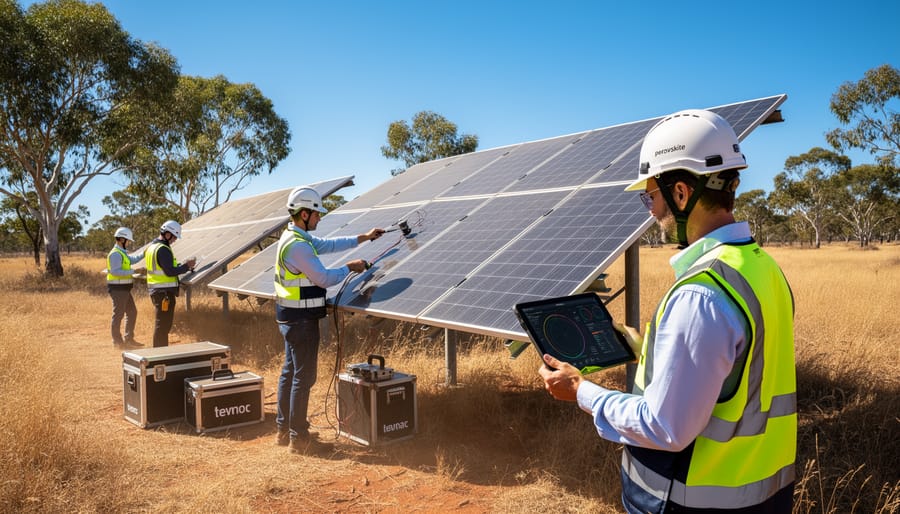
Australia is punching well above its weight in perovskite solar innovation, with world-leading research happening right here. The University of New South Wales (UNSW) has achieved remarkable breakthroughs in perovskite-silicon tandem cells, setting efficiency records that have caught global attention. Their research team is working closely with industry partners to accelerate commercialisation timelines.
Melbourne-based startup Greatcell Solar is pioneering printable perovskite technology that could dramatically reduce manufacturing costs. They’re focused on making solar cells that can be produced using printing techniques similar to newspapers—a game-changer for affordability and scalability.
The Australian National University (ANU) is tackling stability challenges head-on, developing protective coatings that extend perovskite cell lifespans in our harsh climate conditions. This work is crucial for making the technology viable across Australia’s diverse environments, from the tropical north to the arid outback.
These efforts complement other renewable innovations like solar-powered hydrogen production, creating an integrated approach to Australia’s clean energy future.
Partnerships between universities and manufacturing sectors are accelerating practical applications, with pilot projects testing perovskite panels in real-world Australian conditions. This homegrown expertise positions Australia as a potential manufacturing hub when commercial production scales up globally.
What This Means for Your Solar Decision Today
If you’re considering solar panels for your Australian home or business right now, here’s the straightforward advice: don’t wait for perovskite technology to become mainstream. Current silicon solar panels are proven, reliable, and readily available throughout Australia, with excellent warranties typically spanning 25 years or more.
The decision becomes clearer when you consider your circumstances. If you’re planning a solar installation within the next 12-18 months, silicon panels remain your best bet. They’re delivering strong performance across Australian conditions, from Darwin’s tropical humidity to Melbourne’s variable weather. You’ll benefit from competitive pricing, established installation networks, and government rebates available today.
However, if your timeline extends beyond two years, keeping an eye on perovskite-silicon hybrid developments makes sense. These emerging products might offer improved efficiency, particularly valuable if you have limited roof space or want maximum output from shaded areas. The Oxford PV systems coming online demonstrate this technology’s approaching maturity.
For commercial operations and large-scale projects, the calculus differs slightly. If your development timeline stretches to 2026 or beyond, engaging with solar consultants about hybrid options could position you advantageously. Meanwhile, explore complementary technologies like alternative energy storage to maximise your renewable investment.
Risk tolerance matters too. Early adopters comfortable with cutting-edge technology might explore pilot programs as they emerge, while those prioritising certainty should stick with proven silicon solutions. Remember, the environmental benefits begin the moment your panels start generating clean energy. Every month spent waiting is another month relying on grid power.
The encouraging news? Either choice supports Australia’s renewable transition. Today’s silicon panels already deliver remarkable value, while tomorrow’s perovskite innovations promise even greater possibilities. Your solar journey can begin now, with upgrades always possible as technology evolves.
While perovskite solar cells aren’t quite ready for your rooftop today, their journey from laboratory curiosity to near-commercial reality has been remarkably swift. The technology stands at an exciting threshold, with pilot projects demonstrating real-world viability and manufacturing facilities ramping up production.
For homeowners, stick with proven silicon panels for now, but keep watching this space—perovskite technology could transform your next solar upgrade within five years. Business owners should engage with solar installers about future-proofing strategies and upcoming tandem technologies that could boost energy yields. Policymakers have a golden opportunity to position Australia as a clean energy innovator by supporting commercialisation pathways and manufacturing initiatives. Industry professionals should explore partnerships with perovskite developers and prepare supply chains for this emerging market.
Australia’s renewable energy transition doesn’t depend on a single breakthrough—it’s built through embracing innovation alongside proven technologies. Perovskite solar cells represent the kind of game-changing advancement that can accelerate our journey toward a cleaner, more energy-independent future. By staying informed and supporting emerging technologies, we’re all contributing to a brighter tomorrow powered by Australian sunshine.