
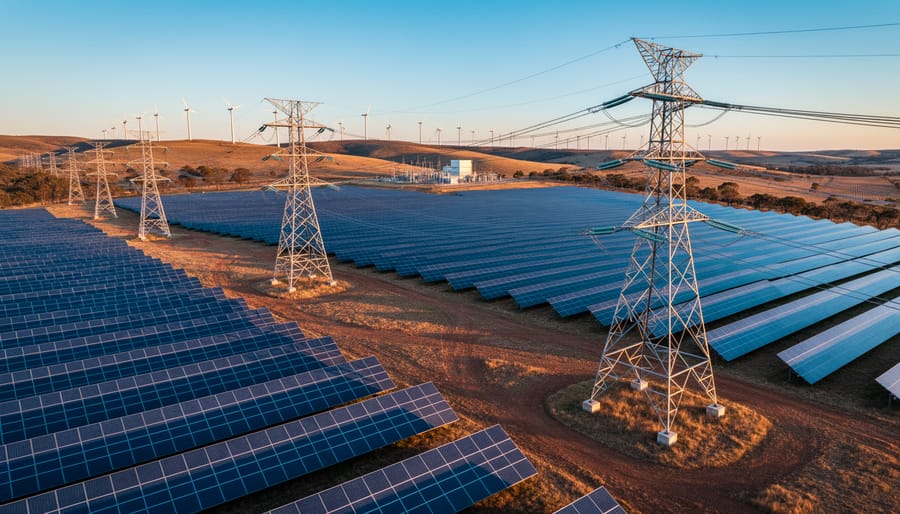
Australia’s renewable energy revolution faces an unexpected roadblock: our electricity grid wasn’t built for the solar farms and wind turbines now racing to connect. While renewable projects queue for years waiting for grid access, a suite of powerful yet underutilised solutions called grid-enhancing technologies is quietly proving it can double or even triple the capacity of existing transmission lines without building a single new pylon.
These technologies—dynamic line rating systems, power flow controllers, and advanced conductors—work like adding express lanes to a congested motorway. Instead of the traditional approach of building entirely new transmission infrastructure at eye-watering costs and decade-long timescales, grid-enhancing technologies optimise what’s already there. They monitor real-time conditions, intelligently route electricity around bottlenecks, and safely push more renewable power through existing wires.
The stakes couldn’t be higher. Australia has committed to 82 percent renewable electricity by 2030, yet transmission constraints currently block approximately 50 gigawatts of proposed renewable projects from connecting. Traditional grid upgrades cost billions and take 10-15 years to complete, but grid-enhancing technologies can be deployed in months for a fraction of the price, unlocking stranded renewable capacity almost immediately.
Globally, these technologies have already delivered remarkable results. In the United States, a single grid-enhancing installation increased transmission capacity by 40 percent within months. Scotland’s deployment prevented hundreds of hours of wind curtailment, keeping clean energy flowing when it would have otherwise gone to waste.
When integrated with smart grid technology, these solutions create an agile, responsive network ready for Australia’s renewable future.
Why Australia’s Grid Can’t Handle More Renewable Energy (Yet)
Australia’s renewable energy boom has hit an unexpected roadblock, and it’s not about the technology itself. Solar panels are cheaper than ever, wind turbines are spinning across the countryside, yet something’s holding us back from adding more clean energy to the mix. The culprit? Our electricity grid simply wasn’t built for this.
Think of the grid’s “hosting capacity” like a highway system. Just as roads have a maximum number of cars they can handle before traffic grinds to a halt, our electrical infrastructure has limits on how much renewable energy it can safely absorb. And right now, many parts of Australia’s network are running at full capacity.
The challenge stems from how renewable energy behaves compared to traditional power stations. Coal and gas plants deliver steady, predictable electricity that flows in one direction—from generator to user. Solar and wind, however, are variable and often distributed across thousands of smaller sites. When the sun’s blazing across Queensland or a strong southerly hits South Australia’s wind farms, the grid can receive more electricity than it was designed to handle, causing voltage fluctuations and potential instability.
The real-world consequences are already playing out. In 2022, several large-scale solar projects in New South Wales faced curtailment—forced to switch off during peak production times because the network couldn’t accept their output. In regional Victoria, new renewable projects have been knocked back despite having perfect conditions, simply because the local grid infrastructure has reached its limit. It’s like having a full tank of petrol but nowhere to drive.
Even rooftop solar owners in parts of South Australia have experienced the frustration of being unable to export excess energy back to the grid during sunny afternoons. This isn’t just disappointing for investors and households—it’s holding back Australia’s clean energy transition and our climate goals.
But here’s the good news: this is an engineering challenge, not an insurmountable barrier. Grid-enhancing technologies offer practical, cost-effective solutions that can unlock our network’s potential without requiring decades of infrastructure rebuilding. The pathway forward exists—we just need to embrace it.
The Three Technologies Transforming Grid Capacity Right Now
Dynamic Line Rating: Teaching Old Cables New Tricks
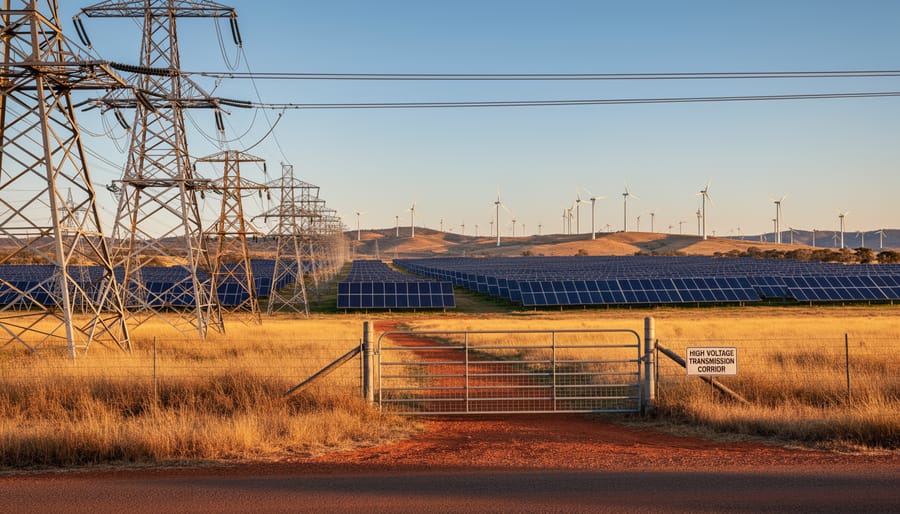
Imagine if the power lines crisscrossing Australia could suddenly carry 20-40% more electricity without a single new cable being strung. Sounds too good to be true? Welcome to the world of Dynamic Line Rating, a technology that’s teaching our existing infrastructure some impressive new tricks.
Traditional power networks operate under a “set and forget” mentality, with transmission capacity based on worst-case scenarios: hot summer days with no wind. But here’s the thing—most days aren’t worst-case scenarios. When cooler weather rolls in or a decent breeze kicks up, those same power lines can safely carry significantly more electricity. Dynamic Line Rating systems use real-time monitoring—measuring temperature, wind speed, and actual line conditions—to adjust capacity on the fly.
The technology works brilliantly alongside renewable energy. Wind farms often generate maximum power during windy conditions, precisely when power lines can handle extra load. Solar farms, while producing during daylight hours, often benefit from cooler morning temperatures that allow higher transmission capacity.
Here in Australia, we’re already seeing promising results. TransGrid’s Dynamic Ratings Project in New South Wales has demonstrated capacity increases of up to 30% during favourable conditions. The trial monitors conductor temperature and weather conditions in real-time, safely unlocking hidden capacity in existing transmission lines. Similarly, Powerlink Queensland has been testing dynamic rating systems across their network, with early results showing substantial capacity gains during renewable energy peak generation periods.
What makes this technology particularly attractive is the timeline and cost. While building new transmission infrastructure can take a decade and billions of dollars, Dynamic Line Rating systems can be deployed within months for a fraction of the investment. It’s not about replacing traditional grid upgrades entirely—sometimes you genuinely need new cables—but rather squeezing every possible electron through what we’ve already got while those longer-term projects proceed.
For Australia’s renewable energy ambitions, this means connecting more wind and solar projects faster, reducing curtailment, and maximizing our clean energy investments.
Advanced Power Flow Control: Traffic Management for Electricity
Imagine you’re driving to work and your GPS detects heavy traffic ahead. Instead of keeping you stuck in congestion, it instantly reroutes you along clearer roads. Advanced power flow control devices do exactly this for electricity networks, intelligently redirecting power around bottlenecks to keep renewable energy flowing smoothly.
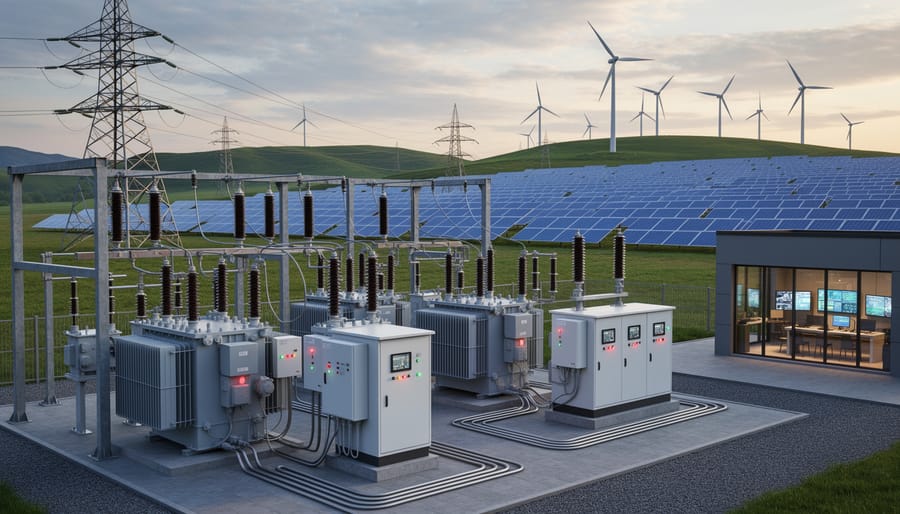
These smart devices, sometimes called flexible AC transmission systems or power flow controllers, act as sophisticated traffic managers for the grid. When a solar farm generates more electricity than local transmission lines can handle, these controllers automatically redirect that clean power through alternative pathways, preventing waste and maximizing renewable energy use. It’s fair dinkum game-changing technology for Australia’s expanding wind and solar sectors.
The practical benefits are impressive. Traditional grid infrastructure often forces renewable energy farms to curtail production during peak generation times because transmission lines become congested. Power flow controllers eliminate much of this curtailment by optimizing how electricity moves through existing infrastructure. A wind farm in South Australia that might previously have needed to shut down turbines during windy periods can now keep generating, with smart controllers finding available capacity elsewhere on the network.
These devices work brilliantly alongside energy storage solutions, creating a dynamic partnership. When storage facilities charge or discharge, power flow controllers adjust routing in real-time, ensuring the entire system operates at peak efficiency.
For Australian renewable energy projects, this technology removes a major barrier to expansion. Developers can build larger solar and wind farms knowing the grid can accommodate their output through intelligent routing rather than expensive new transmission lines. The controller adjusts power flow within milliseconds, responding faster than any human operator could manage, making every megawatt of clean energy count toward our renewable transition.
Topology Optimization: Reconfiguring the Grid Without Rebuilding It
Imagine being able to double or even triple the capacity of your existing power grid without laying a single kilometre of new transmission cable. That’s exactly what topology optimization achieves, and it’s transforming how Australia manages its renewable energy transition.
At its core, topology optimization uses sophisticated software combined with intelligent switching devices to reconfigure how electricity flows through the existing grid network. Think of it like optimising traffic flow in a city by adjusting traffic lights and opening alternative routes, rather than building entirely new roads. The grid already has multiple pathways for electricity to travel; topology optimization simply finds the most efficient routes in real-time.
This technology works brilliantly alongside AI-powered grid optimization, continuously analysing network conditions and automatically reconfiguring connections to maximize capacity. When a solar farm in regional New South Wales needs to feed power into the grid during peak generation hours, the system can redirect flows through underutilized pathways, avoiding bottlenecks that would otherwise curtail renewable output.
The cost advantage is remarkable. While building new transmission infrastructure can cost millions of dollars per kilometre and take years to complete, topology optimization upgrades typically cost a fraction of that investment and can be implemented within months. For Australia’s expansive landscape where transmission distances present unique challenges, this represents genuine game-changing potential.
Several Australian network operators are already trialling these systems with impressive results. In some cases, they’re achieving capacity increases of 20-40 percent on existing infrastructure, meaning more renewable energy from wind, solar, and bioenergy facilities can reach consumers without expensive infrastructure builds.
This smart approach doesn’t replace the need for new transmission entirely, but it buys valuable time and maximizes what we’ve already built. For bioenergy producers connecting to the grid, topology optimization can mean the difference between immediate connection and years of waiting for infrastructure upgrades.
Real-World Wins: Where Grid-Enhancing Tech Is Already Working
Grid-enhancing technologies aren’t just theoretical solutions gathering dust in research papers. They’re already delivering remarkable results across Australia and similar markets, unlocking renewable energy potential that would have otherwise remained stranded.
In South Australia’s mid-north region, dynamic line rating technology installed on ElectraNet’s transmission network in 2019 has become a game-changer for wind farm operators. By monitoring real-time weather conditions including wind speed and ambient temperature, the system determines the actual carrying capacity of transmission lines rather than relying on conservative fixed ratings. The result? An additional 200 megawatts of renewable hosting capacity without building a single new tower. “We’ve seen days where dynamic ratings increased our available capacity by up to 30 percent,” explains local wind farm manager Sarah Chen. “That’s clean energy flowing to homes that would have been curtailed under the old system.” The technology enabled three new wind projects to connect years ahead of schedule, saving an estimated 85 million dollars in transmission upgrades while reducing wholesale electricity prices by 4 percent during peak renewable generation periods.
Over in Western Australia’s Wheatbelt region, advanced power flow control devices installed at a critical substation in 2021 have opened the door for agricultural communities to benefit from renewable energy development. The technology redirects power flows across parallel transmission paths, eliminating a bottleneck that had blocked 150 megawatts of proposed solar farms. Within 18 months, two major solar projects were operational, with a third under construction. Local landowners now receive lease payments from hosting solar arrays, diversifying farm income during challenging seasons. Meanwhile, the regional town of Merredin has seen electricity costs drop by approximately 12 dollars monthly for average households as cheap solar generation floods the local grid during daylight hours.
These real-world examples demonstrate what’s possible when we deploy smart technology instead of defaulting to expensive infrastructure builds. The beauty of grid-enhancing technologies lies in their ability to deliver quick wins. Most installations achieve full operation within 12 to 24 months, compared to five years or more for new transmission lines. That’s renewable energy reaching Australian homes and businesses years earlier, creating jobs and cutting emissions while traditional infrastructure projects remain in the planning stages.
The Bioenergy Connection: How Grid Tech Enables Smarter Renewable Integration
Grid-enhancing technologies are opening exciting doors for Australia’s bioenergy sector, making it easier than ever for biomass plants and biogas facilities to connect to existing networks and operate seamlessly alongside other renewable sources.
Here’s where bioenergy truly shines: unlike solar panels that only produce during daylight hours or wind turbines that depend on weather patterns, biomass and biogas facilities can generate power on demand. Grid-enhancing technologies recognize and maximize this remarkable flexibility. Dynamic line rating systems, for instance, can identify optimal times for bioenergy facilities to ramp up production when solar generation drops in the evening, ensuring steady power flow without overloading transmission lines.
Advanced power flow control devices help biogas plants from dairy farms or food waste facilities dispatch electricity precisely when needed, complementing the variable output from solar and wind installations. This means a regional grid can support more renewable capacity overall because bioenergy fills the gaps left by weather-dependent sources.
Consider a practical example: a biogas facility in regional Queensland might operate at moderate capacity during sunny midday periods when solar is abundant, then increase output as evening demand peaks and solar fades. Grid-enhancing technologies coordinate this dance automatically, using real-time monitoring and control systems to balance all renewable sources without requiring expensive network upgrades.
The topology optimization software we mentioned earlier treats dispatchable bioenergy as a valuable grid stabilization asset, routing power flows to prevent bottlenecks while maximizing the contribution from all renewable sources. This complementary relationship means communities can pursue ambitious renewable energy targets without choosing between different clean technologies.
For Australian bioenergy operators, this technological evolution represents a fair go at grid access. Previously, connection applications faced lengthy delays and costly infrastructure requirements. Grid-enhancing technologies now provide smarter pathways, allowing biomass and biogas facilities to connect faster and operate more efficiently within increasingly complex renewable energy networks. The result is a resilient, flexible grid where bioenergy’s unique strengths support Australia’s clean energy transition.
What This Means for Australian Communities and Industry
For everyday Australians, grid-enhancing technologies translate into meaningful, tangible benefits that extend well beyond technical improvements to our electricity network.
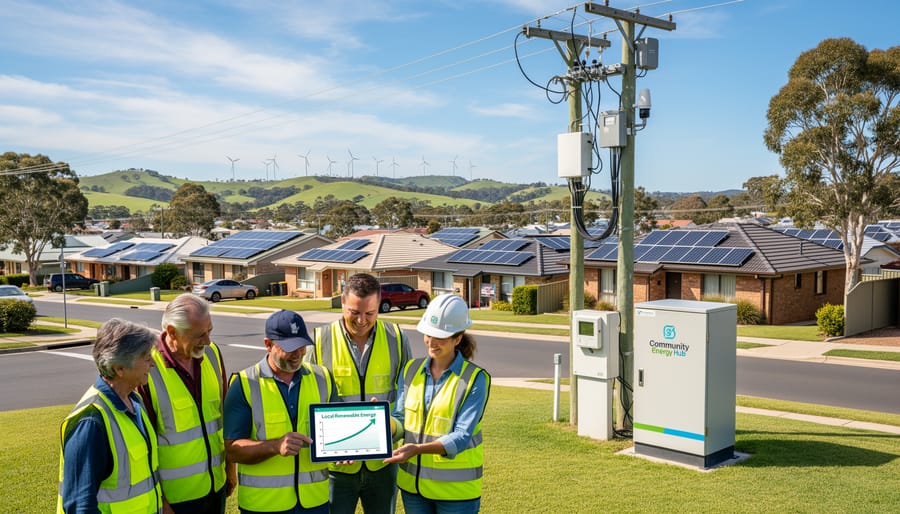
The most immediate impact will be felt in regional communities where renewable projects currently face years-long approval processes. By increasing the hosting capacity of existing transmission lines, these technologies can fast-track the connection of solar and wind farms that would otherwise remain stuck in the queue. This means local communities can see new renewable installations generating clean power and economic activity much sooner than traditional infrastructure upgrades would allow.
Job creation represents another significant opportunity. Installation and maintenance of dynamic line rating systems, power flow controllers, and advanced monitoring equipment require skilled technicians across regional Australia. The Australian Energy Market Operator estimates that widespread deployment could create thousands of positions in electrical trades, data analysis, and network management over the next decade, particularly in renewable energy zones across New South Wales, Victoria, and Queensland.
Household energy bills should also benefit. Because grid-enhancing technologies cost a fraction of building new transmission lines, these savings flow through to consumers. Rather than funding billion-dollar infrastructure projects, electricity distributors can deploy these solutions at 10 to 20 percent of the cost, keeping downward pressure on network charges that make up roughly half of typical power bills.
For businesses investing in distributed renewable energy systems, these technologies mean faster project approvals and better returns on investment. Agricultural operations installing bioenergy facilities or manufacturing plants adding rooftop solar can connect to the grid more quickly and reliably.
Perhaps most importantly, accelerated deployment of renewables brings us closer to emissions reduction targets while strengthening energy security. Every megawatt of clean energy connected through enhanced grid capacity represents another step toward a more sustainable, resilient power system that serves all Australians.
Making It Happen: Next Steps for Australia’s Energy Future
Australia stands at a pivotal moment where the right policy settings and industry action can unlock grid-enhancing technologies to accelerate our renewable energy future. The good news? The path forward is clear, and everyone has a role to play.
For policymakers, the priority is creating supportive regulatory frameworks that incentivize network operators to adopt these technologies. This means updating planning standards to recognize dynamic line ratings and advanced monitoring as viable alternatives to traditional infrastructure upgrades. Several states are already exploring regulatory sandboxes that allow utilities to trial grid-enhancing solutions with reduced red tape, providing valuable learnings for nationwide rollout.
Industry has equally important work ahead. Network operators should commence pilot programs testing these technologies on congested transmission corridors, while renewable energy developers can advocate for their deployment in regions where projects face connection delays. Investment opportunities abound for organizations willing to back Australian companies developing grid-enhancement solutions tailored to our unique conditions.
Individual Australians and environmental organizations can drive change through advocacy. Contact your local representatives to express support for grid modernization initiatives. Industry groups might consider partnering with universities on research projects that demonstrate these technologies under Australian conditions, building the evidence base for wider adoption.
The transition doesn’t require waiting for massive infrastructure projects. Grid-enhancing technologies offer immediate wins, enabling us to squeeze more renewable energy through existing wires while longer-term upgrades proceed. By acting now, championing smart solutions, and working collaboratively across sectors, Australia can transform grid constraints from roadblocks into stepping stones toward our clean energy future. The technology exists; what’s needed is the collective will to deploy it.
The path forward is clear: grid-enhancing technologies represent our fastest and most cost-effective ticket to a renewable energy future. Rather than waiting years for expensive new transmission lines, Australia can unlock the grid’s hidden potential right now, dramatically increasing the clean energy flowing through existing infrastructure. These proven solutions—dynamic line rating, power flow control devices, and advanced monitoring systems—have already demonstrated their power to boost renewable hosting capacity by up to 40 percent in projects across the country.
The beauty of these technologies lies not just in their effectiveness, but in their accessibility. They’re available today, they work with what we’ve already built, and they deliver results quickly. For every month we delay embracing these solutions, we’re leaving renewable energy projects stuck in connection queues and missing opportunities to reduce emissions.
Now is the time to champion grid-enhancing technologies in your community, workplace, and conversations with decision-makers. Whether you’re an industry professional evaluating infrastructure investments, a policymaker shaping energy strategy, or simply an Australian who cares about our environmental future, your voice matters in accelerating this transition.
Picture Australia’s grid in five years: humming efficiently with unprecedented renewable energy flows, supporting thriving regional communities with bioenergy projects, and proving that smart technology can transform what’s possible. That future isn’t a distant dream—it’s within reach, waiting for us to grasp it. Together, we can build the clean energy nation we all deserve.