
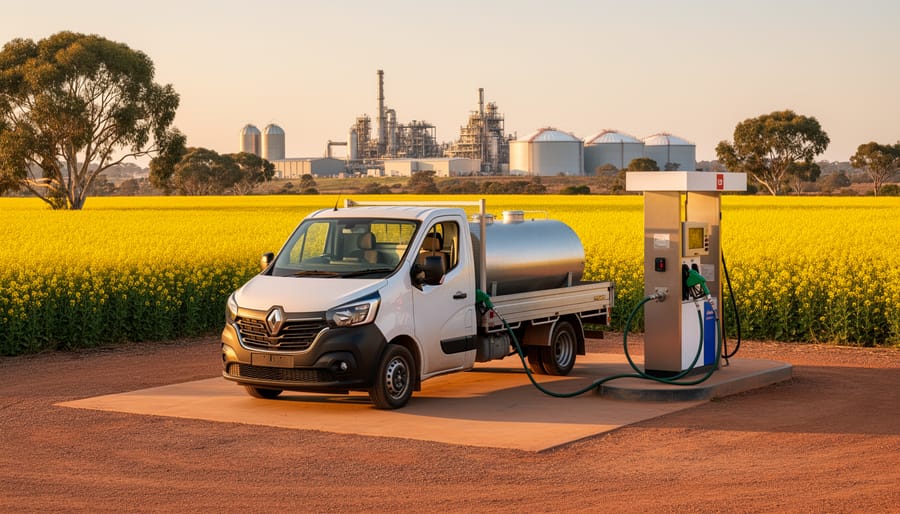
Biodiesel is quietly revolutionising Australia’s economic landscape, pumping billions into regional communities while creating thousands of jobs from the paddock to the pump. When a farmer in Queensland converts canola into fuel that powers local transport fleets, or when a fish and chip shop in Melbourne sells its used cooking oil to a biodiesel processor, they’re participating in an industry generating over $400 million annually for the Australian economy. This isn’t just about environmental benefits—it’s about real money flowing into rural areas, new employment opportunities for agricultural workers, and energy independence that keeps Australian dollars circulating within our borders rather than disappearing overseas for imported petroleum.
The economic ripple effect extends far beyond the biodiesel plants themselves. Feedstock farmers enjoy diversified income streams, equipment manufacturers supply specialised processing technology, logistics companies transport product across the country, and research institutions develop innovations that position Australia as a biofuels leader in the Asia-Pacific region. These broader bioenergy economic impacts demonstrate how biodiesel production strengthens energy security while building resilient local economies. Success stories like the Southern Oil Refinery in Gladstone—processing 60 million litres annually and employing dozens of skilled workers—prove that biodiesel delivers measurable economic value alongside its environmental credentials, creating a compelling case for expanded investment across Australia’s renewable fuel sector.
The Money Trail: Where Biodiesel Investment Flows
From Farm Gate to Fuel Tank: The Value Chain
The biodiesel value chain creates a ripple effect of economic benefits across Australia, transforming raw materials into renewable fuel while supporting communities at every step. Understanding this flow reveals why biodiesel is more than just an environmental solution—it’s an economic opportunity.
It starts at the farm gate, where Australian growers cultivate oilseed crops like canola, or livestock producers generate tallow as a by-product. These feedstock suppliers receive additional income streams, diversifying their revenue beyond traditional agriculture. A canola farmer in the Riverina, for example, might sell crops both for food and fuel production, creating financial resilience.
Next, the feedstock moves to collection and processing facilities, where local workers extract oils and prepare materials for conversion. This stage employs skilled technicians and logistics personnel while supporting regional transport companies.
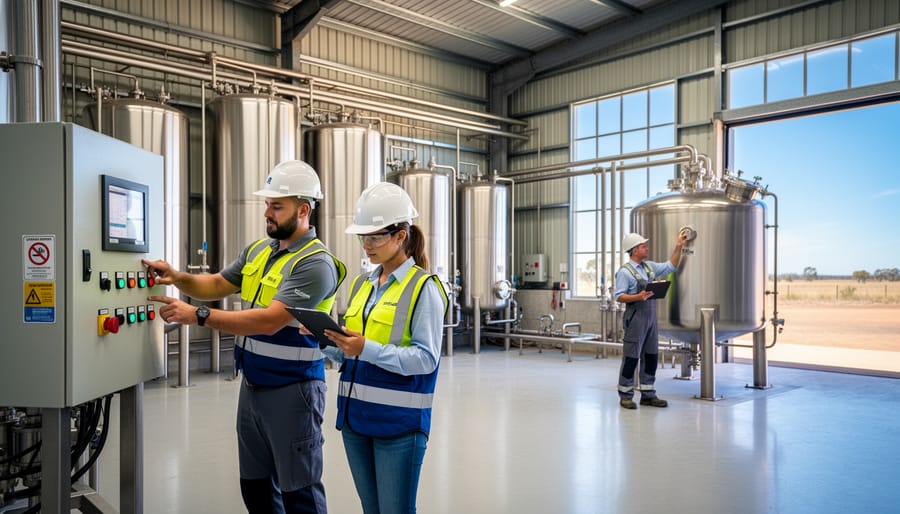
The biodiesel production facilities themselves represent significant infrastructure investment, often located in regional centres where they become major employers. These plants hire chemical engineers, quality control specialists, and plant operators—creating stable, well-paying jobs outside capital cities.
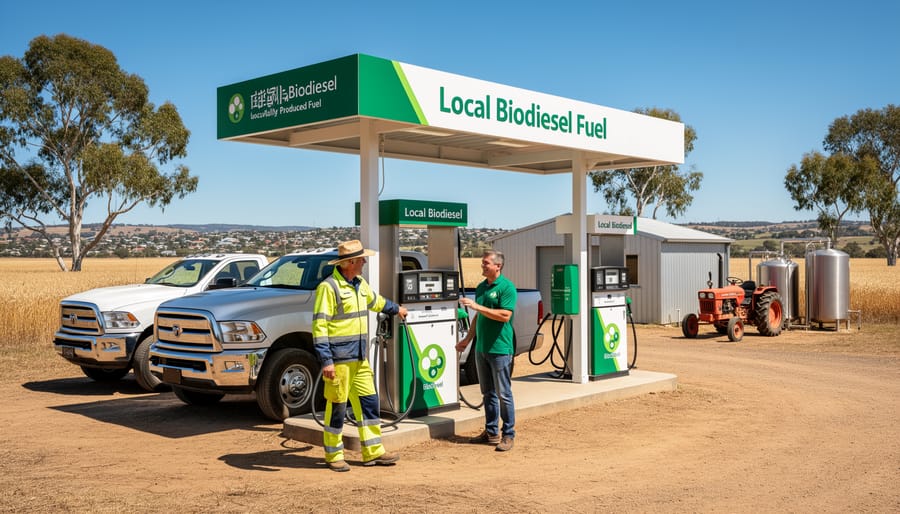
From production, the fuel flows through distribution networks to service stations and commercial fleets. Distributors, retailers, and mechanics all benefit from this expanding market. Despite supply chain challenges, each transaction keeps money circulating within Australian communities rather than flowing overseas to petroleum exporters.
This domestic value chain strengthens regional economies, with every litre of biodiesel produced supporting multiple Australian businesses and workers from paddock to pump.
Australian Success Stories Worth Watching
Across Australia, innovative businesses are proving that biodiesel isn’t just good for the environment—it’s brilliant for the bottom line too.
Take Biodiesel Producers Limited, an Aussie company that’s turned waste cooking oil collection into a thriving enterprise. Operating from their facility in Brisbane, they’ve created a circular economy model that keeps local restaurants happy while producing high-quality biodiesel for transport fleets. Their success demonstrates how clever Aussies can transform someone else’s waste into valuable fuel, creating jobs in collection, processing, and distribution along the way.
In regional New South Wales, the Golden Plains Biodiesel Cooperative has become a beacon of rural ingenuity. Local farmers banded together to process canola and other oilseed crops grown right in their backyard. This cooperative approach means farmers aren’t just selling raw materials—they’re capturing the value-adding process too. The result? Stronger farm incomes, increased regional employment, and fuel security for agricultural operations. It’s the kind of fair dinkum solution that keeps money circulating in local communities rather than flowing to distant refineries.
Meanwhile, Argent Energy Australia has made significant strides in industrial-scale biodiesel production. Their investment in advanced processing technology at Port Adelaide showcases how biodiesel can attract substantial capital investment and create skilled manufacturing jobs. They’re supplying major transport companies and government fleets, proving biodiesel can compete at commercial scale.
These success stories share common threads: they’ve identified local feedstock opportunities, built strong community partnerships, and focused on reliable quality. They’re not just producing fuel—they’re demonstrating that sustainable business models can deliver genuine economic benefits while reducing carbon emissions. Their achievements offer a roadmap for other Australian entrepreneurs ready to dive into the biodiesel sector.
Jobs That Didn’t Exist Five Years Ago
Regional Towns Finding New Life
Across regional Australia, biodiesel production facilities are breathing new economic life into communities that have faced decades of declining opportunities. These plants aren’t just manufacturing renewable fuel—they’re creating sustainable livelihoods and reinvigorating local economies in ways that matter to everyday Australians.
Take the Western Australian Wheatbelt, where biodiesel facilities have transformed agricultural communities. Farmers who once struggled with volatile grain markets now have diversified income streams, supplying canola and other oilseeds for local processing. The ripple effect extends well beyond the farm gate, with transport operators, maintenance contractors, and service providers all benefiting from increased economic activity.
In regional Queensland, biodiesel production has created skilled employment opportunities that keep young people in their hometowns. Process operators, laboratory technicians, and logistics coordinators earn competitive wages without needing to relocate to major cities. For communities that watched their children leave in search of opportunities, this represents a fundamental shift.
The Darling Downs region showcases how biodiesel facilities anchor broader economic development. When a production plant establishes operations, it typically generates between 30 to 50 direct jobs, with hundreds more created indirectly through supply chains and service industries. Local cafes, accommodation providers, and retail businesses report increased turnover, while real estate markets stabilize as workers settle into communities.
Regional councils are recognizing biodiesel’s potential as an economic development tool, actively courting producers with streamlined approvals and infrastructure support. This isn’t charity—it’s smart economics. Every biodiesel facility represents long-term investment in communities that have often been overlooked in Australia’s economic transformation.
The beauty of biodiesel production lies in its regional focus. Unlike many industries that centralize in capital cities, biodiesel thrives where feedstocks grow, ensuring economic benefits flow directly to the communities that need them most.
What Biodiesel Means for Your Local Community
When biodiesel production takes root in a community, the economic ripple effects extend far beyond the production facility itself. The transformation touches everything from local retail to infrastructure development, creating a more resilient and self-sufficient local economy.
Take the Central Queensland town of Dalby, where local biodiesel initiatives have sparked new business opportunities across multiple sectors. Farm equipment suppliers now offer biodiesel conversion services, mechanical workshops have expanded their expertise, and even local cafes and restaurants have found additional revenue streams by selling their used cooking oil as feedstock. This diversification strengthens the entire business ecosystem, making communities less vulnerable to economic downturns in any single sector.
Infrastructure development represents another significant community benefit. As biodiesel production grows, regions often see improvements in fuel storage facilities, upgraded transport networks, and enhanced agricultural processing capabilities. These upgrades serve the biodiesel industry while simultaneously benefiting other local businesses. In regional New South Wales, improved fuel distribution infrastructure initially developed for biodiesel has helped reduce transport costs for conventional fuels too, delivering savings to all residents.
Community energy resilience stands out as perhaps the most valuable long-term benefit. When communities produce their own fuel locally, they become less dependent on global supply chains and less vulnerable to international fuel price fluctuations. During recent periods of global energy uncertainty, Australian communities with local biodiesel production maintained more stable fuel prices and reliable supply, demonstrating the security advantages of local production.
Local government revenue also benefits through increased business activity, property development, and expanded rate bases. These additional funds often translate into improved community services, better roads, and enhanced public facilities that benefit all residents. The economic foundation biodiesel creates allows communities to invest in their own future, building prosperity that extends across generations while supporting Australia’s transition toward renewable energy independence.
The Farmer’s New Revenue Stream
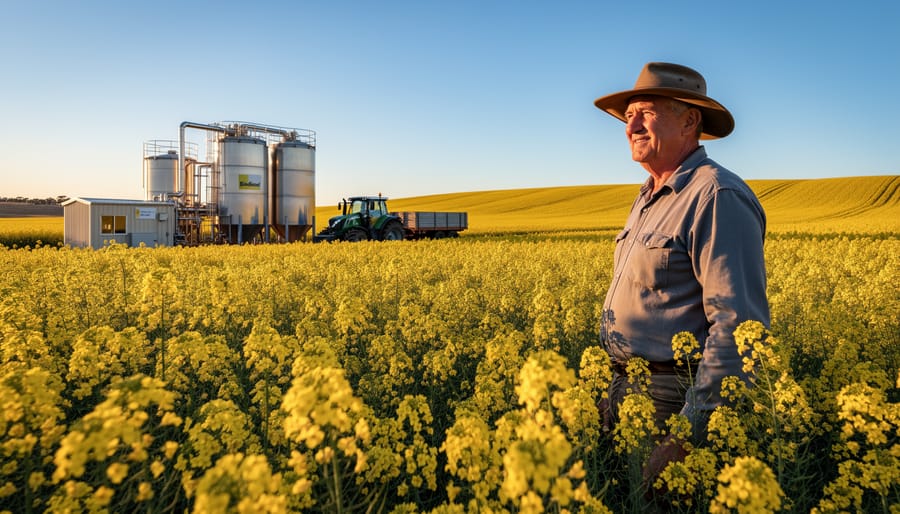
For Australian farmers facing the constant challenges of commodity price fluctuations and unpredictable weather patterns, biodiesel feedstock production has emerged as a genuine game-changer. Rather than putting all their eggs in one basket, progressive farmers are discovering that growing crops for biodiesel production provides a reliable secondary income stream that cushions them against traditional agricultural uncertainties.
Take the case of the Murray family in regional Queensland, who planted canola specifically for biodiesel production alongside their traditional wheat crops. Within three years, their canola operation was generating an additional $85,000 annually—money that proved invaluable during a particularly difficult drought season when their wheat yields suffered. This diversification didn’t just provide financial breathing room; it actually helped them keep their farm viable when neighbouring properties were struggling.
Canola remains one of the most popular biodiesel feedstock choices across southern Australia, thriving in the cooler climates of Victoria, South Australia, and parts of New South Wales. Farmers typically see returns of $600 to $900 per hectare, depending on market conditions and yields. What makes canola particularly attractive is its compatibility with existing farming equipment and knowledge, meaning farmers don’t need massive upfront investments to get started.
Meanwhile, in Queensland’s warmer regions, cottonseed has become the feedstock of choice. Cotton farmers who previously treated seeds as a low-value byproduct are now earning substantial additional income by selling them to biodiesel processors. One Darling Downs cotton producer reported that cottonseed sales added roughly 15 percent to their overall farm revenue—a significant boost that required virtually no extra effort.
Safflower and mustard seed are also gaining traction, particularly among farmers looking for drought-resistant options. These crops fit neatly into crop rotation systems, improving soil health while generating biodiesel income. Some forward-thinking farmers in Western Australia have even established direct supply agreements with local biodiesel producers, guaranteeing stable prices and eliminating the uncertainty of spot market sales.
The beauty of this diversification extends beyond immediate profits. Farmers report feeling more financially secure knowing they’re not solely dependent on international grain prices or the whims of supermarket buyers. They’re producing something that’s genuinely needed domestically, contributing to Australia’s energy independence while building resilient, future-proof farming operations that can weather whatever challenges lie ahead.
Energy Independence: The Economic Security Angle
Australia currently imports around 90% of its liquid fuel needs, creating significant economic vulnerability and sending billions of dollars offshore each year. Biodiesel production offers a practical pathway to shift this equation, keeping energy dollars circulating within our communities while building genuine economic resilience.
When regional processing facilities convert locally grown canola, waste cooking oil, or other feedstocks into biodiesel, the entire value chain stays in Australian hands. Farmers receive income for their crops, processors employ local workers, and distributors supply Australian businesses. This represents a fundamental shift from exporting money to petroleum-producing nations toward investing in our own productive capacity.
The energy independence benefits extend beyond simple import substitution. Biodiesel provides price stability that fossil fuels cannot match. While international oil markets fluctuate wildly based on geopolitical tensions and OPEC decisions, locally produced biodiesel offers predictable pricing tied to Australian agricultural conditions and production costs.
Transport operators particularly value this stability. Fleet managers can forecast fuel expenses more accurately, making long-term planning viable. For remote communities and agricultural operations far from capital cities, reducing dependence on diesel trucked across vast distances delivers genuine cost savings and supply security.
The economic security dimension becomes especially clear during global disruptions. Recent international supply chain challenges highlighted our vulnerability, but biodiesel production capacity represents a domestic buffer. Every litre produced locally is one less litre subject to shipping delays, international price spikes, or supply interruptions.
This isn’t simply about reducing imports—it’s about building economic sovereignty. Australian-produced biodiesel creates a sustainable foundation where energy security and economic prosperity reinforce each other, strengthening our nation’s resilience for decades ahead.
The Real Challenges Facing Biodiesel Economics
Let’s be straight up – biodiesel isn’t a magic pudding that solves all our economic challenges overnight. The pathway to widespread adoption faces genuine hurdles that deserve honest discussion, along with the encouraging solutions already taking shape across Australia.
Production costs remain the elephant in the room. Creating biodiesel typically costs more per litre than conventional diesel, particularly when feedstock prices fluctuate. Australian producers have felt this pinch acutely when competing against heavily subsidised fossil fuels. The challenge intensifies when we’re sourcing quality feedstocks – whether used cooking oil, tallow, or dedicated energy crops – all of which carry their own price tags and availability constraints.
Scalability presents another genuine consideration. While small and medium-scale operations thrive in regional communities, ramping up to compete with massive fossil fuel infrastructure requires substantial capital investment. The existing fuel distribution network wasn’t designed with biodiesel in mind, meaning upgrades and modifications demand financial commitment.
Policy inconsistency has sometimes thrown spanners in the works. When government support fluctuates or lacks long-term certainty, investors naturally become cautious. This uncertainty can stall projects that might otherwise flourish with stable regulatory frameworks.
But here’s where the story gets encouraging. Innovative Australian companies are tackling these challenges head-on. Some are perfecting processes to convert low-cost waste streams into premium biodiesel, dramatically reducing feedstock expenses. Others are forming cooperative models where farmers, processors, and distributors share both risks and rewards, making scalability more achievable.
Technology improvements continue driving production costs downward. What seemed economically unviable five years ago is becoming competitive today. Several Australian facilities now operate profitably by combining smart feedstock sourcing, efficient processing, and strategic market positioning.
The pathway forward requires patience and persistence, but the economic fundamentals are steadily improving. With continued innovation, supportive policy settings, and growing market demand for sustainable fuels, biodiesel’s economic challenges are increasingly looking like temporary hurdles rather than permanent roadblocks. The fair dinkum opportunities are emerging for those willing to engage with both the challenges and solutions constructively.
What’s Coming Next: Economic Opportunities on the Horizon
Australia’s biodiesel sector stands at an exciting crossroads, with promising economic opportunities emerging across multiple fronts. The next five years could see remarkable growth as various factors align to strengthen this renewable fuel industry.
Technological improvements are steadily reducing production costs, making biodiesel increasingly competitive with traditional diesel. New enzyme technologies and advanced processing methods are boosting conversion efficiency, meaning producers can extract more fuel from the same amount of feedstock. This efficiency gain translates directly into better profit margins and more affordable fuel for consumers.
The aviation sector presents a particularly exciting frontier. Australian airlines are actively seeking sustainable aviation fuel alternatives, and biodiesel derivatives could play a significant role in meeting their net-zero commitments. This emerging market could be worth billions, creating substantial opportunities for domestic producers to expand beyond traditional transport applications.
Policy momentum is building too. Discussions around expanding the Renewable Energy Target to include liquid fuels could provide the regulatory certainty investors need. Several states are already exploring biodiesel mandates for government vehicle fleets, which would guarantee stable demand and encourage production scale-up.
Export markets are opening as well. Countries across Asia are implementing their own renewable fuel standards, creating potential demand for Australian biodiesel and expertise. Our agricultural sector is well-positioned to supply both domestic and regional markets with quality feedstocks.
For regional communities, these developments mean more than statistics. They represent tangible opportunities for farm diversification, processing plant employment, and research collaboration. As one Queensland producer recently noted, the pieces are finally falling into place for biodiesel to become a cornerstone of Australia’s renewable economy.
The economic story of biodiesel extends far beyond balance sheets and employment figures—it represents a genuine opportunity to reshape Australia’s energy landscape while strengthening our communities from the ground up. From regional farming towns finding new revenue streams through canola and waste oil collection, to manufacturing centres creating skilled green jobs, biodiesel is proving that environmental responsibility and economic prosperity can walk hand in hand.
The transformation is already underway. Australian businesses converting their fleets to biodiesel are cutting fuel costs while supporting local producers. Farmers are diversifying income through feedstock cultivation, creating resilience against market fluctuations. Regional processors are breathing new life into communities, offering stable employment and reducing our reliance on imported fuels. These aren’t distant possibilities—they’re happening right now across the country.
Yet realising biodiesel’s full potential requires collective action. Whether you’re a business owner considering cleaner fuel alternatives, a policymaker shaping energy strategies, or simply someone passionate about sustainable solutions, your engagement matters. Support local biodiesel producers by choosing their products. Advocate for policies that incentivise renewable fuel development. Share success stories that inspire others to join the movement.
The transition to biodiesel isn’t just about replacing one fuel with another—it’s about building an economy that values sustainability, supports rural communities, and secures our energy independence. Every decision to back biodiesel initiatives is an investment in Australia’s prosperous, cleaner future. The opportunity is here. Let’s seize it together.