
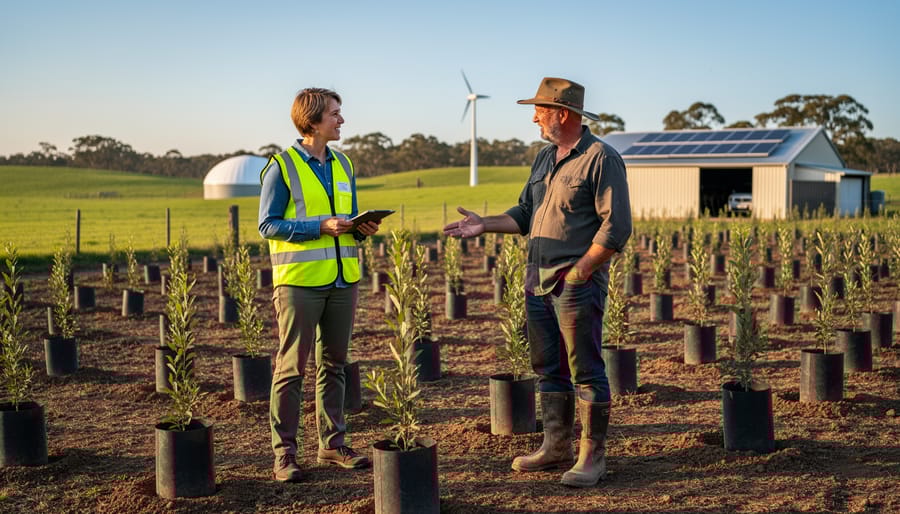
Carbon offsets have shifted from abstract corporate pledges to tangible local action across Australia, with councils and communities proving that climate solutions work best when they’re grounded in place. From the coastal forests of Victoria capturing carbon while creating jobs, to dairy farms in Western Australia turning waste into renewable energy, these real-world examples demonstrate how offset programs deliver measurable environmental and economic benefits.
Australian local governments are leading this transformation by investing in native revegetation projects that restore biodiversity, partnering with agricultural producers to reduce methane emissions, and supporting bioenergy facilities that simultaneously tackle waste management and energy generation. These aren’t distant, questionable offset schemes in faraway countries. They’re verifiable projects in our own backyard, creating employment, strengthening regional economies, and building community resilience while addressing climate change.
The beauty of local carbon offset initiatives lies in their diversity and adaptability. A metropolitan council might fund conservation projects in regional areas, while rural shires develop agricultural carbon programs that directly benefit local farmers. Innovative partnerships are emerging where councils invest in community-scale renewable energy infrastructure, generating both carbon credits and tangible energy security.
Understanding these practical examples reveals a clear pathway forward. Carbon offsets, when designed with transparency and local benefit in mind, become powerful tools for climate action that communities can see, measure, and celebrate. The following case studies showcase how Australian councils are turning climate commitments into on-ground outcomes.
Why Local Councils Are Stepping Up Where Others Haven’t
Local councils across Australia are proving themselves nimble champions of climate action, stepping into a space where progress at state and federal levels has sometimes stalled. Their secret weapon? They’re closer to the ground, literally and figuratively.
Unlike distant government departments, councils know their communities inside out. When Byron Shire Council develops a carbon offset program, they’re not implementing a one-size-fits-all policy – they’re responding to residents who’ve been calling for action at town meetings, writing emails, and voting for climate-conscious representatives. This direct accountability creates powerful momentum. Councils can’t hide from their constituents; they see them at the shops, at school pick-ups, and at community events.
This proximity translates into practical advantages. Councils control local resources that state governments simply don’t – community land, waste facilities, local reserves, and planning approvals. When Darebin Council in Victoria wanted to invest in renewable energy projects, they could act quickly, cutting through the red tape that often bogs down larger government initiatives. They’re not waiting for permission from Canberra; they’re getting on with it.
The speed advantage is remarkable. While federal policy debates can drag on for years, councils can pilot innovative programs, learn from them, and scale up successful initiatives within electoral terms. They’re testing grounds for climate solutions, proving what works before bigger governments take notice.
Perhaps most importantly, councils are filling a leadership vacuum. When residents feel frustrated by slow national progress on climate change, their local council becomes the accessible face of climate action. Success stories from places like Adelaide Hills Council or Lake Macquarie City Council inspire neighbouring councils to follow suit, creating a ripple effect of climate leadership from the ground up.
This grassroots approach isn’t just feel-good environmentalism – it’s delivering measurable emissions reductions while building community pride and resilience. Local governments are showing that waiting for someone else to act simply isn’t necessary when you’ve got the tools, the mandate, and the motivation right in your own backyard.

Tree Planting and Urban Greening Programs That Actually Deliver
Melbourne’s Urban Forest Strategy
The City of Melbourne has set a cracking example for urban carbon offsetting through its visionary Urban Forest Strategy, launched in 2012 with the ambitious goal of increasing tree canopy cover from 22 percent to 40 percent by 2040. This isn’t just about beautifying the city—it’s a powerful climate action initiative that tackles multiple environmental challenges simultaneously.
The program has already planted more than 3,000 trees annually, with each mature tree capable of sequestering approximately 20 kilograms of carbon dioxide per year while simultaneously combating the urban heat island effect that sees Melbourne’s CBD temperatures soar up to 4 degrees hotter than surrounding suburbs. This strategic approach to urban green infrastructure demonstrates how local councils can deliver practical carbon offsets while improving liveability.
What makes Melbourne’s approach particularly effective is its community engagement component. Through initiatives like the “email a tree” program, residents can report trees needing attention, fostering genuine connection between locals and their urban forest. The council also provides free street trees to residents and businesses, removing financial barriers to participation.
The measurable benefits extend beyond carbon sequestration. The expanded canopy reduces stormwater runoff, improves air quality, and creates habitat corridors for native wildlife. Early results show the strategy is on track, with tree canopy coverage steadily increasing and heat reduction measurements confirming cooler streetscapes. For councils nationwide seeking replicable carbon offset models, Melbourne’s approach proves that strategic tree planting delivers multiple environmental dividends while building community resilience and pride.
Regional Council Revegetation Partnerships
Across regional Australia, innovative partnerships between local councils and landholders are transforming degraded landscapes into thriving carbon sinks while reconnecting fragmented ecosystems. These collaborations demonstrate how strategic revegetation projects can deliver multiple environmental benefits beyond carbon sequestration.
The Northern Rivers region in New South Wales showcases this approach brilliantly. Byron Shire Council partnered with dozens of local landholders to establish native vegetation corridors across 500 hectares of previously cleared farmland. The project not only captures an estimated 15,000 tonnes of carbon dioxide annually but also creates vital wildlife corridors connecting remnant rainforest patches. Participating farmers receive ongoing support through free native seedlings, fencing materials, and technical advice, making environmental stewardship financially viable for rural properties.
Similarly, the Goulburn Broken Catchment Management Authority in Victoria coordinates large-scale revegetation programs that bring together multiple councils and landholders. Their Carbon Farming Initiative encourages farmers to dedicate marginal land to native vegetation while earning Australian Carbon Credit Units. One participating dairy farmer near Benalla transformed 40 hectares of erosion-prone hillside into a biodiverse native woodland, generating passive income from carbon credits while reducing farm maintenance costs.
The beauty of these regional partnerships lies in their flexibility. Councils provide coordination, expertise, and often seed funding, while landholders contribute land and ongoing stewardship. The Sunshine Coast Council’s Landholder Environment Grants program has supported over 200 revegetation projects, collectively planting more than 180,000 native trees and shrubs across private properties.
These success stories prove that carbon offset programs needn’t be complex or expensive. By leveraging existing landholder networks and providing practical support, regional councils create lasting environmental legacies while engaging communities in meaningful climate action that benefits everyone.
Turning Council Waste Into Clean Energy and Carbon Credits
Landfill Gas Capture Projects
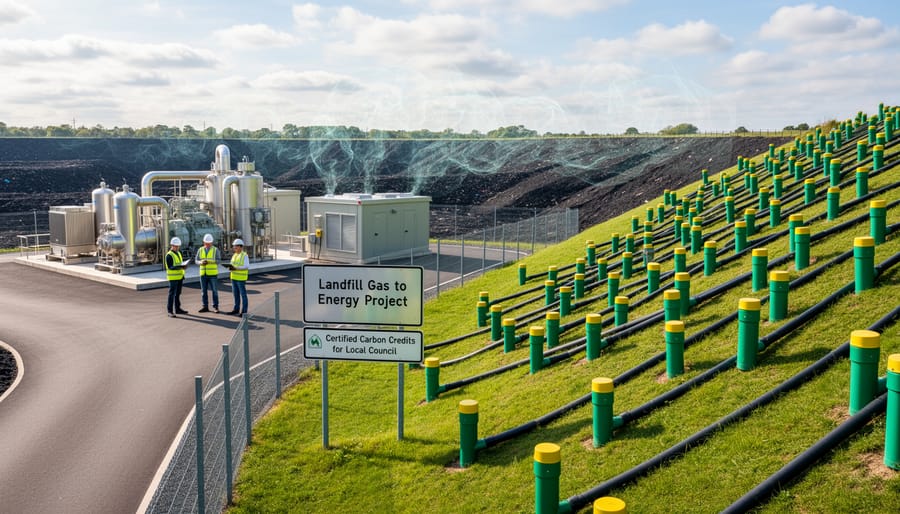
Across Australia, forward-thinking councils are transforming an environmental challenge into a renewable energy opportunity through landfill gas capture projects. These initiatives tackle methane emissions head-on while generating clean electricity for thousands of homes.
The City of Greater Geelong’s Lara Resource Recovery Centre stands as a shining example of what’s possible. Since implementing their gas capture system, the facility collects methane produced by decomposing waste and converts it into enough electricity to power approximately 2,500 homes annually. This single project prevents around 26,000 tonnes of carbon dioxide equivalent from entering the atmosphere each year, whilst simultaneously reducing the community’s reliance on fossil fuel-based electricity.
Similarly, the Western Sydney Regional Organisation of Councils operates an impressive landfill gas project at the Erskine Park facility. Their system captures methane from waste decomposition and feeds it directly into a generator, producing renewable electricity that’s fed back into the grid. The beauty of this approach lies in its dual benefit: stopping a potent greenhouse gas from escaping whilst creating a valuable energy resource.
Brisbane City Council’s Chandler Waste Management Facility also demonstrates the potential of this technology. Their gas-to-energy plant has been operating for years, capturing methane that would otherwise be 25 times more potent than carbon dioxide as a greenhouse gas.
What makes these projects particularly compelling is their financial sustainability. The electricity generated creates ongoing revenue streams, helping councils offset operational costs whilst delivering genuine environmental outcomes. For councils considering carbon offset initiatives, landfill gas capture represents a practical, proven solution that addresses climate change whilst supporting the transition toward renewable energy. These success stories show that with commitment and appropriate infrastructure, turning waste into watts is both environmentally responsible and economically sensible.
Organic Waste Bioenergy Initiatives
Australian councils are pioneering impressive circular economy models by transforming everyday rubbish into valuable renewable energy and carbon offsets. These organic waste bioenergy initiatives demonstrate how local governments can turn a mounting waste problem into a climate solution while serving their communities.
The City of Sydney’s innovative organics processing facility in Kemps Creek stands as a shining example. This facility diverts approximately 25,000 tonnes of food and garden waste from landfill each year, processing it into nutrient-rich compost and capturing methane that would otherwise escape into the atmosphere. The captured biogas powers the facility itself, with excess energy fed back into the grid. By preventing decomposition in landfill conditions, this single operation avoids thousands of tonnes of CO2-equivalent emissions annually, generating verified carbon offsets that contribute to the council’s ambitious carbon neutrality goals.
In South Australia, the City of Salisbury has operated one of Australia’s longest-running green waste processing programs. Their facility collects organic waste from over 40,000 households, transforming it into high-quality compost sold back to the community at affordable prices. The closed-loop system captures biogas for electricity generation while the finished compost helps local gardens and farms sequester additional carbon in healthy soils. This model has inspired neighbouring councils to establish similar programs, creating a regional network of organic processing facilities.
The ACT government has taken things further by implementing a comprehensive organics recovery strategy across all Canberra suburbs. Their three-bin system diverts food scraps and garden organics to a dedicated processing facility where anaerobic digestion creates biogas for renewable energy. Importantly, the carbon offsets generated through these activities are carefully measured and verified, providing transparent evidence of environmental benefits while reducing landfill pressure and methane emissions.
Agricultural Land Management Programs Councils Are Supporting
Soil Carbon Incentive Schemes
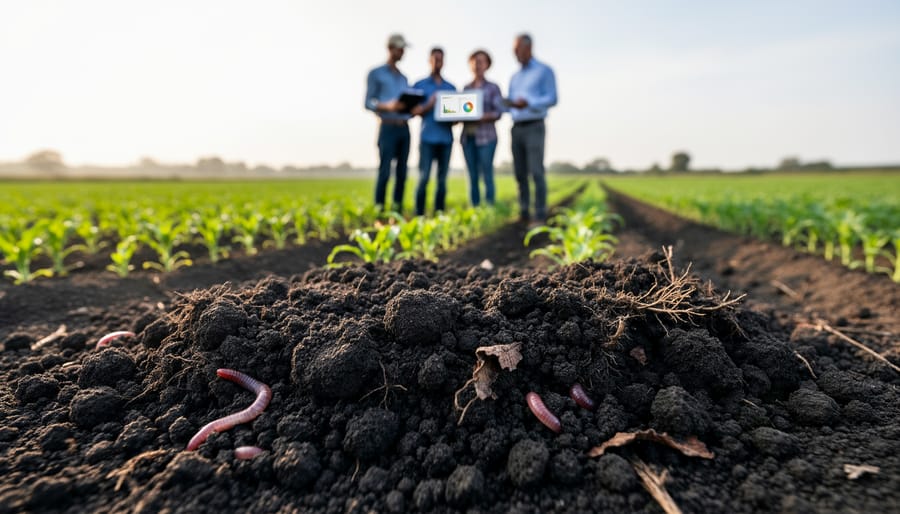
Australian councils are increasingly partnering with farmers to transform agricultural land into powerful carbon sinks through innovative incentive schemes. These programs reward growers for adopting practices that lock carbon away in soil while simultaneously boosting farm productivity—a genuine win-win for climate and agriculture.
The Goulburn Broken Catchment in Victoria showcases how this works in practice. Local farmers participating in the regional soil carbon sequestration program have switched to minimal tillage, cover cropping, and strategic grazing rotations. These changes don’t just trap carbon—they’ve improved soil health, increased water retention during droughts, and reduced input costs. One dairy farmer reported saving thousands annually on fertilizer while seeing pasture productivity jump by 15 percent.
In New South Wales, the Hunter Region councils have developed a soil carbon registry connecting farmers with carbon credit markets. This program provides technical support and financial incentives for adopting regenerative agriculture practices. Participating wheat farmers have documented significant increases in soil organic matter within just three years, translating to better yields and additional income from carbon credits.
The brilliance of these schemes lies in their ripple effects. Beyond carbon storage, healthier soils mean more resilient farms that can weather extreme weather events—increasingly important as climate impacts intensify. These programs prove that fighting climate change doesn’t require sacrificing productivity. Instead, they demonstrate how environmental stewardship and agricultural prosperity can grow hand-in-hand, creating landscapes that feed both people and the planet’s future.
Council-Supported Carbon Farming Cooperatives
Across rural Australia, local councils are breaking down barriers that once kept smaller farming operations out of carbon markets. These council-supported cooperatives are transforming how regional communities participate in carbon farming initiatives, proving that you don’t need thousands of hectares to make a difference.
The Central West Councils Carbon Cooperative in New South Wales showcases this approach brilliantly. Seven regional councils pooled resources to establish a shared technical support service, helping farmers navigate the complexities of carbon credit registration. What once required expensive consultants and complicated paperwork now happens through free council-run workshops and one-on-one guidance. Over 120 farming families have joined since 2021, collectively sequestering carbon across properties ranging from 50 to 500 hectares.
Similarly, the Limestone Coast Soil Carbon Network in South Australia brought together 45 farmers who individually couldn’t afford the verification costs. By aggregating their projects, these producers share measurement expenses and achieve economies of scale that make carbon farming financially viable. The local council coordinates quarterly field days where farmers swap practical tips about soil management practices that boost both carbon storage and productivity.
These cooperatives demonstrate that council leadership can democratise carbon markets. By handling administrative burdens and creating economies of scale, local governments ensure carbon farming benefits flow beyond large corporate operations to everyday Australian farmers who care for the land.
How Councils Are Investing in External Offset Projects
When local renewable energy generation can’t meet ambitious emissions targets, forward-thinking Australian councils are turning to strategic investments in certified carbon offset projects beyond their boundaries. This approach demonstrates smart regional thinking and collaborative problem-solving.
The City of Sydney has pioneered this strategy through its groundbreaking partnership with Flow Power, purchasing renewable energy from wind farms across New South Wales and South Australia. This agreement ensures 100% of the council’s electricity comes from clean sources, demonstrating how urban centres can support rural renewable energy development while meeting their own sustainability goals.
Interstate partnerships are proving particularly effective. Several Victorian councils have pooled resources to invest in large-scale solar farms in regional Queensland, where abundant sunshine makes generation more efficient. This collaborative approach reduces individual council costs while maximising environmental impact, creating a win-win situation for participating communities.
The Northern Adelaide Waste Management Authority offers another compelling success story. Beyond managing local organic waste, they’ve invested in biogas capture projects at multiple regional facilities, supporting methane reduction across South Australia. This diversified approach spreads risk while multiplying benefits.
Western Australian councils are exploring investment in Indigenous-led savanna burning programs in the Northern Territory. These partnerships not only offset carbon emissions but also support traditional land management practices and create meaningful employment in remote communities.
These external investments complement rather than replace local initiatives. They acknowledge practical limitations while maintaining commitment to climate action. By supporting renewable energy and carbon reduction projects wherever they’re most viable, councils demonstrate leadership that inspires businesses and residents. The key is ensuring transparency, verification standards, and genuine additional environmental benefit beyond business-as-usual scenarios.
Making It Work: Policy Tools Councils Actually Use
Funding and Revenue Models
Australian councils are getting creative with funding their carbon offset programs, proving that financial sustainability and environmental action can go hand-in-hand. The good news? There’s no one-size-fits-all approach, and successful councils are mixing traditional and innovative revenue streams.
Many councils integrate offset program costs into existing rate structures, allocating a small percentage of general revenue to environmental initiatives. This approach provides stable, predictable funding without requiring separate budget allocations. Others have successfully secured federal and state government grants, particularly through programs like the Australian Renewable Energy Agency and various state-based climate action funds.
Carbon credit sales present an exciting revenue opportunity. Councils generating Australian Carbon Credit Units through forestry or landfill gas capture projects can sell these credits on the voluntary or compliance markets, creating a self-funding cycle. The City of Melbourne, for instance, has demonstrated how offset programs can become revenue-positive over time.
Innovative partnerships are also changing the game. Some councils partner with local businesses seeking to offset their emissions, creating win-win arrangements where companies fund tree planting or renewable energy projects in exchange for recognition and credits. Others collaborate with universities for research grants or form regional alliances to share costs and expertise.
The most successful councils blend multiple funding sources, ensuring their offset programs remain resilient and scalable as ambitions grow. This diversified approach means environmental action doesn’t depend on any single budget line surviving political changes.
Community Engagement Approaches
Getting the community on board transforms carbon offset programs from council initiatives into community-wide movements. Successful councils have discovered that engagement works best when it’s hands-on and inclusive.
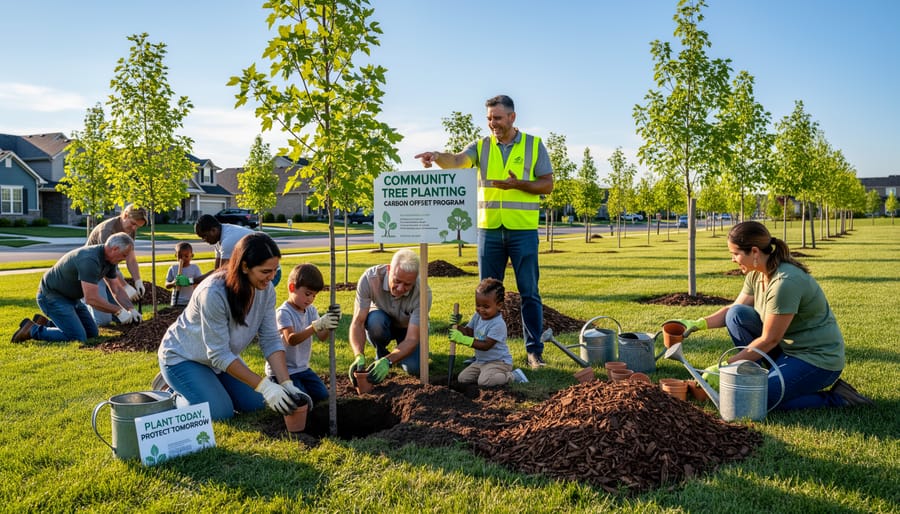
The City of Melbourne runs regular volunteer tree planting days that have seen thousands of residents rolling up their sleeves to plant native species across parks and streetscapes. These events create genuine connection – participants literally dig into climate action while meeting like-minded neighbours. The council provides the seedlings, tools, and morning tea, making it easy for anyone to contribute.
Business offset programs offer another powerful engagement pathway. Byron Shire Council partnered with local businesses to develop a voluntary carbon offset scheme where cafes, accommodation providers, and shops can calculate their emissions and invest in council-managed revegetation projects. Participating businesses receive recognition through window decals and promotional materials, turning climate action into a competitive advantage. It’s proved particularly popular with tourism operators keen to appeal to environmentally conscious visitors.
Educational workshops help residents understand their carbon footprint and local offset opportunities. Councils like Moreland have run community sessions explaining how household solar installations, composting programs, and local tree planting all contribute to carbon reduction. These workshops demystify carbon offsets, showing residents they’re not just abstract concepts but practical actions anyone can support.
The key across all these approaches is making participation accessible, visible, and rewarding – transforming climate concern into concrete community action.
What’s Working and What’s Not (Lessons From the Field)
Australian councils embarking on carbon offset programs have learned valuable lessons that can help others avoid common stumbling blocks and fast-track their success.
The most significant challenge councils face is community scepticism. Several Victorian councils discovered that residents questioned whether offset projects truly delivered environmental benefits or were simply “greenwashing” exercises. The solution? Transparency became their greatest ally. Councils that published detailed annual reports showing verified emission reductions, independent audits, and clear methodology gained community trust. As one sustainability officer from Western Sydney put it: “We stopped talking in abstract terms and started showing people the trees we planted, the biogas we captured, and the tonnes of carbon we measured.”
Another common pitfall involves underestimating project timelines and administrative burden. Many councils initially assumed offset programs would be straightforward, only to discover that establishing verification protocols, engaging stakeholders, and managing ongoing monitoring required dedicated staff resources. Smaller regional councils struggled particularly with this aspect. The most successful approach has been forming regional partnerships, where neighbouring councils pool resources and expertise to share the administrative load.
Technical capacity gaps also presented hurdles. Not every council has in-house expertise to assess bioenergy feasibility or forestry carbon sequestration rates. Progressive councils addressed this by partnering with universities, engaging specialist consultants for initial assessments, and investing in staff training programs.
The standout success factor across all councils has been starting small and building momentum. Rather than launching ambitious, complex programs immediately, councils that piloted smaller projects, demonstrated measurable results, and gradually expanded their efforts achieved better outcomes. This approach also made securing council budget approvals considerably easier, as elected members could see evidence-based returns on investment.
What’s working brilliantly is the integration approach, where offset projects deliver multiple community benefits beyond carbon reduction—creating local jobs, improving air quality, enhancing biodiversity, and reducing waste management costs simultaneously.
Local councils across Australia are demonstrating that carbon offset programs don’t have to be complicated or distant from everyday life. From the Blue Mountains to Adelaide Hills, these inspiring examples prove that practical, community-focused climate action is not only possible but already happening in our own backyards. The beauty of these initiatives lies in their diversity – whether it’s revegetation projects creating new habitats, bioenergy facilities turning waste into power, or supporting agricultural improvements that benefit local farmers while sequestering carbon.
The momentum is building, and it’s an exciting time for local climate action. These councils have shown the way forward, creating blueprints that others can adapt and improve upon. If you’re passionate about climate solutions, now’s the time to engage with your own council. Attend meetings, ask questions about their environmental strategies, and champion carbon offset programs in your community. Every conversation matters, every voice counts, and together we’re proving that meaningful climate action starts at home. The future of carbon offsetting in Australia is local, practical, and full of possibility.