
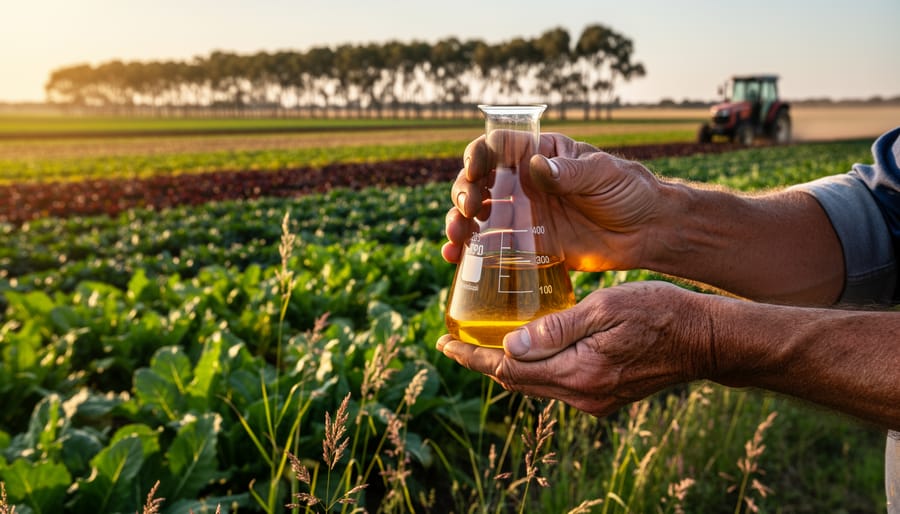
The future of fuel is growing beneath our feet, but not in the way you might think. While conventional biofuels have promised environmental salvation for decades, they’ve delivered deforestation, monocultures, and questionable carbon math. The difference? Regenerative agriculture is rewriting the rules entirely.
Picture a Queensland grain farm where cover crops become biodiesel feedstock while simultaneously rebuilding soil carbon, increasing water retention, and providing habitat corridors for native species. This isn’t theoretical greenwashing – it’s happening right now across Australian landscapes, proving that biofuel production can heal ecosystems rather than harm them.
Regenerative biofuels emerge from farming systems designed to mimic natural processes. Instead of clearing land for single-crop fuel plantations, these systems integrate energy crops into diverse rotations that restore degraded soils, eliminate synthetic inputs, and capture more carbon than they release. The crops themselves – native grasses, perennial oilseeds, and agricultural residues previously burned or wasted – become valuable resources without displacing food production or natural habitats.
Australia stands at a remarkable crossroads. Our vast agricultural landscapes, combined with world-leading regenerative farming innovations, position us perfectly to demonstrate how bioenergy can contribute to climate solutions rather than create new problems. From Western Australian farmers converting sheep station waste into renewable diesel to Victorian operations growing perennial energy crops on marginal land, the evidence is mounting.
This isn’t about choosing between feeding people and fueling vehicles, or between conservation and agriculture. Regenerative biofuels dissolve these false binaries, offering a pathway where environmental restoration and energy production strengthen each other. The question isn’t whether this approach works – it’s how quickly we can scale what’s already succeeding.
The Biofuel Paradox: When Green Energy Wasn’t So Green
When biofuels first burst onto the scene in the early 2000s, they were heralded as the silver bullet for our energy woes. Finally, we could power our vehicles with crops instead of fossil fuels! But as we’ve learned the hard way, not all green solutions are created equal.
The reality turned out to be more complicated than the glossy brochures suggested. Across the globe, vast tracts of land were converted to monoculture crops like corn and canola, grown specifically for fuel production. These fields, stretching as far as the eye could see, looked productive on the surface. Underneath, however, the soil was crying out for help.
Traditional biofuel farming relied heavily on the same industrial agriculture practices that had been degrading farmland for decades. Chemical fertilisers pumped nitrogen into depleted soils, while pesticides knocked out beneficial insects along with the pests. Water resources were stretched thin—some crops required irrigation that simply wasn’t sustainable in water-scarce regions like much of Australia. Year after year of growing the same crop stripped nutrients from the soil, creating a dependency on ever-increasing chemical inputs just to maintain yields.
Then there was the troubling “food versus fuel” debate. As prime agricultural land shifted to biofuel production, food prices spiked in some regions, hitting vulnerable communities hardest. The environmental accounting didn’t stack up either. When researchers conducted thorough life cycle assessment studies, they discovered that some first-generation biofuels barely reduced greenhouse gas emissions compared to petroleum—and in some cases, when land-clearing was factored in, they were actually worse.
The lesson? Good intentions aren’t enough. We needed a fundamentally different approach—one that worked with nature rather than against it, building soil health while producing clean energy. That’s precisely where regenerative agriculture enters the picture, offering a genuine path forward that doesn’t compromise our food security or environmental future.
What Makes Regenerative Agriculture Different
The Soil Carbon Connection
Here’s the real game-changer: when biofuel crops are grown using regenerative agriculture practices, they don’t just reduce emissions—they can actually pull carbon out of the atmosphere and lock it away in the soil. This transforms biofuels from a carbon-neutral alternative into something far more powerful: a carbon-negative solution.
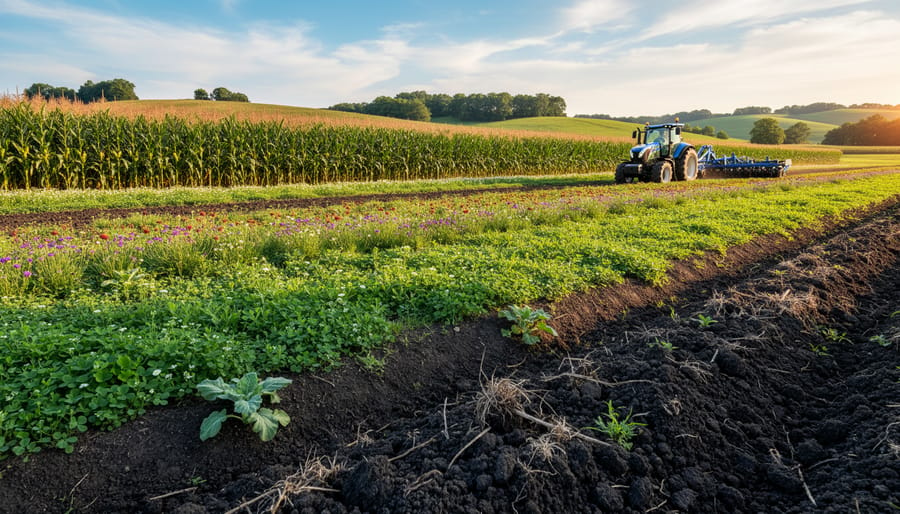
The science is straightforward. Regenerative farming techniques like minimal tillage, diverse crop rotations, and cover cropping encourage plants to develop deeper root systems. As these roots grow and decompose, they deposit carbon deep underground where it can remain for decades or even centuries. The living soil ecosystem, rich with microbes and fungi, acts like a massive carbon sponge. In practical terms, a well-managed regenerative farm growing oilseed crops for biofuel can sequester anywhere from half a tonne to several tonnes of carbon per hectare each year.
This means the carbon captured in the soil can exceed the emissions released when the biofuel is eventually burned. It’s a complete reversal of the traditional energy equation—instead of adding carbon to the atmosphere, we’re actively removing it.
Australian trials have shown particularly promising results with perennial native grasses and deep-rooted oilseeds. One Victorian farm growing regenerative canola for biodiesel measured soil carbon increases of 1.2 tonnes per hectare annually over five years—effectively making their fuel production process a carbon sink rather than a source.
Beyond Monocultures: Integrated Crop Systems
Traditional farming often relies on single-crop fields that deplete soil nutrients and require heavy chemical inputs. Regenerative biofuel production takes a completely different approach, using diverse planting strategies that actually strengthen the land while growing fuel feedstocks.
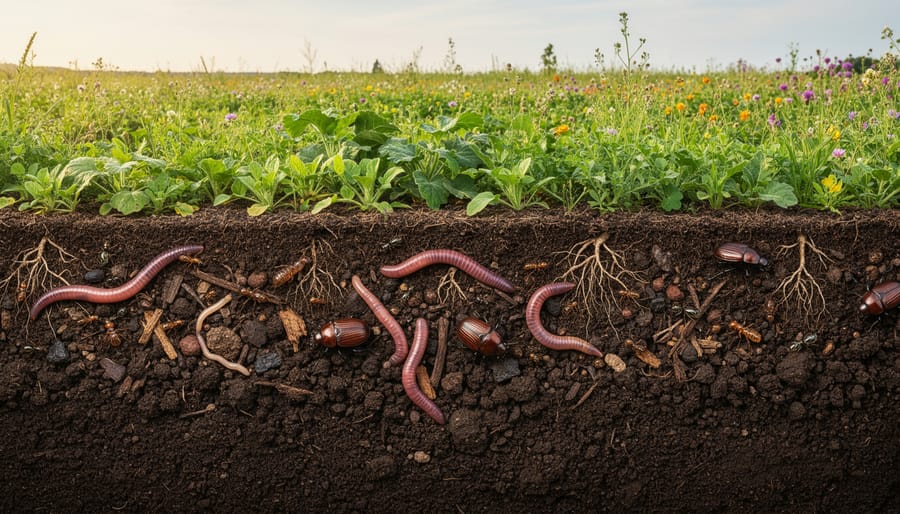
Think of it as farming with nature, not against it. Intercropping combines multiple species in the same field—perhaps native grasses alongside legumes that fix nitrogen naturally. These plant partnerships create healthier soil ecosystems that need fewer fertilisers and resist pests better than monocultures ever could.
Cover crops play a starring role too. Between main harvests, farmers plant species that protect bare soil, prevent erosion, and add organic matter. When tilled back into the ground, these cover crops become natural fertiliser for the next biofuel crop. It’s brilliant simplicity that aligns perfectly with circular bioeconomy principles.
Several Australian farms are already demonstrating this approach works commercially. In Queensland, producers are integrating perennial grasses with traditional grain crops, creating year-round ground cover whilst producing consistent biomass yields. The results speak for themselves: improved water retention, increased biodiversity, and reliable feedstock production that benefits both the bottom line and the environment.
Australian Success Stories: Farms Leading the Charge
Across Australia, innovative farmers are proving that regenerative agriculture and bioenergy production aren’t just compatible—they’re creating a blueprint for the future. These pioneers are transforming their land while generating clean energy, and their results speak volumes.
In the Northern Rivers region of New South Wales, Bangalow Sweet Potato Farm has become a standout example of what’s possible when regenerative principles meet bioenergy innovation. The farm cultivates sweet potatoes and other root vegetables using cover cropping and minimal tillage techniques, building soil organic matter year after year. What sets them apart is their on-site anaerobic digester, which processes crop residues and food waste into biogas for farm operations. Since implementing this system three years ago, they’ve documented a 3.2% increase in soil carbon levels—that’s roughly 12 tonnes of CO2 equivalent captured per hectare. Even better, their sweet potato yields have jumped by 18%, and they’ve slashed their reliance on grid electricity by 65%. Farm manager Sarah Chen explains it simply: “We’re feeding the soil, the soil feeds our crops, and the leftovers power our operations. It’s a closed loop that just keeps getting better.”
Further west, the Regenerative Grains Collective near Dubbo represents a different approach. This cooperative of twelve wheat and canola farmers has shifted entirely to regenerative practices—diverse crop rotations, livestock integration, and zero synthetic fertilisers. The real innovation lies in their partnership with a regional biofuel processor. They’re growing carinata, a non-food oilseed crop that thrives in their climate and serves as an excellent break crop in rotation. The seeds are pressed for sustainable aviation fuel, while the protein-rich meal feeds their cattle. After five years, participating farms have recorded soil organic carbon increases averaging 0.4% annually, water infiltration rates have improved by 40%, and they’re producing 800 litres of biofuel feedstock per hectare without competing with food production. As collective spokesperson Tom Bradley puts it, “We’re not choosing between farming and the environment anymore—we’re doing both, and doing them better.”
Down in Victoria’s Gippsland region, Dairy Energy Australia demonstrates how existing livestock operations can transform waste into wealth. This dairy farm collective converts manure and agricultural residues into biomethane, generating enough renewable gas to power 450 local homes while producing nutrient-rich digestate that returns to pastures. Their soil tests show remarkable improvements in microbial activity and nutrient cycling, reducing their need for imported fertilisers by half.
These aren’t experimental projects—they’re working farms generating real income while healing the land. Their success proves that regenerative bioenergy isn’t just environmentally sound; it’s economically smart and ready for wider adoption across Australia.
The Supply Chain Revolution: From Farm Gate to Fuel Tank
Local Processing Hubs: Keeping Value in Rural Communities
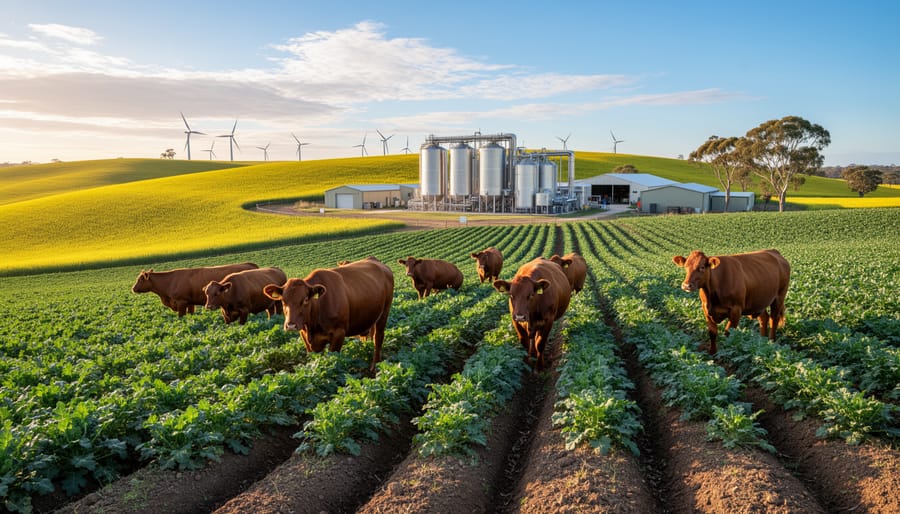
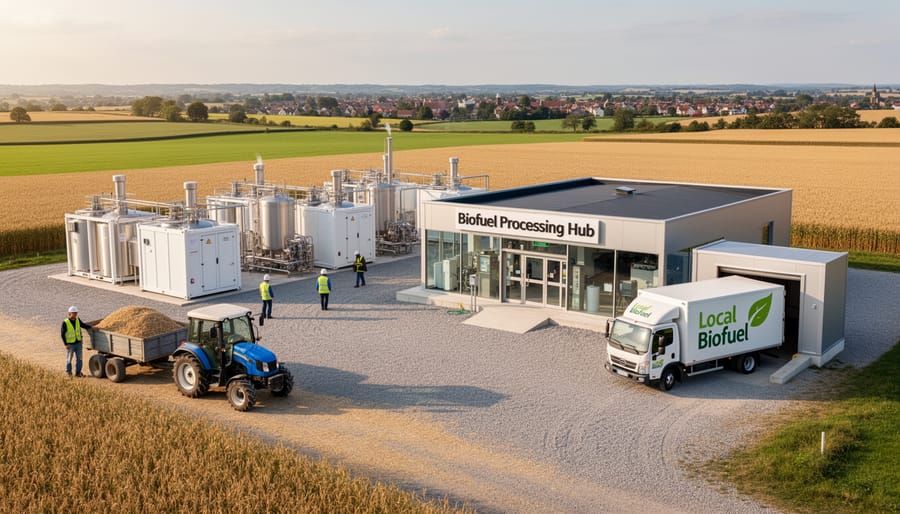
The beauty of decentralized processing is how it flips the traditional agricultural model on its head. Rather than trucking raw materials hundreds of kilometres to distant facilities, regional processing hubs transform feedstock right where it’s grown, cutting transport emissions dramatically while keeping economic benefits firmly in local hands.
Take the Southern Highlands BioCo-op in New South Wales, where twelve farms collectively operate a mobile processing unit. This shared infrastructure converts crop residues and cover crops into renewable diesel within 50 kilometres of harvest. The result? Transport emissions reduced by 75 percent compared to conventional supply chains, and processing profits distributed among participating farmers rather than flowing to distant corporations.
These hubs create diverse employment opportunities beyond farming itself. Processing technicians, quality control specialists, logistics coordinators, and maintenance crews all find work in their own communities. It’s genuine economic resilience built from the ground up.
The model works particularly well for Australia’s regional areas, where distance has always been a challenge. Mobile processing units can service multiple farms on rotation, making the technology accessible to smaller operations that couldn’t justify a permanent facility. This flexibility means even family-run properties can participate in the biofuel economy while maintaining their regenerative practices.
When value stays local, communities thrive. That’s not just good environmental sense—it’s sound economics with a conscience.
Waste Streams Become Resources
In regenerative biofuel systems, nothing goes to waste—every byproduct becomes someone else’s treasure. When oilseed crops are processed for biodiesel, the remaining meal provides protein-rich livestock feed, reducing demand for imported soy. Leftover plant matter from ethanol production transforms into high-quality compost that enriches soil on nearby farms, closing the nutrient loop. Some Australian facilities capture methane from processing operations to generate electricity, powering their own operations while feeding surplus energy back to the grid. These resource recovery systems demonstrate practical circular economy principles in action. A Queensland biofuel producer partnered with local dairy farmers, supplying them with nutrient-dense feed byproducts while purchasing their waste oils for conversion—creating a closed-loop relationship that strengthens both businesses. This approach transforms linear “take-make-waste” thinking into regenerative cycles where yesterday’s outputs become tomorrow’s inputs, building resilience throughout regional communities.
The Economic Case: Why This Model Works for Farmers
Let’s talk dollars and sense, because sustainable farming needs to be profitable farming. The financial case for regenerative biofuel production rests on three pillars: diversified income, long-term soil investment, and access to premium markets.
The upfront investment varies considerably depending on scale. Small-scale operations might redirect existing cover crops toward biofuel production with minimal additional outlay, while larger enterprises investing in dedicated processing equipment could face initial costs between $50,000 and $200,000. However, these figures tell only part of the story.
Unlike conventional monoculture approaches, regenerative biofuel systems create multiple revenue streams simultaneously. Farmers aren’t just growing fuel—they’re improving soil health, which increases productivity of food crops grown in rotation. They’re potentially accessing carbon credit systems that reward carbon sequestration. And they’re producing premium products for markets increasingly willing to pay more for demonstrably sustainable fuels.
Take the example of a Western Australian mixed farm that integrated perennial grasses for biofuel production. Within three years, they reported 30 percent higher yields in adjacent wheat crops due to improved soil structure, alongside steady biofuel income. The diversification also provided risk management—when grain prices dropped, biofuel contracts maintained cash flow.
The premium market opportunity shouldn’t be underestimated. Australian transport companies and manufacturers seeking genuine sustainability credentials are actively sourcing regeneratively produced biofuels, often paying 15-25 percent above standard rates. This premium reflects the verified environmental benefits—carbon negative production, biodiversity enhancement, and water quality improvements.
Risk mitigation comes through diversification itself. Rather than betting everything on a single crop vulnerable to market fluctuations and climate variability, farmers spread income across complementary enterprises that actually strengthen each other. The soil becomes the investment that keeps delivering returns.
What You Can Do: Supporting Regenerative Biofuel in Australia
The good news? You don’t need to wait for governments or major corporations to drive the regenerative biofuel revolution. Everyday Australians, businesses, and community groups can make meaningful contributions right now, and the pathways are clearer than you might think.
If you’re a consumer interested in supporting this sector, start by investigating whether your local fuel stations offer biofuel blends. Many service stations across Australia now stock E10 (10% ethanol blend), and while not all ethanol comes from regenerative sources yet, choosing these blends signals market demand for biofuel alternatives. You can also contact biofuel producers directly to ask about their feedstock sourcing practices—consumer questions create commercial pressure for transparency and better standards.
For businesses seeking renewable energy solutions, consider partnering with Australian companies pioneering regenerative biofuel production. Several enterprises now offer carbon-neutral fuel options derived from agricultural waste and purpose-grown crops on regenerated land. Transport companies, in particular, have excellent opportunities to trial these fuels in their fleets, creating case studies that encourage wider adoption. The Federal Government’s Bioenergy Roadmap provides resources for businesses exploring renewable fuel transitions.
Investors looking to support sustainable agriculture can explore opportunities in regenerative farming enterprises that produce biofuel feedstocks. The Australian Regenerative Agriculture Alliance connects investors with verified regenerative projects, while platforms like Farmers2Founders showcase innovative agri-tech ventures including bioenergy initiatives.
Policy advocates shouldn’t underestimate their influence either. Writing to local MPs about supporting renewable fuel mandates, attending public consultations on energy policy, and joining organizations like the Bioenergy Australia network amplifies the voice calling for stronger regenerative biofuel support. State governments are increasingly receptive to renewable energy proposals, particularly when backed by community support.
Educational institutions and community groups can also contribute by hosting information sessions about regenerative agriculture and bioenergy. Sharing success stories—like the Queensland sugarcane farms now producing both food and fuel sustainably—helps build public understanding and acceptance. Every conversation, every informed choice, and every letter to decision-makers strengthens Australia’s transition toward truly green energy biofuel systems rooted in regenerative principles.
The convergence of regenerative agriculture and bioenergy represents more than just another renewable energy source—it’s a blueprint for healing our relationship with the land while powering our future. Unlike conventional approaches that force us to choose between production and conservation, this integrated model proves that economic prosperity and environmental restoration can walk hand in hand.
What makes this approach truly transformative is its ripple effect across multiple dimensions of sustainability. When farmers adopt regenerative practices for bioenergy feedstocks, they’re not simply growing fuel—they’re rebuilding soil health, sequestering carbon, restoring water cycles, and creating habitat for native species. Each hectare dedicated to regenerative bioenergy becomes an active participant in landscape restoration rather than another extractive burden on our already strained ecosystems.
For rural Australia, this shift couldn’t come at a more crucial time. Regional communities have long been the backbone of our nation, yet they’ve faced declining populations and economic pressures as traditional agriculture struggles with climate variability. Regenerative bioenergy offers these communities a genuine pathway to resilience, creating diversified income streams, generating local employment, and positioning regional Australia at the forefront of the global clean energy transition.
Australia stands uniquely positioned to lead this revolution. We have the land, the agricultural expertise, the innovation culture, and increasingly, the political will to embrace transformative solutions. The success stories emerging across the country demonstrate that the technology works, the economics stack up, and the environmental benefits are measurable and significant.
The question isn’t whether regenerative bioenergy can work—it’s how quickly we can scale it. Whether you’re a farmer, investor, policymaker, or concerned citizen, there’s a role for you in building this future. The transformation begins now, and it starts with each of us choosing to support systems that regenerate rather than deplete.