
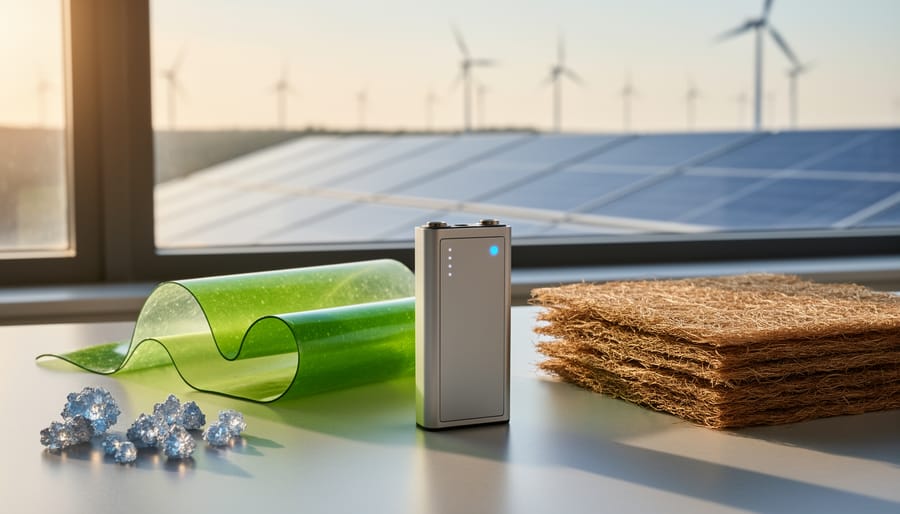
The batteries powering tomorrow’s clean energy grid aren’t being built in traditional factories—they’re growing in laboratories from algae, being woven from plant fibres, and crystallising from seawater minerals. Australia stands at the threshold of an energy storage revolution, where materials once considered waste are becoming the building blocks of our renewable future.
Imagine solar panels that store their own energy in bio-based films, or community batteries constructed from recycled timber derivatives that safely power entire suburbs. These aren’t distant possibilities—they’re emerging realities transforming how we capture and hold renewable energy. The challenge isn’t just generating clean electricity anymore; it’s keeping that power available when the sun sets and the wind drops. That’s where innovative materials are changing everything.
From Western Australia’s lithium reserves reimagined through closed-loop recycling, to Queensland laboratories growing organic semiconductors that could replace rare earth metals, Australian researchers and companies are pioneering storage solutions that work with nature rather than against it. These breakthroughs address the fundamental tension in our energy transition: how to store intermittent renewable power without creating new environmental problems.
The materials revolution in energy storage means batteries that decompose safely, last decades longer, cost less to produce, and can be manufactured locally. For environmentally conscious Australians, industry professionals, and policymakers, understanding these innovations isn’t just fascinating—it’s essential for shaping the sustainable energy landscape we’ll inhabit for generations.
Why Energy Storage Is the Missing Piece in Australia’s Renewable Puzzle
Australia’s renewable energy revolution is gathering impressive momentum, with solar panels dotting rooftops across the country and wind farms spinning from Tasmania to Queensland. Yet there’s a fundamental challenge holding back our clean energy future: the sun doesn’t always shine, and the wind doesn’t always blow.
This intermittency problem represents the missing piece in our renewable puzzle. When a cloud passes over a solar farm or wind speeds drop, energy generation plummets. Without reliable energy storage solutions, we’re forced to rely on fossil fuel backup generators to keep the lights on during these gaps.
Currently, Australia’s storage capacity lags behind our renewable generation capabilities. Traditional lithium-ion batteries, while useful for short-term storage, face limitations in scale, cost, and environmental impact. Many existing systems can only store energy for a few hours, making them inadequate for managing seasonal variations or extended periods of low renewable generation.
This gap creates an extraordinary opportunity for innovation. Australia needs storage technologies that can capture excess renewable energy during peak production times and release it when demand exceeds supply. We’re talking about solutions that can bridge not just hours, but days or even weeks.
The good news? Australian researchers and companies are rising to this challenge, developing breakthrough materials and systems that could transform how we store clean energy. From advanced thermal storage to innovative biological solutions, these emerging technologies promise to unlock the full potential of our abundant renewable resources, ensuring reliable, sustainable power for all Australians while accelerating our transition away from fossil fuels.
The Game-Changing Materials Transforming Energy Storage
Organic Flow Batteries: Storing Energy in Liquid Form
Imagine batteries that store renewable energy in liquids as harmless as the compounds found in plants. That’s the promise of organic flow batteries, an innovation transforming how we think about large-scale energy storage. Unlike conventional batteries that rely on metals like lithium or cobalt, these systems use organic molecules dissolved in water-based solutions, flowing through electrochemical cells to store and release electricity on demand.
The beauty of this technology lies in its simplicity and safety. These organic compounds are carbon-based, often derived from abundant natural sources, making them far less toxic and environmentally damaging than traditional battery materials. When the electrolyte solutions flow through the system, they charge and discharge without degrading quickly, offering the potential for decades of reliable service.
Australian researchers are at the forefront of this exciting field. Teams at institutions including the University of New South Wales have been developing organic flow batteries specifically designed for grid-scale renewable energy storage. Their work focuses on creating cost-effective, non-toxic electrolytes that can store solar and wind energy generated during peak production times, then release it when demand surges or generation drops.
The environmental advantages are compelling. Organic flow batteries eliminate mining impacts associated with lithium extraction, reduce fire risks, and use materials that can be recycled or safely disposed of. They’re also remarkably scalable—simply add more electrolyte solution to increase storage capacity.
Potential applications stretch from stabilizing electricity grids in regional communities to backing up commercial solar installations. For remote Australian properties and industrial operations, these batteries offer a practical pathway to energy independence. As the technology matures and costs decrease, organic flow batteries could become the backbone of Australia’s renewable energy future, proving that sometimes the most innovative solutions are also the safest and most sustainable.
Salt-Based Thermal Storage: Turning Heat Into Power
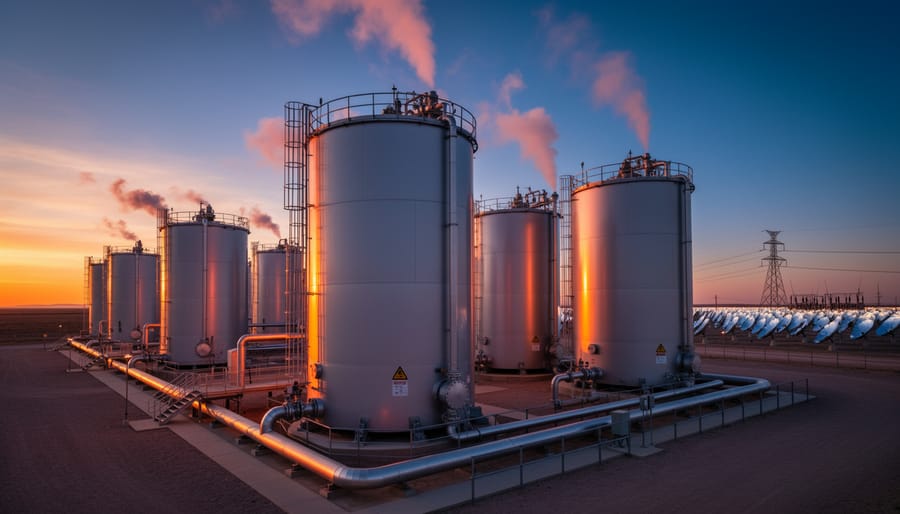
Imagine capturing the sun’s energy during the day and releasing it hours after sunset—that’s exactly what molten salt thermal storage makes possible. This proven technology is transforming how we think about renewable energy reliability, particularly when paired with solar thermal plants.
The concept is beautifully simple: solar collectors heat a mixture of salts to temperatures exceeding 500 degrees Celsius. These liquid salts flow into insulated tanks where they can store energy for up to 15 hours. When electricity is needed, the molten salt generates steam to drive turbines, delivering power well into the evening peak demand period.
Australia is making impressive strides with this technology. The Aurora Solar Energy Project near Port Augusta in South Australia demonstrates the potential brilliantly. When operational, it will store 1,100 megawatt-hours of energy using molten salt, providing eight hours of dispatchable power to 90,000 homes. This means reliable electricity even when the sun isn’t shining—a game-changer for grid stability.
The sustainability advantages are compelling. Unlike lithium batteries that degrade over time, molten salt systems maintain efficiency for decades. The salts themselves are non-toxic, abundant, and fully recyclable. There’s no mining of rare earth minerals or disposal challenges—just simple chemistry doing heavy lifting.
What makes thermal storage particularly attractive for Australia is its compatibility with our abundant solar resources. It bridges the gap between renewable generation and reliable supply, addressing one of the biggest concerns about transitioning to clean energy. As more projects come online, we’re proving that renewable energy can be both sustainable and dependable, turning our sunburnt country’s greatest asset into round-the-clock clean power.
Bio-Derived Supercapacitors: When Nature Meets Technology
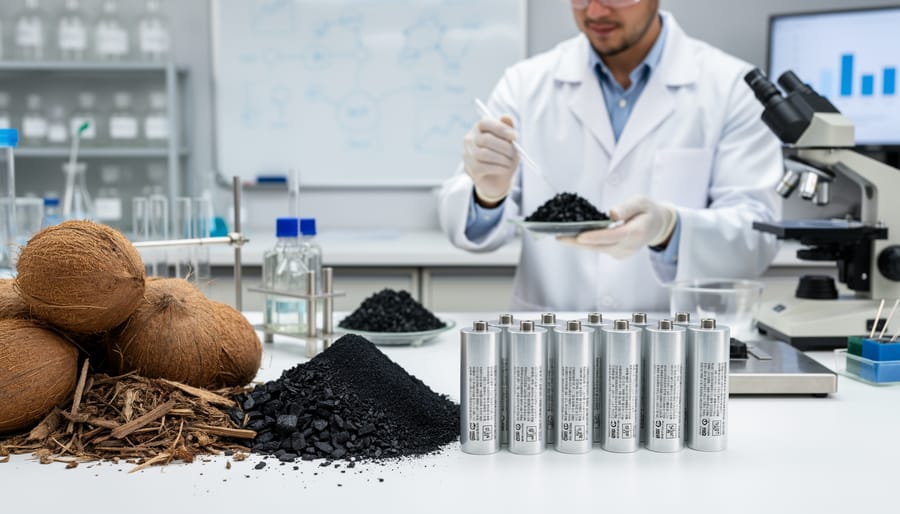
What if yesterday’s crop stubble could power tomorrow’s devices? That’s the brilliant reality unfolding with bio-derived supercapacitors, where discarded organic materials are being transformed into cutting-edge energy storage solutions.
Australian farmers are sitting on a goldmine of potential supercapacitor materials. Hemp fibres, coconut shells, and agricultural waste like wheat husks and sugarcane bagasse are being converted into activated carbon—the key ingredient in high-performance supercapacitors. Through a process called pyrolysis, these natural materials develop the perfect porous structure needed for storing electrical charge, rivalling synthetic alternatives at a fraction of the environmental cost.
The beauty of these bio-derived supercapacitors lies in their rapid charging capabilities. Unlike traditional batteries that take hours to recharge, supercapacitors can power up in seconds or minutes, making them ideal for applications requiring quick energy bursts. Think farm machinery that needs instant power, renewable energy systems balancing supply fluctuations, or electric vehicles needing rapid top-ups.
Queensland’s macadamia industry recently partnered with researchers to transform their shell waste into supercapacitor electrodes, turning 30,000 tonnes of annual waste into valuable energy storage components. Western Australian grain growers are exploring similar opportunities with wheat chaff, creating circular economy models where nothing goes to waste.
The technology is wonderfully practical for remote Australian communities and farms. These supercapacitors can withstand extreme temperatures better than conventional batteries, handle hundreds of thousands of charge cycles without degrading, and when they finally reach end-of-life, they’re biodegradable. It’s nature-inspired innovation at its finest—taking what the land provides, using it wisely, and returning it safely when done.
Sodium-Ion Batteries: The Abundant Alternative
Sodium-ion batteries are emerging as a game-changer in energy storage, offering a promising alternative to their lithium cousins. Unlike lithium, which requires intensive mining operations, sodium can be extracted from abundant seawater, making it virtually limitless. This simple shift in chemistry delivers significant environmental and economic benefits, particularly for a coastal nation like Australia.
The advantages are compelling: sodium-ion batteries eliminate concerns about resource scarcity and reduce manufacturing costs by up to 30 percent compared to lithium-ion systems. They’re also safer, with lower fire risk, and perform reliably across extreme temperatures—perfect for Australia’s diverse climate zones from the Top End to Tasmania.
Australian innovation is already taking centre stage. Companies like Altech Batteries in Perth are pioneering sodium battery technology with commercial production facilities, while research partnerships between universities and industry are accelerating development. These batteries are finding practical applications in grid-scale storage and off-grid communities, where cost-effectiveness matters most.
For remote Indigenous communities and regional towns, sodium-ion technology offers an affordable pathway to energy independence without the environmental baggage of traditional battery production. As manufacturing scales up locally, Australia is positioned to become a regional leader in this abundant, accessible energy storage solution.
Real Success Stories: Eco-Storage in Action Across Australia
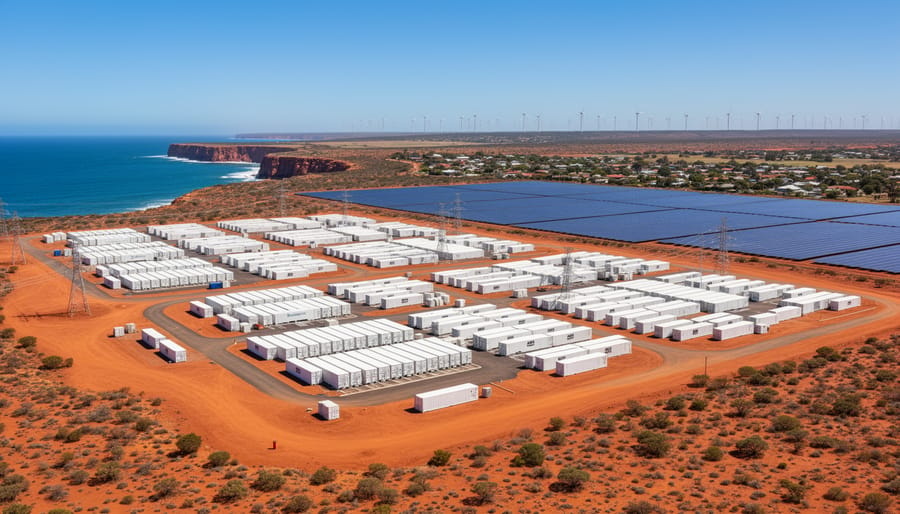
Across Australia, innovative energy storage projects are transforming how communities harness and use renewable power, proving that sustainable solutions deliver real-world results.
In South Australia, the Hornsdale Power Reserve has become a global benchmark for utility-scale battery storage. When the 150-megawatt Tesla battery came online in 2017, it immediately demonstrated its value during a major coal plant failure, responding within milliseconds to stabilize the grid. The project has saved South Australian consumers over 150 million dollars in energy costs while reducing the need for expensive backup generation. Beyond the numbers, Hornsdale proves that large-scale storage can make renewable energy reliable enough to power entire regions, giving other states confidence to pursue similar investments.
On a smaller scale, the White Gum Valley community in Western Australia showcases how neighbourhood-level storage creates local energy independence. This pioneering development integrates rooftop solar panels with shared battery systems and smart grid technology, allowing residents to store excess solar power and share it among neighbours. The results speak volumes: participants have slashed their electricity bills by up to 80 percent while building a stronger sense of community through shared sustainability goals. This project demonstrates that storage solutions needn’t be massive to be mighty.
In the industrial sector, EnergyAustralia’s Ballarat Battery Energy Storage System supports local manufacturing while providing grid stability services. The 30-megawatt facility helps manage peak demand from nearby industries, reducing strain on transmission infrastructure and lowering costs for local businesses. It also provides essential frequency control services, keeping the grid humming smoothly as more renewable energy comes online.
These diverse examples teach valuable lessons: storage technology works at any scale, community engagement amplifies benefits, and practical outcomes matter more than perfect technology. Whether powering entire regions, neighbourhoods, or industrial zones, Australian storage projects prove that innovation paired with determination creates tangible environmental and economic wins. These aren’t just pilot projects—they’re blueprints for Australia’s renewable energy future, showing that sustainable storage solutions deliver results today while building resilience for tomorrow.
How These Materials Actually Help the Environment
The environmental wins from these innovative storage materials go well beyond just holding energy more efficiently. They’re genuinely reshaping how we think about sustainability in the energy sector.
Traditional battery production has long been a thorny issue. Lithium mining, for instance, requires massive water consumption and can disrupt local ecosystems. Enter sodium-ion and organic flow batteries, which rely on abundant materials like saltwater and plant-based compounds. This shift dramatically reduces the environmental footprint right from the extraction phase, taking pressure off fragile mining regions and communities.
Recyclability is another game-changer. Conventional lithium batteries present serious end-of-life challenges, with only a fraction currently being recycled globally. The new generation of storage materials has been designed with circularity in mind. Sodium-based systems use materials that are easier to recover and reprocess, while biodegradable options simply return to the earth without leaving toxic legacies. It’s a fair dinkum approach to closing the loop.
Manufacturing these materials also produces fewer carbon emissions. Organic compounds and earth-abundant elements require less energy-intensive processing compared to rare earth metals, shrinking the carbon footprint before the battery even powers its first device.
Perhaps most importantly, these innovations are unlocking renewable energy’s full potential. Better storage means solar and wind can reliably power homes and businesses around the clock, accelerating our transition away from fossil fuels. When renewable energy becomes truly dependable, adoption rates soar—and that’s when we see real, measurable environmental progress at scale.
What This Means for Your Business or Community
For Australian businesses, energy storage innovation opens the door to genuine energy independence and cost savings. Manufacturing facilities and food processors can install battery systems using these new materials to store solar power generated during the day, slashing electricity bills by up to 40 percent while reducing reliance on the grid. Smaller enterprises, from breweries to retail operations, can explore leasing arrangements or government grants that make this technology accessible without hefty upfront investments.
Agricultural operations stand to benefit enormously. Farmers can pair storage systems with existing solar arrays to power irrigation pumps, cool rooms, and processing equipment around the clock. This means running essential operations during off-peak hours and maintaining productivity during outages—a game-changer during extreme weather events. Some pioneering farms are already exporting excess stored energy back to the grid, creating an additional revenue stream.
community energy projects represent perhaps the most exciting opportunity, allowing neighbourhoods to band together and invest in shared storage infrastructure. These initiatives build local resilience while keeping energy dollars circulating within communities rather than flowing to distant corporations.
The job creation potential is substantial. From manufacturing and installation to maintenance and system design, the energy storage sector is projected to generate thousands of skilled positions across regional and urban Australia. Technical colleges and universities are already developing training programs to meet this growing demand, offering pathways for apprentices and career changers alike to join this transformative industry.
The future of energy storage isn’t decades away—it’s unfolding right now, and Australia is positioned to lead the charge. From graphene-enhanced batteries powering remote communities to sodium-ion systems supporting our grid, these breakthrough technologies are already moving from laboratories to real-world applications. The innovations we’ve explored aren’t science fiction; they’re practical solutions being deployed today by forward-thinking organisations and communities across the country.
What makes this moment particularly exciting is the convergence of environmental necessity and technological possibility. Every solar panel paired with advanced storage brings us closer to genuine energy independence. Every business investing in sustainable batteries creates ripple effects throughout the supply chain. Every community embracing eco-innovative storage solutions demonstrates that cleaner energy doesn’t mean compromise—it means progress.
Now it’s your turn to be part of this transformation. Whether you’re a homeowner exploring battery options for your solar system, a business leader evaluating sustainable energy infrastructure, or simply someone passionate about our planet’s future, your choices matter. Stay informed about emerging technologies, ask your energy provider about green storage options, and support policies that accelerate renewable energy adoption.
Australia’s abundant sunshine, innovative spirit, and growing commitment to sustainability position us uniquely to become a global leader in eco-innovative energy storage. The question isn’t whether these technologies will shape our future—it’s how quickly we’ll embrace them. The transformation has begun, and the possibilities are boundless.