
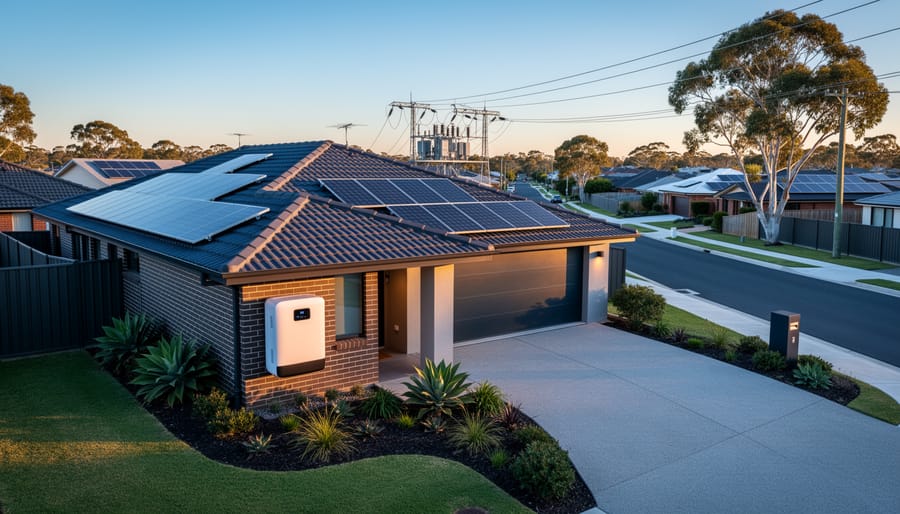
Imagine your home not just drawing power from the grid, but feeding surplus solar energy back into it—transforming every rooftop into a mini power station. This is bi-directional power flow, and it’s revolutionizing how Australia generates, stores, and shares electricity.
Traditional power grids operate like one-way streets, with electricity flowing from large power stations to your home. Bi-directional flow flips this model, allowing energy to travel both ways. When your solar panels generate more electricity than you need, that excess power flows back to the grid, earning you credits and helping power your neighbour’s home. When the sun sets, you draw energy back as needed.
This technology sits at the heart of smart grid technology, using advanced meters, inverters, and communication systems to manage these complex energy exchanges in real-time. In South Australia, households with battery storage and bi-directional capability are already creating virtual power plants—linking thousands of homes to balance grid demand during peak periods while maximizing renewable energy use.
The implications extend far beyond individual savings. Bi-directional flow reduces strain on aging infrastructure, minimizes the need for expensive grid upgrades, and accelerates Australia’s transition to 100% renewable energy. For environmentally conscious Australians, it represents a tangible way to participate in the clean energy revolution while improving energy security and resilience across communities.
What Is Bi-Directional Power Flow?
Imagine the difference between a one-way street and a two-way road. Traditional electricity grids work like one-way streets, with power flowing in a single direction from large power stations to your home or business. Bi-directional power flow transforms this into a two-way road, allowing electricity to travel both ways: from the grid to your property when you need it, and back to the grid when you have excess to share.
This concept is revolutionising how Australians interact with electricity. Picture a rooftop solar system on a sunny Brisbane afternoon. Your panels are generating more energy than your household needs. Instead of that excess power going to waste, bi-directional flow enables it to travel back through your meter, feeding into the grid where neighbours can use it. When the sun sets and your panels stop producing, power flows the traditional way, from the grid back to your home.
The technical magic happens through smart inverters and advanced metering systems that can measure and manage electricity flowing in both directions. Think of it as a conversation rather than a lecture. Your home isn’t just listening to the grid anymore; it’s talking back, contributing to a shared energy ecosystem.
This two-way exchange becomes particularly powerful with battery storage. Your home battery can charge when electricity is abundant and cheap, then discharge back to the grid during peak demand periods when power is scarce and valuable. It’s like having a water tank that not only stores rainwater for your use but can also help supply the neighbourhood during droughts, creating a resilient, community-powered energy network.

Why Smart Grids Need Two-Way Power Flow
Managing Renewable Energy Sources
Australia’s energy landscape is undergoing a remarkable transformation, driven by the extraordinary uptake of renewable energy sources. Unlike traditional power stations that generate electricity from a single, predictable location, renewable energy comes from thousands of distributed sources scattered across the country. Solar panels on suburban rooftops, wind farms in regional areas, and bioenergy facilities processing agricultural waste all feed power into the grid at varying times and intensities.
This shift presents both opportunity and challenge. Solar generation peaks during midday sunshine but drops to zero at night. Wind turbines spin when breezes blow, not necessarily when demand is highest. Bioenergy facilities offer more consistency but still operate as distributed generators rather than centralized plants. The unpredictable nature of these renewable sources means the grid must be flexible enough to accept power flowing in from multiple directions simultaneously.
Australia leads the world in rooftop solar adoption, with over three million households now generating their own electricity. On sunny weekends in some states, rooftop solar alone can supply more than half the grid’s power needs. This success story demonstrates why bi-directional power flow isn’t just useful but essential. The grid must evolve from a one-way highway carrying electricity from large power stations to consumers, into a dynamic network managing energy flowing from countless sources.
Without bi-directional capability, all this renewable potential would simply go to waste, unable to reach those who need it most.
Balancing Supply and Demand
One of the most compelling advantages of bi-directional power flow is its ability to balance supply and demand across the grid in real-time. Picture a sunny Saturday afternoon when thousands of solar panels across Australian suburbs are generating electricity, but many homes are empty as families enjoy the weekend outdoors. Without bi-directional capability, this excess renewable energy would simply go to waste. Instead, battery storage systems absorb this surplus power, storing it for later use.
When evening arrives and households switch on lights, air conditioning, and kitchen appliances, demand surges while solar generation drops off. This is where the magic happens. The stored energy flows back into homes and the broader grid, meeting demand precisely when it’s needed most. This two-way dance ensures that clean energy generated during peak production times isn’t wasted, while reducing reliance on fossil fuel power stations during high-demand periods.
South Australian energy networks have demonstrated this brilliance in action. During heatwave conditions, when air conditioners work overtime, residential batteries discharge stored solar energy back to the grid, preventing blackouts and avoiding the need to fire up expensive gas peakers. This intelligent balancing act not only strengthens grid stability but also maximizes the value of every kilowatt-hour of renewable energy produced, making our transition to clean power more efficient and economically sensible.
Real-World Success: Bi-Directional Systems in Action
Australian Community Energy Projects
Across Australia, forward-thinking communities and businesses are already reaping the rewards of bi-directional power systems, demonstrating that this technology isn’t just theoretical—it’s delivering real results today.
In South Australia, the Hornsdale Power Reserve project has become a global success story. This massive battery installation doesn’t just store renewable energy; it actively stabilises the grid through bi-directional flow, pushing power back when needed most. Since going live, it’s saved consumers millions in energy costs while significantly reducing the state’s reliance on fossil fuel peaker plants. The system responds to grid demands in milliseconds, something traditional power stations simply can’t match.
Meanwhile, in regional New South Wales, the Coffs Harbour community energy project showcases how smaller-scale systems work brilliantly too. Local businesses and homes with solar panels and battery storage now feed excess energy back into the grid during peak demand periods. Participants report average savings of 30-40% on their electricity bills, while the local network has seen a 25% reduction in strain during summer heatwaves.
The White Gum Valley development in Western Australia takes it further still. This residential community was specifically designed around bi-directional energy flow, with shared solar and battery systems. Residents enjoy significantly lower power bills—some households saving over $1,200 annually—while collectively reducing carbon emissions by approximately 80 tonnes each year.
These projects prove that bi-directional systems deliver measurable benefits: lower costs, cleaner energy, and more reliable power. They’re not experimental anymore; they’re the practical solution Australia needs for our renewable energy future.

Electric Vehicles as Mobile Power Banks
Imagine your electric car not just as transport, but as a massive battery on wheels that can power your home or even strengthen the entire electricity grid. That’s the promise of vehicle-to-grid technology, and it’s quickly becoming reality across Australia.
V2G technology transforms electric vehicles into mobile power banks through bi-directional charging systems. Instead of energy flowing only one way from the grid to your car, it can reverse direction. During peak demand periods when electricity prices soar, your EV can feed stored power back into the grid or supply your home, potentially earning you credits on your energy bill while helping stabilize the network.
Several exciting pilot programs are proving this concept works brilliantly in Australian conditions. The Australian National University in Canberra has been trialing V2G technology with impressive results, demonstrating how a fleet of electric vehicles can provide grid services during those scorching summer afternoons when air conditioners strain the system. Meanwhile, ActewAGL’s project in the ACT has shown that even a small number of EVs can make a meaningful difference to grid stability.
The future potential is enormous. With over 100,000 electric vehicles already on Australian roads and numbers growing rapidly, we’re looking at a distributed network of energy storage that could revolutionize how we manage electricity supply. As one researcher described it, it’s like having thousands of mini power stations scattered across suburbs, ready to balance supply and demand in real-time. For households, this means potential savings and energy independence. For Australia, it’s another step toward a cleaner, more resilient energy future.
The Technology Behind Two-Way Power Flow
Smart Inverters and Meters
At the heart of bi-directional power flow sits two remarkable pieces of technology working in harmony: smart inverters and smart meters. Together, they’re transforming how Australian homes and businesses interact with the grid.
Smart inverters are the clever translators of your solar system. They convert the direct current (DC) electricity your solar panels generate into alternating current (AC) that your home appliances use and the grid accepts. But modern smart inverters do much more than simple conversion. They actively manage the direction of electricity flow, sensing when your home needs power and when you have excess to share back to the grid. Think of them as intelligent traffic controllers, ensuring electricity flows exactly where it’s needed, when it’s needed.
Working alongside these inverters, smart meters provide the eyes and ears of your energy system. Unlike traditional meters that simply record consumption, smart meters track electricity flowing in both directions simultaneously. They capture real-time data on how much energy you’re drawing from the grid and how much you’re feeding back, measured down to the minute. This precise monitoring enables accurate billing credits for exported power and helps you understand your energy patterns better.
Together, this dynamic duo makes genuine two-way energy exchange possible, turning passive consumers into active participants in Australia’s renewable energy future.

Energy Management Systems
Behind every successful bi-directional power system sits sophisticated software working quietly in the background, making thousands of decisions each day. Energy Management Systems, or EMS, are the digital brains that orchestrate this complex dance of electricity flowing in and out of homes, businesses, and the grid.
Think of an EMS as your energy personal assistant. It monitors real-time electricity prices, weather forecasts, your household’s energy usage patterns, and the state of your battery. When the sun’s blazing and your solar panels are producing excess power, the system automatically stores what you need and decides whether to sell surplus energy back to the grid when prices peak. During evening demand spikes, it draws from your battery rather than expensive grid power.
For smart homes across Australia, this automation means significant savings without lifting a finger. Modern systems integrate with weather apps, utility price signals, and even your electric vehicle’s charging schedule. They learn your habits, optimizing when to charge, store, or export based on your lifestyle and financial goals.
The beauty of these systems lies in their ability to coordinate thousands of individual households into a virtual power plant, strengthening grid stability while maximizing returns for participants. As the technology matures, these platforms are becoming increasingly intuitive, making sustainable energy management accessible to everyday Australians.
Benefits for Aussie Homes and Businesses
Lower Energy Bills and New Revenue Streams
One of the most compelling reasons Australians are embracing bi-directional power flow is the genuine opportunity to reduce energy bills and earn money from their solar investments. Through feed-in tariffs, households can sell excess electricity back to the grid, transforming homes from mere consumers into mini power stations.
Here’s how it works in practice: when your solar panels generate more electricity than you’re using, that surplus flows back into the grid. Your energy retailer credits your account based on their feed-in tariff rate, which typically ranges from 5 to 10 cents per kilowatt-hour in most Australian states, though some retailers offer higher rates.
Consider the Johnson family in Adelaide. After installing a 6.5kW solar system with bi-directional capability, they’re now exporting around 15kWh daily during peak production hours. At 8 cents per kWh, that’s an extra $36 monthly, or roughly $430 annually. Combined with reduced electricity purchases during daylight hours, they’ve slashed their quarterly bills by 65 percent.
When paired with home battery storage, the economics become even more attractive. You can store excess solar energy and either use it during expensive peak periods or sell it back when demand and prices are highest, maximising both savings and revenue potential.
Energy Independence and Resilience
Bi-directional power systems paired with battery storage are transforming how Australian homes and businesses achieve energy independence while strengthening resilience against increasingly severe weather events. When cyclones, bushfires, or heatwaves knock out traditional power lines, these systems keep the lights on by drawing from stored solar energy rather than relying on distant fossil fuel generators.
During the 2022 Queensland floods, households with bi-directional systems maintained power for days while neighbouring properties went dark. This capability proves particularly valuable as extreme weather becomes more frequent across Australia. Instead of generating emergency power from diesel generators that spew emissions, stored renewable energy flows seamlessly from batteries back through the system.
The technology also reduces our collective reliance on peaking power plants, which typically burn fossil fuels during high-demand periods. By feeding stored energy back to the grid during these critical times, bi-directional systems help smooth demand peaks and support a cleaner energy mix for everyone. This represents a practical step toward building community resilience while accelerating Australia’s transition away from carbon-intensive power generation.
Challenges We’re Working Through
Let’s be upfront: while bi-directional flow technology is transforming Australia’s energy landscape, we’re still navigating some genuine challenges that require creative solutions and patience.
The infrastructure upgrade needed across our aging electricity grid represents a significant hurdle. Many Australian neighbourhoods weren’t designed with two-way power flow in mind, meaning substations, transformers, and network management systems need modernisation. It’s like trying to run a modern app on an old computer – the potential is there, but the hardware needs catching up. The good news? Network operators across the country are actively investing in these upgrades, turning limitations into opportunities for innovation.
Technical standards and regulations are still evolving too. Different states have varying rules about battery installations and export limits, which can feel like trying to navigate a patchwork quilt of requirements. Energy regulators are working toward harmonising these standards, but it takes time to get everyone rowing in the same direction.
Cost remains another consideration. While battery prices have dropped significantly, the upfront investment for a home battery system still gives many households pause. However, government incentives, falling technology costs, and innovative financing options are steadily improving accessibility. Think of it as the early days of solar panels – what seemed expensive then has become increasingly affordable and worthwhile.
Grid stability during rapid transitions poses technical complexities that engineers are actively solving. Managing thousands of batteries charging and discharging requires sophisticated coordination, but pilot programs across Australia are proving we can crack this challenge with smart technology and collaboration.
These aren’t roadblocks – they’re stepping stones toward a cleaner, more resilient energy future that’s well within our reach.
The transformation happening across Australia’s energy landscape isn’t just about new technology—it’s about reimagining how we all connect to the grid. Bi-directional power flow represents a fundamental shift that puts control back in the hands of everyday Australians while building the resilient, renewable energy system our future demands.
You have the power to be part of this revolution. Installing solar panels and battery storage transforms your home into an active participant in the energy network, not just a passive consumer. If you’re considering an electric vehicle, you’re potentially adding another battery to support grid stability while reducing emissions. Even advocating for smart grid policies in your community creates momentum for change.
The success stories we’re seeing today—from pioneering households earning income by supporting the grid during peak demand, to entire suburbs working together as virtual power plants—offer just a glimpse of what’s possible. As more Australians embrace these technologies, we’re collectively building an energy system that’s cleaner, more affordable, and remarkably resilient.
The vision ahead is genuinely exciting: neighbourhoods powered by rooftop solar during the day, storing excess energy in home batteries and EVs, then sharing that power when it’s needed most. Combined with expanding renewable sources like bioenergy providing reliable baseload power, we’re creating an energy future that works with nature rather than against it. The question isn’t whether this transformation will happen—it’s whether you’ll be part of making it happen sooner.