
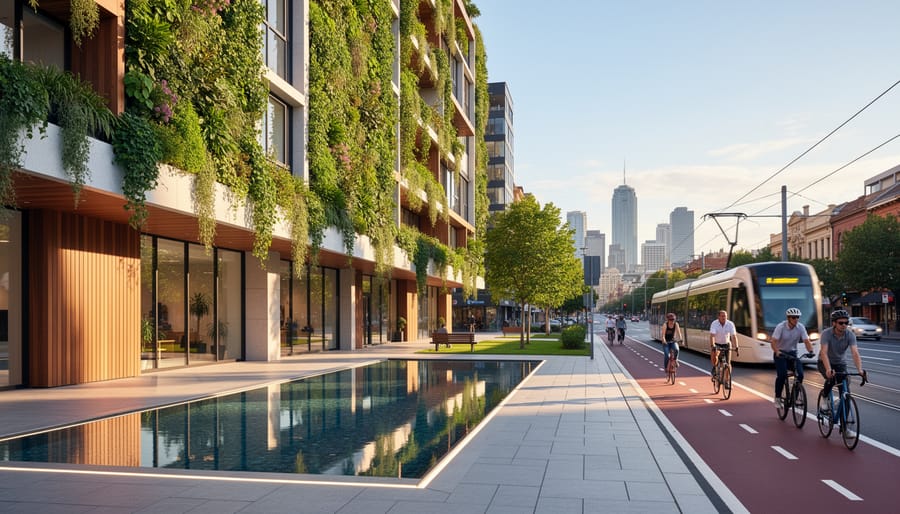
Imagine walking into a building where natural light floods through strategically placed windows, living walls purify the air you breathe, and the gentle sound of water creates an instant sense of calm. This isn’t a luxury resort – it’s the future of Australian urban planning, and it’s already transforming cities from Melbourne to Brisbane.
Biophilic design principles reconnect us with nature in our built environments, addressing a critical challenge: Australians now spend 90% of their time indoors, yet our wellbeing depends on natural connections our bodies evolved to need. When buildings incorporate natural elements – from timber textures and indoor plants to views of greenery and natural ventilation – occupants experience measurably lower stress, higher productivity, and improved health outcomes.
The business case is equally compelling. Buildings designed with biophilic principles achieve up to 15% better energy efficiency through natural lighting and ventilation strategies, reducing operational costs while creating healthier spaces. One Central Park in Sydney demonstrates this perfectly, with its vertical gardens cooling the building naturally and cutting energy consumption significantly compared to conventional designs.
Australian cities face mounting pressure from urban density, heat islands, and disconnection from nature. Biophilic design offers practical solutions that planners, architects, and policymakers can implement immediately – from pocket parks in underutilised spaces to green roofs that manage stormwater while providing urban habitat.
This approach isn’t just about aesthetics or feel-good initiatives. It’s evidence-based urban planning that delivers measurable outcomes: healthier communities, reduced energy consumption, enhanced biodiversity, and cities that feel fundamentally better to live in. Whether you’re designing a single building or reimagining an entire precinct, biophilic principles provide a roadmap for creating spaces where both people and nature thrive.
What Biophilic Design Actually Means for Urban Spaces
The Science Behind Our Need for Nature
Our connection to nature isn’t just a pleasant preference—it’s wired into our biology. Scientists call this ‘biophilia’, the innate human tendency to seek connections with nature and other forms of life. This deep-rooted bond developed over millions of years of evolution, where our survival depended on reading natural environments.
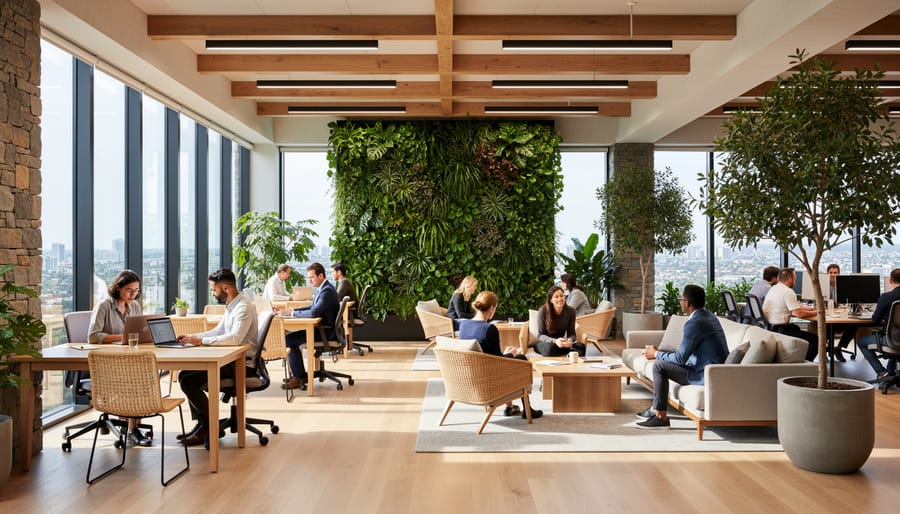
Modern research is now confirming what our ancestors instinctively knew. Studies from the University of Melbourne have shown that even brief exposure to natural elements can reduce stress hormones by up to 15% within minutes. Workers in offices with natural light and plant life report 15% higher productivity and significantly improved mood compared to those in conventional spaces. Hospital patients recovering in rooms with garden views require less pain medication and leave earlier than those facing brick walls.
The science is equally compelling for mental wellbeing. Australian researchers have found that urban residents with regular access to green spaces experience lower rates of anxiety and depression. Children in schools incorporating natural elements demonstrate improved concentration and better academic performance.
What’s particularly encouraging is that these benefits don’t require pristine wilderness experiences. Even small interventions—a living wall in an office, natural timber finishes, or views of urban parkland—trigger positive physiological responses. Our brains recognise and respond to these natural patterns, reducing the cognitive fatigue that comes from navigating entirely artificial environments. This remarkable finding opens exciting possibilities for transforming our cities into healthier, more vibrant spaces.
The Core Principles That Make Biophilic Design Work
Direct Connection: Bringing Nature Into the Built Environment
Creating genuine connections with nature in our built environments doesn’t require relocating to the bush. Through thoughtful design choices, Australian architects and planners are bringing the outdoors inside in ways that transform how we experience urban spaces.
Natural light stands as the foundation of direct biophilic connection. Large windows, skylights, and strategically positioned reflective surfaces maximise daylight penetration, reducing our reliance on artificial lighting while synchronising our internal clocks with natural rhythms. Melbourne’s One Central Park demonstrates this brilliantly, using heliostat technology to redirect sunlight into shaded areas, cutting energy costs whilst creating vibrant, naturally lit spaces.
Fresh air circulation through operable windows and thoughtfully designed ventilation systems creates another vital link. Rather than sealing buildings completely, incorporating natural ventilation reduces air conditioning demands and connects occupants to weather patterns and seasonal changes. Brisbane’s subtropical climate makes this particularly effective, with many new commercial buildings featuring automated louvres that respond to temperature and air quality.
Water features provide both visual and auditory connections to nature. The calming sound of flowing water in courtyard fountains or indoor water walls creates peaceful environments while naturally humidifying spaces. Sydney’s successful integration of water elements in public buildings shows how these features can reduce stress levels amongst occupants.
Living plants and green walls complete the direct connection. Beyond their aesthetic appeal, vegetation actively purifies indoor air, regulates humidity, and provides tangible daily interaction with living systems. Perth’s government buildings increasingly feature vertical gardens that thrive in Western Australia’s climate, demonstrating that direct nature connection works across our diverse environments.
Indirect Connection: Natural Patterns and Materials
Not every connection to nature requires living plants or green walls. Indirect biophilic design taps into our evolutionary response to natural patterns, materials, and forms, creating spaces that feel inherently calming and restorative.
Think about timber flooring that brings the warmth of Australian eucalyptus into your home, or stone benchtops that echo the ancient geology of our landscape. These natural materials don’t just look beautiful, they carry textures, grains, and imperfections that our brains recognise as authentic. When Brisbane’s Sunshine Coast University Hospital incorporated timber cladding and natural colour palettes throughout patient areas, staff reported improved wellbeing even in windowless corridors.
Patterns matter too. Nature rarely creates straight lines or perfect symmetry. Incorporating organic shapes, fractals found in coastlines or branching patterns, and biomimetic designs can reduce stress levels by up to 25 percent according to recent studies. Melbourne’s latest office fitouts are embracing curved walls, hexagonal tiles reminiscent of honeycomb, and rippling ceiling designs that mirror water movement.
Colour psychology plays its part as well. Earth tones like terracotta, sage green, and sandy beige ground us psychologically, while touches of sky blue can lower blood pressure. The beauty of indirect biophilic design is its practicality. You don’t need maintenance, watering systems, or perfect lighting conditions. A thoughtfully chosen stone feature wall or timber acoustic panels can deliver nature’s psychological benefits year-round, making sustainable design accessible to any Australian building, regardless of its orientation or available natural light.
Spatial Connection: Creating Spaces That Feel Natural
Creating environments that feel instinctively comfortable isn’t about luck—it’s about understanding how humans have evolved to respond to natural spaces. When we incorporate biophilic spatial connections into our buildings, we’re tapping into patterns that have kept our ancestors safe and thriving for millennia.
The principle of prospect and refuge perfectly illustrates this connection. Think about your favourite café or reading nook. Chances are, it offers you a good view of your surroundings while providing a sense of enclosure at your back. This isn’t coincidence—it’s our evolutionary preference for spaces where we can see without being seen. In Australian workplaces and homes, this might translate to window seats with partial privacy screens, or desks positioned to overlook a courtyard whilst backed by a solid wall. These arrangements reduce stress and increase productivity because they satisfy our innate need for both awareness and security.
Organized complexity takes inspiration from nature’s balanced intricacy. Natural environments present visual interest without overwhelming us—consider the layered canopy of a eucalyptus forest or the fractal patterns in coastal rock formations. When designing interior spaces, this principle encourages incorporating varied textures, natural materials, and thoughtful detail that engages attention without causing fatigue. Melbourne’s Council House 2 demonstrates this beautifully, with its textured timber panels and flowing vertical garden creating visual richness that staff consistently report enhances their wellbeing.
Transitional spaces mirror the gradual shifts we experience in nature—from dense forest to clearing, or beach to ocean. Rather than abrupt doorways between rooms, incorporating sustainable building practices might include covered verandahs, glazed atriums, or gradual lighting changes that help occupants psychologically adjust between different zones. These gentle transitions reduce cognitive load and create more harmonious environments, proving that the most comfortable spaces are those that acknowledge our deep connection to natural patterns.
Real Australian Cities Already Making This Happen
Melbourne’s Green Roofs and Living Walls Revolution
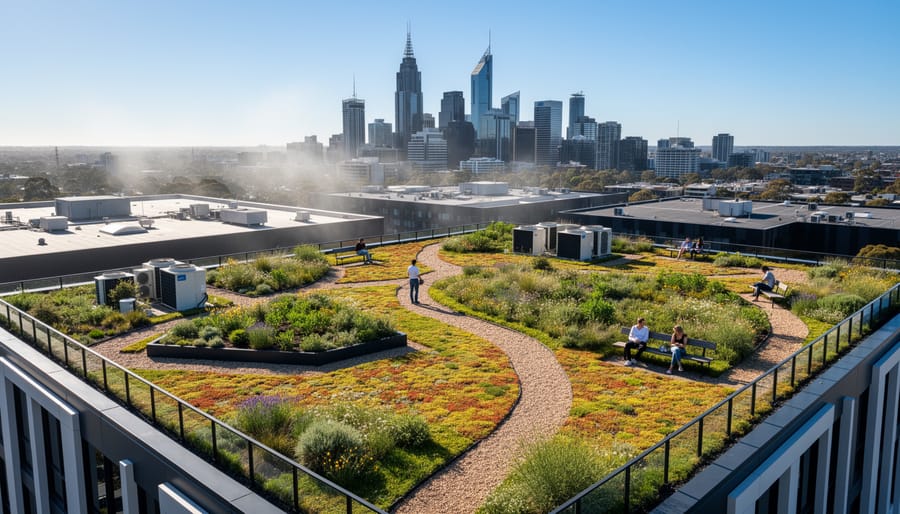
Melbourne has become Australia’s undisputed champion of vertical greening, transforming its urban landscape one building at a time. The city’s commitment to biophilic design is visible across its skyline, where green roofs and living walls have become signature features rather than novelties.
Take the award-winning One Central Park building, which showcases how vertical gardens can dramatically reduce urban heat island effects whilst improving air quality for surrounding neighbourhoods. Its cascading plant walls don’t just look stunning—they actively filter pollutants and provide natural insulation, reducing energy demands for heating and cooling by up to 25 percent.
The City of Melbourne’s Urban Forest Strategy has set ambitious targets, aiming to increase canopy cover to 40 percent by 2040. This initiative includes hundreds of green roofs across commercial and residential buildings, each acting as a natural air conditioner during scorching summers. These living systems absorb rainfall, reducing strain on stormwater infrastructure whilst creating habitats for native birds and insects.
Collins Street now features Australia’s longest living wall installation, stretching 125 metres and containing over 10,000 plants. Local businesses report that the green infrastructure has noticeably cooled street temperatures during summer, making the precinct more walkable and attractive to pedestrians.
These aren’t just feel-good projects—they’re practical solutions delivering measurable results. Studies show Melbourne’s green walls reduce ambient temperatures by 3-5 degrees Celsius in their immediate vicinity, cutting cooling costs and creating healthier, more liveable urban spaces. The message is clear: biophilic design works, and Melbourne is proving it every day.
Sydney’s Harbour-Inspired Urban Developments
Sydney’s spectacular harbour location has inspired a new generation of residential and commercial developments that bring biophilic principles to high-density living. These projects prove that even in Australia’s most populated urban centres, residents can maintain deep connections with nature.
One Central Park stands as a remarkable success story, transforming Sydney’s skyline with vertical gardens designed by renowned botanist Patrick Blanc. The development features over 35,000 native and exotic plants cascading down its facade, creating natural insulation that reduces energy consumption while filtering air pollutants. Residents report feeling calmer and more connected to nature despite living in the city’s heart.
Along the harbour foreshore, developments like Barangaroo incorporate coastal vegetation native to Sydney Harbour, including she-oaks and banksias that once dominated the shoreline. These projects use natural sandstone and timber elements that echo the harbour’s rugged beauty, creating spaces that feel authentically connected to place.
The clever integration of water views through strategically positioned communal areas and the incorporation of tidal-influenced garden designs help residents maintain visual connections with Sydney’s defining natural feature. These developments demonstrate how biophilic design reduces energy demands through natural temperature regulation whilst improving residents’ wellbeing. By combining native plantings, natural materials, and thoughtful orientation towards water and light, Sydney’s harbour-inspired developments are setting benchmarks for sustainable urban living across Australia.
Brisbane’s Subtropical Biophilic Approach
Brisbane’s climate is a biophilic designer’s dream, and the city’s architects are making the most of it. With year-round warmth and abundant sunshine, buildings here naturally embrace cross-ventilation and daylighting strategies that reduce energy consumption while reconnecting people with their environment.
The city’s subtropical setting allows for generous use of louvred windows, deep verandahs, and open-air walkways that blur the boundaries between inside and out. These features aren’t just aesthetically pleasing—they’re tremendously practical, slashing air conditioning costs while improving air quality and worker wellbeing. One standout example is the Brisbane Airport Domestic Terminal, which uses soaring roof forms to channel natural breezes throughout the space, creating comfortable conditions without excessive mechanical cooling.
Native plantings play a starring role in Brisbane’s biophilic approach. Designers are increasingly incorporating Queensland bottle trees, native grasses, and eucalyptus species that thrive in the local climate with minimal irrigation. These plantings don’t just survive—they flourish, providing habitat for local wildlife while significantly reducing maintenance costs and water consumption.
The result is a distinctive architectural character that’s both environmentally responsible and deeply connected to place. Brisbane demonstrates that biophilic design isn’t about forcing nature into buildings—it’s about working with your local environment to create spaces where people and nature naturally coexist.
Where Biophilic Design Meets Energy Efficiency
Natural Cooling and Heating That Cuts Energy Bills
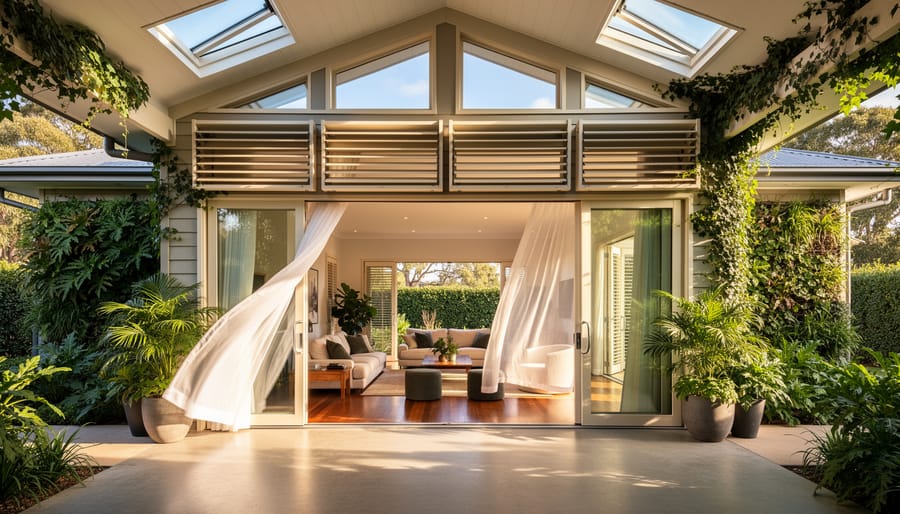
Imagine stepping into a building that stays naturally cool during scorching summer days without cranking up the air conditioning. This isn’t wishful thinking—it’s the power of biophilic design at work. By strategically incorporating vegetation, natural ventilation, and green infrastructure, buildings can significantly reduce their reliance on energy-intensive heating and cooling systems.
Green walls and rooftop gardens act as natural insulators, keeping interiors cooler in summer and warmer in winter. In Melbourne, several commercial buildings have slashed their cooling costs by up to 30% simply by installing vertical gardens that shade walls from direct sunlight. These living systems work alongside renewable energy systems to create genuinely sustainable spaces.
Natural ventilation strategies, inspired by traditional Australian homestead designs, draw cool breezes through buildings while releasing hot air through carefully positioned openings. This age-old wisdom, now enhanced with modern architectural understanding, can reduce air conditioning needs by 40-60% in suitable climates.
Trees planted strategically around buildings provide shade during summer while allowing warming winter sun through their bare branches. In Brisbane’s subtropical climate, deciduous trees near windows have helped households cut cooling costs substantially. Green roofs also manage stormwater naturally, reducing urban heat island effects that force surrounding buildings to work harder to stay cool. The result? Lower energy bills, reduced carbon emissions, and healthier, more comfortable spaces for everyone inside.
Powering Biophilic Cities with Renewable Energy
Biophilic cities create a remarkable opportunity to merge green infrastructure with renewable energy production, turning urban gardens and green spaces into dual-purpose assets. The organic matter generated by living walls, rooftop gardens, and urban forests doesn’t need to become waste—it can fuel local energy systems through biogas production and biomass conversion.
Consider this: a typical urban park or building with extensive green facades produces significant amounts of grass clippings, pruned branches, and fallen leaves throughout the year. Rather than sending this material to landfill, forward-thinking Australian cities are integrating organic waste management systems that convert green waste into biogas or biofuel. This creates a beautiful closed-loop system where nature feeds our buildings, and those buildings give back by supporting more green growth.
Energy-positive buildings represent the pinnacle of this partnership. These structures combine extensive biophilic design elements with renewable energy systems, producing more power than they consume. Solar panels work alongside green roofs, while biodigesters process organic waste from community gardens and food preparation areas. The result? Buildings that don’t just look good and improve wellbeing—they actively contribute clean energy to the grid.
This approach is particularly suited to Australian conditions, where abundant sunshine powers solar systems while our diverse plant life generates valuable biomass. Urban councils partnering with local businesses are already demonstrating how biophilic design and bioenergy can work together, creating cities that are both greener and cleaner.
Making It Happen: Practical Steps for Urban Planners and Communities
Starting Small: Quick Wins for Existing Urban Spaces
You don’t need a complete urban overhaul to bring nature back into your community. Some of the most effective biophilic interventions are surprisingly simple and affordable, making them perfect starting points for advocacy and grassroots action.
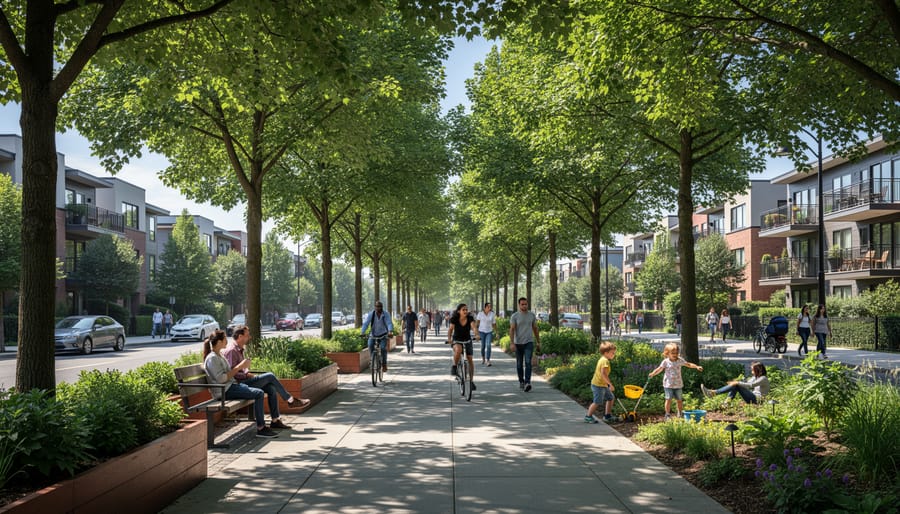
Street trees deliver remarkable bang for buck. Research from Melbourne shows a single mature street tree can reduce surrounding air temperatures by up to 5 degrees on scorching summer days whilst capturing stormwater runoff. Many Australian councils now have street tree programs where residents can request plantings outside their homes. In Brisbane’s inner suburbs, community groups successfully campaigned for increased street tree density, transforming treeless streets into leafy corridors within just three years.
Pocket parks prove that size doesn’t matter when it comes to urban greening. These small patches of green space, often squeezed into underutilised lots or parking spots, provide vital breathing room in dense neighbourhoods. Sydney’s Pocket Parks Program has transformed forgotten corners into community gathering spaces with native plantings, seating, and water features. The beauty of pocket parks lies in their flexibility – they can be temporary installations that demonstrate demand for permanent green infrastructure.
Green corridors connecting parks, waterways, and reserves create wildlife pathways whilst encouraging walking and cycling. Adelaide’s Park Lands Trail system showcases how existing green spaces can be linked through tree-lined paths and planted verges, making nature accessible throughout the city. These corridors don’t require massive investment – progressive planting programs and community volunteer days can gradually build connectivity whilst fostering neighbourhood pride and environmental stewardship.
Building It In: Design Standards for New Developments
The real power of biophilic design lies not just in retrofitting existing buildings, but in embedding these principles from the ground up. Forward-thinking councils and developers across Australia are discovering that mandating biophilic elements in planning approvals creates healthier, more sustainable communities while reducing long-term energy costs.
Several Australian local governments are leading the charge. The City of Melbourne’s Green Factor Tool, for instance, requires developments to meet minimum scores based on green infrastructure inclusion. Developers must incorporate elements like green roofs, vertical gardens, or permeable surfaces, with points awarded for different biophilic features. This approach transforms planning requirements from rigid boxes to flexible, creative solutions.
Building codes can specify measurable standards too. Requirements might include minimum ratios of vegetation to floor area, mandatory natural light access in common areas, or water features that also serve stormwater management purposes. The key is making standards specific enough to be enforceable but flexible enough to encourage innovation.
The beauty of mandating biophilic design is its ripple effect. When developers in Sydney’s Barangaroo precinct were required to meet strict sustainability targets, they didn’t just tick boxes—they created award-winning spaces with integrated greenery that reduced building cooling costs by up to 30 percent.
For councils considering such mandates, start with pilot programs in specific zones or development types. Provide clear guidelines, visual examples, and perhaps incentives like expedited approvals for developments exceeding minimum standards. Developers initially concerned about costs quickly discover that biophilic features attract premium tenants, command higher rents, and significantly reduce operational expenses.
The message is clear: building biophilic principles into planning frameworks isn’t just good environmental policy—it’s smart economics that benefits everyone.
Australia stands at a pivotal moment where our cities can genuinely transform into thriving ecosystems that nurture both people and planet. Biophilic design isn’t just an architectural trend—it’s a fundamental shift toward acknowledging that our wellbeing is inseparable from the natural world. As we’ve seen through projects like One Central Park in Sydney and Melbourne’s vertical gardens, healthier, more connected cities aren’t distant dreams. They’re being built right now, one green wall and native garden at a time.
The beauty of biophilic principles is that they align perfectly with Australia’s broader sustainability goals. By reducing our reliance on artificial cooling and lighting through strategic natural design, we’re simultaneously cutting energy consumption and carbon emissions. We’re creating urban spaces where wildlife can flourish alongside residents, where mental health improves through daily connection with nature, and where communities gather in cooling green spaces rather than energy-intensive indoor environments.
Every Australian has a role to play in this transformation. Whether you’re a homeowner adding native plants to your balcony, a business owner greening your office space, or a community member advocating for biophilic principles in local planning decisions, your actions matter. Push for green infrastructure in your council meetings. Support developments that prioritize natural integration over concrete sprawl. Choose native species that support local biodiversity when landscaping.
The path forward is clear and achievable. We’ve got the knowledge, the success stories, and increasingly, the political will to make biophilic design standard practice across Australian cities. Together, we can build urban environments where nature and humanity don’t just coexist—they flourish as one interconnected system. The question isn’t whether we can create these spaces, but how quickly we’ll embrace this essential transformation.