
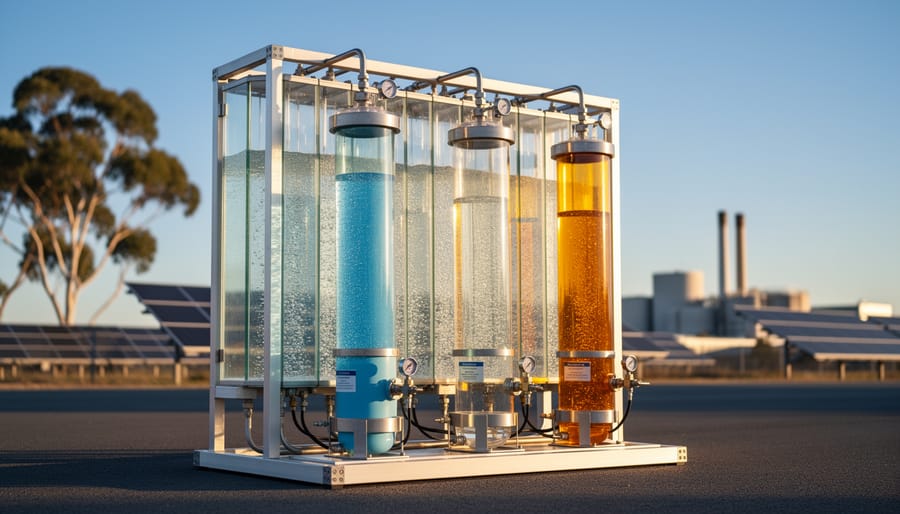
Artificial photosynthesis is revolutionizing Australia’s clean energy landscape by mimicking nature’s most efficient process to generate three distinct products that could transform our energy future. While natural photosynthesis in plants produces glucose and oxygen, scientists have refined this ancient biological process to create renewable hydrogen fuel, pure oxygen, and valuable chemical building blocks using only sunlight and water.
Understanding these three products matters because Australia’s abundant sunshine positions us perfectly to lead the global renewable energy transition. Research institutions across Melbourne, Sydney, and Brisbane are already developing commercial-scale artificial photosynthesis systems that could power transport networks, support industrial manufacturing, and create export opportunities worth billions to our economy.
The hydrogen produced through artificial photosynthesis offers a clean alternative to fossil fuels, storing solar energy in chemical bonds that release only water when used. The oxygen byproduct supports medical applications and industrial processes, while the chemical building blocks provide sustainable alternatives to petroleum-based materials. Together, these three outputs represent a complete ecosystem of renewable resources.
For environmentally conscious Australians and industry leaders alike, grasping how artificial photosynthesis generates these three distinct products reveals practical pathways toward energy independence and emissions reduction. This technology isn’t distant future speculation, it’s happening now in Australian laboratories and pilot facilities, with real applications emerging across agriculture, transport, and manufacturing sectors that demonstrate how we can harness our natural advantages to build a sustainable, prosperous future.
What Artificial Photosynthesis Actually Does (Nature’s Blueprint, Reimagined)
Think of a leaf as nature’s solar panel, quietly converting sunshine, water, and carbon dioxide into energy and oxygen. For millions of years, plants have perfected this remarkable process, and now scientists are learning to do the same in laboratories across Australia and around the world. Artificial photosynthesis takes inspiration from this natural blueprint but uses human-made materials to achieve similar results.
Here’s how it works in straightforward terms. Plants use chlorophyll, the green pigment in their leaves, to absorb sunlight. Scientists have developed synthetic materials that perform a similar job, capturing sunlight with specially designed molecules or semiconductors. These materials act like tiny energy catchers, absorbing light and using that energy to power chemical reactions.
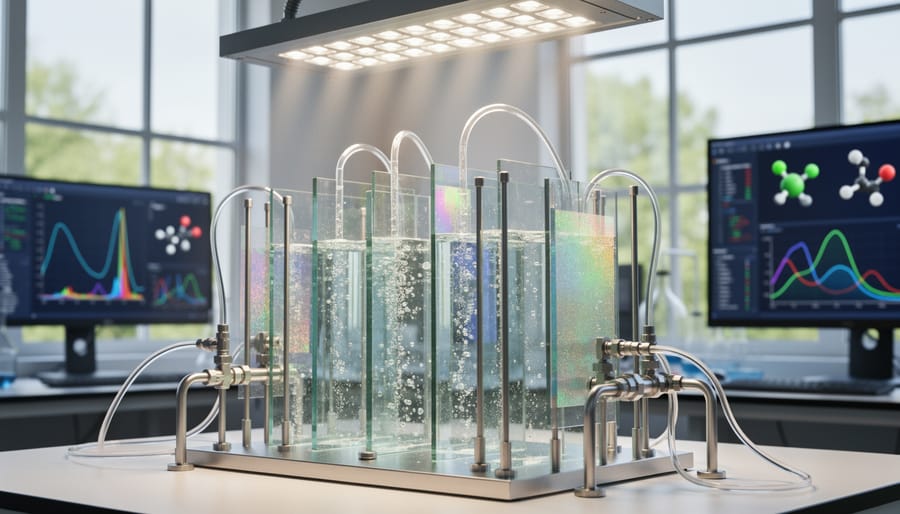
The next step mirrors what happens inside plant cells. Natural photosynthesis splits water molecules into hydrogen and oxygen using the sun’s energy. In artificial systems, scientists use catalysts, special materials that speed up reactions, to break apart water molecules in the same way. Some research teams use metals like cobalt or nickel, while others experiment with earth-abundant materials to keep costs down.
The beauty of this approach is its simplicity and sustainability. Just like plants, artificial photosynthesis systems need only three basic ingredients: sunlight, water, and the right catalysts. There’s no need for fossil fuels or complex machinery. The result is clean energy production that generates valuable products without harmful emissions.
Australian researchers at institutions like the Australian National University and Monash University are making exciting strides in this field, developing more efficient catalysts and better light-absorbing materials. Their work is bringing us closer to commercial systems that could transform how we produce clean fuel and valuable chemicals, all while taking a leaf from nature’s own playbook.
Product One: Clean Hydrogen Fuel That Powers Everything
Why Hydrogen Matters for Australia’s Energy Independence
Hydrogen produced through artificial photosynthesis isn’t just a scientific curiosity—it’s a game-changer for Australia’s journey toward energy independence. While we’ve made impressive strides in electrifying homes and vehicles, some sectors remain stubbornly difficult to decarbonize. Heavy industry, long-haul transport, and high-temperature manufacturing processes need energy-dense fuels that batteries simply can’t provide efficiently. This is where hydrogen steps up, offering a clean alternative that can power steel production, shipping vessels, and aviation without the carbon emissions.
Australia finds itself in an enviable position to lead the global hydrogen economy. Our sunburnt country receives some of the most abundant sunlight on the planet, creating perfect conditions for both natural and artificial photosynthesis processes. This natural advantage means we can produce hydrogen at competitive costs while simultaneously addressing energy storage challenges that come with renewable power generation.
The proof is already in the pudding. Western Australia’s Hydrogen Energy Supply Chain project has successfully demonstrated large-scale hydrogen production and export capabilities, while Queensland’s hydrogen hubs are attracting significant investment from both domestic and international partners. The Port of Gladstone is transforming into a hydrogen production powerhouse, showing how regional communities can benefit from the transition.
These success stories demonstrate that artificial photosynthesis technology isn’t pie in the sky—it’s creating real jobs and economic opportunities across Australia today. From research facilities in our universities to pilot projects in industrial zones, Aussie innovation is proving that clean hydrogen can power our future while maintaining our energy sovereignty and creating lasting prosperity for communities nationwide.
From Lab to Real Life: How Hydrogen Fuel Gets Used
The hydrogen produced through artificial photosynthesis isn’t staying in the laboratory. Across Australia, this clean fuel is already powering real-world applications that are transforming how we think about energy.
Hydrogen-powered vehicles represent one of the most visible applications. Several Australian cities now feature hydrogen refuelling stations serving bus fleets and commercial vehicles. These vehicles emit nothing but water vapour, making them perfect for urban environments where air quality matters. Toyota and Hyundai have both introduced hydrogen fuel cell vehicles to the Australian market, with refuelling taking just minutes compared to lengthy charging times for battery electric vehicles.
In industrial settings, hydrogen is replacing fossil fuels in processes that traditionally relied on coal or natural gas. Steel manufacturers are exploring hydrogen-based production methods, while chemical plants use it to create ammonia for fertilisers without carbon emissions. Mining operations in Western Australia are testing hydrogen-powered heavy machinery, demonstrating that even our most energy-intensive industries can transition to clean fuel.
Perhaps most exciting is Australia’s potential as a hydrogen exporter. With abundant sunshine and vast land suitable for artificial photosynthesis facilities, we’re uniquely positioned to become a renewable hydrogen superpower. Japan and South Korea have already signed agreements to import Australian hydrogen, creating export opportunities worth billions. Regional communities stand to benefit through job creation and economic development, turning our natural advantages into a sustainable prosperity that benefits all Australians while helping the world decarbonise.
Product Two: Oxygen That Benefits More Than Just Breathing
Industrial Uses That Create Economic Value
While hydrogen often steals the spotlight in artificial photosynthesis discussions, oxygen is the unsung hero creating remarkable economic opportunities across multiple industries. This abundant byproduct isn’t simply released into the atmosphere – it’s a valuable commodity that makes synthetic photosynthesis systems financially viable.
In medical settings, oxygen is literally life-saving. Hospitals and healthcare facilities require constant supplies of medical-grade oxygen for respiratory support, anaesthesia, and emergency care. Australian medical facilities spend millions annually on oxygen supplies, and artificial photosynthesis facilities could become local producers, reducing transportation costs and ensuring reliable supplies during emergencies – a lesson reinforced during recent health crises.
Water treatment plants represent another significant market. Oxygen injection improves water quality by supporting beneficial bacteria that break down contaminants. Several Australian water utilities are already exploring on-site oxygen generation to reduce operating costs and improve treatment efficiency.
The steel industry offers perhaps the most substantial economic opportunity. Steel production consumes enormous quantities of oxygen – approximately 50 cubic metres per tonne of steel produced. BlueScope Steel and other Australian manufacturers currently rely on energy-intensive air separation units. Artificial photosynthesis facilities co-located with steel plants could supply oxygen while simultaneously producing hydrogen for use in emerging green steel technologies, creating a circular economy model that’s both environmentally sound and economically attractive.
Chemical manufacturing, welding operations, and aquaculture also present growing markets. This diverse demand transforms oxygen from a mere byproduct into a revenue stream that helps offset the operational costs of hydrogen production facilities.
Environmental Win: Closing the Carbon Loop
Here’s something that gets us excited about artificial photosynthesis: it doesn’t just produce hydrogen fuel, it actively cleans our air while doing it. When these systems split water molecules to create hydrogen, they simultaneously release pure oxygen back into the atmosphere. Think of it as nature’s own carbon balancing act, but supercharged for urban environments.
For Australian cities grappling with air quality concerns, this dual benefit is a genuine game-changer. Brisbane, Sydney, and Melbourne could benefit from strategically placed photosynthetic hydrogen production facilities that function as both energy generators and urban air purifiers. The oxygen produced isn’t contaminated with pollutants, making it particularly valuable in industrial areas where air quality often takes a hit.
What makes this especially promising for Australia is the scalability. A single commercial-scale facility can produce tonnes of oxygen daily while generating clean hydrogen fuel. In Western Australia’s mining regions, companies are already exploring how this oxygen byproduct might support local ecosystems affected by industrial activity. It’s practical environmental rehabilitation that pays for itself through energy production. This approach transforms what could be a single-purpose technology into a multi-benefit solution, addressing both our energy needs and environmental responsibilities simultaneously.
Product Three: Energy-Rich Chemical Building Blocks (Beyond Just Fuel)
Turning Carbon Emissions Into Useful Products
One of the most exciting breakthroughs in artificial photosynthesis isn’t just capturing carbon dioxide – it’s transforming this greenhouse gas into something genuinely useful. Rather than treating CO2 as waste to be stored away, innovative systems are now converting it into valuable chemicals that Australian industries can use as sustainable building blocks for everyday products.
Think of it like nature’s ultimate recycling program. Just as plants transform carbon dioxide into sugars and starches, artificial photosynthesis systems can convert CO2 into compounds like ethylene, methanol, and formic acid. These aren’t obscure chemicals – they’re the foundations of plastics, fuels, cleaning products, and countless items we use daily. The difference is, instead of extracting these materials from fossil fuels, we’re creating them from the very emissions causing climate challenges.
Several Australian research institutions are already making this vision a reality. The University of Melbourne, for instance, has developed catalysts that efficiently convert CO2 into methanol, which can fuel vehicles or serve as a chemical feedstock. Meanwhile, CSIRO researchers are exploring ways to produce aviation fuel from captured carbon, potentially revolutionising how Australian airlines reduce their carbon footprint.
For Australian industries searching for sustainable alternatives to petroleum-based chemicals, this technology offers a fair dinkum solution. Manufacturing plants could potentially capture their own emissions and transform them into raw materials, creating a circular economy where waste becomes resource. This approach doesn’t just reduce environmental impact – it creates economic opportunity.
The beauty of this system lies in its dual benefit: removing atmospheric carbon while generating products that support local industries. It’s practical innovation that turns environmental responsibility into competitive advantage, demonstrating that sustainability and profitability can work hand in hand.
What This Means for Manufacturing and Agriculture
The practical implications of photosynthesis products are already transforming Australian industries. Farmers across Queensland and New South Wales are exploring biofuel production from agricultural waste, converting plant materials into clean hydrogen fuel while capturing valuable oxygen as a byproduct. This circular approach means crop residues that once went to waste now power farm equipment, reducing diesel costs and carbon emissions simultaneously.
Manufacturing is equally promising. Australian researchers have developed methods to convert photosynthesis-derived chemical building blocks into biodegradable plastics and industrial chemicals, replacing petroleum-based alternatives. Companies in Melbourne and Perth are already trialing plant-based production systems that generate their own hydrogen for industrial processes, cutting energy bills by up to 40 percent while slashing emissions.
For fertilizer production, the game-changer is using photosynthesis-derived hydrogen to create ammonia sustainably, rather than relying on fossil fuel-intensive methods. This means Australian agriculture can reduce its carbon footprint while maintaining productivity. Success stories from pilot projects in Tasmania demonstrate how integrated photosynthesis systems can power entire agricultural operations, proving that transitioning away from fossil fuel-derived chemicals isn’t just environmentally responsible – it’s economically smart and entirely achievable with technology available today.
Where Australia Fits in the Artificial Photosynthesis Revolution
Australia is rapidly emerging as a global powerhouse in artificial photosynthesis research, leveraging natural advantages that position the nation perfectly for this revolutionary technology. From Sydney to Perth, leading institutions are turning sunlight into sustainable fuel, with outcomes that could reshape our energy landscape.
The Australian National University’s Research School of Chemistry has pioneered breakthrough work in catalyst development, creating materials that dramatically improve the efficiency of splitting water molecules. Meanwhile, Monash University’s teams are developing innovative photoelectrochemical cells that mimic natural photosynthesis with remarkable precision. These aren’t just laboratory curiosities; they’re practical systems being tested in real-world conditions across the country.
CSIRO’s hydrogen research program has established pilot facilities in regional Queensland, demonstrating how artificial photosynthesis can integrate with existing infrastructure. The organization recently partnered with renewable energy companies to explore large-scale hydrogen production using advanced photocatalytic systems. These projects are creating specialized jobs in regional areas, from technicians maintaining photocatalytic arrays to engineers designing integrated systems.
Australia’s competitive edge is undeniable. We’re blessed with some of the planet’s most abundant sunlight, vast expanses of available land, and world-class expertise in solar technology advances. Our existing renewable energy infrastructure provides the perfect foundation for scaling artificial photosynthesis systems. Combined with innovations in renewable energy storage, these technologies could transform Australia into a green hydrogen exporter.
Start-ups like Hysata and established energy companies are investing heavily in commercializing artificial photosynthesis technology. Economic modelling suggests this sector could generate thousands of jobs by 2030, particularly in manufacturing photocatalytic materials and operating production facilities. The potential for economic growth extends beyond job creation to establishing Australia as a leader in the global hydrogen economy, exporting both technology and clean fuel to energy-hungry markets throughout Asia and beyond.
Artificial photosynthesis delivers three remarkable products—hydrogen fuel, oxygen, and valuable chemical building blocks—that work together to reshape Australia’s energy landscape. These outputs aren’t just scientific achievements; they’re practical solutions already making waves in renewable energy projects across the country. When hydrogen powers our transport, oxygen supports industrial processes, and organic compounds reduce our reliance on fossil fuels, we’re witnessing a complete energy transformation in action.
The beauty of artificial photosynthesis lies in how it complements solar farms, wind turbines, and existing bioenergy initiatives. It doesn’t replace these technologies but enhances them, creating a diverse renewable portfolio that makes Australia’s clean energy transition faster and more resilient. As research advances and more demonstration projects come online, the potential grows exponentially.
Now’s the time to get involved. Stay informed about artificial photosynthesis developments, support policies that fund renewable innovation, and consider how your organization might participate in this energy revolution. Whether you’re a business leader, policymaker, or passionate individual, your voice matters. Together, we can champion technologies that don’t just promise a sustainable future—they deliver it.