
When ExxonMobil, one of the world’s largest oil and gas corporations, commits billions to biofuel development, it sends an unmistakable signal: the energy transition isn’t just environmentally necessary—it’s financially inevitable. The company’s 2022 announcement to invest $17 billion in lower-emission technologies through 2027, with significant allocation toward advanced biofuels, represents more than corporate greenwashing. It’s a calculated bet on economic viability that environmentally conscious Australians and forward-thinking investors should pay close attention to.
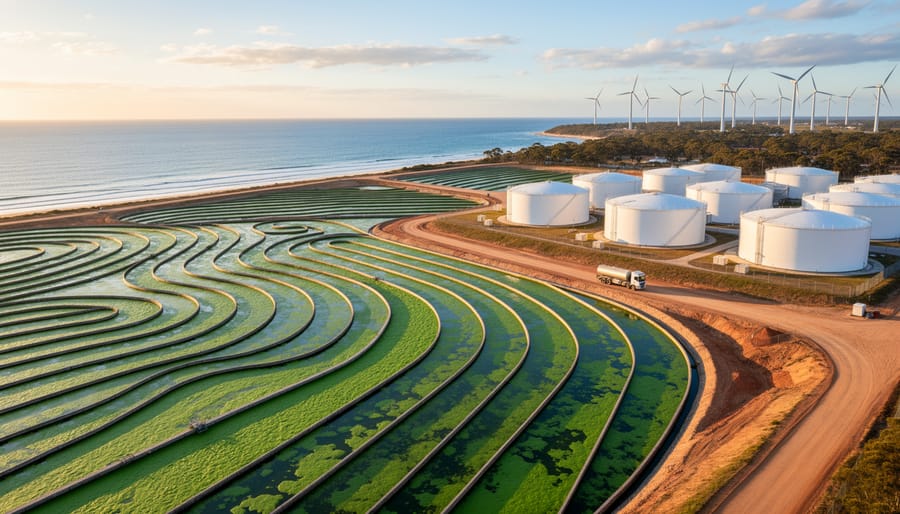
The story begins with algae—microscopic organisms that can produce up to 10 times more oil per acre than traditional crops without competing for arable land. ExxonMobil’s partnership with Viridos has developed breakthrough algae strains that double lipid production, transforming what once seemed like science fiction into commercially viable fuel. This technology matters because it addresses the fundamental question keeping Australian businesses awake at night: can renewable fuels actually replace fossil fuels without breaking the bank?
The answer emerging from ExxonMobil’s pivot is increasingly yes, particularly when examining the complete financial picture. Advanced biofuels now compete directly with conventional diesel in fleet operations, offering Australian transport companies genuine alternatives backed by multinational-scale infrastructure investment. For policymakers, industry professionals, and environmental advocates across Australia, understanding why traditional energy giants are redirecting capital toward biofuels reveals where genuine opportunities exist beyond political rhetoric and greenwashing—in technologies achieving economic tipping points today.
Why a Fossil Fuel Giant Is Betting Big on Biofuels
The Business Case That Changed Everything
ExxonMobil’s pivot toward biofuels wasn’t born from sentiment alone – it emerged from a confluence of compelling economic realities that made the investment impossible to ignore. By 2022, global biofuel demand had surged past 180 billion litres annually, with projections suggesting doubling within the decade. For a company built on meeting energy demand, the mathematics were straightforward: biofuels represented not just a hedge against regulatory pressure, but a genuine growth opportunity.
The regulatory landscape played a crucial role. Governments worldwide introduced low-carbon fuel standards and renewable fuel mandates, creating guaranteed markets for biofuel producers. In Australia, the federal government’s commitment to net-zero emissions by 2050 signaled similar momentum, making biofuels particularly attractive for aviation and heavy transport sectors where electrification faces technical hurdles.
What truly changed the equation was technological advancement. ExxonMobil’s partnership with Viridos to develop algae-based biofuels promised production costs competitive with traditional diesel – a game-changer for commercial viability. Unlike first-generation biofuels competing with food crops, this approach utilised non-arable land and delivered yields potentially 10 times higher than conventional options.
The long-term profitability projections were equally persuasive. With fossil fuel assets facing stranding risks and carbon pricing mechanisms expanding globally, biofuels offered ExxonMobil a pathway to leverage existing refining infrastructure while diversifying revenue streams. The business case wasn’t about abandoning their core competency – it was about evolving it for a carbon-constrained future, demonstrating that environmental responsibility and economic sense could align remarkably well.
From Algae Labs to Commercial Reality
ExxonMobil’s journey into algae biofuel represents one of the most ambitious biotechnology ventures in the energy sector. Back in 2009, they partnered with Synthetic Genomics to develop advanced algae strains that could revolutionize how we produce transport fuels. Think of algae as nature’s tiny solar-powered oil factories – these microscopic organisms convert sunlight and carbon dioxide into lipids (essentially oils) that can be refined into diesel and jet fuel.
The science sounds complex, but it’s remarkably elegant. Algae can double their mass several times daily and produce up to 30 times more energy per acre than traditional crops like corn or sugarcane. They don’t compete for agricultural land or fresh water, making them ideal for Australian conditions where water security matters. ExxonMobil’s researchers genetically optimized algae strains to boost lipid production while maintaining growth rates – imagine breeding champion racehorses, but at a cellular level.
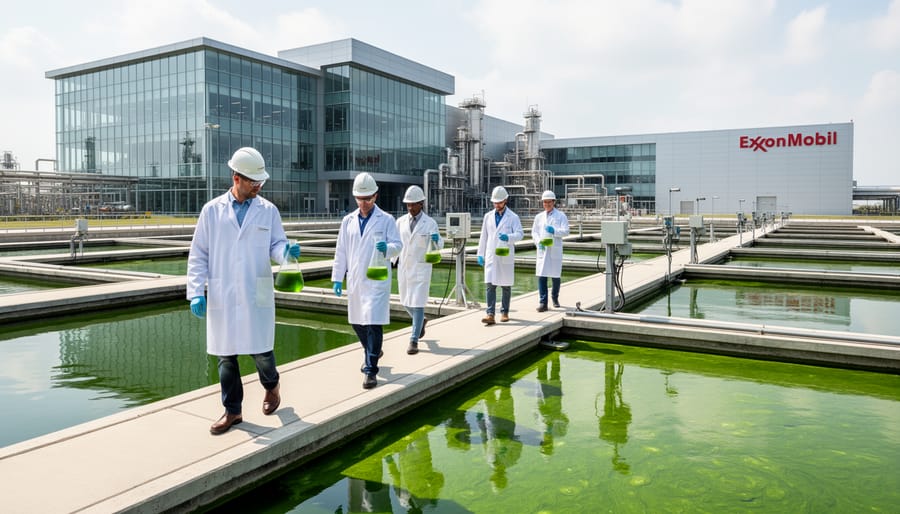
After more than a decade of research, the company achieved a significant breakthrough in 2022, demonstrating they could scale production beyond laboratory conditions. Their pilot facilities proved that industrial-scale algae cultivation could work economically, addressing the major hurdle that had stalled previous attempts.
The real-world applications are particularly exciting for aviation. Airlines are under pressure to reduce emissions, and algae-based jet fuel offers a drop-in solution requiring no engine modifications. ExxonMobil’s advanced biofuels could power commercial flights while cutting lifecycle carbon emissions by up to 80 percent compared to conventional jet fuel.
For Australia, this technology holds tremendous promise. Our vast coastlines and abundant sunshine create ideal conditions for algae farms, potentially positioning the country as a future biofuel exporter while supporting regional employment and energy independence.
The Money Behind the Movement: How Biofuel Finance Actually Works
Three Finance Models Making Biofuels Profitable
The journey to profitable biofuels relies on three proven biofuel finance models that are reshaping the energy landscape in Australia and worldwide. Understanding these approaches reveals why companies like ExxonMobil see biofuels as sound investments rather than risky experiments.
Private equity investment brings patient capital to biofuel ventures, allowing projects to mature without quarterly earnings pressure. Australian agribusiness investors have backed several successful facilities, including Queensland’s biofuel plants that convert sugarcane waste into renewable diesel. These investors recognize that biofuels offer stable returns once operational, with feedstock costs often lower than crude oil price volatility.
Corporate partnerships create win-win scenarios where established energy companies provide infrastructure and distribution networks while specialist biofuel producers contribute technical expertise. This model has proven particularly effective down under, where Qantas partnered with local producers to develop aviation biofuel from agricultural waste. These collaborations share both risks and rewards, making large-scale projects financially feasible.
Government-backed schemes provide the crucial foundation through grants, loan guarantees, and renewable fuel mandates. The Australian Renewable Energy Agency has supported numerous biofuel initiatives, reducing upfront capital barriers that traditionally deterred investors. These programs don’t just hand out money; they create market certainty by guaranteeing demand through blending mandates and carbon reduction targets.
What makes these models work together is their complementary nature. A typical successful biofuel project might secure government support for initial development, attract private equity for construction, and establish corporate partnerships for long-term offtake agreements. This layered approach spreads risk while ensuring projects have the resources needed from concept through commercial operation, proving that biofuels can compete economically with fossil fuels.
What Makes a Biofuel Project Bankable
When investors assess biofuel ventures, they’re looking beyond good intentions—they want solid returns backed by sustainable fundamentals. Understanding what makes projects bankable reveals why companies like ExxonMobil are entering this space with confidence.
Feedstock availability sits at the heart of every viable biofuel project. Investors need assurance that raw materials—whether agricultural waste, algae, or purpose-grown crops—can be sourced consistently and cost-effectively. Australia’s vast agricultural landscape offers tremendous potential, though feedstock availability challenges around collection and transport infrastructure remain critical considerations.
Conversion efficiency determines profitability. Modern facilities must demonstrate they can transform biomass into fuel at competitive yields, using proven technologies that minimize waste and maximize output. This technical capability separates successful ventures from risky propositions.
Market access proves equally crucial. Projects need clear pathways to customers, whether through aviation fuel contracts, road transport networks, or industrial applications. The growing mandate for sustainable aviation fuel in Australia creates compelling opportunities for developers who can meet quality standards.
Finally, the regulatory environment shapes investor confidence. Supportive policies, carbon credit schemes, and renewable fuel standards provide the stability that large-scale investments require. Australia’s evolving renewable energy framework, combined with international commitments to decarbonization, creates an increasingly favorable climate for biofuel ventures that tick all the right boxes.
Can Biofuels Actually Compete With Fossil Fuels on Price?
The Real Numbers Behind Biofuel Production
The economics of biofuel production have shifted dramatically over the past decade, transforming from an expensive alternative to a genuinely competitive option. When ExxonMobil announced its advanced biofuel ventures, production costs hovered around $3-4 per gallon. Today, technological breakthroughs and economies of scale mean biofuels are getting cheaper, with some facilities achieving costs below $2 per gallon.
The sweet spot for competitiveness sits around $1.50-1.80 per gallon, depending on crude oil prices and regional factors. Australia’s Viva Energy Darwin Refinery demonstrates this perfectly. By processing locally sourced feedstocks like tallow and used cooking oil, they’ve achieved production costs that compete directly with traditional diesel, particularly when carbon credits and renewable fuel incentives factor in.
South Australia’s Muradel facility offers another success story worth celebrating. Their algae-based biofuel production reached commercial viability by partnering with local councils to access wastewater treatment plants, slashing input costs by 40 percent. This clever approach shows how Australian ingenuity can turn challenges into opportunities.
Queensland’s biodiesel producers have cracked the code too, processing waste materials that would otherwise end up in landfills. Their production costs have dropped 35 percent since 2018, making renewable diesel price-competitive without subsidies in regional markets. These real-world examples prove that biofuels aren’t just environmentally sound—they’re becoming economically sensible for Australian businesses and communities alike.
How Government Support Levels the Playing Field
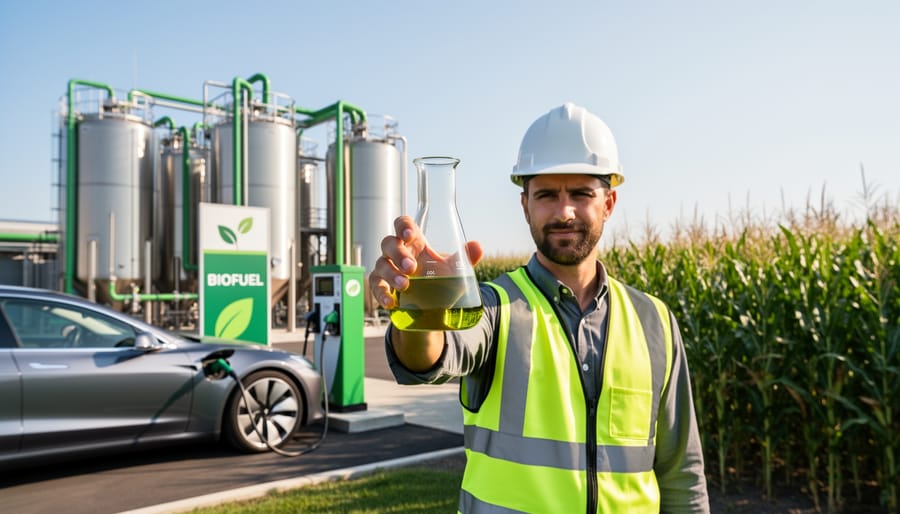
Government support isn’t about handouts; it’s about smart investment in our energy future. Around the world, including right here in Australia, biofuels benefit from subsidies, tax incentives, and carbon pricing mechanisms that acknowledge their genuine environmental value.
Australia’s Emissions Reduction Fund and various state-based incentives help bridge the cost gap between traditional fuels and cleaner alternatives. When you factor in carbon pricing, the true economics start making sense. Biofuels avoid the carbon penalties that fossil fuels increasingly face, creating a more level playing field for companies willing to invest in sustainable technology.
Globally, places like California’s Low Carbon Fuel Standard demonstrate how regulatory frameworks drive real change. These programs reward lower-emission fuels, making biofuel production economically attractive for major players like ExxonMobil.
Think of these mechanisms as investing in what we want more of rather than merely penalising what we’re trying to phase out. When government policy aligns with environmental goals, it accelerates innovation and deployment. The result? Cleaner fuels reach market faster, creating jobs and reducing emissions simultaneously.
For Australian businesses and investors, understanding these support structures reveals genuine opportunities in the bioenergy sector, transforming what might seem financially risky into strategically sound investments.
What ExxonMobil’s Move Means for Australian Bioenergy
Australian Success Stories Already Leading the Way
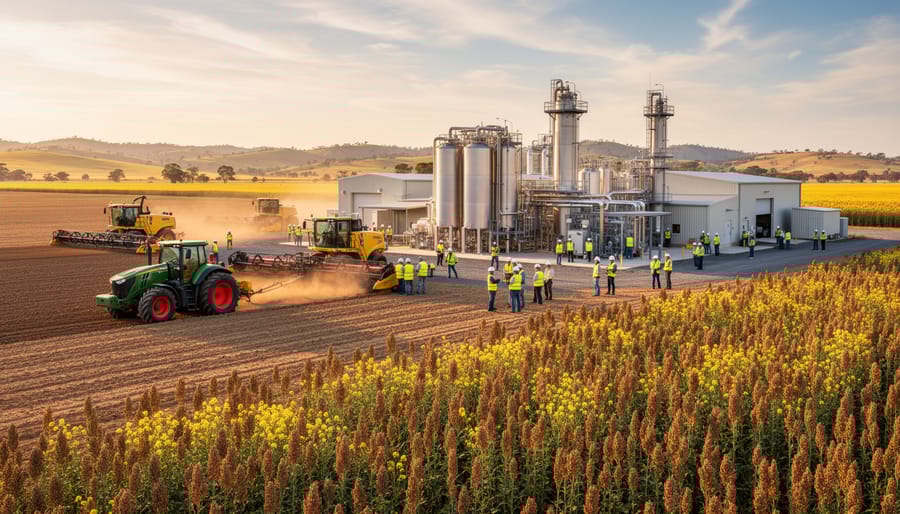
Australia isn’t waiting for the global energy transition to arrive – we’re already building it. Right across the country, innovative companies are transforming waste into valuable biofuels, creating regional jobs and slashing emissions in the process.
Take Macquarie Group’s investment in Australian Renewable Fuels, which operates biodiesel plants in three states. They’re converting used cooking oil and tallow into clean-burning fuel that powers trucks and machinery today, not tomorrow. It’s a brilliant example of the circular economy in action – what was once waste destined for landfill now drives our transport network.
In Queensland, Southern Oil Refining is producing more than 100 million litres of biodiesel annually from agricultural by-products. They’re not just reducing emissions by over 80 percent compared to fossil diesel – they’re also supporting local farmers by creating new revenue streams from crop residues and waste oils.
Meanwhile, New South Wales is home to Biorefining Australia, pioneering the production of sustainable aviation fuel from waste biomass. Their technology demonstrates how regional communities can become renewable energy hubs, attracting investment and skilled workers to areas that need them most.
These success stories prove the biofuel model works brilliantly in Australian conditions. When combined with the kind of financial backing that major players like ExxonMobil are now providing globally, Australia’s biofuel sector is positioned to expand dramatically, creating thousands of jobs while helping us meet our climate commitments.
Your Role in the Biofuel Economy
You don’t need to work for a major energy company to play a meaningful role in Australia’s biofuel revolution. The exciting reality is that everyday Australians and organizations have numerous ways to support and benefit from this growing sector.
Start by choosing biofuel-blended options at the bowser when available. Many service stations now offer E10 ethanol blends, and increased consumer demand signals to retailers that Australians want sustainable alternatives. For fleet operators and businesses, transitioning company vehicles to biofuel-compatible models demonstrates environmental leadership while potentially reducing long-term fuel costs.
Consider supporting local biofuel producers by purchasing Australian-made biodiesel or ethanol products. These purchases strengthen regional economies and reduce our reliance on imported fossil fuels. Agricultural businesses can explore opportunities to supply feedstock to biofuel facilities, creating additional revenue streams from crop waste or dedicated energy crops.
Investment opportunities are expanding too. From publicly traded renewable energy companies to community-supported biofuel cooperatives, various options exist for different risk appetites and investment levels. Some Australian superannuation funds now offer renewable energy-focused investment options, allowing you to align retirement savings with environmental values.
Organizations can partner with biofuel producers for waste-to-energy projects, transforming operational waste into valuable fuel. Educational institutions might establish research partnerships, while local councils can support planning applications for new biofuel facilities. Every action, whether as a consumer, investor, or advocate, contributes to building a more sustainable energy future.
When corporate giants like ExxonMobil redirect billions toward biofuels, it’s more than a strategic pivot—it’s a powerful signal that sustainable energy has crossed the threshold from idealistic aspiration to genuine economic opportunity. For Australia, this global shift presents an extraordinary chance to position ourselves at the forefront of the bioenergy revolution.
The message is clear: biofuels aren’t just environmentally responsible; they’re financially sound. With established infrastructure, abundant feedstock resources, and growing expertise in agricultural innovation, Australia possesses the natural advantages needed to become a regional biofuel powerhouse. We’ve already seen promising success stories across Queensland and New South Wales, where local producers are turning agricultural waste into profitable clean energy solutions while supporting rural communities.
This transformation won’t happen by itself. It requires engaged citizens, forward-thinking businesses, and policymakers willing to back innovation with meaningful support. Whether you’re a farmer considering feedstock opportunities, a business owner exploring sustainable energy options, or simply someone who cares about Australia’s environmental and economic future, your involvement matters.
Stay informed about developments in bioenergy financing and policy changes. Support Australian biofuel initiatives when possible. Most importantly, keep the conversation going—because when we talk about sustainable energy, we’re talking about creating jobs, strengthening regional economies, and building a cleaner future for generations of Australians to come. The momentum is building. Let’s make sure Australia doesn’t just watch this revolution—let’s lead it.