
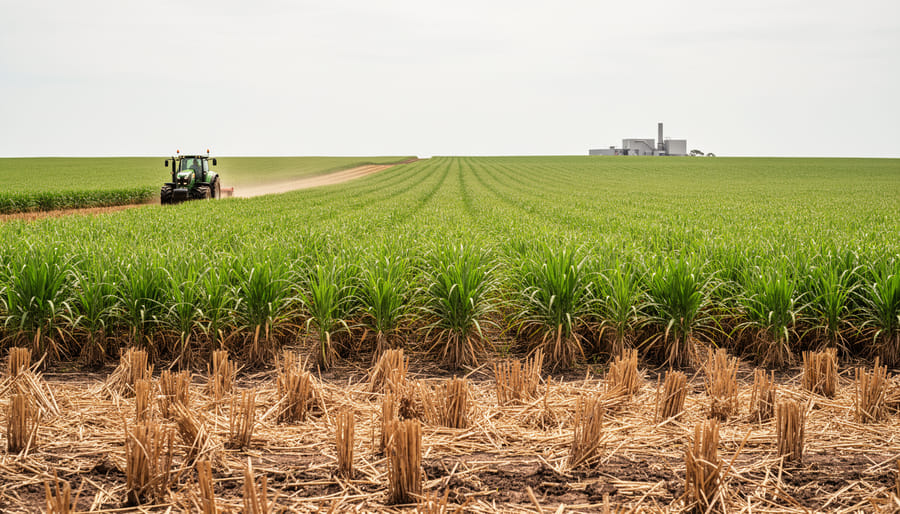
Monoculture farming is the agricultural practice of growing a single crop species across large expanses of land, year after year. Step into any major farming region in Australia, from the wheat fields stretching across Western Australia to the endless sugarcane rows in Queensland, and you’ll witness this approach firsthand.
This farming method dominates modern agriculture for straightforward reasons: it simplifies operations, allows farmers to specialize their equipment and expertise, and generates predictable yields that feed global supply chains. When you plant thousands of hectares with one crop type, everything from seeding to harvesting becomes more efficient. Tractors don’t need retooling, workers master specific tasks, and bulk buyers know exactly what they’re getting.
But this efficiency comes at a cost. The same fields that produce record harvests also create environmental challenges that ripple through ecosystems. Soil degradation accelerates when the same crop depletes identical nutrients year after year. Pest populations explode when their preferred food source covers entire landscapes. Chemical inputs increase as farmers battle these problems, and biodiversity plummets when natural habitats give way to uniform crops.
Here’s where the story gets interesting for Australia in 2026. Those vast fields generating agricultural waste, the leftover stalks and stubble that once seemed like a disposal problem, now represent untapped bioenergy potential. Farmers across the country are discovering that monoculture residues can power rural communities, reduce reliance on fossil fuels, and create new revenue streams. What started as an environmental concern is transforming into a renewable energy opportunity that makes economic sense.
Understanding monoculture means recognizing both its industrial logic and its ecological impact, then finding practical ways forward.
Understanding Monoculture Farming: The Basics
How Monoculture Differs from Traditional Farming
Traditional Australian farming looked nothing like the vast single-crop fields dominating today’s landscape. For generations, farmers practised crop rotation, alternating wheat with legumes or pasture to naturally replenish soil nutrients and break pest cycles. They ran mixed farming operations where crops grew alongside livestock, creating a self-sustaining cycle where animals grazed stubble and their manure fertilized the next season’s planting.
Polyculture, growing multiple crops together in the same field, was common in smaller holdings, particularly among Indigenous agricultural practices and early settlers who intercropped complementary species. These traditional systems mirrored natural ecosystems, with diversity providing built-in resilience against disease, pests, and weather variability.
Monoculture flips this approach entirely. Rather than rotating crops or mixing species, farmers dedicate entire fields to a single crop year after year. Where traditional methods relied on biological diversity to maintain soil health and manage pests, monoculture depends on external inputs: synthetic fertilizers replace natural nutrient cycling, and pesticides substitute for the pest control diversity once provided. The shift delivered unprecedented efficiency and scale but severed the ecological relationships that sustained Australian farmland for centuries.
Why Farmers Choose Monoculture
Farmers embrace monoculture for straightforward reasons that directly affect their bottom line. Specialized machinery designed for a single crop slashes labour costs and harvest time. When you’re planting 500 hectares of wheat, using the same equipment throughout the season is far simpler than switching between multiple crops with different requirements.
The economics stack up quickly. Bulk purchasing seeds, fertilizers, and pesticides for one crop costs less per unit. Standardized processes mean workers need fewer skills, and the entire operation runs more predictably. Australian grain farmers, for instance, can negotiate better prices when delivering truckloads of uniform wheat rather than mixed produce.
Market demand drives the choice too. Food processors and commodity buyers want consistent supply of specific crops. A sugarcane farmer in Queensland knows exactly where their harvest will go and at what price, removing the uncertainty that comes with diversified farming. This predictability lets farmers secure financing, plan investments, and manage risk, critical factors when operating on thin margins. The system rewards specialization, making monoculture the logical choice despite its environmental trade-offs.
The Environmental Reality: What Monoculture Does to Our Land
Soil Health Under Pressure
Australia’s agricultural soils face a crisis that monoculture farming intensifies with each planting season. Repeatedly growing the same crop strips the ground of specific nutrients at accelerated rates, creating an imbalance that weakens the entire soil structure. Wheat fields might exhaust nitrogen, while sugarcane plantations drain phosphorus, forcing farmers into a cycle of ever-increasing fertiliser applications to maintain yields.
Erosion becomes inevitable without the diverse root systems that naturally anchor topsoil. Research shows that intensive monocropping harms soil quality far more severely than organic farming practices, accelerating the loss of precious topsoil during wind and rain events. For Australian farmers already contending with some of the oldest, most weathered soils on the planet, this erosion represents an irreplaceable loss of productive capacity.
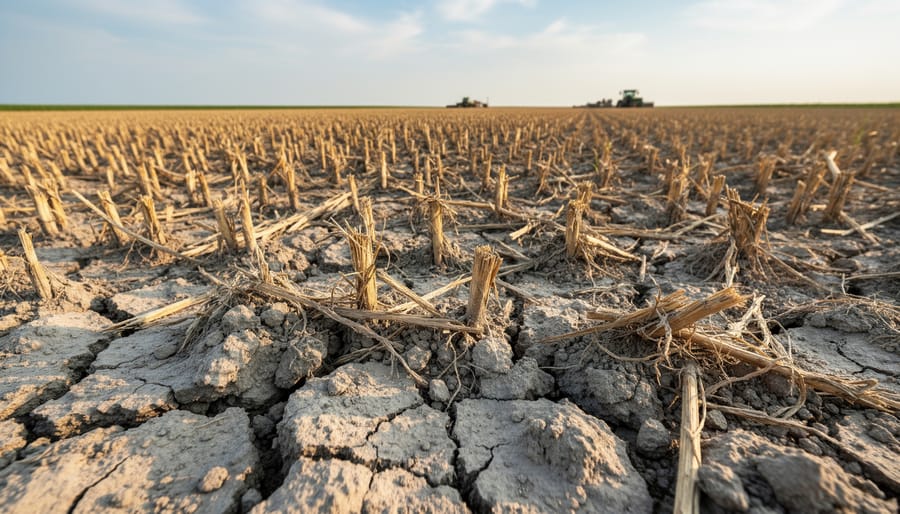
The degradation runs deeper than nutrient depletion. Soil organic matter, the living component that holds water, supports beneficial microbes, and maintains structure, declines steadily under continuous monoculture. Fields become compacted and lifeless, requiring more water and inputs to produce the same harvest. What starts as an efficient farming method gradually transforms productive land into ground that struggles to support anything without intensive chemical support, creating a concerning trajectory for long-term food production across the continent.
The Chemical Dependency Cycle
Monoculture fields exhaust soil nutrients at an accelerated rate because the same crop draws identical mineral elements year after year, leaving the ground progressively depleted. Farmers compensate by applying synthetic fertilizers, often in quantities exceeding what the plants can fully absorb. Excess nitrogen and phosphorus then leach into groundwater or wash into nearby rivers and coastal areas during rainfall, fueling algal blooms that suffocate aquatic life. The US Environmental Protection Agency identifies agriculture nonpoint pollution as a major contributor to water quality degradation across farming regions.
Pest pressure intensifies when the same host crop blankets a landscape season after season, creating perfect conditions for specialist insects, weeds, and diseases to multiply unchecked. Farmers respond with escalating pesticide applications, and resistant strains inevitably emerge, triggering further chemical escalation. This arms race drives input costs upward while residues accumulate in soil and water, threatening beneficial insects, birds, and downstream ecosystems.
Breaking this cycle demands more than willpower. Many Australian farmers are trialing enhanced efficiency fertilizers that release nutrients slowly and match plant uptake timing, cutting both waste and emissions. Others integrate biological pest controls or plant trap crops at field edges to disrupt pest life cycles without spraying entire paddocks. These adjustments acknowledge that monoculture’s chemical intensity isn’t inherent to scale, it’s a design choice we can rethink.
Economic Benefits and Hidden Costs
Monoculture farming thrives on economic logic that’s hard to ignore. Farmers invest in specialized equipment once, a single combine harvester, one set of seeding tools, one spray rig calibrated for a specific crop. That machinery runs continuously during planting and harvest, maximizing return on capital. Market relationships simplify too: a wheat grower negotiates with wheat buyers, understands wheat futures, and builds expertise in one commodity rather than juggling multiple supply chains.
The financial appeal extends to labour and timing. Training workers to manage one crop is faster than teaching diverse cultivation methods. Harvesting wheat across 500 hectares takes days instead of the weeks required to handle rotational crops at different maturity stages. Predictable yields let farmers secure forward contracts, stabilize cash flow, and plan equipment upgrades with confidence. For regional economies dependent on grain exports or sugarcane processing, this concentration creates processing infrastructure, transport networks, and service businesses built around a single agricultural product.
- Specialized machinery reduces per-hectare equipment costs through continuous use
- Streamlined harvest timing and labour management improve operational efficiency
- Simplified market relationships and forward contracts stabilize farm income
- Economies of scale lower input costs through bulk purchasing
- Soil degradation increases long-term fertilizer expenses and reduces productivity
- Single-crop dependency makes farms vulnerable to market price collapses
- Pest or disease outbreaks can devastate entire operations without crop diversity
- Rising chemical input costs squeeze profit margins over time
Yet the hidden costs accumulate silently. Depleted soils demand more fertilizer each season, turning a one-time advantage into a recurring expense that climbs annually. When monoculture increases risk of crop failure, a single disease outbreak or price crash can wipe out a year’s income with no backup revenue stream. Farmers locked into wheat contracts face disaster when global prices drop, while those with diversified crops can shift market focus.
Australian growers are exploring middle-ground strategies. Many farmers are seeing value in on-farm efficiency and trialing enhanced efficiency fertilizers that help cut emissions while reducing input volumes. These products deliver nutrients more precisely, lowering both environmental impact and the recurring cost burden that erodes monoculture’s profitability. The calculation is shifting: efficiency gains that once justified monoculture now also apply to more sustainable practices, letting farmers capture economic benefits without accepting every environmental trade-off. Smart integration of new technologies preserves the scale advantages while building resilience against the mounting costs of degraded land and climate unpredictability.
Food Security in Focus: Lessons from Global Strategies
Countries worldwide are rethinking how monoculture farming fits into food security as global supply chains show increasing vulnerability. Canada’s National Food Security Strategy offers a practical blueprint worth studying. The Canadian approach centers on reducing dependence on imports and building resilience against external disruptions through domestic processing capacity and technological innovation.
Canada’s strategy tackles a reality many nations face: growing massive quantities of raw crops only to export them, then importing processed food at higher costs. Their solution involves processing more domestically grown food within the country and deploying technology to extend growing seasons for crops previously limited by climate. Vertical farming, greenhouse innovations, and controlled-environment agriculture let Canada produce foods year-round that monoculture systems couldn’t traditionally support at scale.
Australia faces similar opportunities. We export wheat, barley, and canola in enormous volumes while importing processed foods that could originate from those same crops. Our climate advantage means we already grow diverse crops across different regions, yet monoculture dominates individual farms. Technology offers pathways to diversify without abandoning efficient monoculture methods where they work best.
The lesson isn’t that monoculture must disappear. Instead, it’s about strategic diversification at regional and national levels. A wheat farm might remain monoculture but contribute residues for bioenergy processing nearby, while other farms in the region rotate different crops. This creates food security through regional diversity rather than forcing every farm to grow multiple crops simultaneously.
Australia’s agricultural research strengths and renewable energy ambitions position us well to adapt these strategies. Combining efficient monoculture production with value-added processing, technological crop expansion, and bioenergy integration could strengthen our food security while maintaining export competitiveness.
The Bioenergy Opportunity: Turning Monoculture Residues into Renewable Energy
Monoculture’s environmental challenges present an unexpected advantage: the sheer volume of crop residues left behind offers Australia a powerful pathway toward energy independence. Every harvest of sugarcane, wheat, or corn leaves behind biomass that many farmers once burned or left to decompose. Now, forward-thinking producers are discovering these residues represent valuable energy feedstock.
Sugarcane bagasse leads Australia’s biomass success stories. Mills across Queensland already generate electricity from the fibrous waste remaining after juice extraction. What once clogged disposal systems now powers processing facilities and feeds electricity back into regional grids. Wheat straw follows a similar trajectory. Farmers in New South Wales and Victoria are partnering with biomass processors to turn farm waste into pellets for heating and power generation, creating additional income from material that previously held no commercial value.
The scale matters. Australia’s abundant biomass from monoculture operations produces millions of tonnes of residues annually. Converting even a fraction into bioenergy creates substantial renewable capacity while solving waste management headaches. Corn stalks, cotton stalks, and canola stubble all contain energy potential waiting for collection infrastructure to catch up with opportunity.
Real farmers are already benefiting. A grain grower outside Dubbo recently added a biomass collection agreement to his wheat operation, earning an extra income stream while reducing fire risk from stubble. A sugarcane producer in Bundaberg invested in cogeneration equipment that cuts his energy bills by two-thirds. These aren’t experimental projects anymore; they’re profitable additions to existing operations.
The environmental math works too. Bioenergy from crop residues offers significantly better life cycle emissions than fossil fuels, particularly when the alternative is open burning of stubble. Capturing that energy creates value while reducing atmospheric carbon.
This transformation doesn’t require farmers to abandon monoculture’s efficiency advantages. It simply adds another output to the same input, turning what grows anyway into dual-purpose production: food and fuel from one field.
Moving Forward: Sustainable Alternatives and Hybrid Approaches
Australian farmers are proving that moving away from strict monoculture doesn’t mean abandoning efficiency. By integrating regenerative agriculture practices with modern precision tools, they’re creating hybrid systems that maintain productivity while rebuilding soil health and resilience.
Crop rotation has made a comeback on progressive farms across the grain belt. Rather than growing wheat year after year, farmers are alternating cereals with nitrogen-fixing legumes like chickpeas or lentils, cutting fertilizer costs by up to 30 percent while breaking pest and disease cycles. A Western Australian broadacre operation recently documented how a three-year rotation system reduced herbicide applications by half and increased overall profitability despite slightly lower per-crop yields.
Cover cropping between main harvests is another strategy gaining traction. Growers plant fast-growing species like oats or clover during fallow periods to protect bare soil from erosion, suppress weeds, and add organic matter. These covers get incorporated back into the soil or harvested as livestock feed, creating dual benefits. In southern New South Wales, cotton farmers using winter cover crops report measurably improved water infiltration and soil structure within two seasons.
For those ready to transition toward more diverse systems, the path forward involves practical steps:
- Start small with a test paddock rotating just two crops instead of converting the entire property at once.
- Invest in soil testing to establish baseline health metrics and track improvement over time.
- Trial enhanced efficiency fertilizers that deliver nutrients more precisely, reducing runoff and emissions while maintaining yields.
- Explore local markets for diverse crops to ensure economic viability before scaling up rotation systems.
- Connect with sustainable farming networks and extension services for ongoing technical support and peer learning.
Precision agriculture technology makes these hybrid approaches more practical than ever. GPS-guided equipment allows farmers to vary inputs across a single field based on soil conditions, applying fertilizer and water only where needed. Drone imagery identifies stress zones early, enabling targeted interventions rather than blanket treatments. A Queensland sugarcane producer using variable-rate nitrogen application cut inputs by 20 percent while maintaining tonnage, proving that sustainability and profitability aren’t opposing goals.
Agroforestry is emerging as a long-term strategy for properties with suitable layouts. Integrating tree belts into cropping systems provides windbreaks, creates wildlife corridors, and generates timber or biomass income streams. Several Victorian farms have planted strategic tree rows that reduce wind erosion on exposed paddocks while producing eucalyptus biomass for local energy projects, demonstrating how diversification creates multiple revenue opportunities.
Monoculture farming, the practice of cultivating a single crop type on a specific field, remains agriculture’s great paradox. It delivers the efficiency and scale that feed millions, yet places enormous strain on the very soil, water, and ecosystems that underpin long-term food production. As we’ve explored, this approach accelerates soil erosion, creates chemical dependencies, and reduces biodiversity, even as it simplifies operations and meets immediate market demands.
Australia stands at a crossroads. Our farmers already understand the trade-offs inherent in intensive cropping systems, and many are actively testing enhanced efficiency fertilizers and precision technologies that reduce environmental impact without sacrificing productivity. The real opportunity lies not in abandoning monoculture entirely, an unrealistic ask given global food demands, but in reimagining what these systems can become.
The bioenergy potential from monoculture residues offers a tangible path forward. Sugarcane bagasse, wheat straw, and corn stalks that once represented waste now fuel renewable energy projects, creating additional income streams while addressing climate challenges. This integration transforms monoculture from a purely extractive practice into one that contributes to Australia’s clean energy transition.
We can build an agricultural future where efficiency and environmental stewardship aren’t opposing forces. By embracing innovation, diversifying approaches where possible, and capturing value from every part of the crop, Australian agriculture can demonstrate that productive farming and planetary health work best together.