
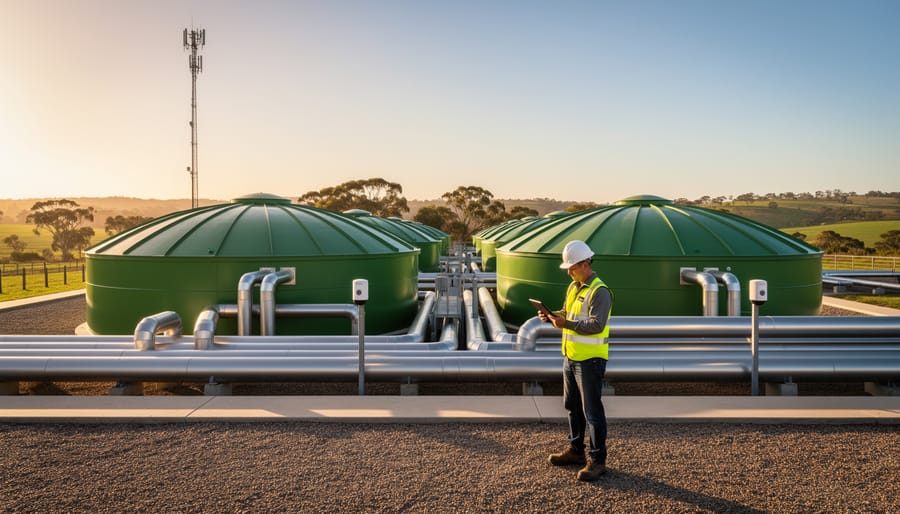
Searching for “7G networks” reveals a common misconception: this technology doesn’t exist yet. Mobile networks currently peak at 5G, with most Australian providers still rolling out this fifth-generation technology across major cities and regional areas. While 6G remains in early research phases with a potential 2030 deployment, understanding how today’s 5G connectivity is already transforming Australia’s renewable energy landscape delivers far more practical value than chasing fictional technology.
Australia’s bioenergy sector is harnessing 5G’s real-world capabilities to revolutionize how we produce and manage sustainable power. Remote monitoring systems now track biogas production at cattle stations across Queensland in real-time, enabling farmers to optimize waste-to-energy conversion without constant physical oversight. Agricultural producers are using 5G-enabled sensors to measure feedstock moisture levels, temperature fluctuations, and decomposition rates at biomass facilities, ensuring maximum energy output while minimizing waste.
The ultra-low latency of 5G networks allows instant adjustments to bioenergy systems when conditions change. A sugar mill in North Queensland recently cut its energy costs by 23% using connected sensors that automatically adjust bagasse processing based on humidity readings transmitted every few seconds. Urban waste management facilities in Melbourne are deploying 5G-connected sorting systems that identify optimal organic materials for anaerobic digestion, increasing biogas yields by up to 30%.
This technological foundation positions Australia’s bioenergy sector for exponential growth, proving that current connectivity solutions deliver transformative results today rather than waiting for tomorrow’s theoretical networks.
Clearing Up the Mobile Network Confusion
Where We Actually Are: The 5G Reality
Before we leap into future technologies, let’s ground ourselves in where Australia’s mobile connectivity actually stands today. The rollout of 5G across the country has been progressing steadily since 2019, with major cities now enjoying robust coverage. However, the story changes quite dramatically once you venture beyond metropolitan areas.
For regional and rural Australia—precisely where many bioenergy facilities operate—5G coverage remains patchy at best. According to recent data, while Sydney and Melbourne boast impressive 5G networks, towns like Wagga Wagga, Dubbo, and Bundaberg are still establishing basic infrastructure. This digital divide matters enormously for bioenergy operations that could benefit from real-time monitoring, automated systems, and data-driven decision-making.
The good news? Telcos are actively expanding their regional footprint, recognizing that agriculture and renewable energy sectors need reliable connectivity. Some forward-thinking bioenergy facilities have successfully partnered with telecommunications providers to prioritize coverage in their areas, creating win-win scenarios. For smaller operations, 4G networks combined with satellite backup are proving surprisingly effective for essential monitoring tasks. The reality is that we’re working with 5G’s current capabilities, not science fiction, and that’s actually enough to transform how bioenergy facilities operate across Australia.
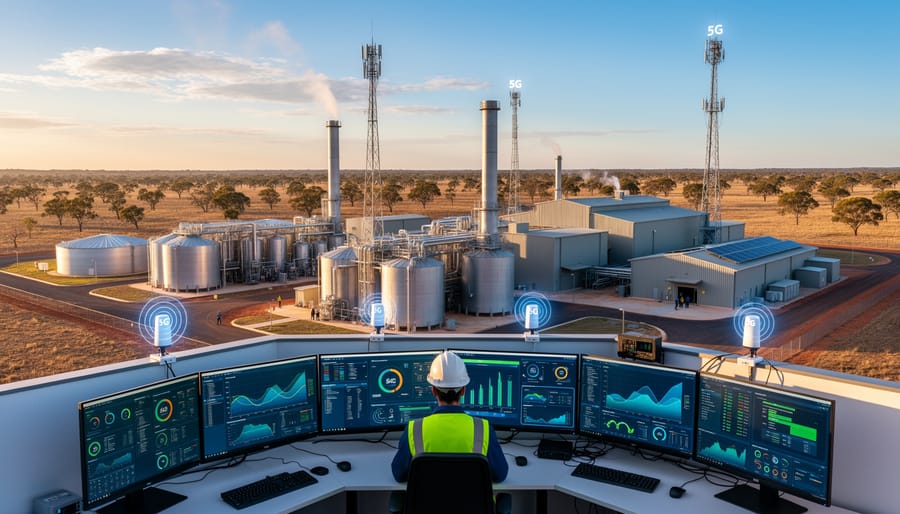
How 5G Is Revolutionising Bioenergy Operations Right Now
Real-Time Monitoring of Biomass Processing
Picture a bioenergy plant in regional Queensland where operators once relied on manual checks every few hours to monitor critical processes. Today, thanks to 5G technology, they’re receiving real-time updates every second from sensors throughout their facility, transforming how they manage biomass conversion.
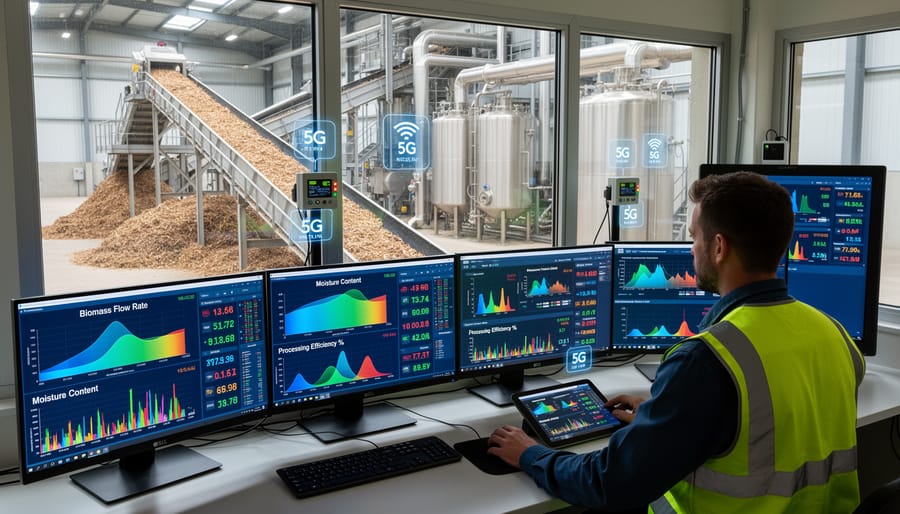
The game-changer here is instant data transmission. Traditional monitoring systems often experienced delays or required workers to physically inspect equipment, creating gaps where problems could develop unnoticed. With 5G connectivity powering 5G IoT devices, sensors now continuously track temperature fluctuations in digesters, moisture levels in biomass feedstock, and conversion efficiency rates across the entire operation.
This matters enormously for plant performance. When temperature sensors detect even slight variations in anaerobic digesters, operators receive immediate alerts on their mobile devices, allowing them to make adjustments before efficiency drops or equipment damage occurs. Moisture monitoring ensures feedstock enters processing at optimal levels, maximizing energy output from every tonne of biomass.
A facility near Toowoomba recently reported a 15 percent improvement in conversion efficiency after implementing 5G-enabled monitoring. Their operations manager explained that catching issues within seconds rather than hours meant fewer production interruptions and significantly reduced waste.
The beauty of this technology lies in its simplicity for users. Plant operators don’t need advanced technical training to benefit from sophisticated sensor networks that analyse thousands of data points simultaneously, making renewable energy production more reliable and economically viable across Australia.
Smarter Energy Distribution Networks
Advanced connectivity is transforming how Australia’s bioenergy facilities interact with the power grid, creating smarter, more responsive energy systems. Think of it like upgrading from a one-way street to a dynamic highway system where traffic flows smoothly in both directions. With 5G networks enabling real-time communication, bioenergy plants can now respond instantly to fluctuating electricity demands across the grid.
This enhanced connectivity allows operators to adjust energy output within seconds rather than hours, ensuring power flows exactly when and where it’s needed most. During peak demand periods, facilities can ramp up production, while scaling back during quieter times to maximize efficiency. The technology also enables predictive maintenance, with sensors continuously monitoring equipment performance and alerting operators before problems arise.
The results are impressive. Queensland’s bioenergy facilities using advanced smart grid integration have achieved 23% better resource utilization while reducing operational costs. These systems essentially create an intelligent conversation between renewable energy producers and consumers, optimizing the entire network. For Australia’s journey toward net-zero emissions, this technology represents a practical leap forward, proving that sustainable energy can be both reliable and responsive to our changing needs.
Remote Management of Regional Facilities
Australia’s tyranny of distance has long challenged energy operators managing facilities across remote regions, but advanced connectivity is changing the game. Bioenergy operators are now remotely monitoring and controlling facilities from Perth to Townsville, slashing travel costs and response times while improving operational efficiency.
Take Queensland’s agricultural bioenergy sites, where operators previously spent days travelling between locations. Today’s enhanced mobile networks enable real-time monitoring of biogas production, equipment performance, and energy output from centralised control rooms. When issues arise at a facility near Dubbo, technicians can diagnose problems remotely and dispatch maintenance teams with the right equipment already loaded, eliminating multiple site visits.
This connectivity proves particularly valuable during emergencies. Operators can quickly shut down systems, adjust processes, or redirect resources without physical presence, protecting both infrastructure and personnel. For regional communities hosting these facilities, this means more reliable energy supply and faster problem resolution, making bioenergy an increasingly practical choice for Australia’s decentralised energy future.
Australian Success Stories: 5G-Connected Bioenergy in Action
Queensland Sugarcane Mill Goes High-Tech
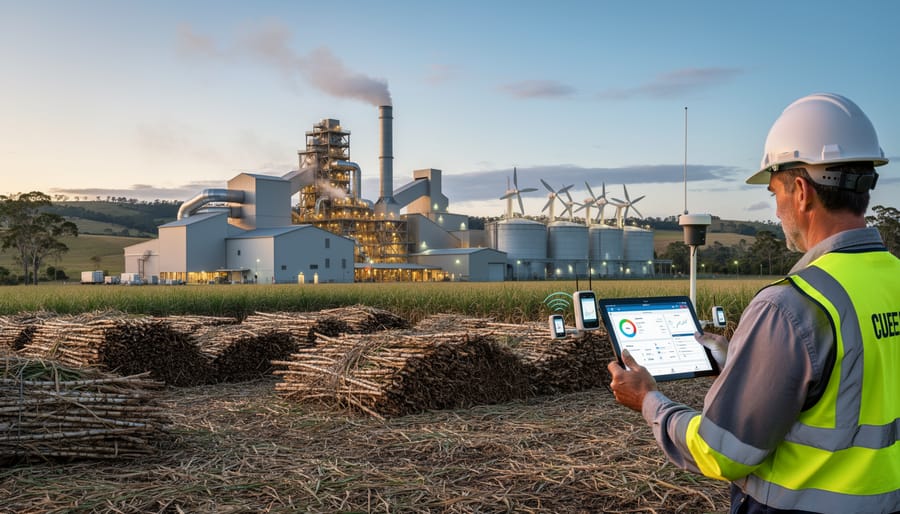
In the heart of Queensland’s sugarcane country, the Proserpine Mill is showing how smart connectivity is transforming traditional agriculture into a powerhouse of renewable energy. This facility has embraced advanced 5G technology to squeeze every last bit of value from bagasse, the fibrous residue left after crushing sugarcane.
The mill now generates enough electricity to power itself and feed surplus energy back into the local grid, providing clean power to approximately 15,000 homes during crushing season. But here’s where the technology gets really clever: 5G-enabled sensors throughout the facility monitor moisture levels, combustion efficiency, and turbine performance in real-time. This means operators can make split-second adjustments that maximise energy output while minimising waste.
The results speak for themselves. Since implementing enhanced connectivity systems, the mill has increased its energy efficiency by 18 percent and reduced maintenance costs significantly. Equipment failures are predicted before they happen, keeping the facility running smoothly throughout the demanding harvest period.
What’s particularly exciting is how this Queensland success story demonstrates the practical marriage of agricultural heritage with cutting-edge technology. It’s not about replacing traditional industries but rather giving them the tools to thrive sustainably. Other sugarcane mills across the state are now looking to follow Proserpine’s lead, proving that regional Australia can be at the forefront of the renewable energy revolution.
Victorian Dairy Farm Waste Turns Profitable
At Gippsland’s Tarwin Valley, dairy farmer Michael Chen has transformed what was once a costly waste problem into a revenue stream that’s turning heads across regional Victoria. His 400-cow operation now generates enough renewable energy to power the entire farm, with surplus electricity feeding back into the grid.
The secret? A sophisticated biogas system enhanced by 5G-connected sensors that monitor methane production in real-time. These smart devices track everything from temperature and pH levels in the anaerobic digester to gas flow rates and energy output, sending constant updates to Michael’s smartphone and computer.
“We’re capturing methane that would’ve just escaped into the atmosphere and turning it into clean energy,” Michael explains. “The connected sensors have been a game-changer. They alert me immediately if something’s off, so we can fix issues before they impact production.”
The system has boosted methane capture efficiency by 23% compared to traditional setups. The data insights allow Michael to fine-tune feeding schedules and adjust digester conditions for optimal gas production. What’s more, the renewable energy certificates he earns provide an additional income stream worth thousands annually.
For regional dairy farmers facing rising energy costs and tightening environmental regulations, Michael’s success demonstrates how smart connectivity can transform agricultural waste into genuine opportunity.
The Practical Benefits for Australia’s Bioenergy Future
Lower Operating Costs Through Predictive Maintenance
Connected bioenergy systems powered by advanced mobile networks are transforming how Australian facilities manage their operations, delivering substantial cost savings through smarter equipment monitoring. Rather than waiting for machinery to fail—resulting in expensive emergency repairs and production losses—operators can now track equipment health in real-time and address issues before they escalate.
Take the experience of a Queensland biomass facility that implemented network-connected sensors across their processing equipment. Within the first year, they reduced unplanned downtime by 60 percent and slashed maintenance costs by nearly half. The sensors continuously monitor vital signs like temperature, vibration, and performance metrics, alerting operators to potential problems days or weeks before breakdowns occur.
This shift from reactive to proactive maintenance represents a game-changer for the bioenergy sector. Predictive maintenance technologies allow operators to schedule repairs during planned maintenance windows, order parts in advance, and keep production running smoothly. The environmental benefits extend beyond energy generation—preventing catastrophic equipment failures means avoiding material waste and reducing the carbon footprint associated with emergency logistics and rushed manufacturing of replacement components.
Better Integration with Solar and Wind
While the notion of “7G” networks might be getting ahead of ourselves, today’s 5G connectivity is already proving brilliant at helping bioenergy systems work hand-in-glove with solar and wind power. Here’s the thing: sunshine and wind are wonderfully clean, but they’re also unpredictable. The sun doesn’t shine at night, and wind doesn’t blow on schedule.
This is where bioenergy becomes a real champion. With advanced connectivity, bioenergy plants can receive real-time data about when solar panels and wind turbines are producing less power, then ramp up production to fill those gaps seamlessly. Smart sensors and rapid data transmission allow these systems to respond within minutes, ensuring Australians always have reliable electricity without firing up fossil fuel plants.
Take South Australia’s experience, where integration with solar and wind has created one of the world’s most resilient renewable energy grids. Connected bioenergy facilities monitor weather patterns, energy demand, and renewable output simultaneously, adjusting their operations to maintain perfect balance.
This connectivity transforms what could be competing technologies into a coordinated team, making our clean energy future both achievable and dependable.
What’s Coming Next: 6G and Beyond
While 7G remains firmly in the realm of speculation, the genuine pathway forward is considerably more grounded. International standards bodies are currently mapping out 6G networks, with commercial deployment expected around 2030. These next-generation networks will build incrementally on 5G’s foundation, offering enhanced speed, lower latency, and improved energy efficiency rather than revolutionary leaps.
For Australia’s bioenergy sector, this evolution matters because it’ll enable more sophisticated monitoring across larger distributed energy systems. Imagine biogas plants in regional Queensland communicating seamlessly with energy grids, or biomass facilities adjusting operations in real-time based on more precise data streams. The improvements won’t be dramatic overnight, but they’ll be meaningful.
What’s particularly promising is that 6G development prioritises sustainability itself. Engineers are designing these networks to consume less power while handling more data, which aligns perfectly with renewable energy goals. By the time we’re seriously discussing 7G networks, perhaps in the 2040s, they’ll likely represent further refinements rather than completely new technology.
The real opportunity isn’t waiting for some distant breakthrough. It’s harnessing today’s 5G capabilities whilst staying prepared for steady improvements. Australian bioenergy operators who build strong digital foundations now will be best positioned to benefit from each incremental advancement. That’s the realistic, practical path forward – one that values continuous improvement over waiting for the next big thing that may not arrive as imagined.
While 7G networks remain firmly in the realm of science fiction, the real revolution is unfolding right now across Australia with 5G technology. This isn’t about waiting for tomorrow’s innovations – it’s about seizing today’s opportunities to transform our bioenergy sector through proven connectivity solutions.
From remote biomass facilities in regional Queensland to innovative waste-to-energy plants in Victoria, 5G networks are already delivering measurable improvements in efficiency, sustainability, and profitability. Smart sensors optimise feedstock processing, predictive analytics reduce downtime, and real-time monitoring ensures maximum output while minimising environmental impact.
The time for action is now. Whether you’re a policymaker shaping Australia’s renewable energy future, an industry professional seeking competitive advantages, or an environmental advocate championing sustainable solutions, embracing current 5G technology offers immediate, tangible benefits. Don’t let futuristic concepts like 7G distract from the powerful tools available today.
We encourage all stakeholders to explore how existing connectivity infrastructure can enhance your bioenergy operations. Partner with telecommunications providers, invest in smart monitoring systems, and join the growing network of Australian innovators proving that sustainable energy and advanced technology go hand in hand. The future of bioenergy is connected, and it starts with the decisions we make today.