
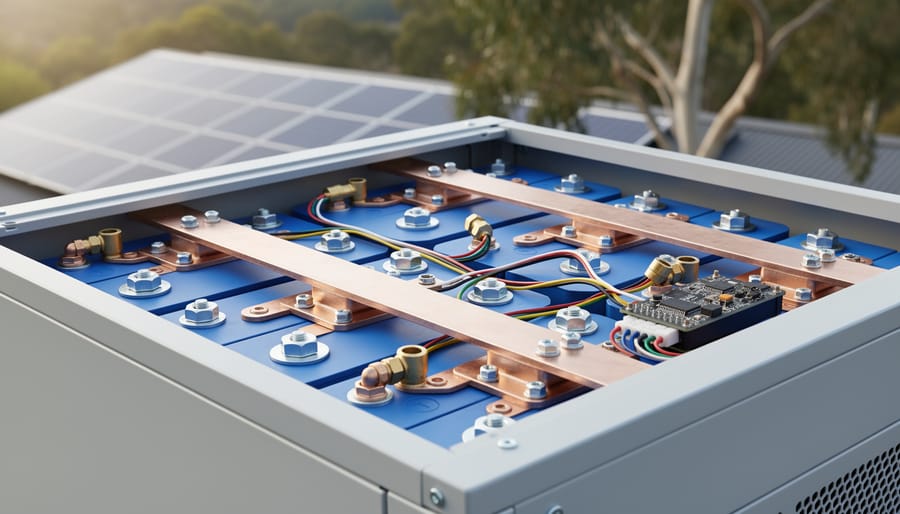
Understand that a Battery Management System (BMS) serves as the intelligent guardian of your LiFePO4 battery, monitoring cell voltages, temperatures, and current flows to prevent the premature degradation that costs Australian households and businesses thousands in replacement expenses. Choose a BMS with cell balancing capabilities that equalizes charge across individual cells, extending your battery bank’s working life from the typical 3,000 cycles to beyond 6,000 cycles—a difference that transforms a decade-long investment into two decades of reliable service. Verify your BMS includes temperature monitoring with automatic shutdown protocols, particularly crucial in Australia’s harsh climate where summer heat accelerates battery aging and creates safety risks if left unmanaged. Select systems with State of Charge (SOC) accuracy within 5% to optimize your battery storage solutions, ensuring you neither overcharge nor deeply discharge your cells beyond safe thresholds.
The reality is that LiFePO4 batteries represent significant capital investment for solar installations, off-grid systems, and commercial renewable energy projects across Australia. Without proper management, these batteries fail prematurely, undermining both financial returns and sustainability goals. A quality BMS transforms your battery from a vulnerable component into a robust, long-lasting energy asset that maximizes your renewable energy independence while supporting Australia’s transition toward cleaner power generation. Understanding BMS technology empowers you to protect your investment and contribute meaningfully to our collective energy future.
What Makes LiFePO4 Batteries Different (And Why They Need Special Care)
The Chemistry Behind the Longevity
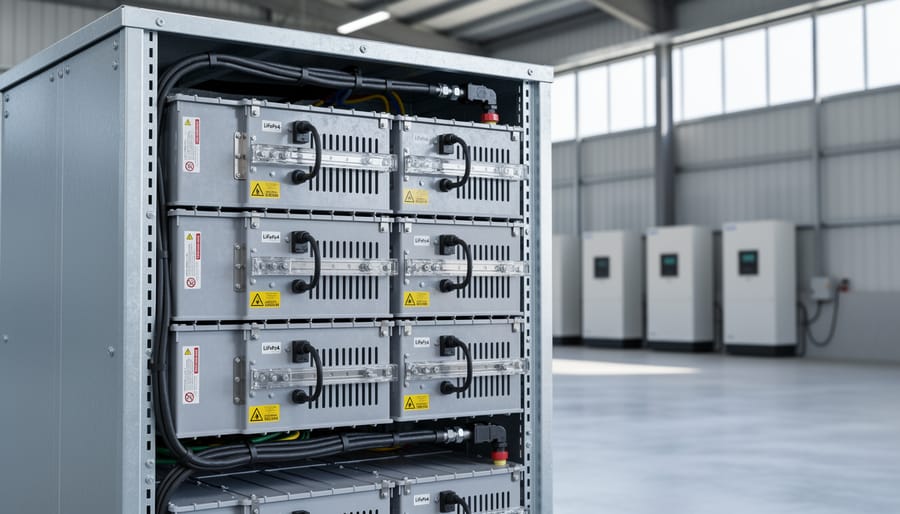
LiFePO4 batteries have earned their reputation as the workhorses of renewable energy storage, and understanding their chemistry reveals why they’re such a smart investment for Australian households and businesses. Unlike traditional lithium-ion batteries, LiFePO4 (lithium iron phosphate) chemistry creates incredibly stable molecular bonds. Think of it like building with Australian hardwood rather than softwood—the structure simply lasts longer under stress.
The iron phosphate cathode material resists thermal runaway, meaning these batteries stay cool-headed even during our scorching summer days. This chemical stability translates directly into impressive cycle life—typically 3,000 to 5,000 charge cycles compared to 500-1,000 for conventional batteries. That’s potentially ten years or more of reliable service in everyday applications.
What makes this chemistry particularly brilliant for sustainable energy systems is its tolerance for partial charging. Solar installations rarely deliver perfectly consistent power throughout the day, yet LiFePO4 batteries handle this variability without degrading. The phosphate bonds remain stable whether you’re drawing power during evening peak times or storing excess energy from midday sun.
A Battery Management System leverages these inherent chemical advantages, ensuring each cell operates within its optimal range. This partnership between robust chemistry and intelligent monitoring creates a battery system that genuinely pays environmental and financial dividends over its extended lifespan.
Where LiFePO4 Shines in Australian Renewable Energy
Across Australia, LiFePO4 batteries paired with advanced battery management systems are transforming how we store and use renewable energy. In suburban Adelaide, homeowners are coupling these systems with rooftop solar, creating reliable energy independence that slashes power bills whilst reducing grid strain. The combination of smart storage systems and LiFePO4 technology means solar energy captured during the day powers homes well into the evening.
Remote agricultural operations are experiencing remarkable success too. A wheat farm in regional New South Wales recently installed a LiFePO4 system with sophisticated BMS protection, enabling complete off-grid operation for critical infrastructure like irrigation pumps and grain storage facilities. The BMS ensures batteries perform reliably even during harsh summer conditions, protecting the substantial investment.
Community bioenergy projects are also benefiting. A Victorian biomass facility now uses LiFePO4 battery banks as backup power, with the BMS monitoring ensuring seamless transitions during grid interruptions. These real-world applications demonstrate how proper battery management extends beyond technical specifications, becoming the foundation for Australia’s renewable energy future whilst delivering tangible economic and environmental benefits to everyday Australians.
How Battery Management Systems Extend Your Investment
The Three Critical Functions Your BMS Must Perform
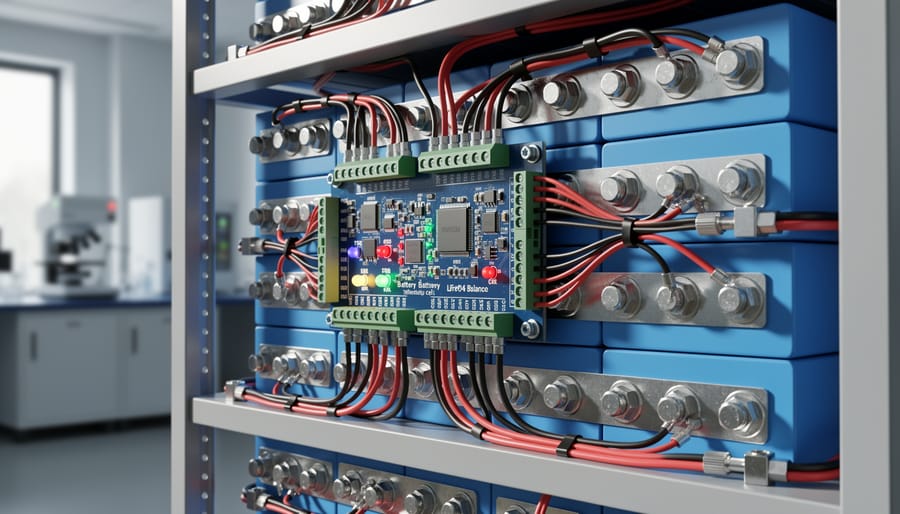
Think of your LiFePO4 battery pack like a rowing team—everyone needs to pull their weight evenly for optimal performance. That’s where your Battery Management System steps in as the coach, performing three essential functions.
First is cell balancing, which ensures every cell in your battery pack charges and discharges at the same rate. Just as one weak rower can slow down an entire crew, unbalanced cells force stronger cells to work harder, shortening the entire pack’s lifespan. A quality BMS redistributes energy between cells, keeping them working in harmony—crucial for the large-scale battery installations powering Australian renewable energy projects.
Second, voltage monitoring acts like a safety referee, constantly checking each cell stays within safe operating limits. Push voltage too high during charging, and you risk permanent damage. Let it drop too low during discharge, and you’ll accelerate degradation. Your BMS continuously tracks these boundaries, protecting your investment from the kind of damage that turns a 10-year battery into a 3-year disappointment.
Third, temperature management prevents overheating and cold-related performance issues. Advanced thermal management systems work alongside your BMS to maintain ideal operating temperatures—particularly important in Australia’s diverse climate zones, from tropical Queensland to temperate Victoria. Together, these three functions transform a collection of individual cells into a reliable, long-lasting energy storage system that maximizes your renewable energy investment while supporting Australia’s clean energy transition.
Protection That Pays for Itself
A quality BMS is like having a vigilant guardian watching over your investment around the clock. Consider this real-world comparison: a typical 10kWh LiFePO4 battery system for a Queensland home costs approximately $8,000. Without proper BMS protection, overcharging can reduce battery lifespan by 40%, meaning you’d need replacement after just 6 years instead of the expected 10-15 years. That’s a $3,200 loss in value.
The financial benefits stack up quickly. BMS prevents overcharging by cutting power flow when cells reach capacity, avoiding the damaging voltage stress that degrades battery chemistry. It also guards against deep discharge, stopping your battery from draining below safe levels—a single deep discharge event can permanently reduce capacity by 20%.
Perhaps most importantly, BMS thermal management prevents dangerous thermal runaway. When a Brisbane solar installer recently analysed their maintenance records, they found that systems with quality BMS experienced zero thermal incidents over five years, while unprotected systems had a 12% failure rate requiring costly repairs averaging $2,500 each.
The numbers tell a compelling story: investing an additional $400-600 in a quality BMS typically saves Australian households between $2,000-4,000 over a battery’s lifetime through extended longevity and prevented failures.
Lifecycle Management: Getting Every Year Out of Your Battery
Smart Charging Strategies That Double Battery Life
Getting the most from your LiFePO4 battery isn’t rocket science—it’s about working with your BMS rather than against it. The good news? Modern battery management systems handle the heavy lifting automatically, but understanding the basics helps you make smarter decisions.
The golden rule for LiFePO4 longevity is maintaining a depth of discharge between 20-80%. Think of it like never letting your phone battery hit empty or constantly charging to 100%—the middle ground is the sweet spot. A quality BMS monitors this automatically, preventing your battery from venturing into those stress zones that accelerate degradation. Over a typical 10-year period, this practice alone can extend your battery cycles from 3,000 to beyond 6,000, essentially doubling your investment’s lifespan.
Temperature management is particularly crucial in Australia’s varied climate. From Darwin’s tropical heat to Hobart’s cool winters, your BMS constantly adjusts charging rates to protect battery health. During scorching summer days, the system might slow charging to prevent thermal stress, whilst in cooler conditions, it optimises performance differently.
Success stories are emerging across regional Australia, where off-grid homeowners report their LiFePO4 systems performing brilliantly for 7-8 years with minimal capacity loss—far exceeding initial expectations. The secret? Letting their BMS do what it’s designed to do: monitor voltage, balance cells, and maintain optimal charging parameters without human intervention. Set it up correctly from the start, and your battery practically looks after itself, delivering reliable, clean energy day after day.
Monitoring and Maintenance in the Real World
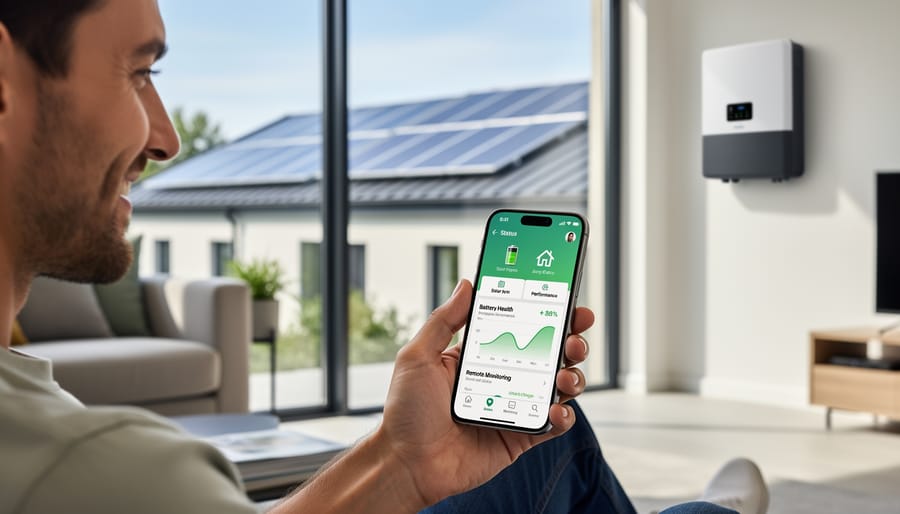
Modern LiFePO4 battery management systems make monitoring straightforward, particularly through smartphone apps that put real-time data at your fingertips. Most quality systems now offer Bluetooth or WiFi connectivity, allowing you to check battery health from anywhere on your property—or even remotely if you’re managing a rural installation while away.
For day-to-day monitoring, check your system weekly through the app, looking at state of charge, voltage levels, and cell balance. Monthly, review temperature trends and charging cycles to ensure everything’s operating within normal parameters. The beauty of contemporary BMS technology is that it does the heavy lifting automatically, alerting you only when attention’s needed.
Watch for these warning signs: sudden drops in capacity, one cell consistently reading lower than others, unusual temperature increases, or the BMS activating protection mode frequently. These indicators suggest it’s time for professional assessment.
For remote properties across regional Australia, mobile app monitoring has become a genuine game-changer. Farmers managing off-grid homesteads can monitor their battery systems from town, while caravan owners can check their setup before heading bush. Some systems even send automatic notifications if issues arise, giving you peace of mind wherever you are.
Success story: A Tasmanian eco-lodge owner monitors six separate battery banks across their property through a single app interface, catching a potential cell imbalance issue before it affected guest services. That’s the practical benefit of modern BMS monitoring—protection that works while you focus on what matters.
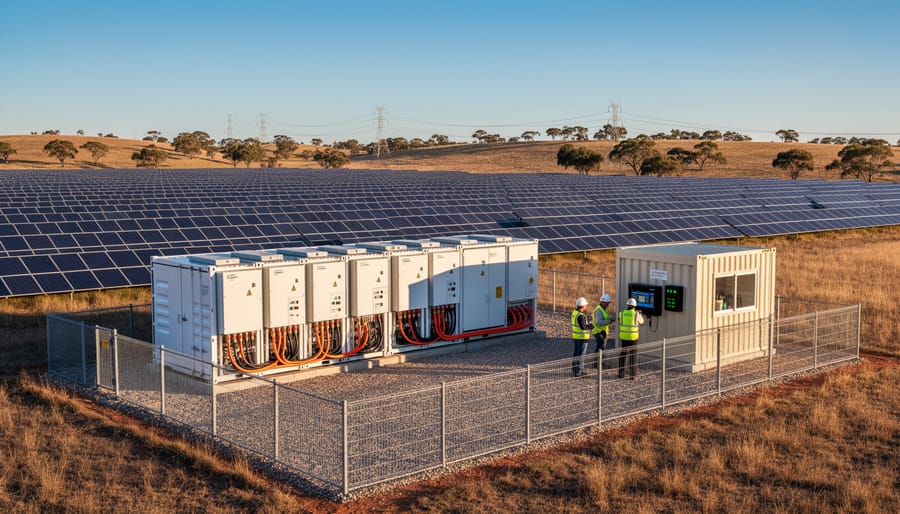
Success Story: Solar Farm Reduces Battery Replacement Costs by 60%
When the Mildura Solar Cooperative installed their 250kWh LiFePO4 battery bank in 2020, they faced a familiar problem. Their previous lead-acid system required battery replacements every three years, creating substantial costs and environmental waste. The team knew LiFePO4 batteries promised longer lifespans, but without proper management, they risked repeating expensive mistakes.
The cooperative invested in a comprehensive battery management system specifically designed for their LiFePO4 installation. The results have been remarkable. Three years on, their battery bank operates at 94% of original capacity, and projections suggest they’ll avoid replacement costs until at least 2030—potentially saving over $120,000 compared to their previous setup.
Project manager Sarah Chen explains the transformation: “The BMS changed everything. We can see exactly what’s happening with each cell in real-time. When temperatures spiked during that heatwave last summer, the system automatically adjusted charging rates and prevented damage we wouldn’t have spotted until it was too late.”
The installation wasn’t without challenges. Initial integration with their existing solar inverters required technical adjustments, and staff needed training to interpret BMS data effectively. However, the cooperative found these hurdles manageable with support from their installer.
The most significant breakthrough came from balancing. Their BMS actively equalizes charge across all cells, preventing the capacity degradation that plagued their old system. This seemingly simple function extended their expected battery life from roughly 5 years to a projected 12-15 years.
For the Mildura community, the benefits extend beyond cost savings. Reduced battery replacements mean less mining waste and fewer resources consumed. The cooperative now shares their data with neighboring farms considering similar installations, demonstrating that investing in quality battery management delivers returns environmentally and financially.
Their advice to others? Don’t skimp on the BMS. The upfront cost represents a fraction of potential battery replacement expenses, and the peace of mind alone justifies the investment.
Choosing the Right BMS for Your Renewable Energy Setup
What Features Actually Matter
When shopping for a BMS, you’ll encounter plenty of flashy features that sound impressive but may not actually protect your investment. Let’s focus on what genuinely matters for Australian conditions.
Cell balancing stands as the most critical feature—without it, your LiFePO4 cells will age unevenly, drastically shortening battery life. Active balancing outperforms passive systems, though it costs more. For a typical home solar setup, active balancing can extend your battery pack’s useful life by several years.
Temperature management is non-negotiable in Australia’s climate extremes. Your BMS should monitor individual cell temperatures and shut down charging when readings exceed safe limits. A Brisbane family recently shared how their temperature-protected system prevented damage during a scorching 42-degree heatwave—the BMS simply paused charging until conditions improved.
Communication capability deserves serious consideration. Bluetooth or WiFi connectivity allows you to monitor your system’s health from your phone, spotting problems before they become expensive failures. One solar installer in regional Victoria credits remote monitoring with saving clients thousands in preventable damage.
Current limiting protects against overcharging and excessive discharge rates. This feature prevents the dangerous situations that occasionally make headlines and ensures your warranty remains valid.
Now, what about those extras? RGB status lights and fancy displays are nice but unnecessary. Historical data logging helps troubleshoot issues but isn’t essential for basic operation. Waterproof ratings matter only for specific installations. Focus your budget on robust core protection features rather than bells and whistles—your battery bank will thank you with years of reliable service.
Sizing and Integration Considerations
Getting the sizing right from the start sets you up for success with your LiFePO4 battery system. Your BMS capacity must match your battery bank’s specifications—a 200Ah battery bank requires a BMS rated for at least that capacity, with a 20-30% buffer being smart practice for Australian conditions where summer temperatures can push systems harder.
Compatibility matters enormously when integrating with existing renewable energy setups. Modern BMS units communicate seamlessly with quality solar inverters, sharing critical data about charge states and system health. This two-way communication optimises charging cycles and prevents damage from overcharging or excessive discharge rates. When combining batteries with bioenergy systems, ensure your BMS can handle the specific voltage and current characteristics of your generator or biogas-powered system.
Scalability deserves careful consideration too. A Queensland farm recently started with a 10kWh battery system but chose a BMS designed for 30kWh expansion—when their energy needs grew two years later, adding capacity was straightforward and cost-effective. Look for modular BMS solutions that allow you to add battery banks without replacing the entire management system. This forward-thinking approach protects your investment and supports your growing renewable energy ambitions.
The Environmental Impact: Why Better Battery Management Matters for Australia’s Future
Australia’s journey toward a cleaner energy future depends on more than just installing solar panels and wind turbines—it hinges on how effectively we manage the batteries that store this renewable power. Every properly managed LiFePO4 battery with an effective BMS represents a meaningful step toward our national carbon reduction targets.
When your battery management system extends a LiFePO4 battery’s life from perhaps 5 years to 15 years through intelligent monitoring and protection, you’re preventing thousands of kilograms of materials from entering waste streams prematurely. Across Australia’s rapidly growing residential battery market—now exceeding 100,000 installations—this multiplication effect becomes extraordinary. Individual choices to invest in quality battery management systems collectively prevent millions of tonnes of potential e-waste.
The reliability equation matters just as much. Communities transitioning to renewable microgrids in regional Queensland and remote Northern Territory locations depend on consistent energy storage. When BMS technology prevents unexpected battery failures, these systems maintain stable power supply, demonstrating that renewables can truly replace fossil fuel dependence. This proven reliability encourages broader adoption across the nation.
The economic argument reinforces environmental benefits. Extended battery life means fewer replacement cycles, reducing manufacturing demand and the associated carbon footprint of production and transport. Meanwhile, proper battery recycling programs can reclaim valuable materials when systems eventually reach end-of-life, creating circular economy opportunities.
For Australian businesses and households alike, choosing quality battery management represents environmental stewardship that scales. Your decision to prioritize battery longevity through proper BMS integration contributes directly to national sustainability goals, proving that responsible technology management transforms individual actions into collective environmental progress. Every battery that reaches its full lifespan potential is a victory for Australia’s renewable energy transition.
Your LiFePO4 battery paired with a quality BMS isn’t just a purchase—it’s a commitment to Australia’s clean energy future and a practical step toward energy independence. As we’ve explored throughout this guide, the humble battery management system works tirelessly behind the scenes, protecting your investment while squeezing every last cycle from your LiFePO4 cells. With proper BMS technology, you’re looking at decades of reliable performance rather than years, transforming what might seem like a significant upfront cost into exceptional long-term value.
The key takeaways are straightforward: your BMS is the guardian of battery health, preventing the invisible damage that shortens lifespan. Regular monitoring, proper installation, and choosing systems matched to your specific needs will multiply your battery’s working life. From remote Queensland cattle stations to suburban Melbourne homes, Australian success stories prove that well-managed LiFePO4 systems deliver on their promise.
Now it’s time for action. Review your current system’s BMS capabilities, establish a simple monitoring routine, and if you’re planning an installation, don’t skimp on battery management features. Talk to qualified installers who understand the Australian climate’s unique demands. Keep records of your system’s performance to track degradation patterns early.
Remember, every well-maintained battery system reduces Australia’s reliance on fossil fuels and strengthens our renewable energy infrastructure. Your investment ripples outward, contributing to a cleaner, more resilient grid for everyone. The future of sustainable energy isn’t just in massive projects—it’s in thousands of properly managed battery systems working together across this vast continent.