
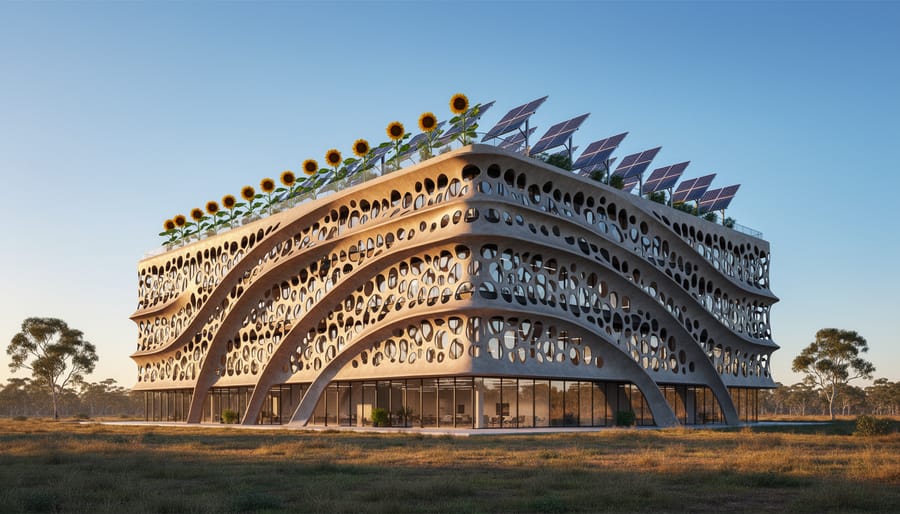
Nature has spent 3.8 billion years perfecting designs that work. Termite mounds that regulate temperature without air conditioning. Lotus leaves that repel water and self-clean. Whale fins that maximize energy efficiency through fluid dynamics. These aren’t just biological curiosities—they’re architectural blueprints solving the same challenges we face in building design today.
Biomimicry in architecture translates nature’s time-tested strategies into sustainable building solutions. Australian architects and designers are increasingly looking to our unique ecosystems for inspiration, creating structures that consume less energy, adapt to harsh climates, and work in harmony with their surroundings rather than against them. This approach isn’t about making buildings look like plants or animals—it’s about understanding how natural systems solve complex problems and applying those principles to construction.
The results speak for themselves. Buildings modeled on termite ventilation systems reduce cooling costs by up to 90%. Facades inspired by eucalyptus bark patterns improve thermal performance while capturing the essence of Australian landscapes. Solar panels arranged like sunflower fields generate 40% more energy than traditional fixed installations.
This article showcases five remarkable examples where architects have successfully borrowed from nature’s playbook. These case studies demonstrate measurable environmental benefits, from dramatic energy savings to reduced water consumption, proving that biomimicry delivers both ecological and economic value. Each example offers practical insights applicable to Australian conditions, whether you’re planning a new build or retrofitting an existing structure.
What Biomimicry Actually Means for Buildings and Energy
Biomimicry in architecture goes beyond making buildings look like trees or shells—it’s about understanding how nature has already solved the challenges we face in construction and energy use. At its core, this approach asks a simple but powerful question: “How would nature do this?” After 3.8 billion years of research and development, nature has worked out remarkably efficient solutions for heating, cooling, generating power, and managing resources without waste.
When architects apply biomimicry principles to buildings, they’re not just copying natural forms—they’re adapting natural strategies that have stood the test of time. Think about how termite mounds maintain constant temperatures in the scorching African heat, or how leaves capture sunlight with incredible efficiency. These aren’t just interesting facts; they’re blueprints for buildings that require less artificial heating, cooling, and power.
The connection between biomimicry and energy becomes especially clear when you consider how many of nature’s solutions naturally incorporate what we’d call renewable energy solutions. Plants don’t just exist in the environment—they actively harness it, converting sunlight, managing water flow, and creating zero waste in the process. When buildings mimic these strategies, renewable energy integration becomes organic rather than add-on.
For Australian conditions, this approach makes particular sense. Our harsh sun, variable rainfall, and extreme temperatures mirror the challenges that ecosystems in comparable climates have already solved. A building designed like a desert plant can shed heat efficiently. One that mimics coastal ecosystems can manage moisture and airflow naturally. The beauty of biomimicry is that it doesn’t fight against our environment—it works with it, just as nature does.
This natural integration means biomimetic buildings often require significantly less energy to operate, making them perfect candidates for on-site renewable power systems that can meet their reduced energy needs entirely.
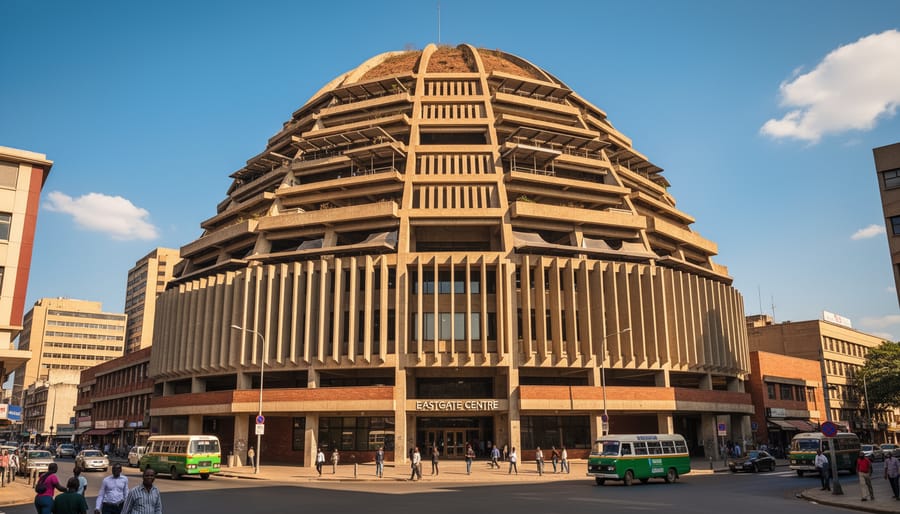
The Eastgate Centre: Termite Mounds That Slash Energy Bills
In the heart of Harare, Zimbabwe, stands a building that’s been keeping its cool without conventional air conditioning since 1996. The Eastgate Centre, a mixed-use complex designed by architect Mick Pearce, draws its genius from an unlikely source: the humble termite mound.
Termites in Africa face a serious challenge. They need to maintain their mounds at exactly 31 degrees Celsius to cultivate the fungus they eat, even when outside temperatures swing from 3 to 42 degrees. Their solution? A sophisticated natural ventilation system that inspired one of biomimicry’s greatest architectural triumphs.
The Eastgate Centre mimics this termite ingenuity through passive cooling mechanisms that would make any Australian building owner take notice. The building’s porous structure allows air to circulate constantly. During Zimbabwe’s cool nights, the building’s thermal mass absorbs cold air through fans powered by minimal energy. As the day heats up, warm air rises through the building and escapes through chimneys at the top, drawing cooler air from the base through the floors.
The results speak for themselves, and they’re impressive by any measure. The Eastgate Centre uses 90 percent less energy for ventilation than conventional buildings of comparable size. This translates to savings of roughly $3.5 million AUD in air conditioning costs that were never needed in the first place. Tenants enjoy rents that are 20 percent lower than neighboring buildings, proving that sustainable design isn’t just good for the planet—it’s brilliant for the bottom line.
For Australia, where air conditioning accounts for a staggering 40 percent of household energy consumption during scorching summers, the lessons from termite mounds are particularly relevant. Australian architects are already exploring similar passive cooling principles for office buildings, schools, and homes across the country. The key lies in designing structures that work with our climate, not against it.
The beauty of this approach extends beyond energy savings. The Eastgate Centre requires no massive cooling plants, no chillers, and significantly less mechanical maintenance. It’s a reminder that nature has already solved many of our toughest design challenges—we just need to observe, learn, and adapt these time-tested solutions to our modern needs. The termites have been perfecting their craft for millions of years, and Zimbabwe’s boldness in following their example has created a landmark that continues to inspire sustainable architecture worldwide.
The Beijing National Aquatics Centre: Bubbles That Capture the Sun
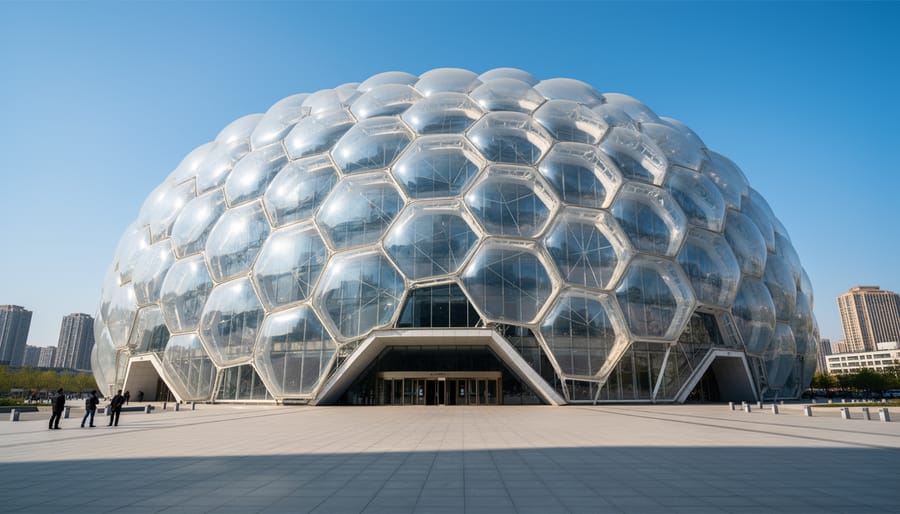
When you look at soap bubbles floating through the air, catching the light with their delicate, shimmering walls, you might not immediately think “energy-efficient building design.” Yet that’s exactly what inspired the architects behind Beijing’s National Aquatics Centre, better known as the Water Cube, built for the 2008 Olympics.
The building’s outer skin mimics the molecular structure of soap bubbles, creating a stunning facade made from ETFE (ethylene tetrafluoroethylene) cushions. These translucent pillows aren’t just visually striking—they’re working hard to capture and manage solar energy in ways that traditional building materials simply can’t match.
Here’s where nature’s wisdom really shines through. The bubble-inspired structure allows 90% of natural light to filter through while simultaneously trapping solar heat between the cushion layers. During Beijing’s harsh winters, this passive solar heating reduces the building’s heating costs by an impressive 30% compared to conventional glass structures. The air pockets between the ETFE layers act like nature’s own insulation system, keeping warmth inside when needed while preventing overheating during summer months.
What makes this particularly relevant for Australian conditions is how the design integrates with broader renewable energy strategies. The Water Cube demonstrates that biomimicry can work hand-in-hand with bioenergy systems. The structure’s reduced heating demands mean that supplementary biomass heating systems require far less fuel to maintain comfortable temperatures, making the entire energy equation more sustainable.
The building also incorporates solar thermal panels that work in harmony with the bubble-inspired design, capturing and storing solar energy for heating the pools. This combination of passive design principles borrowed from nature and active renewable energy systems shows how biomimicry creates opportunities for more efficient bioenergy integration.
For architects and building designers across Australia, the Water Cube offers a brilliant lesson: sometimes the most effective solutions float right in front of us. By observing how nature creates efficient structures with minimal materials, we can design buildings that work with the sun’s energy rather than fighting against it, reducing our reliance on conventional heating systems while creating spaces that feel light, open, and connected to the natural world.
The Lotus Temple and Council House 2: Plants as Power Models
Nature’s architectural genius shines brilliantly in plant structures, and two remarkable buildings demonstrate how architects have transformed botanical wisdom into energy-efficient reality. The Lotus Temple in New Delhi and Melbourne’s Council House 2 prove that looking to plants for inspiration delivers measurable sustainability outcomes.
The Lotus Temple takes its cue from the sacred lotus flower, with 27 pristine marble petals arranged in clusters forming a stunning bloom. Beyond its beauty, this design creates natural ventilation through strategically positioned openings between petals, allowing hot air to rise and escape while drawing cooler air from below. The structure maintains comfortable temperatures without conventional air conditioning, serving thousands of daily visitors in Delhi’s sweltering climate. The lotus plant itself thrives in challenging conditions, and the temple mirrors this resilience through passive cooling that slashes energy consumption.
Right here in Melbourne, Council House 2 stands as Australia’s flagship example of plant-inspired architectural innovation. This building takes biomimicry to extraordinary heights, quite literally. The facade mimics how plants regulate temperature and manage sunlight exposure. Timber shutters along the northern face open and close automatically, responding to sun intensity just as leaves adjust their angles throughout the day. This clever system prevents excessive heat gain while maximizing natural light.
The building’s “breathing” ventilation system draws inspiration from plants’ transpiration processes. Fresh air enters through floor vents, naturally rises as it warms, and exits through rooftop turbines—no energy-hungry fans required for most of the year. Cool night air is captured and stored in the building’s thermal mass, providing natural cooling during warmer hours.
Melbourne’s success story extends beyond passive systems through its integration with renewable energy. Rooftop solar panels work alongside natural ventilation, while water recycling systems complete the sustainable picture. The results speak volumes: Council House 2 uses 85% less electricity and 72% less gas than comparable buildings, proving that plant-inspired design delivers genuine environmental and economic benefits. This Melbourne landmark demonstrates that Australian buildings can thrive sustainably, just like our native flora adapts brilliantly to local conditions.
Living Walls and Bioreactor Facades: Buildings That Generate Biomass
Imagine a building that doesn’t just sit there looking pretty – it actually breathes, grows, and produces energy right before your eyes. That’s exactly what living walls and bioreactor facades are doing, and they’re turning heads across the globe as one of biomimicry’s most exciting frontiers.
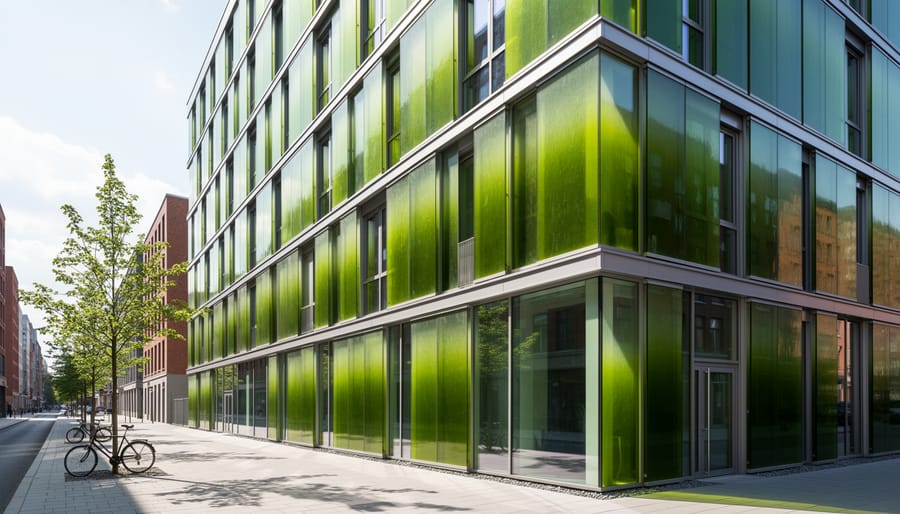
Unlike traditional green walls that simply support plant growth, bioreactor facades take biomimicry to the next level by incorporating living microorganisms that actively generate biomass for energy. Think of them as the lungs and digestive system of a building rolled into one – constantly working to produce useful resources whilst improving the structure’s environmental performance.
The star of this innovative technology is the BIQ House in Hamburg, Germany, completed in 2013. This pioneering residential building features 129 glass panels filled with microalgae on its southeast and southwest facades. As sunlight hits the panels, the algae photosynthesize and multiply, creating biomass that’s harvested regularly and converted into biogas for heating and hot water. The clever bit? The algae panels also provide dynamic shading that automatically adjusts based on how densely the organisms grow – more sun means more algae, which means more shade, perfectly self-regulating. During testing, the system generated approximately 150 kilowatt-hours of energy per square metre annually, whilst significantly reducing the building’s heating and cooling loads.
Beyond energy generation, these bioreactor panels offer brilliant insulation properties. The liquid medium maintains stable temperatures, buffering the building against extreme heat and cold – something particularly valuable in Australia’s harsh climate zones. The panels also capture carbon dioxide as the algae grow, meaning the building actively removes greenhouse gases from the atmosphere.
For Australian applications, this technology holds tremendous promise. Our abundant sunshine – often seen as a challenge for building design – becomes a powerful asset for algae cultivation. Imagine office buildings in Sydney or Perth where the facades don’t just deflect heat but transform it into usable energy. Research institutions across Australia are already exploring how local algae species might perform even better than European varieties in our conditions.
The beauty of bioreactor facades lies in their elegant simplicity: they mimic how natural ecosystems capture solar energy and convert it into stored biomass, just as forests and oceans have done for millions of years. This isn’t just decoration or greenwashing – it’s architecture that genuinely works with nature to create tangible environmental and economic benefits.
How Biomimetic Design Naturally Integrates Bioenergy Systems
Nature has spent 3.8 billion years perfecting energy-efficient systems, and when architects borrow these blueprints, something remarkable happens: buildings naturally require less energy to operate. This relationship between biomimetic design and reduced energy consumption creates a perfect foundation for integrating renewable energy solutions, making bioenergy systems not just viable but exceptionally efficient.
Think about a termite mound in the Australian outback. These natural structures maintain stable internal temperatures without any mechanical systems, simply through clever passive ventilation. When the Eastgate Centre in Zimbabwe replicated this design, it slashed energy consumption by over 90 percent compared to conventional buildings. This dramatic reduction in baseline energy needs means any renewable energy system added to the building works smarter, not harder.
The same principle applies across Australian architecture. Buildings designed with nature-inspired passive cooling, natural ventilation, and strategic thermal mass require far less energy for climate control. This reduced energy footprint transforms how we think about renewable energy integration. Instead of needing massive systems to power energy-hungry buildings, we can deploy appropriately sized bioenergy solutions that actually match realistic needs.
Consider the practical applications emerging across Australia. Office buildings incorporating termite-inspired ventilation systems have successfully integrated biomass heating for their reduced thermal loads. The organic waste generated by building occupants becomes feedstock for on-site biogas generation, creating closed-loop systems that would make any ecosystem proud. Some forward-thinking designs even incorporate algae-based facades that simultaneously provide shading, produce biomass, and generate energy.
The Pixel Building in Melbourne demonstrates this integration beautifully. Its biomimetic features, including a facade inspired by forest canopy light filtering, reduced energy demands so effectively that renewable systems including bioenergy could meet the building’s needs entirely. The building processes its own wastewater through natural systems, creating biogas as a beneficial by-product.
This synergy between nature-inspired design and bioenergy represents the future of sustainable architecture. By first reducing energy loads through biomimicry, we create buildings where renewable energy systems become genuinely practical and cost-effective. It’s not just about copying nature’s forms but understanding and applying nature’s fundamental wisdom about energy efficiency.
Bringing These Ideas Home: Applications for Australian Buildings
The good news for Australians? Our climate practically begs for biomimetic design. From Darwin’s tropical heat to Melbourne’s four-seasons-in-a-day weather, nature has already solved the challenges our buildings face every single day.
Take passive cooling, for instance. The termite mound principles that inspired Eastgate Centre work brilliantly in Australian conditions. Several new developments in Brisbane and Perth are incorporating similar ventilation chimneys that draw hot air upward and out, pulling cooler air through the building naturally. One commercial building in Cairns reduced its air conditioning costs by 40 percent using this termite-inspired approach, which is no small feat in the tropical north.
Australian architect firms are also embracing the lotus leaf effect for self-cleaning facades. A recent apartment complex in Sydney’s inner west features lotus-inspired cladding that repels dirt and pollution, staying cleaner for longer and reducing water usage for maintenance. In a city experiencing increasingly strict water restrictions, this isn’t just clever design; it’s practical necessity.
For residential applications, solar orientation inspired by sunflowers and heliotropic plants offers immediate benefits. Homes designed with living areas facing north and service rooms buffering the western sun can reduce cooling costs by up to 30 percent during our scorching summers. Some cutting-edge Queensland homes now feature adjustable louvres that track the sun’s movement, providing shade exactly where and when it’s needed, much like leaves adjusting their position throughout the day.
Natural ventilation modelled on prairie dog burrows is gaining traction in Australian farm buildings. Several wineries in the Barossa Valley have incorporated cross-ventilation systems that maintain stable temperatures for wine storage without mechanical cooling, dramatically cutting energy bills.
The exciting part? These aren’t futuristic pipe dreams. Many biomimetic principles can be retrofitted to existing buildings. Adding strategic planting for natural cooling, installing ventilation chimneys, or repositioning outdoor spaces to capture breezes are all achievable projects.
For commercial developers, the investment pays off quickly. Buildings with biomimetic features typically see 20-40 percent reductions in energy costs within the first year. For homeowners, even simple changes like adjusting window coverings to mimic plant behaviour or creating airflow pathways inspired by termite mounds can make noticeable differences to comfort and bills.
The key is starting somewhere. Whether you’re building from scratch or improving an existing structure, there’s a biomimetic solution that fits your budget and Australia’s unique climate challenges.
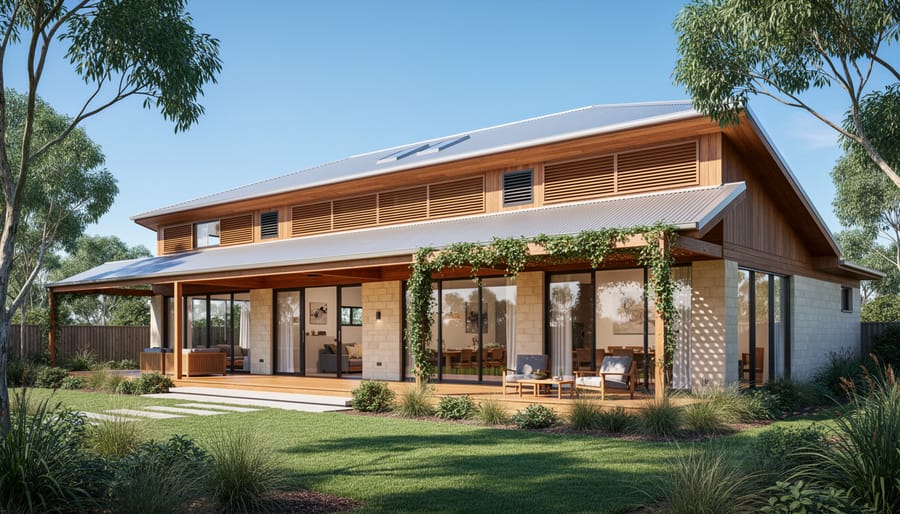
The buildings we’ve explored demonstrate that biomimicry isn’t just clever design—it’s a pathway to creating structures that actively participate in Australia’s sustainable energy future. When architecture imitates nature’s time-tested strategies, we create buildings that work harmoniously with renewable energy systems rather than fighting against them. Natural ventilation inspired by termite mounds reduces cooling demands. Self-cleaning facades modeled on lotus leaves minimize maintenance while maximizing solar panel efficiency. These aren’t futuristic concepts—they’re practical solutions already proving their worth across the globe.
For Australian architects, developers, and building owners, the message is clear: nature has already solved the problems we’re grappling with today. Every eucalyptus tree managing extreme heat, every coral adapting to changing conditions, offers lessons we can apply to create buildings that consume less energy, generate cleaner power, and provide healthier spaces for occupants.
The beauty of biomimetic design is that it delivers tangible benefits alongside environmental impact. Lower operating costs, improved occupant comfort, enhanced property values, and reduced carbon footprints aren’t competing priorities—they’re complementary outcomes of looking to nature for inspiration.
As you plan your next building project, renovation, or energy upgrade, consider asking a simple question: How would nature solve this? The answer might just transform your approach to sustainable architecture, creating spaces that honor both human needs and the natural world that sustains us.