
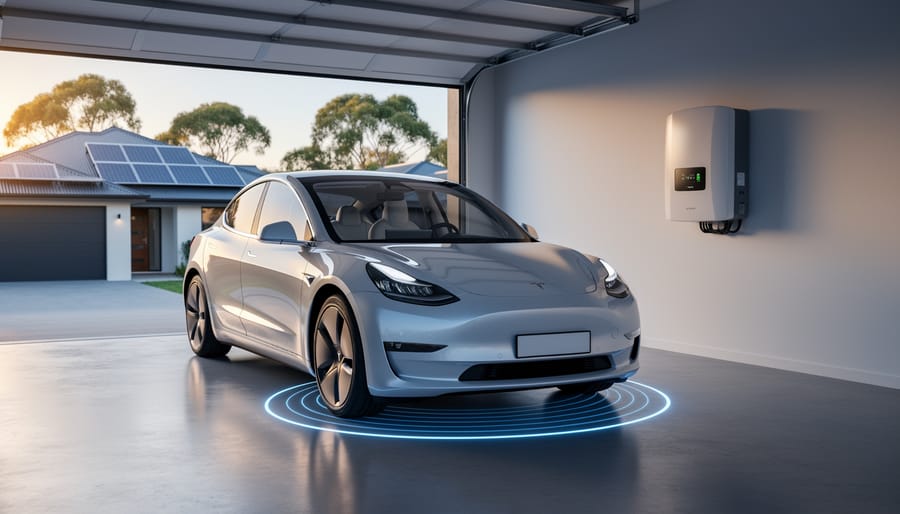
Imagine charging your electric vehicle simply by parking it in your garage, or powering your home battery system without fumbling with cables in the dark. This isn’t science fiction – it’s the promise of Qi wireless charging technology, now making the leap from your smartphone to Australia’s renewable energy landscape.
Qi wireless charging works through electromagnetic induction, where energy transfers between two coils when they come into close proximity. While you’ve likely experienced this convenience with your mobile phone, forward-thinking Australian businesses and households are now exploring how this same technology can revolutionize how we store and access renewable energy. The technology eliminates wear-and-tear from physical connectors, reduces maintenance costs, and offers remarkable convenience for charging electric vehicles, battery storage systems, and portable solar generators.
The Australian renewable energy sector is witnessing exciting developments in wireless charging applications. From Sydney’s experimental EV charging pads to Queensland’s solar-powered wireless charging stations for e-bikes, real-world success stories demonstrate this technology’s growing viability. These installations prove that wireless charging isn’t just about convenience – it’s about creating seamless, weather-resistant charging solutions perfectly suited to Australia’s harsh climate conditions.
However, understanding both the capabilities and current limitations of Qi technology for energy storage applications is essential before making investment decisions. This article explores how wireless charging actually works, examines practical applications already succeeding across Australia, addresses honest limitations around efficiency and scale, and provides clear guidance on whether this technology suits your specific renewable energy needs.
What Makes Qi Wireless Charging Different from Other Energy Transfer Methods
The Science Behind the Magic (Made Simple)
Think of Qi wireless charging like a miniature power station operating right on your desk. At its heart lies electromagnetic induction, the same principle that’s powered transformers and electric motors for over a century. Here’s how it works in simple terms: when electricity flows through the charging pad’s coil, it creates an invisible magnetic field, much like how a flowing river generates energy. Your smartphone or device contains a second coil that captures this magnetic energy and converts it back into electricity to charge the battery.
It’s remarkably similar to how induction cooktops heat your pots without direct flame. No physical connection needed, just proximity. The charging pad and device need to be close mates, typically within a few millimetres, for the magnetic field to transfer energy efficiently. This contactless power transfer might seem like wizardry, but it’s pure physics at work. While current Qi chargers handle modest power levels perfect for phones and tablets, Australian researchers and companies are scaling up this technology for electric vehicle charging and even renewable energy storage applications, proving that what works brilliantly in your pocket today could power sustainable solutions tomorrow.
Why Qi Won the Wireless Charging Race
When Qi technology emerged in 2008, backed by the Wireless Power Consortium, few imagined it would become the gold standard for wireless charging. Yet today, virtually every modern smartphone, smartwatch, and wireless earbud relies on this technology. Its success story offers valuable insights for Australia’s renewable energy sector.
Qi won the wireless charging race through strategic simplicity and collaboration. Rather than creating a proprietary system, the Wireless Power Consortium brought together competitors including Samsung, Apple, and Nokia to develop an open standard. This approach meant consumers could charge any Qi-enabled device on any Qi charging pad, eliminating the frustrating cable drawer full of incompatible chargers.
The numbers tell the story: over 5 billion Qi-enabled devices exist worldwide, with charging stations appearing in airports, cafes, and cars across Australia. This widespread infrastructure didn’t happen by accident. Manufacturers recognised that universal compatibility drives consumer confidence and market growth.
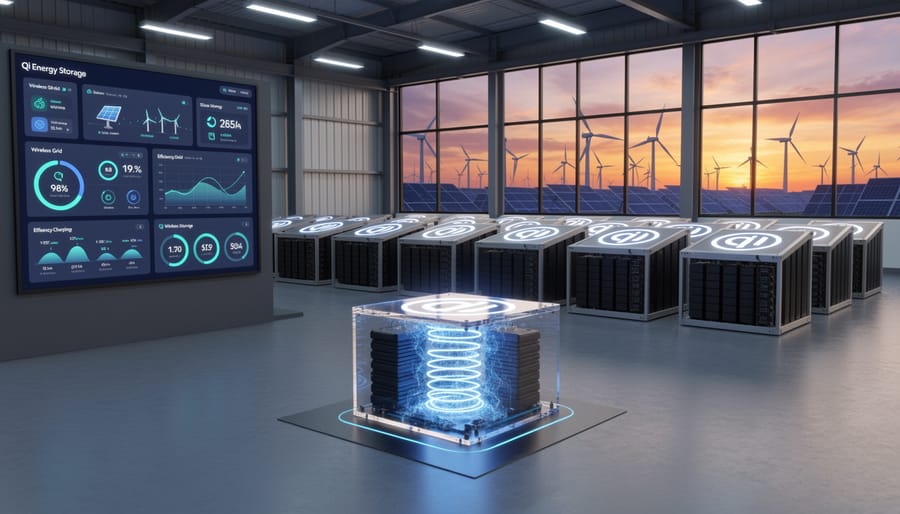
For renewable energy applications, Qi’s proven scalability matters enormously. The same principles that wirelessly charge your phone at a Melbourne cafe can transfer energy between solar battery systems and electric vehicles. The technology has already demonstrated reliability across billions of daily charging cycles, providing a tested foundation for larger energy storage solutions. This existing ecosystem means Australia can leverage established manufacturing processes and technical expertise, accelerating our transition to sustainable energy systems.
From Smartphones to Solar Batteries: Qi’s Role in Energy Storage Systems
Charging Home Battery Systems Without the Hassle
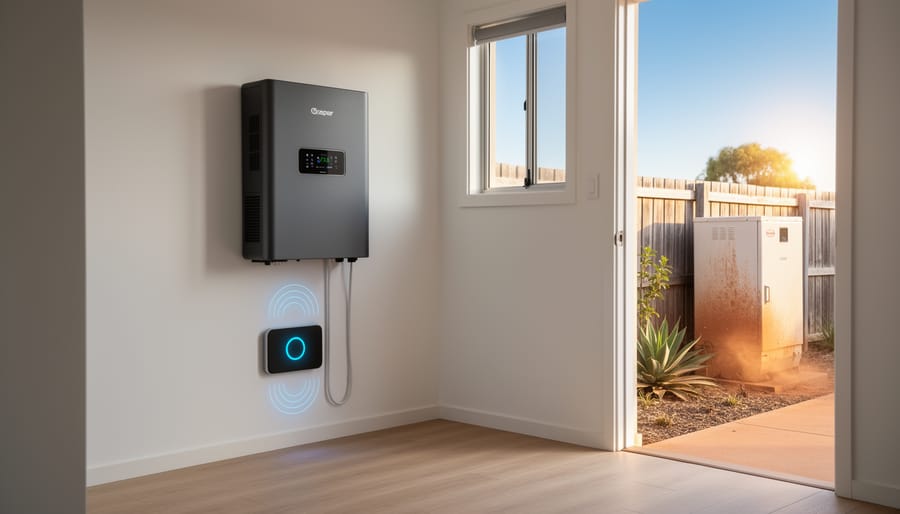
For Australian households embracing rooftop solar, wireless charging technology is transforming how we think about battery storage systems. Rather than relying on traditional plug-in connections that deteriorate under our harsh climate conditions, wireless charging pads create a seamless, maintenance-free solution for keeping home batteries topped up.
The beauty of this approach becomes particularly evident in coastal areas and the Top End, where salt air and humidity wreak havoc on conventional charging connectors. Take the Johnson family in Cairns, who installed a wireless home battery system two years ago. Unlike their neighbours dealing with corroded charging ports and frequent replacements, their system continues operating flawlessly through wet seasons and tropical conditions.
The technology works similarly to your smartphone’s charging pad, just scaled up. Home battery units simply rest on charging platforms, eliminating the need for physical connections that wear out over time. This means fewer service calls, reduced maintenance costs, and uninterrupted energy storage from your solar panels.
For households cycling their batteries daily, capturing excess solar during the day and drawing power at night, this durability proves invaluable. You’re not just protecting your investment; you’re ensuring reliable backup power when you need it most. The elimination of exposed charging points also improves safety, particularly in homes with curious children or during severe weather events. It’s practical innovation that makes sustainable living genuinely hassle-free.
Making Renewable Microgrids More Flexible
Wireless charging technology is transforming how we think about renewable microgrids, particularly in remote Australian communities where adaptability is crucial. Traditional battery storage systems require hardwired connections, making reconfiguration a time-consuming and costly exercise. Qi-based wireless charging enables a modular approach where energy storage units can be repositioned, swapped out, or expanded without rewiring infrastructure.
This flexibility proves invaluable for growing renewable projects. A community in regional Queensland recently demonstrated this advantage by starting with three wireless-charging battery pods and seamlessly adding four more as solar capacity increased, without shutting down their existing system. The plug-and-play nature means communities can scale their energy storage to match seasonal demands or unexpected growth.
For remote locations across the Outback, wireless systems eliminate the vulnerability of corroded connections and damaged cables, common challenges in harsh Australian conditions. Maintenance becomes simpler too, as faulty units can be swapped out in minutes rather than hours. This modularity creates resilient energy systems that evolve with community needs, making renewable energy genuinely accessible for Australia’s most isolated populations.
Real-World Success Stories: Qi Technology in Action
Electric Vehicle Charging Stations Going Wireless
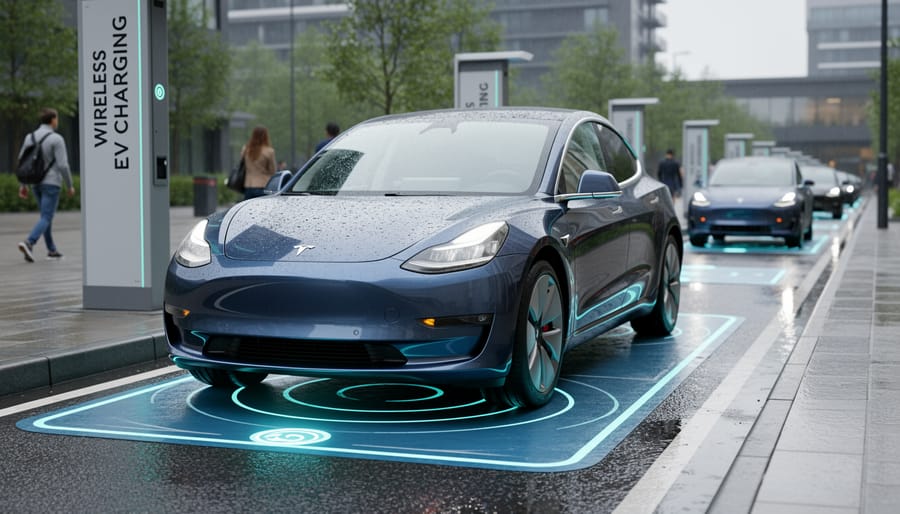
Australia’s transition to electric vehicles is taking an exciting leap forward with wireless charging technology that’s moving beyond your smartphone. Several innovative projects across the country are now trialling Qi-based systems for electric vehicle charging, promising to make sustainable transport even more convenient for everyday Australians.
Picture this: you pull into your driveway or a shopping centre car park, and your EV begins charging automatically without plugging in a single cable. That’s the vision becoming reality through wireless charging pads embedded in parking spaces. Brisbane-based trials have already demonstrated successful charging of delivery vans and taxis using this technology, with drivers reporting how much simpler their daily routines have become.
The benefits extend far beyond convenience. Wireless systems eliminate the wear and tear on charging cables and connectors, significantly reducing maintenance costs for charging infrastructure. This is particularly valuable in harsh Australian conditions where sun exposure and dust can degrade traditional charging equipment. For councils and businesses investing in charging networks, this means lower long-term costs and more reliable service.
What makes this especially promising is the potential for integration with renewable energy sources. Imagine wireless charging stations powered by rooftop solar, creating a completely clean energy loop from generation to vehicle. Early adopters in Perth and Melbourne are already testing these combined systems, demonstrating how wireless technology could accelerate our journey toward zero-emission transport while supporting local renewable energy goals.
Portable Energy Banks Powering Remote Communities
Across remote corners of Australia, wireless charging technology is breathing new life into energy access for communities beyond the grid’s reach. These aren’t your typical smartphone chargers—they’re robust portable energy banks using Qi-based wireless technology to deliver power where it’s needed most.
In Western Australia’s Pilbara region, mining operations and remote stations are trialling wireless-charged battery systems that eliminate the fiddly connectors that often fail in dusty conditions. Workers simply place ruggedised battery packs onto charging pads powered by solar arrays, creating a simple drop-and-charge system that even works through protective cases. The beauty lies in the sealed design—no exposed ports means no dust infiltration, a game-changer in Australia’s harsh outback.
Following the 2019-2020 bushfire season, several rural fire brigades adopted wireless-charging portable power banks for emergency communications. These units maintain charge readiness without degradation from constant plugging and unplugging, whilst their weatherproof wireless interfaces perform reliably even when ash and smoke fill the air.
On cattle stations spanning thousands of hectares, farmers are deploying solar-powered wireless charging stations at strategic points. Station hands drop off depleted battery packs while collecting freshly charged ones, maintaining power for electric fencing, water pumps, and communication devices without running generators or replacing countless AA batteries.
These practical applications demonstrate how familiar wireless technology, scaled appropriately, solves real energy challenges in Australian communities where reliability matters more than charging speed. The simplicity of wireless power transfer proves particularly valuable when conditions are tough and traditional connections would fail.
The Environmental Win: How Wireless Charging Supports Sustainability Goals
Reducing Electronic Waste Through Standardization
The shift toward universal Qi wireless charging standards represents a genuine win for sustainability, particularly in reducing electronic waste across Australia and globally. Before standardisation, Australians filled drawers with proprietary chargers and cables, each becoming obsolete when switching devices or brands. Now, one Qi charging pad works across smartphones, earbuds, smartwatches, and increasingly, larger applications.
This standardisation delivers measurable environmental benefits. Research suggests universal charging standards could prevent thousands of tonnes of electronic waste annually. When your charging infrastructure remains compatible across device upgrades, you’re not binning perfectly functional chargers every few years. For businesses, this translates to longer-lasting charging stations in offices, cafes, and public spaces.
The principle extends beyond consumer electronics. As Qi technology scales to renewable energy applications, standardisation ensures compatible components across different manufacturers, reducing the specialized waste that plagues custom systems. It’s a practical example of how industry cooperation creates environmental outcomes that benefit everyone, making sustainable choices the convenient choice.
Energy Efficiency: Separating Myth from Reality
Let’s tackle the elephant in the room: yes, Qi wireless charging has traditionally been less efficient than plugged-in charging, but the story’s changing rapidly. Early systems operated at around 60-70% efficiency, meaning some energy was lost as heat. Fair dinkum, that wasn’t ideal for environmentally conscious users. However, recent advances have pushed efficiency above 85% in optimal conditions, bringing wireless charging much closer to wired alternatives.
The key lies in understanding when wireless charging shines. In applications where devices need frequent, short charging bursts—like sensors in renewable energy monitoring systems or emergency backup devices—wireless charging actually reduces energy waste by eliminating wear on charging ports and cables. Think of solar-powered weather stations across the Outback, where sealed wireless charging systems prevent dust contamination and equipment failure.
Here’s the practical reality: efficiency depends heavily on proper alignment and quality components. Premium Qi chargers with active cooling and optimized coil positioning now rival traditional charging methods. For stationary applications in renewable energy systems, where devices sit in fixed positions, efficiency concerns largely disappear. The technology works best when designed into the system from the start, rather than retrofitted. When implemented thoughtfully, Qi charging becomes part of the sustainability solution, not an energy drain.
Overcoming Current Limitations: What Needs to Happen Next
While Qi wireless charging holds tremendous promise for renewable energy applications, we need to be fair dinkum about the hurdles we’re facing today. The technology isn’t quite ready to power entire homes or large-scale storage systems, but understanding these limitations helps us appreciate how close we’re getting.
The primary challenge remains power transfer efficiency. Currently, most Qi systems operate at 5-15 watts, brilliant for smartphones but insufficient for household energy needs. Even advanced systems managing several hundred watts still lose 20-30% of energy through heat dissipation. For environmentally conscious Australians committed to maximising every solar electron, this represents a genuine concern that researchers are actively addressing through improved coil designs and smarter power management systems.
Distance constraints present another practical limitation. Today’s technology requires devices to sit within millimetres of charging pads. Imagine trying to power your fridge this way! Scientists are working on extended-range systems, with some laboratory prototypes successfully transmitting power across several metres, though efficiency drops significantly with distance.
Cost factors can’t be ignored either. Installing Qi-enabled systems currently costs more than traditional wired connections, which matters when you’re budgeting for solar installations or battery storage upgrades. However, prices are falling as manufacturing scales up, following the same trajectory we’ve seen with solar panels over the past decade.
Here’s the optimistic bit: progress is happening remarkably fast. Australian universities and research institutions are partnering with industry leaders to overcome these barriers. Recent breakthroughs in magnetic resonance coupling and adaptive frequency tuning show real potential for achieving 95% efficiency rates. It’s not about if these limitations will be resolved, but when—and that timeline is shortening every year.
Making It Work for Your Home or Business
Is Your Current Setup Ready for Wireless Charging?
Before jumping into wireless charging for your renewable energy setup, take a moment to assess what you’ve already got. This quick compatibility check will save you time and help you make smart decisions.
First, check your existing battery system. Most modern lithium-ion batteries used in solar and wind installations can integrate with wireless charging technology, though you’ll want to verify your system’s voltage requirements. If you’ve recently upgraded to smart storage systems, you’re already halfway there.
Next, evaluate your physical space. Wireless charging pads need proper positioning—typically within 5-10 centimetres of receiving devices. Do you have adequate clearance around your battery units? Is ventilation sufficient for the slight heat generated during wireless transfer?
Consider your power management system too. Does your current setup support the communication protocols needed for wireless charging? Many Australian installations already include compatible inverters and controllers.
Finally, think about your energy goals. Are you looking to add electric vehicle charging stations? Perhaps you’re planning to expand your biomass generator capacity? Understanding your future needs helps determine whether wireless charging fits your renewable vision. The good news? Most modern Australian renewable setups require minimal modifications to accommodate this convenient technology.
What to Ask Before You Invest
Before committing to Qi wireless charging solutions for your renewable energy setup, having a yarn with potential suppliers can save you headaches down the track. Start by asking about efficiency rates specific to Australian climate conditions—our scorching summers and varied temperatures can impact performance differently than overseas environments. Question how their systems handle dust and moisture, particularly important for installations in regional and remote areas.
Find out about compatibility with your existing solar panels, battery storage, or other renewable infrastructure. Can the system scale up as your energy needs grow? What’s the realistic lifespan of the components, and what warranty covers Australian conditions?
Don’t forget to ask about installation requirements and ongoing maintenance. Who handles repairs if something goes wrong, and how quickly can they respond across different Australian states? Request case studies from similar Australian projects—successful local applications speak volumes.
Finally, dig into the environmental credentials. How recyclable are the components at end-of-life? What’s the embodied energy in manufacturing? These questions help ensure your investment truly aligns with sustainability goals while delivering reliable performance for years to come. The right supplier will welcome these conversations and provide transparent, detailed answers.
Qi wireless charging technology represents more than just a convenient way to power our devices—it’s a glimpse into Australia’s sustainable energy future. As we’ve explored, this elegant solution is already making headway beyond our smartphones, finding applications in renewable energy systems, electric vehicles, and smart grid technology. While it’s still early days for large-scale energy storage applications, the potential is undeniably exciting.
For environmentally conscious Australians, the journey toward clean energy isn’t about waiting for a single perfect solution. It’s about embracing a combination of technologies that work together, creating a resilient and sustainable energy ecosystem. Qi wireless charging fits beautifully into this picture, offering efficiency, reduced wear on equipment, and seamless integration with solar, wind, and battery storage systems.
The question isn’t whether wireless charging will transform our energy landscape—it’s how quickly we’ll adapt and implement these innovations. Whether you’re a homeowner considering solar panels with integrated wireless charging capabilities, a business exploring electric vehicle fleets, or simply someone passionate about reducing your environmental footprint, now is the time to explore your options.
Take a moment to assess your specific circumstances. Could wireless charging technology enhance your renewable energy setup? What small steps can you take today toward a cleaner tomorrow? The future of sustainable energy storage is being written right now, and every Australian has a role to play in shaping it. Your journey toward energy independence and environmental stewardship starts with informed choices and bold action.