
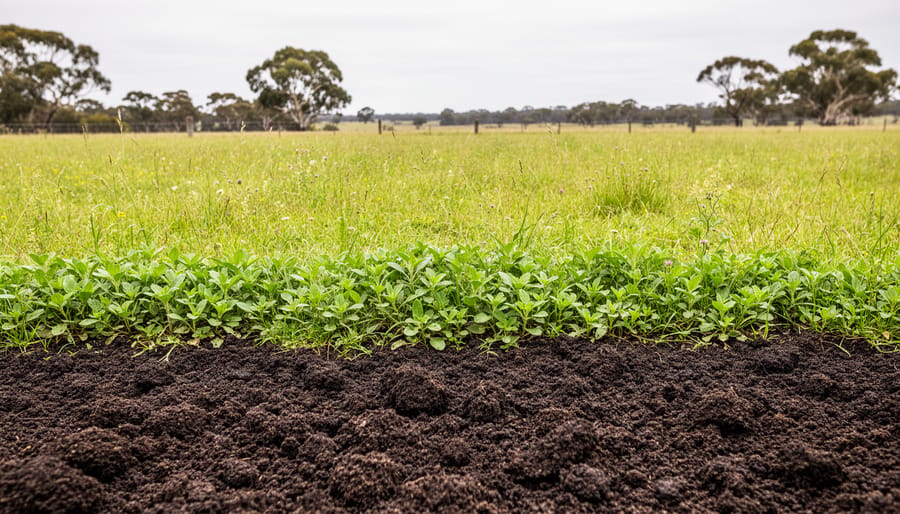
Australian farmers are quietly revolutionising agriculture from the ground up, and the world is finally taking notice. Regenerative farming represents a fundamental shift in how we work the land, moving beyond simply sustaining what we have to actively restoring soil health, biodiversity, and ecosystem function. While conventional agriculture has focused on maximising yields through synthetic inputs, regenerative practices rebuild living soil that captures carbon, holds water, and produces nutrient-dense food without depleting the earth beneath our feet.
The concept isn’t entirely new. Indigenous Australians have managed country regeneratively for over 60,000 years, working with natural cycles rather than against them. What’s changed is the science catching up to traditional wisdom, revealing how practices like minimising soil disturbance, maintaining living roots year-round, and integrating livestock can transform degraded farmland into thriving ecosystems that actually pull carbon from the atmosphere.
This matters now more than ever. As droughts intensify and input costs climb, Australian producers are finding that regenerative methods don’t just benefit the environment; they strengthen farm resilience and profitability. A grazing property in western New South Wales increased its groundcover from 30% to 85% within three years of switching to planned grazing, weathering the 2018 drought while neighbours were destocking.
The momentum is building. Government incentives, carbon credit opportunities, and consumer demand are aligning to support farmers willing to transition. Understanding what regenerative farming truly means, how it works, and whether it fits your operation could reshape your relationship with the land you manage.
What Is Regenerative Farming? (Beyond the Buzzword)
Regenerative farming works by rebuilding what conventional agriculture depletes. Instead of extracting nutrients season after season until the soil needs constant chemical support, regenerative practices focus on creating living, self-sustaining systems that improve over time. Think of it as farming with nature’s blueprint rather than against it.
At its core, regenerative farming means managing land so it gets healthier with each passing year. You’ll see this in paddocks where soil structure improves, water infiltration increases, and plant diversity expands without constant external inputs. The approach centres on four interconnected principles: building soil biology through minimal disturbance, keeping living roots in the ground year-round, maintaining soil cover to protect microbial life, and integrating animals back into crop systems where they historically belonged.
- Soil Health
- The foundation of regenerative systems, measured not just by nutrient levels but by biological activity, structure, and the ability to hold water and carbon. Healthy soil feels different in your hands, crumbles easily, and smells earthy rather than chemical.
- Biodiversity
- Diversity above and below ground, from the mix of plant species in a paddock to the millions of organisms in a handful of soil. More diversity creates resilience against pests, diseases, and climate swings.
- Water Cycling
- How effectively your land captures, stores, and releases water through improved soil structure and organic matter. Better water cycling means less runoff, deeper moisture penetration, and greater drought resilience.
- Ecosystem Thinking
- Viewing your farm as interconnected relationships rather than isolated inputs and outputs. What benefits soil biology also improves water retention, which supports plant health, which feeds livestock in a continuous cycle.
Here’s what sets regenerative apart from other approaches. Organic farming bans synthetic inputs but doesn’t necessarily rebuild soil health; you can farm organically while still degrading your land through excessive tillage. Sustainable farming aims to maintain what you have without making things worse. Conventional agriculture prioritizes short-term productivity, often at the expense of long-term soil function.
Regenerative farming goes further by actively improving the resource base. A regenerative grazier rotates livestock through paddocks in patterns that mimic wild herds, giving plants time to recover and roots time to pump carbon into the soil. A regenerative cropper plants diverse cover crops between cash crops, building organic matter while suppressing weeds and fixing nitrogen naturally.
The practical difference shows up in how you spend your time and money. You’re observing soil biology and plant response rather than scheduling chemical applications. You’re managing for outcomes like increased organic matter and water infiltration rather than just yield per hectare this season.
How Regenerative Farming Captures Carbon (And Why It Matters)
When you think about carbon emissions, farmland probably isn’t the first thing that comes to mind as a solution. But here’s what makes regenerative farming genuinely interesting: your paddocks can actually pull carbon dioxide out of the atmosphere and lock it away underground, sometimes for decades or longer.
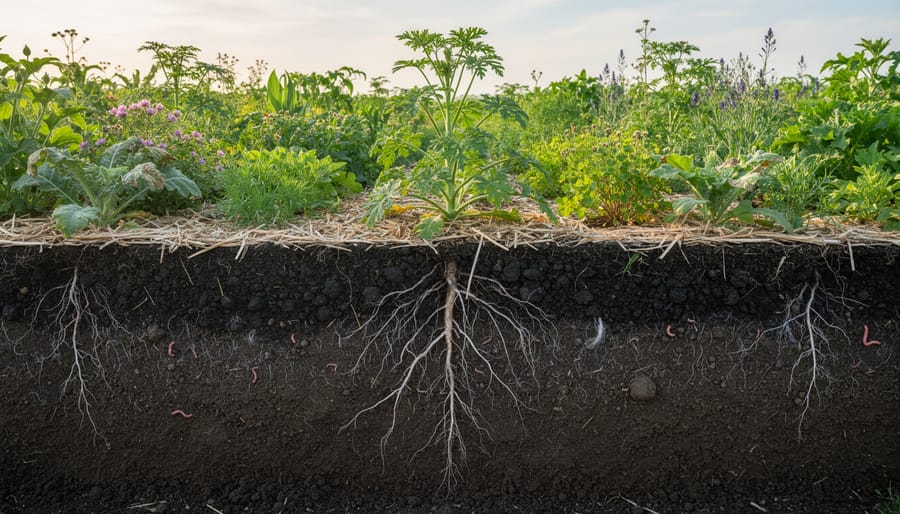
The mechanism is straightforward. Plants capture carbon from the air through photosynthesis, using that carbon to build stems, leaves, and roots. In conventional farming, much of that carbon gets released back into the atmosphere when soil is disturbed through tillage or when plant residues decompose on bare ground. Regenerative farming changes this equation by keeping living roots in the soil year-round, minimizing disturbance, and feeding a thriving underground ecosystem that stores carbon in stable forms.
The real work happens below ground, where you can’t see it. Plant roots exude sugars and other compounds that feed billions of microorganisms. These microbes, along with fungi, insects, and earthworms, create soil aggregates, sticky clumps where carbon gets physically locked away. The longer you maintain healthy soil biology through regenerative practices, the more carbon accumulates. That’s how soil as a carbon sink actually functions: not as a quick fix, but as a biological system that improves with time.
For Australian farmers, this matters on multiple levels. The direct climate benefit is measurable. Healthy soils can sequester 0.4 to 1.2 tonnes of carbon per hectare annually, varying with climate, soil type, and management. Over time, that adds up across thousands of hectares. More immediately, soils rich in organic matter hold more water, a critical advantage in Australia’s variable rainfall patterns. They also require fewer synthetic inputs because the soil biology does much of the nutrient cycling work that fertilizers currently handle.
The economic opportunity is developing quickly. Carbon markets, both voluntary and compliance-based, are creating ways for farmers to monetize sequestration. Some Australian producers are already turning their properties into farm carbon banks generating income from improved soil health while reducing their operating costs. That’s not theoretical. It’s happening now, and the policy signals worldwide suggest this trend will strengthen through 2026 and beyond.
Regenerative vs. Conventional Agriculture: The Real Differences
Input Costs and Long-Term Economics
The financial question hits first: transitioning to regenerative practices typically costs more upfront before the savings arrive. You’re looking at expenses for cover crop seed, potentially new equipment for no-till drilling, soil testing to establish baselines, and possibly consulting fees as you build knowledge. If you’re integrating livestock into a cropping system, fencing and water infrastructure add to the bill.
The timeline matters more than the total. Most Australian farmers report seeing input cost reductions within three to five years as soil biology improves and does work that chemicals previously handled. Fertilizer bills drop first, established regenerative systems often use 30 to 50 percent less synthetic nitrogen as soil organic matter builds and biological nitrogen fixation kicks in. Herbicide costs fall as thick cover crops suppress weeds naturally. Fuel expenses decrease when you’re making fewer passes across paddocks.
The payoff accelerates once your soil starts functioning differently. Better water infiltration means crops handle dry spells without expensive irrigation interventions. Improved nutrient cycling reduces the need for constant inputs. Diverse rotations break pest and disease cycles, cutting chemical applications.
The economic calculus isn’t just about lower costs. Regenerative systems often show yield stability rather than peak yields, you might not hit record highs, but you avoid the catastrophic lows that come from degraded soil during tough seasons. That consistency has real value when you’re managing cash flow and loan commitments.
Starting small lets you test the economics on a manageable scale before committing the whole operation. Many farmers run regenerative practices on a portion of their land while maintaining conventional systems elsewhere, comparing results over several seasons before making larger shifts.
Labour and Management Requirements
Regenerative farming demands a fundamentally different relationship with your land. Instead of following a calendar-driven spray schedule, you’re reading the landscape constantly, checking soil moisture, observing plant vigor, monitoring insect populations, and assessing livestock impact on pasture. This shifts the work from routine chemical applications to active decision-making based on what you’re actually seeing in the paddock.
The learning curve is real. You need to understand soil biology, grazing patterns, and how different plants interact within your system. Many Australian farmers report spending more time walking their properties in the first few years, building observation skills that conventional systems don’t require. You’re timing interventions based on plant growth stages and weather patterns rather than supplier recommendations.
Management intensity often increases during transition. Rotational grazing means moving livestock more frequently. Cover crop timing requires careful planning around cash crops. You’re coordinating multiple elements, livestock, diverse plantings, water cycling, rather than managing monocultures with predictable inputs.
The payoff comes as the system stabilizes. Healthier soil means fewer disease issues to manage. Reduced tillage saves time and fuel. Better water infiltration means less irrigation management. You’re building knowledge capital that makes your farm more resilient and less dependent on external inputs over time.
What’s Happening in the U.S. (And What Australia Can Learn)
In December 2025, the USDA made a clear statement about the direction of agricultural policy by launching a NRCS $700 million investment through the Regenerative Pilot Program. This isn’t just another government initiative, it’s a signal that mainstream agriculture is shifting toward soil health and ecosystem thinking. For Australian farmers watching global policy trends, this represents the kind of institutional support that could reshape how governments fund and incentivize farming practices.
The program splits the funding between two streams: $400 million through the Environmental Quality Incentives Program (EQIP) and $300 million through the Conservation Stewardship Program (CSP). What makes this different from traditional conservation funding is the “farmer-first, outcomes-based approach.” Rather than prescribing specific practices, the program supports voluntary regenerative agriculture conservation plans that address whole-farm resource concerns. It focuses on what farmers achieve, improved soil health, enhanced water quality, boosted long-term productivity, not just what methods they use.
For Australian agriculture, this program offers a preview of where policy support might head. While Australia’s current incentive landscape differs from the U.S. system, the outcomes-based framework addresses a common farmer frustration: government programs that dictate methods without understanding individual farm contexts. The USDA’s recognition that regenerative agriculture can lower production costs while delivering environmental benefits aligns with what many Australian producers already know from experience. As pressure builds for climate action and sustainable food systems, Australia could benefit from similar large-scale support that trusts farmers to design regenerative systems suited to their specific land, climate, and enterprise mix.
Practical Regenerative Techniques Australian Farmers Are Using
Australian farmers are putting regenerative principles into action with techniques that work in our unique conditions. These aren’t theoretical approaches, they’re practical methods that producers across the country are using to rebuild soil health while maintaining viable operations.
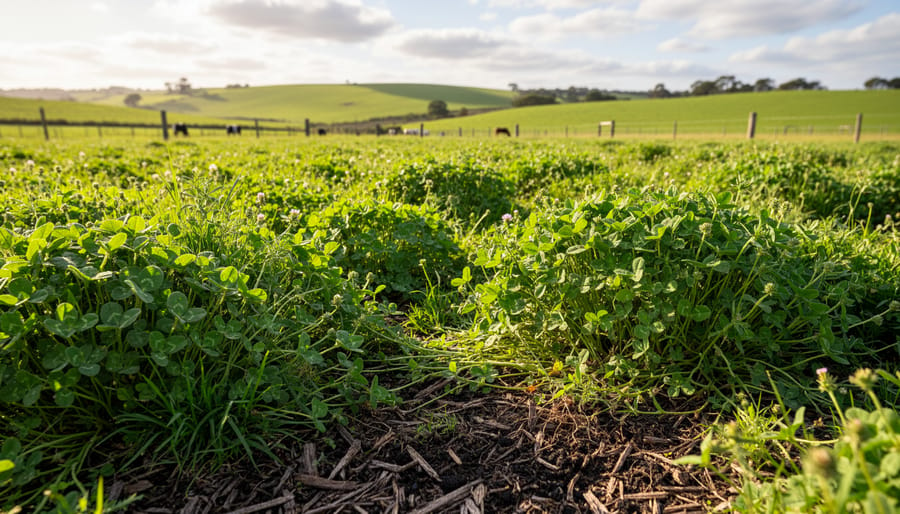
Cover cropping has gained traction in grain systems, particularly across southern cropping regions. Farmers sow multi-species mixes between cash crops: legumes like field peas or vetch to fix nitrogen, brassicas to break up compaction, and grasses to add organic matter. The plants aren’t harvested for grain but instead grazed by livestock or rolled down as mulch. This living cover protects soil from erosion during fallow periods, feeds soil biology, and reduces the need for synthetic fertilizers. Some growers are exploring how these diverse biomass crops can contribute to regenerative biofuel production, turning what was once considered a cost into a potential revenue stream.
Minimal till and no-till systems have become cornerstones of regenerative cropping. Instead of turning over the soil annually, farmers leave crop residues on the surface and plant directly into stubble using specialized seeders. This preserves soil structure, keeps carbon in place, and maintains the fungal networks that conventional tillage destroys. It cuts fuel costs and machinery wear, though it requires more attention to residue management and weed control strategies.
Holistic grazing management transforms how livestock producers work their land. Rather than leaving cattle in large paddocks continuously, farmers move animals frequently through smaller areas in planned rotations. The livestock graze intensively for short periods, then the land rests. This mimics natural grazing patterns, stimulates plant growth, builds soil organic matter through trampled residue and manure, and prevents overgrazing. Producers report better pasture productivity and animal performance once the system establishes.
Integration of livestock with cropping creates power-producing agroecosystems where different enterprises support each other. Sheep or cattle graze cover crops in rotation with grain production, turning biomass into meat and wool while fertilizing fields. The animals control weeds, reduce fire risk from stubble, and add income streams that buffer against commodity price swings.
Diverse crop rotations break pest and disease cycles that monocultures encourage. Instead of wheat-canola-wheat, regenerative farmers might rotate cereals with pulses, oilseeds, and long-season crops. This spreads risk, improves soil nitrogen naturally, and reduces reliance on fungicides and pesticides.
These techniques share a common thread: they work with biological systems rather than against them, building farm resilience from the ground up.
The Connection to Bioenergy and Sustainable Farming Systems
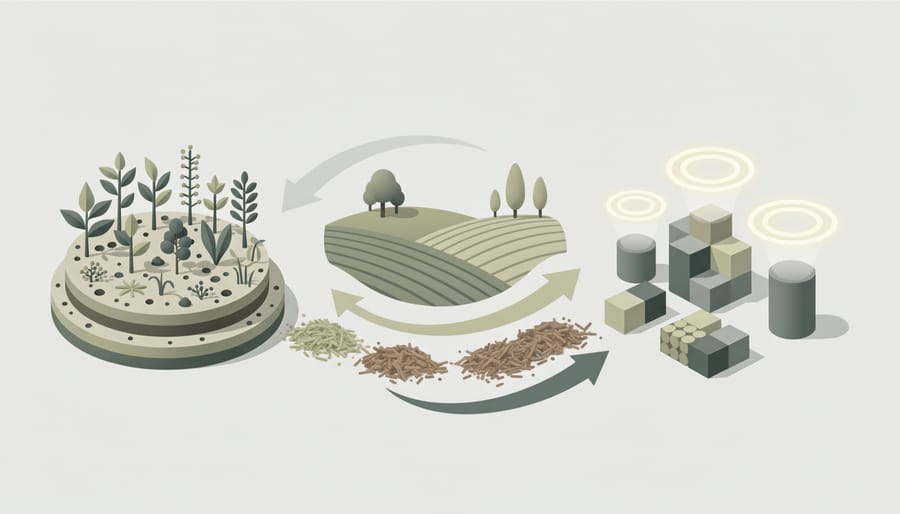
Regenerative farming creates more than just healthier soil, it produces biomass that can power Australia’s clean energy future. The same practices that build soil carbon also generate valuable feedstock for bioenergy production, turning what was once considered waste into a productive resource.
Cover crops do double duty in regenerative systems. While their primary job is protecting and feeding the soil, the above-ground biomass from species like oats, rye, or legume mixes can be harvested for bioenergy without compromising soil benefits. The roots remain in place to feed microbial life and add organic matter, while the harvested material becomes feedstock for biogas digesters or biomass energy facilities. This approach works particularly well in Australian grain belts where farmers are already experimenting with diverse cover crop mixes.
The diversity principle central to regenerative agriculture naturally produces multiple biomass streams. Mixed pastures with deep-rooted perennials generate more total biomass than monocultures while improving soil structure. Integrated crop-livestock systems create manure that becomes feedstock for on-farm biogas production, providing renewable energy while returning nutrients to the land. Some progressive Australian farmers are already running digesters that power irrigation pumps and shed operations, closing the energy loop on their properties.
Agricultural residues shift from problem to resource in this framework. Rather than burning stubble or leaving it to decompose slowly, regenerative systems strategically manage crop residues, some returned to soil, some composted, some directed to energy production. This selective harvest maintains soil cover and organic matter while capturing energy value.
The synergy runs deeper than simple resource efficiency. Regenerative farms building soil carbon are effectively partnering with Australia’s renewable energy transition, sequestering carbon while producing clean energy. It’s a practical demonstration that agriculture can be part of climate solutions rather than climate problems.
Making the Transition: What Australian Farmers Need to Consider
The shift to regenerative farming isn’t something you flip on overnight like a light switch. Most Australian farmers who’ve made the transition successfully did it gradually, learning as they went and adapting to what their specific land told them.
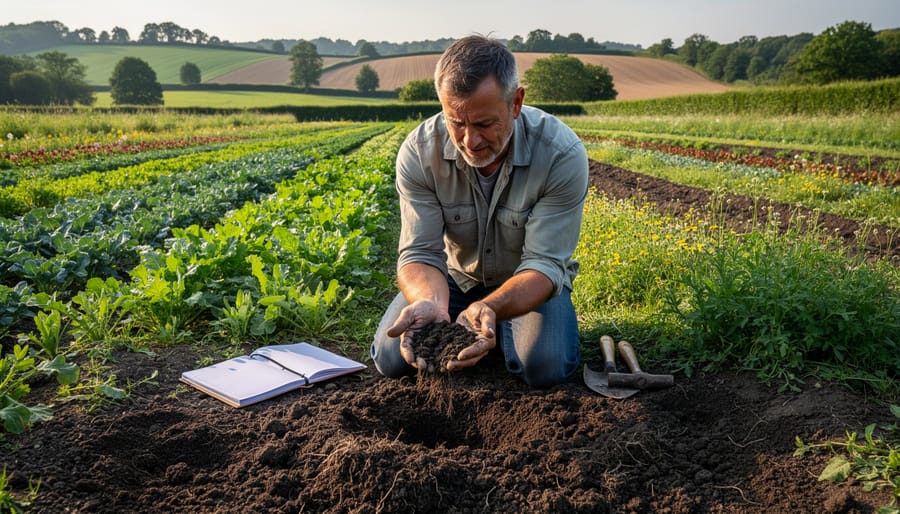
Start by looking at what you’re already doing. Walk your property with fresh eyes and ask questions: Where does water pool or run off too quickly? Which paddocks bounce back faster after grazing? Where’s your soil compaction worst? This honest assessment shows you where regenerative practices could make the biggest difference first, rather than trying to overhaul everything at once.
The farmers seeing the best results typically follow a staged approach:
- Pick a pilot area of 20 to 50 hectares where you can experiment without risking your entire operation. Choose ground that represents your broader challenges but isn’t your most productive or most troubled land.
- Start with one or two practices that fit your current system. If you’re running cattle, try adaptive multi-paddock grazing on your test area. For croppers, a simple cover crop after harvest or reducing tillage passes makes sense as a starting point.
- Build your soil biology before expecting miracles. Plan for two to three years of feeding the soil through diverse plant roots, maintaining ground cover, and cutting back on inputs that harm microbial life. This foundation work determines everything that follows.
- Connect with farmers already doing it in your region. Local Landcare groups, Soils for Life networks, and online communities provide reality checks and solutions for Australian conditions that overseas models might miss.
- Track what’s actually happening through simple soil tests, visual monitoring, and financial records. You need data to know if changes are working or if you need to adjust course.
The timeline question matters because cashflow doesn’t wait for soil biology to rebuild. Most farmers report seeing improvements in soil water-holding capacity and reduced input costs within 18 months to two years. Measurable increases in soil carbon and significant productivity gains typically show up in years three to five, though this varies wildly depending on rainfall, starting soil health, and which practices you implement.
Managing risk during transition means keeping enough conventional backup in your toolkit that a learning curve doesn’t become a financial crisis. You’re not signing a purity pledge. If your cover crop experiment struggles in a dry year, you can adjust. If a paddock needs intervention, intervene. The goal is continuous improvement and building system resilience, not rigid adherence to someone else’s rulebook.
The farmers who struggle are usually the ones who try to copy a complete system from somewhere else or who expect immediate returns. The ones who succeed treat it as a long-term land improvement project that happens to also grow crops and livestock.
Regenerative farming offers Australian producers a pathway forward that addresses both immediate challenges and long-term viability. The opportunity isn’t just environmental, it’s economic, with reduced reliance on expensive inputs and improved resilience against drought and extreme weather events that are increasingly common across Australian landscapes. The carbon sequestration benefits position farmers as active participants in climate solutions rather than bystanders, and with agricultural policy globally shifting toward regenerative approaches, early adopters will be well-positioned for future support programs and market opportunities.
The shift happening in 2026 isn’t a fringe movement. Consumer demand for regeneratively produced food is growing, processors are beginning to pay premiums for verified practices, and the international momentum, including the USDA’s $700 million commitment to regenerative programs, signals where policy support is heading. Australian farmers who start now will have years of learning and soil improvement under their belts when similar frameworks arrive here.
This isn’t about overhauling your entire operation overnight or achieving some perfect standard. Regenerative farming is a journey of continuous observation, learning, and incremental improvement. Start with one paddock. Test cover crops. Adjust your grazing timing. Build from there. The land will respond, your costs will shift, and you’ll develop the knowledge that makes each season easier than the last. The question isn’t whether regenerative approaches work, it’s whether you’re ready to start building soil rather than just mining it.