
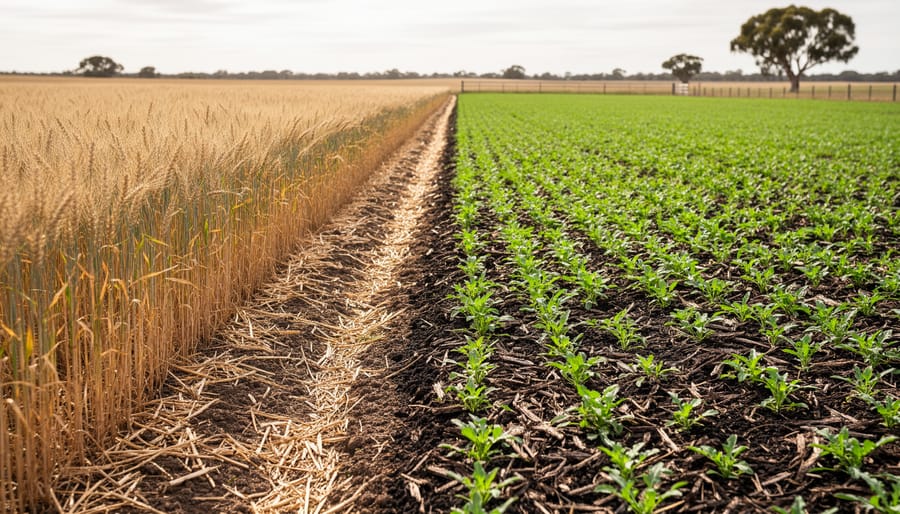
Sustainable farming balances production with environmental protection through methods like crop rotation, integrated pest management, and reduced chemical inputs. Regenerative agriculture goes further by actively rebuilding soil health and sequestering carbon through practices such as no-till farming, cover cropping, and holistic grazing. The distinction matters because Australian farmers need to understand which approach fits their land, resources, and long-term goals.
Both systems share common ground. They reduce synthetic pesticide use, prioritize biodiversity, and aim to leave land healthier than they found it. But they differ in philosophy and intensity. Sustainable farming maintains ecological stability, preventing degradation while producing food efficiently. Regenerative agriculture aims to reverse past damage, treating the farm as an ecosystem that improves year after year.
The results speak for different priorities. A 2024 CSIRO study tracking 85 Australian farms over five years found sustainable practices reduced input costs by 22% while maintaining yields within 5% of conventional methods. Meanwhile, regenerative farms in the same study increased soil organic matter by 1.8% on average, a significant jump that translates to better water retention and carbon storage. However, those regenerative farms experienced a 15% yield reduction in the first three years before recovering to near-baseline levels by year five.
Neither approach holds a universal advantage. Sustainable farming delivers immediate economic benefits with manageable risk, making it practical for farms operating on thin margins. Regenerative agriculture requires patience and upfront investment but offers transformative potential for degraded soils and climate mitigation. A grain grower in the Riverina might choose sustainable methods to stabilize profits while gradually introducing regenerative techniques on select paddocks. A cattle station recovering from drought might embrace full regenerative practices to rebuild landscape function.
The choice depends on your starting point, financial runway, and what success looks like for your operation. Understanding both paths means making informed decisions rather than following trends.
What Sustainable Farming Actually Means in 2026
Sustainable farming in 2026 represents a practical approach to agriculture that balances productivity with resource conservation. At its core, this system aims to maintain current yield levels while protecting the natural assets that make farming possible, ensuring land remains productive for future generations without depleting soil, water, or biodiversity.
The philosophy differs from conventional agriculture through its emphasis on efficiency and reduced environmental impact rather than maximum short-term output. Sustainable farmers prioritize getting more value from fewer inputs. They reduce synthetic fertilizer applications through better timing and placement, minimize pesticide use by integrating pest monitoring systems, and optimize irrigation to match crop needs precisely rather than flooding fields on schedule.
- Resource Efficiency
- The practice of achieving current production levels while using fewer inputs like water, fertilizers, and energy through better planning and technology.
- Input Reduction
- Systematically decreasing chemical fertilizers and pesticides by using targeted application methods and integrated pest management strategies.
- Environmental Stewardship
- Managing farm operations to minimize pollution, protect waterways, and preserve wildlife habitat while maintaining agricultural productivity.
- Precision Agriculture
- Using sensor technology, GPS guidance, and data analytics to apply resources exactly where and when crops need them, eliminating waste.
What makes sustainable farming distinct is that it works within existing agricultural frameworks. Farmers continue using familiar equipment and crop systems but refine their management practices. A wheat producer might stick with conventional tillage but reduce passes, or a cotton grower might maintain monoculture but use soil tests to apply nitrogen only where needed rather than broadcasting it uniformly.
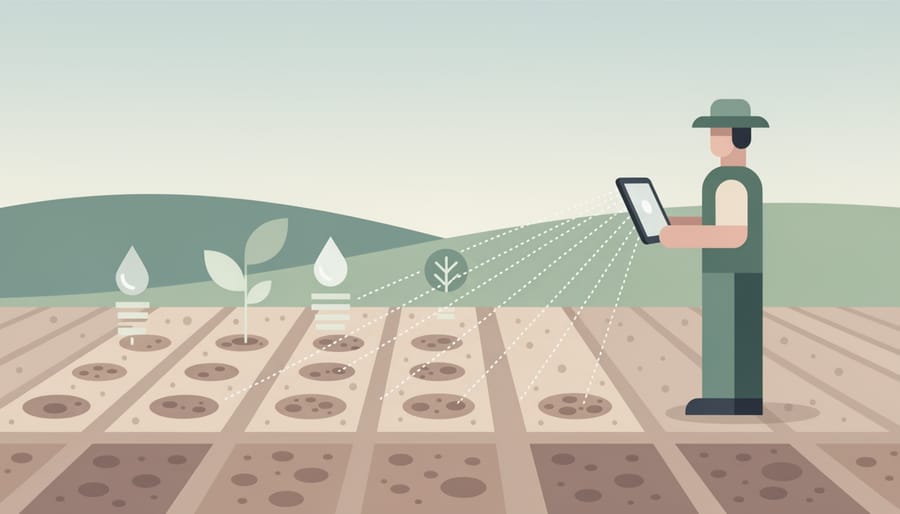
Precision farming technologies have become essential enablers of sustainable practices across Australia. Soil moisture sensors tell farmers exactly when irrigation is needed, preventing water waste in drought-prone regions. Variable rate application systems adjust fertilizer and chemical delivery based on GPS-mapped soil conditions, applying more in deficient areas and less where nutrients are adequate. Satellite imagery and drone monitoring identify crop stress early, allowing targeted intervention rather than blanket treatments across entire paddocks.
The strategic framework developed by agricultural ministries emphasizes agritech’s role in fostering sustainable agriculture precisely because these tools make resource optimization achievable at scale. A farmer can now track fuel consumption per hectare, measure nitrogen use efficiency, and calculate the exact cost per tonne of production with smartphone apps connected to machinery systems.
Sustainable farming doesn’t promise to heal damaged land or rebuild depleted soil, that’s regenerative agriculture’s territory. Instead, it offers a pathway to stop making things worse while maintaining the production levels that keep farms financially viable. It’s agriculture’s version of “first, do no harm,” stabilizing resource use at levels that can theoretically continue indefinitely without catastrophic degradation.
Understanding Regenerative Agriculture: Beyond Sustainability
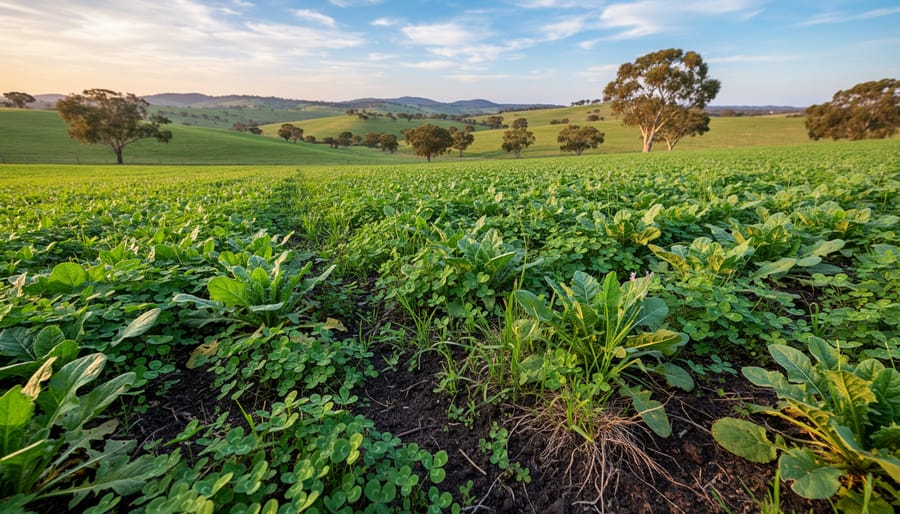
Where sustainable farming focuses on maintaining what you have, regenerative farming takes a fundamentally different approach: actively restoring soil health and repairing ecosystems damaged by decades of conventional agriculture. Rather than simply reducing harm or preserving current conditions, this system aims to reverse degradation and build biological fertility back into your land.
The distinction matters for Australian producers working with soils that have lost organic matter, microbial diversity, and water-holding capacity. Regenerative agriculture operates on the principle that soil is a living system capable of recovery when given the right conditions. The approach treats your paddocks as ecosystems rather than production units, working with natural processes instead of overriding them with synthetic inputs.
The core practices share common threads: they all increase biological activity in the soil, protect it from erosion and compaction, and rebuild the complex networks of fungi, bacteria, and organic matter that create truly fertile ground. Composting transforms organic waste into a concentrated source of nutrients and beneficial microbes. Cover cropping between cash crops keeps living roots in the soil year-round, feeding soil life even during fallow periods and improving water retention. Crop rotation breaks pest and disease cycles while different root systems access nutrients at varying depths.
Mixed farming systems combine enterprises that support each other, spreading risk and creating ecological synergies on the same property. Reduced or no-till approaches protect soil structure and the life within it, avoiding the oxidation of organic matter that follows conventional ploughing. Integrating livestock allows animals to perform ecological functions such as distributing nutrients, breaking up plant material, and stimulating grass growth through controlled grazing pressure.
These practices work together to restore soil ecosystem services that conventional farming has degraded: carbon storage, water filtration, nutrient cycling, and habitat provision. The timeline differs from sustainable farming. Where sustainable practices aim for stability, regenerative methods typically show measurable soil improvement within three to five years as organic matter levels climb, water infiltration rates increase, and biological activity rebounds.
For Australian farmers, this restorative focus addresses a pressing reality. Much of our agricultural land has experienced declining soil health over generations of extractive practices. Regenerative agriculture offers a pathway not just to slow that decline, but to actually rebuild what has been lost and create soils more resilient to drought, flood, and climate variability.

Side-by-Side: How These Approaches Compare
Soil Health and Carbon Impact
The most striking difference between these approaches lies in their effect on soil over time. Sustainable farming practices aim to prevent further degradation, maintaining current organic matter levels and productivity through responsible input management and erosion control. These methods keep soil functioning at its existing capacity without actively rebuilding what has been lost to decades of conventional agriculture.
Regenerative agriculture takes a fundamentally different trajectory. Through practices like cover cropping, reduced tillage, and livestock integration, regenerative systems actively restore damaged soil structure and increase organic carbon content year after year. Research shows this approach doesn’t just halt decline, it reverses it. Soil that was compacted, depleted, and biologically inactive can regain the depth, structure, and microbial life it once had.
The carbon story tells the same tale. Sustainable systems typically stabilize emissions from farm operations and prevent additional carbon loss from soil. Regenerative practices, however, turn soil into an active carbon sink. The soil carbon benefits of regenerative methods come from building organic matter through constant living root systems, diverse crop rotations, and minimized disturbance, all working to pull atmospheric carbon back into the ground.
For Australian farmers facing degraded land, this distinction matters enormously. Sustainable practices offer stability, regenerative practices offer recovery. The choice depends on where your soil sits today and where you need it to be in a decade.
Water Management and Climate Resilience
Water availability remains a critical concern for Australian producers navigating increasingly unpredictable rainfall patterns. Both sustainable and regenerative farming directly address this challenge, but through different mechanisms and timescales.
Sustainable farming approaches water management primarily through efficiency: precision irrigation systems, soil moisture monitoring, and optimized scheduling that reduces waste. Technologies like smart water management allow producers to apply exactly what’s needed, when it’s needed, maintaining production with less water.
Regenerative practices tackle the underlying water-holding capacity of the soil itself. Living roots from cover crops benefit water retention by creating channels that help rainfall infiltrate deeper rather than running off, while increased organic matter acts like a sponge. Producers implementing regenerative systems report soils that hold significantly more moisture during dry periods.
The trade-off: sustainable methods deliver immediate water savings through better management of existing soil capacity, while regenerative approaches invest years building soil structure that fundamentally changes how land captures and stores water. For Australian farms facing longer droughts, this difference in drought resilience becomes increasingly significant as climate patterns shift.
Economic Considerations and Transition Costs
Money matters loom large when Australian farmers weigh up switching approaches. Both sustainable and regenerative transitions require upfront investment, but the timelines and risk profiles differ considerably.
Sustainable farming modifications typically involve incremental changes: precision equipment upgrades, soil testing infrastructure, or variable rate technology that pays back through efficiency gains within two to three seasons. You are working within existing systems, which keeps capital requirements manageable for most operations.
Regenerative transitions demand a different calculus. The shift to practices like cover cropping, reduced tillage, and livestock integration often means accepting lower yields for three to five years while soil biology rebuilds. That revenue gap creates genuine hardship, especially without access to bridging finance. Australian producers consistently report that financial risk limits adoption even when they believe in the long-term benefits.
Support systems remain patchy across states. Some regions offer soil carbon program payments or biodiversity credits that offset transition costs. Others provide virtually nothing. This unevenness means your neighbour across the border might access grants and technical support you cannot, purely based on postcode rather than merit.
The opportunity lies in emerging finance structures. Sustainable agriculture taxonomies are being developed to direct investment toward both approaches based on verified environmental outcomes rather than arbitrary labels. That could reshape the economics substantially by 2027.
Real-World Results: What Australian Farmers Are Seeing
Australian producers are proving that both sustainable and regenerative approaches deliver measurable improvements when implemented with clear goals and adequate support systems. Across grain farms in New South Wales, mixed operations in Victoria, and livestock enterprises in Western Australia, farmers using precision agriculture tools alongside soil-focused practices are documenting changes that validate the investment required to transition.
On broadacre properties that have adopted cover cropping and reduced tillage as part of a regenerative strategy, soil organic matter typically increases by 0.3 to 0.8 percentage points within three to five years. This seemingly modest shift translates to significant improvements in water retention during dry spells, a critical advantage in Australian conditions where rainfall variability challenges conventional systems. Farms maintaining sustainable practices through optimized fertilizer application and integrated pest management report stable yields with reduced input costs, demonstrating that efficiency-focused approaches deliver financial resilience even if they don’t actively restore degraded soils.
Network models supporting on-farm testing have revealed an important pattern: producers who combine sustainable efficiency practices with selective regenerative techniques often achieve better early results than those pursuing purely regenerative systems. A Victorian mixed farmer using crop rotation with strategic livestock integration documented a 22 percent reduction in synthetic fertilizer use within two seasons while maintaining wheat yields at 3.2 tonnes per hectare. Queensland cattle producers integrating rotational grazing report both improved pasture health and reduced supplementary feeding costs during drought periods.
The consistency across these outcomes points to a practical reality: success depends less on choosing a single philosophy and more on matching specific practices to your farm’s starting conditions, climate zone, and available resources. Producers who treat these approaches as complementary tools rather than competing ideologies consistently report stronger results, combining the immediate efficiency gains of sustainable practices with the long-term soil restoration benefits of regenerative methods.
Smart Technology’s Role in Both Approaches
Technology has become a universal enabler for both sustainable and regenerative farming, giving Australian producers the precise data they need to implement either approach more effectively. The same soil sensors, satellite imagery, and farm management software can guide a sustainable operation optimizing fertilizer application or a regenerative farm planning multi-species cover crop rotations. Neither approach owns the technology; the difference lies in what farmers do with the information.
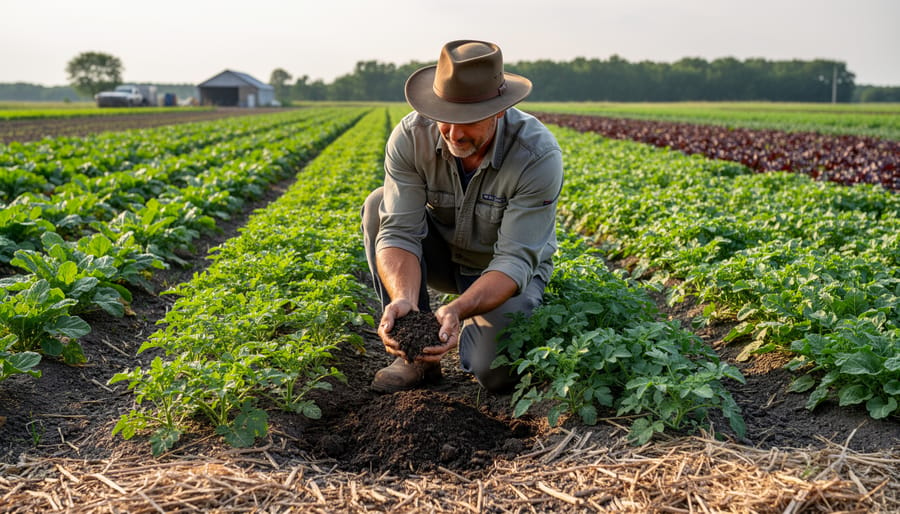
Soil sensors provide real-time data on moisture levels, nutrient content, and microbial activity, helping sustainable farmers reduce input waste and regenerative practitioners track biological recovery. A producer maintaining efficient conventional systems uses this data to apply exactly what’s needed, while one rebuilding degraded soil uses identical sensors to monitor improvements in organic matter and water-holding capacity over time. Variable rate application technology adjusts seed, fertilizer, or amendments across a paddock based on specific conditions, supporting resource efficiency in sustainable operations and targeted restoration in regenerative ones.
Data analytics platforms help both camps make smarter rotation decisions. Sustainable farmers use historical yield data to optimize crop sequences for maximum output with minimal environmental impact, while regenerative producers analyze the same information to plan diverse rotations that rebuild soil structure and biodiversity. Strategic frameworks across Australia increasingly emphasize agritech’s role in fostering sustainable agriculture, recognizing that precision tools accelerate the transition regardless of which philosophy drives the farm.
Drones and satellite monitoring track crop health, detect pest pressure early, and measure ground cover. For sustainable operations, this means timely interventions that prevent problems from escalating. For regenerative farms, it provides evidence of ecosystem recovery and helps demonstrate the land restoration these practices deliver. The technology doesn’t favor one approach over the other; it simply makes both more measurable, manageable, and financially viable for Australian producers ready to farm differently.
Support Systems and Financial Pathways in 2026
Australian farmers face a significant gap between their commitment to sustainability and the financial support available to make the transition. While producers overwhelmingly believe in adopting sustainable farming methods financial risk and uneven support systems continue to slow widespread adoption across both sustainable and regenerative approaches.
Federal and state governments in 2026 are gradually expanding funding pathways, though the landscape remains fragmented. Grant programs targeting soil health improvements, water efficiency upgrades, and carbon sequestration projects provide entry points for farmers exploring either approach. Some states offer cost-share arrangements for precision agriculture equipment that supports optimized resource use, while others focus incentives specifically on practices that restore degraded land.
The development of sustainable finance taxonomies represents a promising shift. These frameworks could direct financial flows toward both sustainable and regenerative agriculture by creating clear investment criteria. This would help banks, investors, and institutional lenders understand which farming practices qualify for preferential loan terms or green bonds, potentially unlocking capital currently unavailable to producers.
Network models like farm demonstration programs are proving valuable by reducing the financial risk of testing new approaches. These initiatives connect early adopters with traditional farmers, allowing producers to evaluate sustainable or regenerative practices on working operations before committing their own resources.
The challenge remains bridging the gap between policy ambition and on-farm reality. Many producers report confusion about which programs apply to their situation, lengthy application processes, and insufficient funding to offset the initial productivity dips that can accompany transitioning practices. Streamlined access to financial support will determine how quickly Australian agriculture can shift toward practices that genuinely restore soil health rather than simply maintain existing conditions.
Choosing Your Path Forward
The decision between sustainable and regenerative farming isn’t either-or for most Australian producers. Your current situation matters more than committing to a single philosophy. Start by honestly assessing your soil condition: properties with severely degraded soil benefit most from regenerative practices focused on restoration, while farms with relatively healthy soil can maintain and gradually improve through sustainable methods.
Your climate zone shapes which practices work best. Northern producers facing variable rainfall might prioritize cover cropping for water retention regardless of which label they use, while southern farms with reliable moisture can experiment with different rotation systems. Resources matter too. Regenerative transitions typically require patience and financial cushion to weather the initial adjustment period, while sustainable modifications often deliver quicker returns with lower upfront investment.
Farm type influences your approach. Livestock operations can integrate grazing management relatively smoothly into either framework. Cropping enterprises might start with sustainable precision farming technologies to reduce inputs, then gradually layer in regenerative practices like composting or reduced tillage as they see results. Market access plays a role as well: some buyers actively seek regenerative certifications, while others simply want verified sustainable practices.
Most successful Australian producers don’t box themselves into one camp. They adopt the practices that make sense for their land, budget, and timeline. You might use precision agriculture tools to optimize fertilizer application while experimenting with cover crops on a few paddocks. Start small, measure results specific to your property, and scale what works. The goal is healthier soil and a viable farm business, not ideological purity. Both approaches offer proven tools to get there.
The Bigger Picture: Farming’s Role in Australia’s Sustainable Future
Australian agriculture stands at a pivotal moment. The choice between sustainable and regenerative farming isn’t just about individual farm success, it shapes our collective capacity to meet climate targets, support biodiversity, and secure long-term food production across increasingly variable conditions.
Both approaches contribute meaningfully to national sustainability goals. Sustainable farming delivers immediate reductions in chemical runoff, water waste, and greenhouse gas emissions while maintaining food security. Regenerative agriculture takes longer to show results but actively rebuilds soil carbon stocks, potentially turning farms into carbon sinks rather than sources. Each pathway matters for different reasons and timescales.
The agricultural sector’s transition also influences Australia’s renewable energy landscape. Healthy soils and diverse cropping systems produce biomass suitable for bioenergy feedstock without competing with food production. Farms implementing cover crops, crop rotation, and integrated livestock systems generate organic materials that can supplement Australia’s renewable energy supply while simultaneously improving soil health.
What’s genuinely encouraging is that Australian producers aren’t waiting for perfect solutions. They’re testing practices from both philosophies, adapting them to local conditions, and sharing what works. This pragmatic experimentation, supported by emerging policy frameworks and precision technology, is creating a uniquely Australian model of agricultural sustainability, one focused less on choosing sides and more on restoring the land that sustains us all. The question isn’t which approach wins, but how quickly we can scale the practices that rebuild our soils while feeding the nation.