
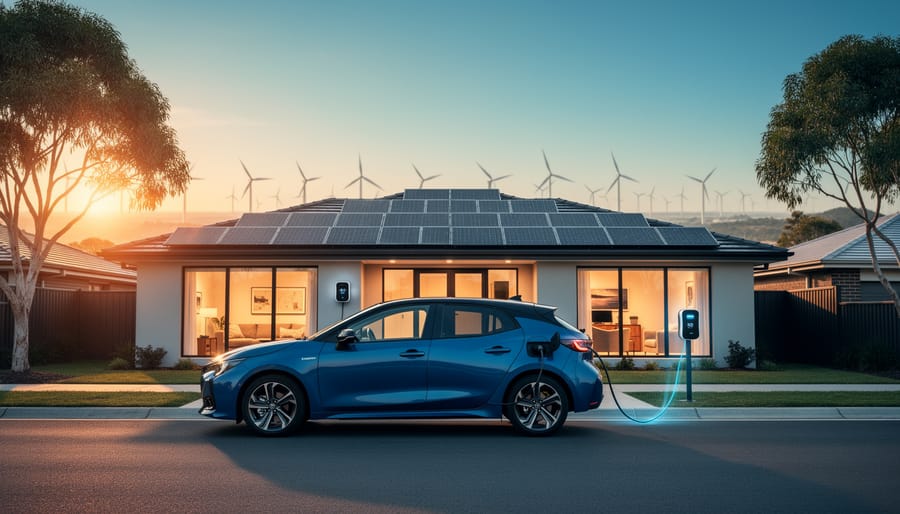
Picture your electric vehicle not just as transport, but as a mobile power station that earns you money while parked in your driveway. This is Vehicle-to-Grid technology – and it’s transforming how Australian households interact with the electricity network. As renewable energy reshapes our power systems, V2G emerges as the missing link between clean transport and grid stability, turning every EV owner into an active participant in the energy transition.
The concept is elegantly simple: when electricity demand peaks and prices surge, your car battery feeds power back to the grid. When demand drops and renewable energy floods the system, your vehicle charges at rock-bottom rates. You pocket the difference whilst strengthening community energy resilience during critical periods.
Australian trials are already proving the model works. In Canberra, 51 Nissan Leaf owners are earning hundreds annually through the Realising Electric Vehicle-to-Grid Services project, whilst Western Australia’s Synergy is demonstrating how V2G can replace expensive diesel generators during peak demand. These aren’t distant promises – they’re functioning systems today.
The timing couldn’t be better. With Australia boasting the world’s highest rooftop solar penetration and EV sales doubling year-on-year, V2G offers a practical pathway to energy independence. Your morning commute uses sunshine stored overnight; your parked car becomes a neighbourhood battery during evening peaks. The technology transforms a depreciating asset into income-generating infrastructure.
This revolution extends beyond individual benefits. By coordinating thousands of vehicle batteries, V2G creates virtual power plants that stabilize grids, reduce blackout risks, and maximize renewable energy usage. The question isn’t whether V2G will reshape Australian energy – it’s how quickly you’ll join the transition.
What Is Vehicle-to-Grid Technology and Why Should You Care?
Imagine your electric vehicle as more than just a way to get from point A to point B. What if it could power your home during a blackout, help balance the electricity grid, and even earn you money while parked in your driveway? That’s the revolutionary promise of Vehicle-to-Grid technology, or V2G for short.
At its heart, V2G is beautifully simple. Your electric vehicle already contains a substantial battery—typically between 50 and 100 kilowatt-hours of storage capacity. V2G technology enables a two-way flow of electricity between your EV and the power grid. Instead of energy only flowing one way into your car’s battery, it can also flow back out when needed.
Here’s how it works in practice. During off-peak hours, usually overnight, your EV charges up using cheaper, often renewable electricity. When demand spikes—say, on a scorching summer arvo when everyone’s cranking their air conditioners—your vehicle can send stored electricity back to the grid or directly to your home. You’re essentially transforming your car into a mobile power bank, one of the most flexible energy storage solutions available today.
This two-way energy flow fundamentally changes what it means to own an EV. Your vehicle becomes an energy asset, not just a cost. It supports grid stability during peak demand, reduces reliance on fossil fuel backup generators, and creates opportunities for you to sell excess energy back to the network.
The beauty of V2G lies in its scalability. One vehicle provides modest support, but imagine thousands of EVs across Australia working together as a distributed energy resource. This creates a virtual power plant capable of supporting renewable energy integration and strengthening our grid resilience—all while your car sits parked, which happens about 95% of the time anyway.
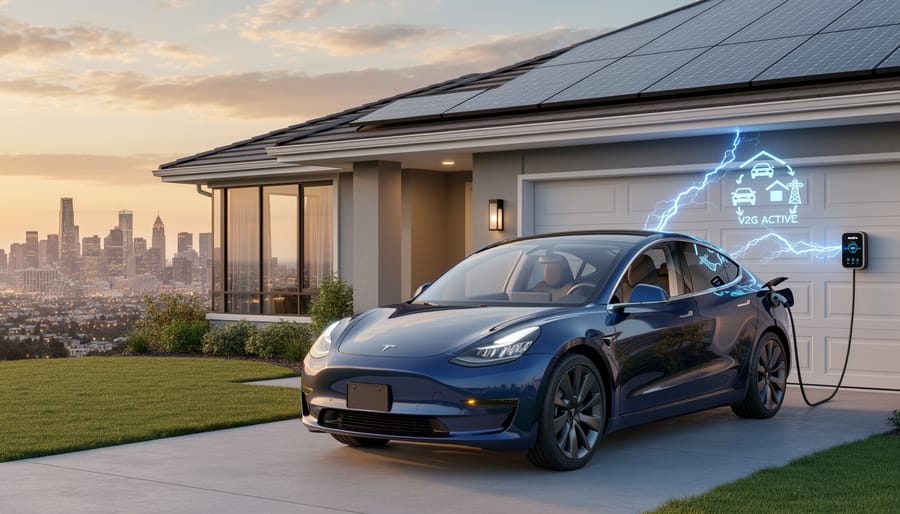
The Three Ways V2G Solutions Save You Money
Slash Your Power Bills During Peak Hours
Picture this: it’s a scorching summer afternoon in Brisbane, and everyone’s cranking their air conditioners. Grid electricity prices skyrocket during these peak periods, sometimes reaching three times the off-peak rate. But with vehicle-to-grid technology, your EV becomes your personal power station.
Instead of paying premium rates between 4pm and 9pm, you can draw stored energy from your car’s battery to run your home. Take Sarah, a Sydney homeowner who recently shared her experience. During peak hours, she runs her home entirely from her electric vehicle, avoiding charges of around 50 cents per kilowatt-hour. By drawing from her car’s battery instead of the grid, she’s slashing her quarterly power bills by approximately $300.
The beauty of this system is its flexibility. You’re not committed to using vehicle power every evening – you choose when it makes financial sense. Many Australian households are discovering that even using V2G technology just a few days per week during peak periods can deliver substantial savings while reducing strain on the grid when it’s needed most.
Turn Your EV Into an Income Stream
Imagine your electric vehicle not just sitting in the driveway, but actively earning money while you sleep. With Vehicle-to-Grid technology, that’s becoming reality for Australian EV owners. During peak demand periods—typically late afternoons when air conditioners are humming across the grid—your fully charged EV can sell excess energy back to the network, turning your car into a mini power station.
The beauty of this system lies in its simplicity. You plug in your compatible EV, set your preferences through an app indicating how much charge you need for tomorrow’s drive, and the V2G system does the rest. When electricity prices spike during high-demand periods, your vehicle automatically feeds power back to the grid, and you receive payment for every kilowatt-hour supplied.
Early adopters in Australian trial programs have reported earning between $400 to $1,200 annually, with potential earnings increasing as the technology scales. It’s passive income that requires virtually no effort once set up. You’re essentially being paid to park your car, whilst simultaneously supporting grid stability and reducing reliance on fossil fuel peaker plants. This creates a win-win scenario: your wallet benefits, and so does the environment.
Protect Yourself From Energy Price Shocks
Remember last summer when energy prices went through the roof during those scorching heatwaves? With vehicle-to-grid technology, you can shield yourself from these price spikes by storing energy when it’s cheap and using it when costs soar. During peak demand events, when electricity prices can jump dramatically, your EV battery becomes your personal energy insurance policy. Instead of watching your power bill climb as air conditioners work overtime across the neighbourhood, you’re drawing from your own stored supply. Australian families using V2G systems report significant savings during summer, particularly when extreme weather drives wholesale electricity prices to eye-watering levels. This energy independence means less worry about market fluctuations and more control over your household budget, while still keeping cool when you need it most.
How V2G Technology Strengthens Australia’s Energy Grid
Balancing Renewable Energy’s Ups and Downs
Imagine the sun blazing across Queensland on a scorching January afternoon, when rooftop solar panels are generating more electricity than homes can use. Meanwhile, wind farms in South Australia are spinning overtime during gusty winter nights. Without proper storage, this valuable clean energy goes to waste. This is where Vehicle-to-Grid technology becomes a game-changer for Australia’s renewable energy future.
V2G systems transform electric vehicles into mobile batteries that balance the grid’s natural fluctuations. When solar and wind generation peaks, EVs can soak up the surplus electricity, charging their batteries at lower costs. Then, when the sun sets or winds calm down, these same vehicles can feed stored energy back into the grid during high-demand periods. It’s like having thousands of mini power stations on wheels, working together to smooth out renewable energy’s inherent variability.
This two-way energy flow supports solar energy integration and makes renewable energy optimization far more practical. The Australian National University estimates that just one million EVs participating in V2G could provide enough storage to stabilize our grid during peak demand, reducing reliance on fossil fuel backup generators.
For everyday Australians, this means your parked EV can earn money while supporting clean energy. For the nation, it means building a more resilient, sustainable grid without expensive infrastructure. V2G turns the challenge of renewable intermittency into an opportunity for innovation and community participation.
Replacing Dirty Peaker Plants With Clean EV Power
During peak demand periods—those scorching summer afternoons when everyone cranks up the air conditioning—energy grids traditionally fire up “peaker plants”: older, inefficient gas or coal facilities that sit idle most of the year but spring into action when needed. These plants are environmental nightmares, emitting substantially more pollution per kilowatt-hour than modern baseload generators.
Here’s where aggregated EV batteries become environmental champions. Instead of firing up these dirty peaker plants, grid operators can draw on thousands of parked electric vehicles to meet demand spikes. When a heatwave hits Sydney or Melbourne, your EV could help avoid burning fossil fuels entirely during those critical hours.
The environmental maths is compelling. A single peaker plant can emit hundreds of tonnes of carbon dioxide during a few hours of operation. Replace that with clean battery power, and those emissions simply disappear. In South Australia, early V2G trials have already demonstrated how EV fleets can respond within seconds to grid signals, providing cleaner, faster emergency power than traditional peaker plants.
This isn’t just theoretical—it’s happening now. Australian energy authorities are increasingly viewing aggregated EVs as genuine alternatives to expensive, polluting infrastructure. Your parked car isn’t just saving you money; it’s keeping the air cleaner for everyone.
Real Success Stories: V2G in Action Across Australia
Across Australia, V2G technology is shifting from theory to reality, with exciting trials already delivering measurable benefits to participants and the broader grid. These real-world success stories demonstrate that the future of sustainable energy isn’t just coming—it’s already here.
In Canberra, the Australian National University partnered with local energy provider ActewAGL to launch one of the country’s most comprehensive V2G trials in 2022. The project equipped 51 Nissan Leaf owners with bidirectional chargers, allowing their vehicles to feed electricity back into the grid during peak demand periods. The results have been remarkable. Participants reported average savings of $150-$200 per quarter on their electricity bills, while the grid benefited from an additional 300 kilowatts of flexible capacity during critical evening peaks. University researcher Dr. Bjorn Sturmberg noted that this trial proved everyday Australians could actively participate in grid stabilization while pocketing genuine savings.
Over in Western Australia, RAC has been pioneering V2G technology at its Kensington headquarters since 2020. Their installation supports a fleet of electric vehicles that not only transport staff but also power the building during high-demand periods. This system has reduced the facility’s peak grid consumption by 30 percent, demonstrating how businesses can integrate V2G into their operations. The success has inspired RAC to expand the program across additional locations.
Queensland’s Sunshine Coast Regional Council is proving that V2G works brilliantly in regional Australia too. Their trial with 15 electric council vehicles has transformed the fleet from a cost centre into an energy asset. During recent grid stress events, these vehicles provided backup power to critical council operations, avoiding expensive diesel generator use. The council estimates they’ll save approximately $50,000 annually while reducing emissions from their transport fleet by 40 percent.
Perhaps most exciting is the collaboration between Jemena, Nissan, and NRMA in Sydney’s western suburbs. This trial involves 150 households and demonstrates V2G at scale in typical Australian neighbourhoods. Participants have collectively discharged over 50,000 kilowatt-hours back to the grid during the trial’s first year, equivalent to powering 15 homes annually. One participant, Blacktown resident Sarah Chen, shared that her EV now effectively pays for itself through grid payments, transforming her view of electric vehicles from an environmental choice to a smart financial investment.
These trials prove that V2G isn’t just viable—it’s already working for everyday Australians, creating a cleaner, more resilient energy future while delivering tangible benefits today.
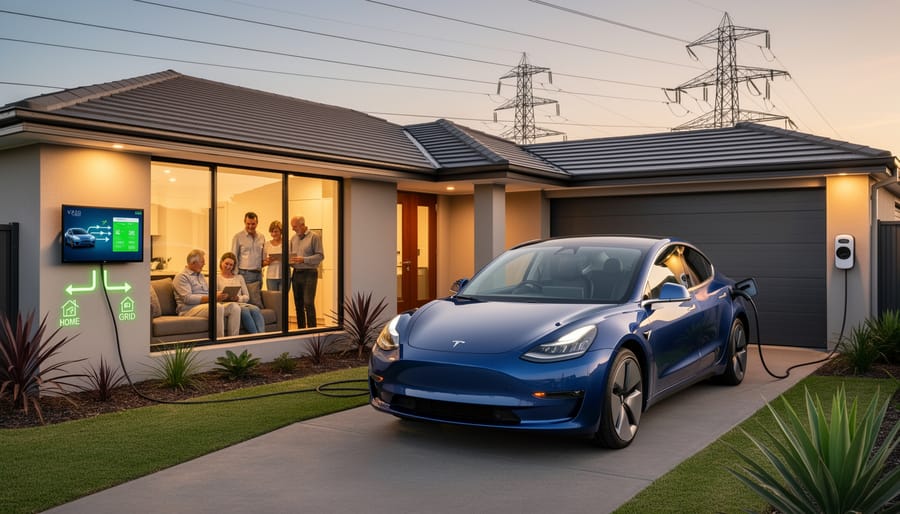
What You Need to Get Started With V2G
Getting started with Vehicle-to-Grid technology is more straightforward than you might think, though it does require a few essential pieces to fall into place. The good news? Australia’s V2G landscape is rapidly maturing, making it easier for households and businesses to join the renewable energy revolution.
First up, you’ll need a compatible electric vehicle. While not all EVs currently support bidirectional charging, the list is growing. Popular models like the Nissan Leaf have offered V2G capability for years, and newer options including certain Hyundai and Mitsubishi models are joining the ranks. Before purchasing an EV, check whether it supports bidirectional charging, as this feature is essential for sending power back to the grid.
Next, you’ll require a V2G-enabled charger, also called a bidirectional charger. Unlike standard EV chargers that only deliver power to your vehicle, these sophisticated units can reverse the flow, sending stored energy from your car’s battery back into your home or the grid. Expect to invest between $5,000 and $10,000 for the charger itself, though prices are steadily declining as technology advances and adoption increases.
Installation requires a qualified electrician familiar with V2G systems, and you’ll likely need approval from your electricity distributor. The charger must integrate with your home’s electrical system and communicate with grid operators to coordinate energy flows safely and efficiently.
Many Australian energy retailers now offer V2G tariffs and programs, creating opportunities to earn credits by participating in demand response events. Check what’s available in your area, as some providers offer incentives that can significantly offset installation costs.
Finally, consider your energy consumption patterns and whether solar panels might complement your V2G setup, creating a powerful combination that maximizes your energy independence while supporting grid stability during peak demand periods.
Overcoming the Hurdles: What’s Holding V2G Back?
Let’s be straight with you—while V2G technology is brilliant in theory, there are genuine hurdles we need to clear before it becomes as common as solar panels on Aussie rooftops.
The biggest challenge? Our current regulatory framework simply wasn’t designed for cars feeding power back into the grid. Energy market rules across Australia are still catching up with this innovation, though there’s good news on the horizon. States like Victoria and South Australia are actively working with industry partners to streamline approval processes and create clearer guidelines for EV owners wanting to participate in V2G programs.
Infrastructure investment presents another practical consideration. Not every charging station can handle bidirectional power flow, and upgrading the grid to manage thousands of vehicles acting as mini power plants requires substantial investment. However, forward-thinking energy companies and governments are already allocating funds to these essential upgrades, recognizing the long-term benefits far outweigh initial costs.
Battery degradation concerns often top the list of worries for potential V2G participants. It’s a fair question—will cycling your battery more frequently shorten its lifespan? Research shows that with smart management systems controlling charge cycles, degradation remains minimal. Many EV manufacturers are now offering extended warranties specifically covering V2G use, demonstrating their confidence in the technology.
The encouraging reality is that each of these challenges has solutions already in development. Australian trials are generating valuable data, helping refine systems and prove the concept works in real-world conditions. What seemed impossible five years ago is rapidly becoming achievable, with communities and companies working together to iron out the wrinkles and make V2G accessible for everyday Australians.
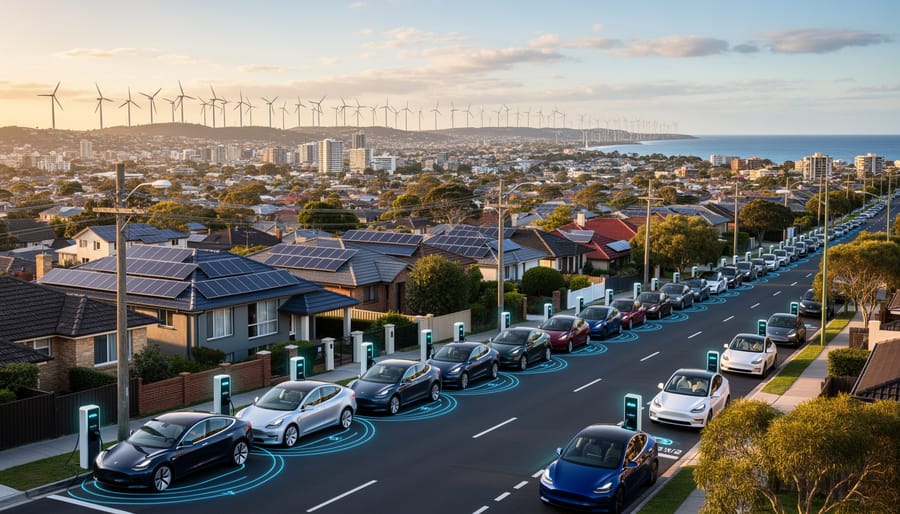
Australia stands at the threshold of an extraordinary energy transformation, and Vehicle-to-Grid technology represents a pivotal piece of this exciting puzzle. As our nation accelerates toward a cleaner, more resilient energy future, the millions of electric vehicles expected on our roads by 2030 won’t just be transport solutions—they’ll form the backbone of a dynamic, distributed energy network that benefits everyone.
For early adopters, the opportunities are immediate and tangible. Today’s V2G-ready EVs and compatible charging infrastructure offer real pathways to reduce electricity bills, earn income from grid services, and achieve greater energy independence. Those who embrace this technology now position themselves at the forefront of Australia’s renewable energy revolution, enjoying financial rewards while contributing to a collective good that extends far beyond individual households.
The long-term vision is even more compelling. Imagine millions of Australian EVs working together as a massive, mobile battery system—storing solar energy during the day, supporting the grid during peak demand, and ensuring our communities remain powered even during extreme weather events. This isn’t distant science fiction; it’s the practical future we’re building together, combining innovative technology with our national commitment to sustainability.
The energy revolution isn’t something to wait for—it’s happening right now, and you can be part of it. Whether you’re considering your first electric vehicle, upgrading your home energy system, or simply exploring what’s possible, investigating V2G options today means joining a movement that’s reshaping how Australia powers itself. The question isn’t whether to participate, but how soon you’ll start your journey toward a cleaner, smarter energy future.