
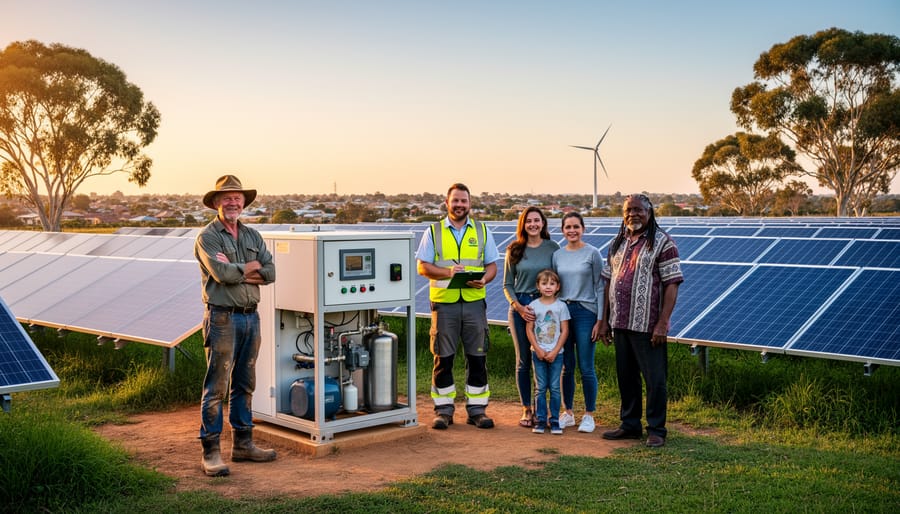
Measure impact by evaluating five interconnected dimensions that transform how you assess the true value of renewable energy projects. Start by documenting the environmental benefits—carbon emissions avoided, waste diverted from landfill, and ecosystems protected—using tangible metrics that stakeholders can understand. Track the economic ripple effects by calculating local jobs created, energy cost savings for participants, and revenue retained within regional communities rather than exported to multinational corporations.
Assess social impact through engagement levels, energy literacy improvements, and whether your project strengthens community resilience during grid disruptions or natural disasters. For community-led energy initiatives, this dimension often proves most compelling to funders and participants alike.
Evaluate governance improvements by examining decision-making transparency, democratic participation rates, and whether your project builds local capacity for managing complex infrastructure. Finally, measure innovation transfer—how your learnings influence other projects, contribute to policy development, or advance technical knowledge across the sector.
These five dimensions originated from impact investing frameworks but have been adapted brilliantly for Australia’s community energy sector, where projects must justify value to diverse stakeholders including councils, traditional owners, farmers, and suburban households. Unlike simplistic kilowatt-hour measurements, this holistic approach captures why a regional bioenergy facility generating the same electricity output as a corporate solar farm delivers fundamentally different community benefits.
The framework empowers you to tell richer stories about project outcomes, secure more diverse funding streams, and build stronger coalitions. When a Central Victorian biogas project demonstrates not just renewable electricity but also agricultural jobs, Indigenous partnership models, and circular economy principles, it becomes far more compelling than technical specifications alone could ever convey.
Why Traditional Energy Metrics Miss the Bigger Picture
When we measure the success of renewable energy projects, we’ve traditionally focused on the numbers that appear on technical reports: kilowatt-hours generated, megawatts of capacity installed, or tonnes of carbon dioxide avoided. These figures matter, certainly, but they’re a bit like judging a tree solely by its timber yield while ignoring the shade it provides, the wildlife it shelters, and the soil it enriches.
Across Australia, community energy initiatives are discovering that their greatest achievements often happen in spaces where conventional metrics don’t venture. Take the solar farm in regional New South Wales that not only powers local homes but has become a catalyst for youth employment, training young electricians and technicians who might otherwise have left town seeking opportunities. The megawatts tell one story, but the revitalised main street and thriving apprenticeship program tell another entirely.
Or consider the bioenergy project in South Australia that transformed agricultural waste into power. Standard assessments would measure the energy output and emissions reduction. What they miss is how the project strengthened relationships between farmers, created new revenue streams for struggling properties, and sparked conversations about circular economy principles in local schools. These ripple effects touch lives, build resilience, and foster innovation in ways that kilowatt counters simply cannot detect.
The challenge isn’t that traditional metrics are wrong, they’re just incomplete. They capture the hardware but miss the heartware. They count the watts but overlook the wonder. For communities investing time, resources, and hope into renewable energy projects, this narrow view means their most meaningful contributions remain invisible, unvalued, and unreported.
This is precisely why we need a broader lens, one that recognises energy projects as living systems embedded within communities rather than isolated technical installations. The five dimensions framework offers this perspective, ensuring we measure what truly matters while celebrating the full spectrum of positive change these projects create.
The 5 Dimensions of Impact: A Framework That Captures What Communities Really Care About
When communities embrace renewable energy projects, they’re not just installing solar panels or bioenergy systems—they’re transforming their entire landscape of possibility. The 5 Dimensions of Impact framework has emerged as a powerful tool for capturing what truly matters to Australian communities, moving beyond kilowatt-hours and carbon metrics to measure real, lived experiences.
This framework resonates deeply with community-led energy initiatives because it acknowledges a simple truth: renewable energy projects touch every aspect of community life. From rural townships in Queensland establishing bioenergy cooperatives to suburban Melbourne neighbourhoods forming solar collectives, communities have always known their projects create ripples far beyond the energy meter.
The five dimensions work together to paint a complete picture. First, the What dimension examines the outcomes your project delivers—whether that’s clean energy, jobs, or improved air quality. The Who dimension ensures you’re identifying everyone your project affects, from direct participants to neighbouring communities. The How Much dimension goes beyond simple counting to understand the depth and duration of change you’re creating.
Then there’s the Contribution dimension, which asks the tough but necessary question: what would have happened without your project? This helps communities claim their genuine impact rather than taking credit for changes that might have occurred anyway. Finally, the Risk dimension acknowledges that even well-intentioned projects can have unintended consequences, encouraging honest assessment of potential downsides.
Together, these dimensions create a framework that’s both rigorous and human-centred—perfect for Australian communities who value straight talk and practical results. They transform impact measurement from a compliance exercise into a storytelling tool that captures the full value of community energy initiatives.
Dimension 1: What Gets Measured
Beyond Megawatts: Tracking Multiple Outcomes Simultaneously
Community energy projects create ripples of positive change that extend far beyond the electricity meter. While megawatt hours matter, truly understanding a project’s value means tracking outcomes across multiple dimensions simultaneously—much like monitoring different instruments in an orchestra working together.
Carbon reduction sits at the heart of bioenergy initiatives, with Australian projects demonstrably cutting emissions by diverting organic waste from landfill while displacing fossil fuel-generated power. A regional biogas facility might simultaneously prevent methane release from decomposing waste and generate clean electricity for hundreds of homes. But the story doesn’t end there.
Cost savings represent another critical metric, delivering tangible economic benefits to participants through reduced energy bills and community dividend schemes. These financial returns help sustain community support and enable project reinvestment.
Energy independence strengthens regional resilience, particularly vital for remote Australian communities previously reliant on costly diesel generators or vulnerable grid connections. When local organic resources power local needs, communities gain control over their energy future.
Co-benefits specific to bioenergy add further dimensions worth tracking. Agricultural communities processing crop waste reduce fire risk while creating nutrient-rich fertiliser byproducts. Regional employment opportunities emerge, keeping skilled workers local. Educational programs inspire the next generation of renewable energy champions.
The most successful projects establish measurement frameworks from day one, capturing baseline data across all relevant dimensions. This comprehensive approach not only demonstrates genuine impact but also builds compelling narratives that attract funding, community participation, and policy support—proving that what gets measured gets valued.
Success Story: How a Regional Victoria Bioenergy Hub Tracks Its Impact
The Gippsland Community Bioenergy Cooperative provides a brilliant example of comprehensive impact tracking in action. When this regional Victoria hub launched three years ago, the team committed to measuring success across all five dimensions from day one.
Their environmental tracking goes beyond carbon reduction, monitoring local air quality improvements and native vegetation restoration around their facility. What captures attention, though, is how they’ve documented social impact. The cooperative created 27 local jobs, with half filled by workers transitioning from traditional industries. They run quarterly community workshops that’ve attracted over 400 participants, building genuine energy literacy across the region.
Financially, they’ve demonstrated viability while keeping energy costs stable for 150 local households. Their governance model includes rotating community board positions, ensuring diverse voices shape decisions.
The standout achievement is their systematic approach to data collection. Simple monthly surveys, energy usage tracking, and partnership with La Trobe University researchers provide evidence that tells their full story. This comprehensive documentation helped them secure additional state government funding and inspired five neighbouring communities to explore similar projects.
Their message is clear: measuring multiple dimensions isn’t complicated, it just requires commitment. The payoff comes when you can show decision-makers and community members the complete picture of what clean energy delivers.
Dimension 2: Who Experiences the Impact
Mapping Your Impact Circle
Before you can measure the impact of your bioenergy initiative, you need to know who’s actually affected by it. Think of your project as a stone dropped in a pond – the ripples spread outward, touching different groups in different ways.
Start by identifying your primary stakeholders. For a typical bioenergy facility, this includes farmers and landholders supplying feedstock like agricultural waste or purpose-grown crops. Then there are the households and businesses receiving renewable power. Don’t overlook local councils, neighbouring properties, and Indigenous communities whose connection to country might be affected.
Next, map your secondary circle. These are folks indirectly touched by your project – the local businesses supplying equipment and services, tradies finding new work opportunities, and even schools benefiting from educational partnerships. A small-scale biogas project in regional Victoria, for example, created unexpected opportunities for agricultural contractors who now transport organic waste to the facility.
Create a simple stakeholder map with concentric circles. Place those most directly impacted in the centre and work outward. For each group, ask: How does this project affect them? What matters most to them – jobs, environmental benefits, reliable energy, or something else?
This exercise reveals the true scope of your community energy projects and ensures you’re measuring what genuinely matters to the people involved. It transforms abstract impact categories into real faces and stories.
The Ripple Effect: Unexpected Beneficiaries
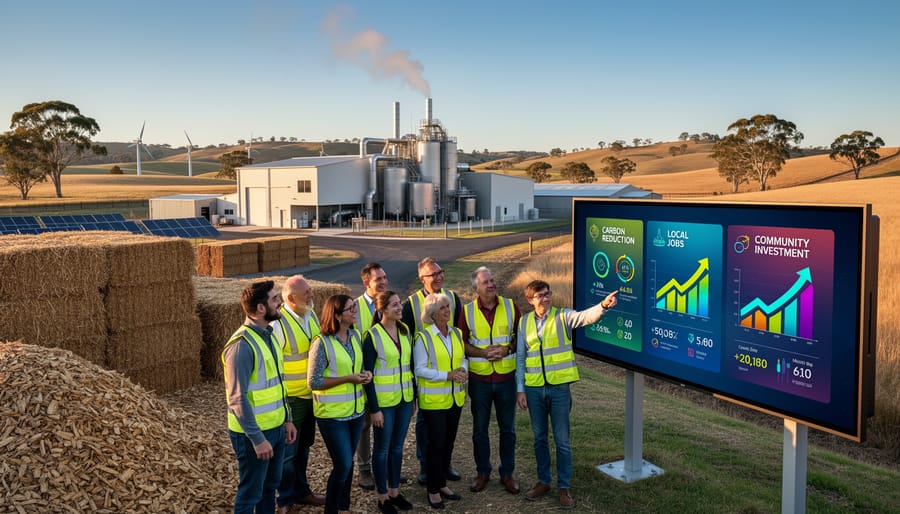
Community energy projects create waves of positive change that extend far beyond their primary participants. In Western Australia, a solar farm initially designed to benefit local farmers became an unexpected boon for indigenous tourism operators. The improved grid reliability enabled them to run refrigeration units consistently, transforming their ability to offer food services and extend operating hours during peak tourist season.
Similarly, a Queensland bioenergy initiative processing agricultural waste didn’t just reduce emissions—it created apprenticeship opportunities for young people in regional areas, giving them viable career pathways without leaving their communities. Local cafes and accommodation providers saw increased trade as the project attracted visitors and consultants.
Perhaps most touching was a Victorian community battery project that indirectly supported elderly residents. When neighbourhood energy costs dropped, fixed-income pensioners found breathing room in their budgets, while the community hub hosting project meetings became a regular social gathering spot, reducing isolation.
These ripple effects demonstrate that impact assessment must look beyond immediate stakeholders. The café owner whose business thrives, the apprentice who finds purpose, the elder who reconnects with neighbours—they’re all part of your project’s true legacy.
Dimension 3: How Much Impact Is Created
Quantifying the Unquantifiable
Not everything that matters comes with a convenient meter reading. While tracking kilowatt-hours and carbon savings provides essential data, the most transformative impacts of community energy projects often resist simple measurement. How do you put a number on the pride a township feels when their local renewable initiative powers the school? What’s the value of neighbors reconnecting over a shared energy vision?
Smart practitioners are developing creative approaches to capture these vital dimensions. Community cohesion surveys conducted before and after project implementation reveal shifts in social connections and collective confidence. One Victorian farming community documented a 40% increase in residents attending local meetings after establishing their bioenergy cooperative, demonstrating tangible evidence of strengthened bonds.
Energy literacy gains can be assessed through pre- and post-program testing, tracking how understanding of renewable systems grows. A Queensland project measured this by documenting school engagement, finding students became enthusiastic advocates who educated their families about sustainable energy choices.
Local empowerment measurement combines qualitative stories with participation metrics. Track how many residents contribute ideas, volunteer hours logged, and local businesses involved. Document decision-making processes that shift from external consultants to community leadership.
The key lies in combining methods: pair statistical tracking with photo documentation, resident testimonials, and regular community feedback sessions. This mixed approach creates a comprehensive picture that resonates with funders, inspires other communities, and honestly represents the multifaceted value these projects deliver beyond the balance sheet.
Dimension 4: Community Contribution and Additionality
What Would Have Happened Otherwise?
Understanding what would have happened without your community energy project is essential for demonstrating genuine impact. This counterfactual thinking helps you prove that your initiative creates value beyond what commercial energy projects alone could achieve.
The most straightforward approach is comparing your project area to similar communities without community energy initiatives. For instance, a regional Victorian town that launched a community bioenergy program might compare its outcomes against a neighbouring town of similar size and demographics. Did your community achieve higher renewable energy adoption rates? Greater local employment? Stronger social connections around sustainability?
Another powerful method involves surveying your community members directly. Ask participants what they would have done if your project didn’t exist. Would they have installed solar panels anyway? Would they have connected with their neighbours about environmental issues? These honest conversations often reveal that community-led projects reach people who wouldn’t otherwise engage with renewable energy, particularly renters, lower-income households, or those intimidated by commercial providers.
Historical data also tells a compelling story. Review energy consumption patterns, local employment figures, and community engagement levels before your project launched. The contrast between then and now demonstrates your actual impact.
Consider too the ripple effects that commercial projects typically miss. A community biogas facility in rural New South Wales didn’t just process organic waste—it sparked school education programs, local tourism interest, and inspired three neighbouring communities to explore similar initiatives. These cascading benefits rarely emerge from purely commercial ventures, making them powerful evidence of your distinctive community-driven impact.
Dimension 5: Risk and Unintended Consequences
Learning from Challenges: When Bioenergy Projects Hit Unexpected Snags
Even the best-intentioned bioenergy projects sometimes face unexpected hurdles, and honest measurement helps turn these challenges into valuable lessons. A South Australian organic waste-to-energy facility discovered their feedstock mix was producing lower biogas yields than projected. Rather than obscuring the issue, they used comprehensive impact tracking to identify the problem early—the local council’s food waste collection included too many compostable plastics that weren’t breaking down efficiently. By transparently sharing this data with stakeholders, they redesigned their collection program and improved community education about proper sorting. Within six months, biogas production increased by 30 percent.
Similarly, a Victorian farm-based bioenergy cooperative found their initial job creation targets were falling short because they’d underestimated the specialized skills needed for operations. Their thorough impact monitoring flagged this gap early, prompting partnerships with local TAFEs to develop tailored training programs. This transformed a potential failure into a long-term workforce development success story.
These examples demonstrate that measuring all five impact dimensions isn’t about proving perfection—it’s about creating accountability and learning loops that make projects stronger. When communities see honest reporting, including challenges and solutions, trust deepens and the entire sector benefits from shared knowledge.
Putting It All Together: Building Your Community Impact Measurement Framework

Start Simple, Then Build
The beauty of measuring impact across five dimensions is that you don’t need to tackle everything at once. Start with what matters most to your community and what you can realistically measure with existing resources. Perhaps that’s simply tracking energy generation and immediate cost savings alongside stories from participants about their experience. There’s nothing wrong with keeping it straightforward initially.
As your community energy project gains momentum, you can gradually layer in additional measurements. A renewable energy cooperative in regional Victoria started by documenting their solar output and community engagement numbers. Twelve months later, they’d added local employment metrics and environmental tracking. By year three, they were conducting detailed social impact assessments that demonstrated improved community wellbeing and connection.
The key is avoiding evaluation paralysis while ensuring you’re capturing meaningful data from day one. Choose one or two indicators from each dimension that align with your project goals and community values. Document these consistently, even if it feels basic. You’re building a foundation for understanding your true impact, and simple measurements done well beat complex frameworks that overwhelm your team. Remember, every major success story started with modest first steps and a commitment to learning along the way.
Making Your Impact Visible
Communicating your impact effectively means tailoring your message to each audience while maintaining the integrity of your findings. When presenting to grant providers, lead with the dimension that matters most to them – typically financial sustainability and scale – then weave in the human stories that demonstrate why your project deserves continued support. For community members, flip this approach. Start with the ‘What’ and ‘Who’ dimensions, sharing tangible examples of how everyday Aussies benefit from your renewable energy initiative. A solar farm in regional Victoria, for instance, might highlight reduced energy bills for local families alongside job creation numbers.
Policymakers respond well to the ‘How much’ dimension supported by compelling narratives. Rather than presenting dry statistics, frame your data within success stories that showcase replicable models. For example, “Our community bioenergy hub prevented 500 tonnes of agricultural waste from landfill while powering 200 homes” tells a complete story across multiple dimensions.
The key is using the five dimensions framework as your storytelling scaffold, ensuring consistency across all communications while adjusting emphasis based on who’s listening. This approach transforms complex project outcomes into accessible, memorable messages that inspire action and build lasting support for community energy solutions.
Measuring impact across these five dimensions isn’t just about ticking boxes or satisfying funding requirements—it’s about telling your community’s story in a way that resonates, inspires, and creates lasting change. When Australian community energy projects systematically capture their social, environmental, financial, stakeholder, and what dimensions, they unlock powerful narratives that demonstrate genuine value to funders, policymakers, and neighbouring communities considering similar initiatives.
Think of comprehensive impact measurement as your project’s megaphone. The Byron Bay community that reduced local emissions while creating jobs has compelling data to share. The regional cooperative that strengthened social connections while generating clean power can prove its worth beyond kilowatt-hours. These stories, backed by robust evidence across all five dimensions, become the foundation for securing ongoing support, attracting new investment, and scaling successful models across Australia.
The beauty of this framework is that it meets you where you are. Whether you’re running a small-scale solar initiative or a larger bioenergy project, you can start measuring what matters most and gradually expand your evaluation approach. Every data point collected, every survey completed, and every story documented contributes to the broader narrative of Australia’s renewable energy transition.
Your community’s success story matters. By embracing thorough impact evaluation, you’re not only demonstrating accountability—you’re building a roadmap for others to follow, contributing to national climate goals, and proving that community-led renewable energy delivers benefits that extend far beyond the power grid. The time to start measuring, learning, and sharing is now.