
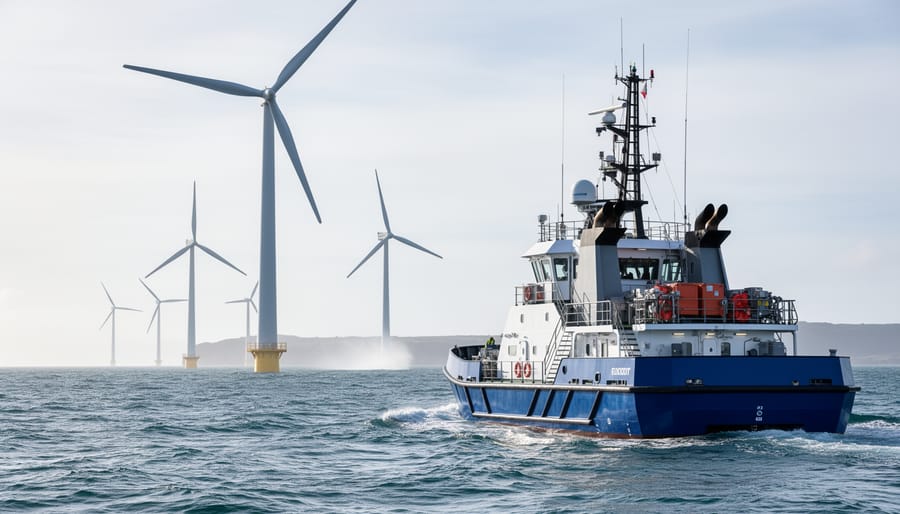
Offshore wind services encompass the specialized technical, logistical, and operational expertise required to plan, build, and maintain wind farms at sea. These services span everything from marine geotechnical surveys and turbine installation to underwater cable laying and long-term asset management. For Australia’s emerging offshore wind sector, accessing the right service providers can mean the difference between a project that delivers clean energy on schedule and one that stalls under the weight of maritime complexity.
The offshore wind industry operates in one of the most demanding environments on Earth. Salt spray corrodes equipment, cyclonic weather systems threaten construction schedules, and the sheer distance from shore turns routine maintenance into a logistical puzzle. Yet Australia is now home to some of the Southern Hemisphere’s most ambitious offshore wind zones, from the Gippsland region off Victoria to the Hunter coast in New South Wales. These projects will require vessel operators who understand local sea conditions, engineers experienced in foundation design for variable seabeds, and environmental consultants who can navigate Australia’s unique marine ecosystems.
The service ecosystem mirrors what’s already proven effective in Europe’s North Sea, but with adaptations for Australian waters. Just as ocean power technologies must account for Southern Ocean swells, offshore wind services here need to consider tropical cyclones, long transit distances, and a developing local supply chain. Understanding which services matter most at each project phase helps developers budget accurately, investors assess risk, and policymakers craft regulations that support safe, efficient deployment.
This guide breaks down the service categories that keep offshore wind projects moving, from initial feasibility studies through decades of operation, with practical insights for anyone evaluating providers or planning Australia’s renewable energy future.
What X Wind Services Brings to Offshore Wind Projects
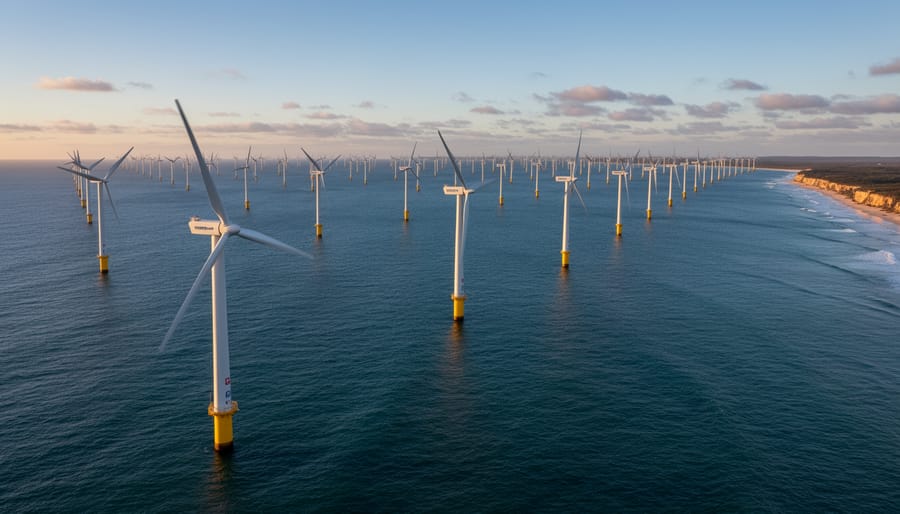
Offshore wind projects operate in one of the planet’s most demanding environments. Unlike land-based renewables, where crews can drive to a turbine and return home each evening, offshore installations face saltwater corrosion, powerful wave forces, unpredictable weather windows, and sites that may sit 50 kilometers from shore in water depths exceeding 60 meters. This hostile setting requires a fundamentally different approach to every stage of development.
The specialized services begin before a single foundation touches the seabed. Marine geophysical surveys map underwater geology, identifying suitable soil conditions and potential hazards like unexploded ordnance from past conflicts. Meteorological masts and floating LiDAR systems collect years of wind speed data at hub height, far more complex than mounting equipment on solid ground. Environmental impact assessments must account for marine mammals, seabirds, fish spawning grounds, and existing shipping lanes. Each study demands expertise that simply doesn’t exist in traditional land-based renewable projects.
Construction amplifies these challenges. Installing a 15-megawatt turbine on a fixed foundation requires jack-up vessels costing hundreds of thousands of dollars per day, precise weather windows, and crews trained in offshore safety protocols. Cable-laying vessels must bury subsea cables deep enough to avoid ship anchors and fishing gear while navigating tidal currents. The onshore versus offshore differences extend to every technical aspect: offshore turbines need advanced corrosion protection, remote monitoring systems that function without constant physical access, and components designed to withstand salt spray and lightning strikes simultaneously.
Once operational, maintenance becomes an ongoing logistical puzzle. Technicians reach turbines by crew transfer vessels or helicopters, weather permitting. Spare parts require marine logistics coordination. Underwater inspections use remotely operated vehicles. Annual maintenance costs for offshore wind run roughly double those of equivalent land-based capacity, but proper service delivery keeps turbines generating at capacity factors above 50 percent, far exceeding what most onshore sites achieve.
This complexity explains why offshore wind development requires dedicated service providers who understand marine engineering, meteorological science, offshore safety regulations, and renewable energy technology equally well.
Why Australia Needs Offshore Wind Expertise Right Now
Australia stands at the threshold of an offshore wind revolution. With some of the world’s strongest and most consistent coastal winds, the nation has declared multiple offshore wind zones stretching from Bass Strait to the waters off Gippsland, the Illawarra, and the Hunter Coast. These zones could generate tens of gigawatts of clean energy, enough to power millions of homes while slashing emissions from the electricity sector. The potential is enormous, but turning that potential into spinning turbines requires something Australia is still building: deep offshore wind expertise.
Unlike Europe or Asia, where offshore wind has matured over two decades, Australia is in the early stages of development. The first large-scale projects are moving through planning and approvals now, with construction expected to ramp up through the late 2020s. That means we’re building the industry from scratch, which brings both opportunity and risk. Getting it right demands specialized knowledge in marine engineering, metocean conditions, and the particular challenges of Australian waters.
Those challenges are real and distinct. Our offshore sites face powerful Southern Ocean swells, occasional tropical cyclones in northern regions, and deeper waters than many established offshore wind markets. The distances from shore can be significant, complicating logistics and increasing installation costs. Australian marine environments also host unique ecosystems, from whale migration routes to significant fishing grounds, requiring careful environmental planning and stakeholder engagement. Cookie-cutter approaches from overseas won’t work here.
This is why specialized offshore wind services matter right now. Without experts who understand both the technology and the local conditions, projects face delays, cost overruns, and potential failures that could set back the entire industry. Australia needs service providers who can navigate regulatory requirements, adapt proven technologies to local conditions, and build the workforce capable of delivering world-class offshore wind farms safely and efficiently.
From Seabed to Grid: How X Wind Services Support Every Stage
Site Assessment and Planning
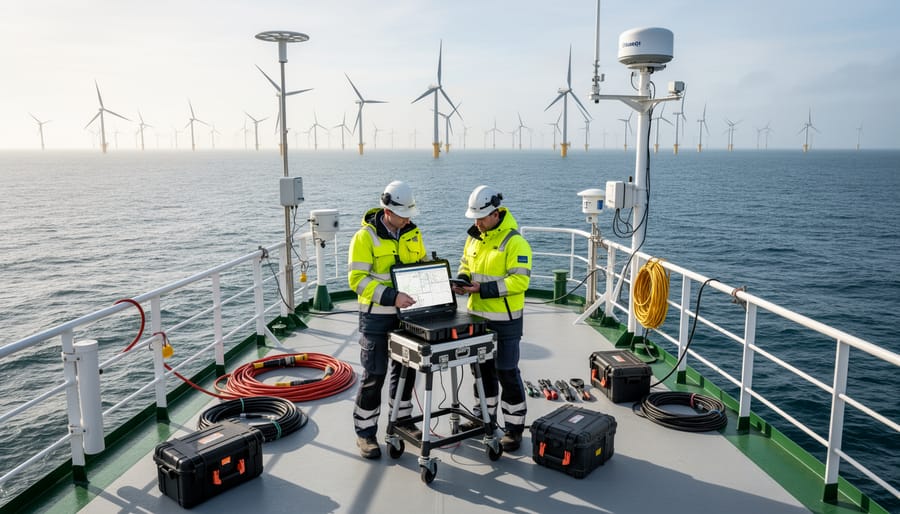
Before a single turbine rises from the ocean, developers need a complete picture of what lies beneath and above the water. Site assessment and planning services form the foundation of every successful offshore wind project, combining marine surveys, meteorological analysis, and environmental studies to determine whether a location can deliver reliable, sustainable energy.
Marine surveys map the seabed topology, soil composition, and underwater obstacles using specialized sonar and drilling equipment. These surveys reveal whether the ocean floor can support massive turbine foundations and identify potential hazards like underwater cables or shipwrecks. Wind resource assessment involves deploying floating LiDAR systems and meteorological buoys that measure wind speeds, directions, and patterns at hub height over multiple seasons. This data determines the project’s energy generation potential and financial viability.
Environmental impact studies assess how turbines might affect marine life, bird migration routes, and existing ocean uses like fishing or shipping lanes. Similar assessment techniques used in marine energy atlases help developers understand seasonal variations and ecosystem interactions. Feasibility analysis synthesizes all this information into economic models that account for installation costs, grid connection requirements, and regulatory compliance.
For Australia’s Star of the South project off Gippsland, assessment teams spent years gathering baseline data on Southern Ocean conditions, including extreme weather patterns and unique marine biodiversity. Without this thorough groundwork, developers cannot secure financing, regulatory approval, or community support. Quality assessment services turn promising offshore locations into bankable projects.
Installation and Construction Support
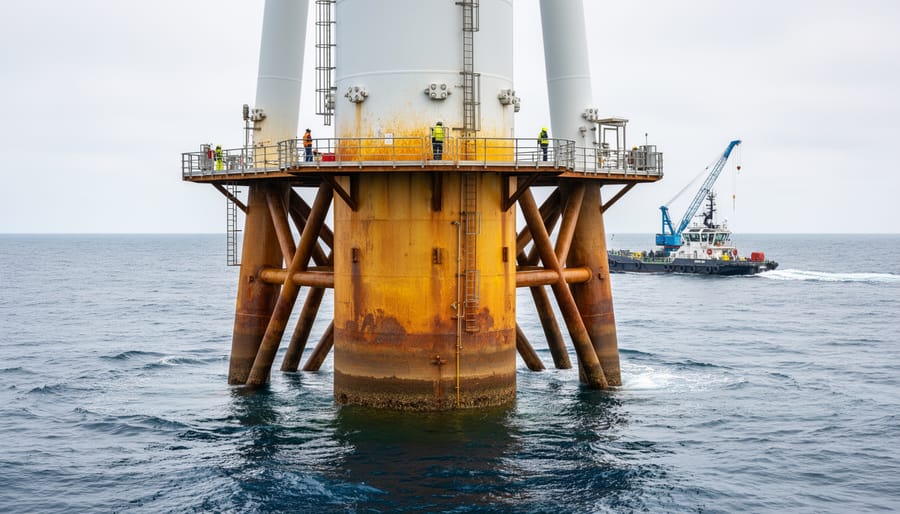
Building an offshore wind farm demands some of the most complex marine operations in modern engineering. Picture installing turbines taller than Sydney’s Centrepoint Tower in waters 50 meters deep, 20 kilometres from shore, that’s the scale service providers tackle daily in this field.
The operation begins with specialized vessels that serve as floating construction platforms. Jack-up barges position themselves over installation sites, extending massive legs to the seabed and lifting their hulls clear of wave action. These vessels must maintain millimetre precision while handling loads exceeding 1,500 tonnes in open ocean conditions. Heavy-lift ships transport monopile foundations, steel cylinders 80 meters long and 10 meters wide, from fabrication yards to installation sites, requiring intricate marine logistics coordination across international supply chains.
Foundation installation alone pushes engineering boundaries. Hydraulic hammers mounted on specialized vessels drive monopiles 30 meters into the seabed with precisely calibrated force, while remotely operated vehicles verify alignment and structural integrity underwater. Floating foundations, emerging as alternatives for deeper waters, demand even greater innovation in mooring systems and dynamic positioning.
Turbine assembly happens offshore through choreographed precision. Crane vessels lift nacelles weighing 500 tonnes onto towers in weather windows of just hours, while blade installation requires calm seas and specialized rigging. One misalignment of a few degrees can compromise a turbine’s 25-year lifespan.
Cable laying completes the construction phase, connecting turbines through subsea arrays and linking to shore. Burial ploughs trench cables into the seabed for protection, while grid tie inverters at onshore substations condition the power for network integration. These services transform engineering designs into functioning assets generating clean electricity for decades.
Operations and Maintenance
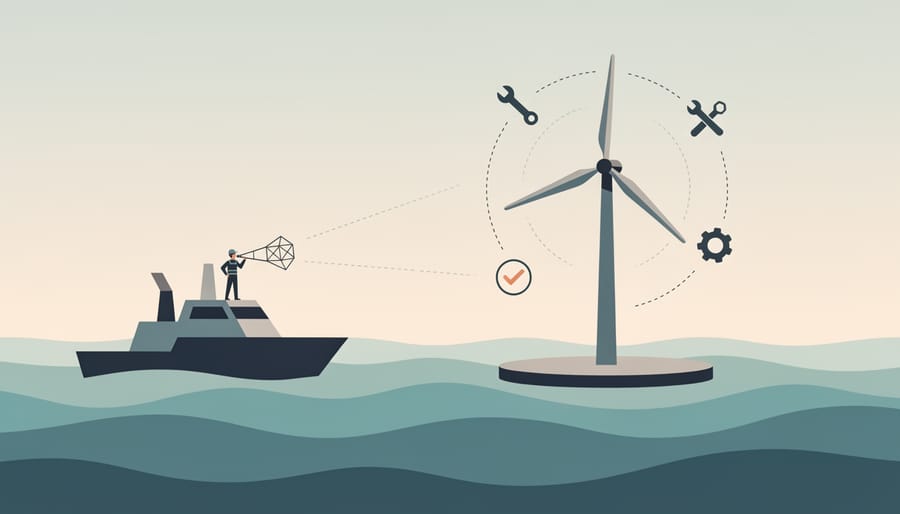
Once turbines are spinning and generating power, the real work of keeping them operational begins. Offshore wind farms operate in one of the harshest environments imaginable, constant salt spray, powerful waves, extreme winds, which means maintenance isn’t optional, it’s the difference between profitable energy production and mounting losses.
Modern offshore wind operations rely on comprehensive monitoring systems that track everything from blade pitch angles to gearbox temperatures in real time. AI monitoring platforms now detect subtle performance anomalies before they become catastrophic failures, allowing operators to schedule repairs during favorable weather windows rather than responding to emergency shutdowns. This predictive approach can reduce downtime by 20-30% compared to traditional maintenance schedules.
Getting technicians to offshore turbines presents its own challenge. Crew transfer vessels designed specifically for offshore wind use motion-compensated gangways that allow safe boarding even in moderate sea states. In rougher conditions, helicopters become necessary, though at significantly higher cost. Australian projects will need to develop local crew transfer capabilities rather than relying solely on international vessels.
Regular inspections cover the entire structure, turbine components, electrical systems, foundations, and subsea cables. Blade inspections often use rope access technicians or drones equipped with high-resolution cameras that can identify hairline cracks before they propagate. Foundation inspections require specialist divers or remotely operated vehicles to check for scour, corrosion, and structural integrity below the waterline.
The maintenance strategy directly impacts the project’s economics. A well-maintained offshore wind farm can operate for 25-30 years at high capacity factors, while deferred maintenance leads to accelerating degradation and premature component replacement. For Australian waters, developing robust maintenance infrastructure early will determine whether our offshore wind sector thrives or struggles.
Success Stories: Where Offshore Wind Services Are Making Waves
Looking at successful offshore wind projects around the world reveals a clear pattern: the quality of specialized services directly determines whether ambitious plans become reliable energy generators or cautionary tales.
The Hornsea Two project off England’s Yorkshire coast demonstrates what coordinated service excellence achieves. When it came online, this 1.3 gigawatt facility became the world’s largest offshore wind farm, powering over 1.4 million homes. Behind those turbines stood a network of specialized service providers who conquered brutal North Sea conditions. Marine survey teams spent months mapping the seabed with precision that would make mistakes costly. Installation vessels maneuvered 165 turbines and their massive foundations into position despite unpredictable weather windows. The project stayed remarkably close to schedule because service providers anticipated problems rather than reacting to them, and their maintenance protocols now keep availability rates above 95 percent.
The difference between offshore wind projects that succeed and those that struggle comes down to service providers who understand that every decision on the water has consequences that ripple through decades of operation.
Across the Atlantic, the Vineyard Wind project off Massachusetts shows how services adapt to new markets. America’s first large-scale offshore wind farm faced the challenge of building local expertise from scratch. Service providers brought international experience but trained local crews in specialized skills like turbine access in rough seas and high-voltage cable installation. This knowledge transfer created a regional workforce that other Atlantic coast projects now tap into, proving that quality service providers multiply their value by building capability, not just completing tasks.
In Taiwan, the Formosa 2 offshore wind farm overcame challenges that mirror what Australia faces: typhoon-prone waters, deep seabeds in some areas, and limited local offshore wind experience. Service providers engineered foundations that withstand extreme weather events and established maintenance strategies suited to the region’s monsoon patterns. The project generates 376 megawatts and demonstrated that tropical and subtropical waters demand services calibrated to local conditions, not templates copied from Europe.
Australia’s own Star of the South project, progressing through development stages in Gippsland waters, relies on service providers conducting detailed marine surveys and environmental assessments that will inform every subsequent decision. Early-stage services here prove their worth by identifying optimal turbine positions, cable routes that avoid sensitive habitats, and construction windows that work with Bass Strait’s notorious conditions.
These successes share common threads: service providers with deep technical expertise, equipment designed for marine environments, maintenance programs that prioritize uptime, and teams who treat offshore wind as a long-term commitment rather than a contract. When services align with project needs, offshore wind delivers the reliable, clean energy that makes the investment worthwhile.
How Offshore Wind Services Create Jobs and Build Local Capability
Offshore wind services do more than power turbines, they power careers. Australia’s offshore wind sector is creating thousands of jobs across engineering, marine trades, environmental science, logistics, and operations management. Unlike traditional energy sectors, these positions span coastal communities where economic opportunities have historically been limited, bringing skilled employment to regions like Gippsland, the Hunter, and Tasmania’s northwest.
The sector needs marine engineers to design installation systems, naval architects to optimize vessel operations, and crane operators skilled in offshore lifting. Technicians trained in high-voltage systems maintain subsea cables. Environmental consultants conduct marine surveys. Welders, divers, and rope access specialists perform inspections and repairs in challenging conditions. This diversity creates pathways for workers from shipbuilding, oil and gas, construction, and fishing industries to transition their expertise into renewable energy.
Australian training providers are responding. TAFE institutes now offer courses in offshore wind turbine technology, marine coordination, and safety systems. Partnerships between developers and universities are establishing specialized degree programs. Companies are investing in apprenticeships that combine classroom learning with hands-on offshore experience, building capability that didn’t exist in Australia five years ago.
The economic multiplier extends beyond direct employment. Specialized vessels need maintenance, workers require accommodation, and supply chains develop around port facilities. Each offshore wind farm generates roughly fifteen jobs per installed megawatt when you count the full service ecosystem, and these marine jobs tend to be long-term rather than construction-only roles.
Local content requirements in Australian offshore wind projects are driving companies to hire locally and train domestically rather than importing expertise. This deliberate capability-building approach means Australia develops the workforce and industrial capacity to maintain offshore wind farms for their thirty-year operational lives, turning short-term construction work into lasting regional employment.
What to Look For in an Offshore Wind Service Provider
Choosing the right offshore wind service provider shapes whether your project delivers on time, on budget, and with the performance you need over decades. With Australia’s offshore wind sector still emerging, you won’t always find providers with local track records, which makes knowing what questions to ask even more important.
Start with proven offshore experience in comparable conditions. A provider with deepwater projects in the North Sea brings valuable expertise, but have they worked in tropical cyclone zones or areas with strong currents similar to Bass Strait? Ask for specific project references that match your site’s conditions. Marine environments vary dramatically, and what works off Scotland may need adaptation for Australian waters.
Safety credentials tell you how seriously a provider takes risk management. Look for internationally recognized certifications like ISO 45001 for occupational health and safety, and check their Total Recordable Incident Rate (TRIR) over the past five years. Offshore wind involves working at height, in challenging sea states, with heavy machinery, companies with strong safety cultures protect both workers and project timelines. Request their emergency response protocols and ask how they’ve handled actual incidents.
Technical capability matters as much as credentials. Does the provider have the specialized vessels and equipment needed, or will they charter everything? Owning or having long-term access to crew transfer vessels, jack-up barges, or cable-laying ships indicates commitment and reduces scheduling risks. Ask about their in-house engineering capacity and whether they rely on subcontractors for critical tasks.
Innovation capacity signals whether a provider will help you navigate challenges or simply follow established playbooks. The best service partners actively invest in new monitoring technologies, predictive maintenance systems, or installation techniques that reduce costs and improve performance. Ask what they’ve implemented recently that improved project outcomes.
Financial stability deserves scrutiny too. Offshore wind projects run for years, and you need partners who’ll be there for the duration. Review their balance sheet, ask about insurance coverage, and understand their parent company structure if applicable. A provider struggling financially may cut corners or lack the resources to handle unexpected complications.
Finally, consider their collaborative approach. Offshore wind projects involve multiple stakeholders, turbine manufacturers, grid operators, environmental regulators, local communities. Providers who communicate transparently, share data effectively, and work constructively with other project partners make everyone’s job easier. Request references from other contractors they’ve worked alongside, not just project owners.
The right service provider becomes a genuine partner in your project’s success, bringing not just technical capability but also problem-solving mindset and long-term commitment to Australia’s offshore wind future.
The Future of Offshore Wind Services in Australia
Australia’s offshore wind sector stands at the threshold of remarkable growth, and the services supporting it are evolving just as rapidly as the turbines themselves. As the nation targets significant offshore wind capacity this decade, service providers are already adapting to meet unprecedented demand while pushing the boundaries of what’s possible in Australian waters.
Floating wind technology represents one of the most exciting frontiers. Australia’s deep coastal waters make traditional fixed-foundation turbines impractical in many prime locations, creating opportunity for floating platforms that can harness strong winds further offshore. Service providers are developing specialized installation vessels, mooring systems, and maintenance protocols specifically for these next-generation projects. The first commercial-scale floating installations will require entirely new approaches to marine logistics and long-term monitoring.
Digital innovation is transforming how offshore wind farms operate. Advanced drone systems now conduct turbine inspections in conditions that would ground human crews, while artificial intelligence algorithms predict equipment failures before they happen. Real-time data from thousands of sensors feeds into maintenance planning systems that optimize crew schedules and reduce costly downtime. Australian service providers are investing heavily in these technologies, recognizing that efficiency gains translate directly to lower electricity costs for consumers.
The shift toward renewable hydrogen production is opening another service dimension entirely. Several proposed offshore wind projects aim to power hydrogen electrolyzers directly, bypassing grid connection challenges. This integration demands new expertise at the intersection of offshore engineering and hydrogen systems, a capability Australia’s maritime and energy sectors are uniquely positioned to develop.
Local manufacturing capacity is beginning to mature. While Australia currently imports most turbine components, fabrication facilities for foundations, towers, and offshore substations are establishing footholds. This shift means service providers can source replacement parts faster and support projects through their entire 25-to-30-year operational life without overseas dependencies. Apprenticeships in marine welding, electrical systems, and specialized coating applications are training the workforce these facilities need.
The path ahead combines proven offshore expertise with Australian innovation. As projects move from planning to reality over the next few years, the service ecosystem will expand rapidly, creating opportunities for established marine operators and newcomers alike.
Australia’s offshore wind revolution isn’t just about turbines rising from the ocean, it’s about the specialized services that make those turbines possible. From the initial seabed surveys to the decades of maintenance ahead, every stage demands expertise, innovation, and commitment to excellence. These services transform ambitious renewable energy targets into functioning power sources that will supply clean electricity to millions of homes.
The technical challenges are significant. Australia’s marine environments present unique conditions that require tailored solutions, from cyclone-resistant designs to logistics across vast distances. Yet these challenges also create opportunities, for local businesses to develop new capabilities, for workers to gain valuable skills, and for communities to participate in a growing industry that prioritizes sustainability.
We’re at a pivotal moment. The projects beginning development now will shape Australia’s energy landscape for generations. They’ll demonstrate whether we can successfully harness our offshore wind resources while protecting marine ecosystems and creating lasting economic benefits.
Supporting offshore wind means supporting the entire ecosystem of services that brings it to life. Whether you’re an industry professional considering this sector, a policymaker shaping regulations, or simply someone who cares about Australia’s energy future, your engagement matters. The expertise exists, the technology works, and the opportunity is here. Australia’s transition to clean energy depends on turning offshore wind potential into reality, and specialized services are the bridge that makes that journey possible.