
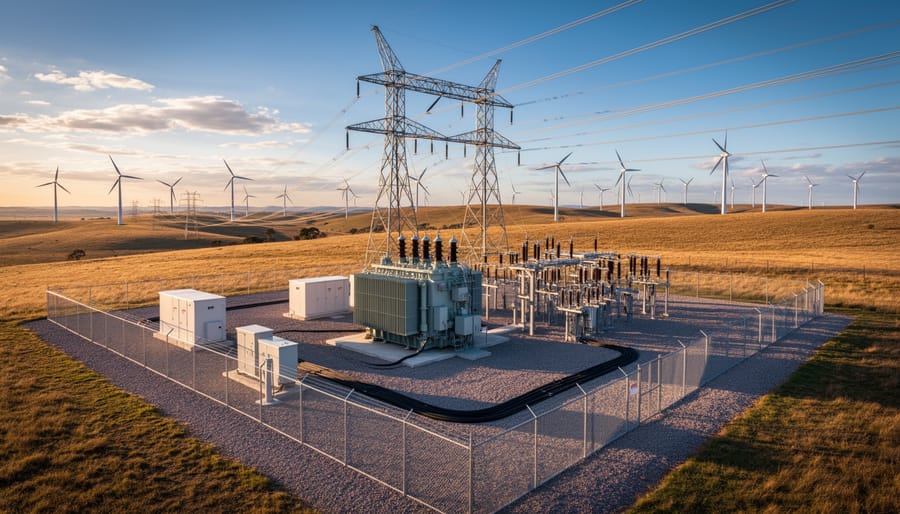
Australia’s renewable energy revolution is gathering momentum, and wind grid tie inverters stand at the heart of this transformation. These sophisticated devices convert the variable electricity generated by wind turbines into clean, stable power that flows seamlessly into our national grid, making wind energy not just a possibility but a practical reality for millions of Australian homes and businesses.
Picture a wind farm in South Australia’s Mid North region, where dozens of turbines spin gracefully against vast blue skies. Without grid tie inverters, all that kinetic energy would remain untapped potential. Instead, these intelligent devices synchronize the turbine’s output with the grid’s exact voltage and frequency requirements, ensuring every kilowatt generated contributes to our energy supply without disrupting the network’s delicate balance.
The technology addresses a challenge that once seemed insurmountable: how to integrate intermittent wind power into a grid designed for steady, predictable coal-fired generation. Modern inverters don’t simply convert DC to AC power—they actively manage power quality, respond to grid fluctuations within milliseconds, and can even provide essential grid stability services that traditional power stations once exclusively offered.
For energy professionals navigating Australia’s transition away from fossil fuels, understanding grid tie inverters isn’t optional—it’s essential. These devices represent the bridge between our renewable energy ambitions and the reliable electricity supply Australians depend on daily. As wind capacity continues expanding across our continent, from Tasmania’s highlands to Western Australia’s coastal plains, the sophistication and reliability of grid tie inverters will determine how quickly we can achieve our clean energy targets.
What Is a Wind Grid Tie Inverter and Why Does It Matter?
Imagine standing beneath a towering wind turbine on a blustery day in South Australia, watching those massive blades slice through the air. That spinning motion generates electricity, but there’s a crucial piece of technology working behind the scenes to make that power useful for your home: the wind grid tie inverter.
At its heart, a wind grid tie inverter is the translator between your wind turbine and the electrical grid. Here’s why that matters. Wind turbines naturally produce direct current (DC) electricity—the same type of power you’d find in a battery. However, the Australian electrical grid runs on alternating current (AC) power, the kind that flows through the power points in your walls. Without a grid tie inverter to convert DC to AC, all that beautiful wind energy would be incompatible with our existing infrastructure.
Think of it like having a brilliant conversation partner who speaks a different language—without a translator, you’d miss everything they’re saying. The inverter doesn’t just convert the power; it synchronises it perfectly with the grid’s voltage and frequency, ensuring seamless integration. This synchronisation is critical for grid stability, especially as Australia rapidly expands its renewable energy capacity.
The importance of these inverters becomes crystal clear when you consider Australia’s wind energy success. The Hornsdale Wind Farm in South Australia, which powers roughly 180,000 homes, relies on sophisticated grid tie inverters to feed clean energy into the network. These devices also enable what’s called “net metering”—when your turbine produces more electricity than you need, the inverter allows that excess power to flow back into the grid, often earning you credits on your energy bill.
Without grid tie inverters, wind turbines would be standalone generators with limited practical application. With them, we’re transforming Australia’s abundant wind resources into reliable, grid-compatible power that’s genuinely making a difference in our transition toward cleaner energy.
How Wind Grid Tie Inverters Work in Large-Scale Wind Farms
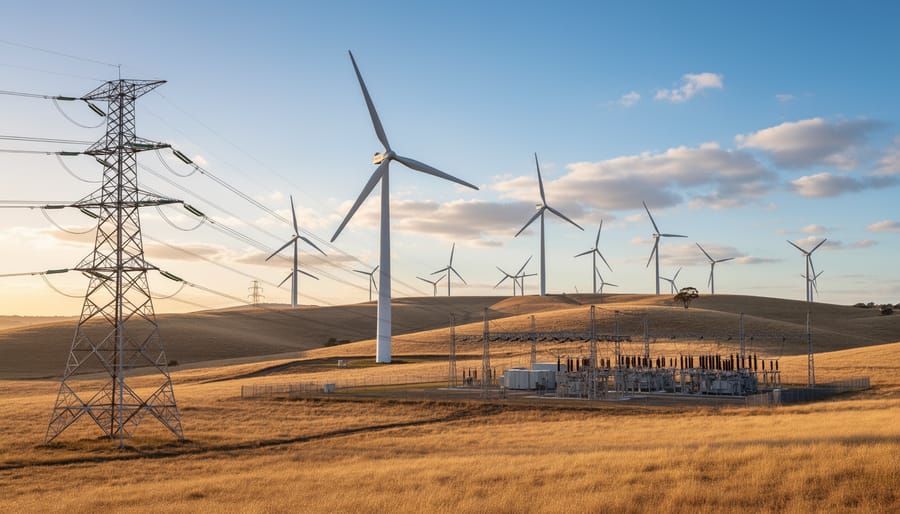
Understanding how wind grid tie inverters work in large-scale wind farms reveals the remarkable technology enabling Australia’s renewable energy transformation. These sophisticated systems form the critical bridge between wind turbines spinning in the breeze and the electricity powering homes and businesses across the country.
The conversion process follows a precise sequence that ensures clean, reliable power delivery:
- Wind Generation: Turbine blades capture kinetic energy from the wind, rotating a generator that produces alternating current (AC) electricity at variable frequencies and voltages depending on wind speed.
- Power Conversion: The variable AC power first converts to direct current (DC) through a rectifier, then the grid tie inverter transforms it back to AC power at the precise frequency and voltage required by the grid.
- Synchronization: Advanced monitoring systems ensure the inverter’s output perfectly matches the grid’s frequency (50 Hz in Australia), phase, and voltage before connection occurs.
- Voltage Regulation: The inverter continuously adjusts power output to maintain stable voltage levels, compensating for fluctuations in wind speed and grid demand.
- Grid Delivery: Clean electricity flows seamlessly into the transmission network, distributed to consumers while maintaining grid stability and power quality.
This process happens thousands of times per second, with modern inverters making split-second adjustments to ensure optimal performance. What makes this particularly impressive is how grid tie inverters coordinate with other renewable sources, especially solar installations. When wind farms and solar arrays work together through integrated inverter systems, they create complementary generation patterns—wind often picks up when sunshine fades, and vice versa.
At facilities like the Hornsdale Wind Farm in South Australia, grid tie inverters manage power from 99 turbines, demonstrating how this technology scales brilliantly for large installations. The inverters there communicate with grid operators in real-time, responding to demand signals and maintaining network stability even as wind conditions change moment by moment.
The beauty of this system lies in its intelligence. Rather than simply dumping power onto the grid, these inverters act as sophisticated mediators, ensuring every kilowatt-hour contributes to grid strength rather than creating instability. This capability has proven essential as Australia increases renewable energy penetration, showing how smart technology enables our clean energy future without compromising reliability.
The Critical Role in Grid-Scale Wind and Solar Integration
Balancing Variable Renewable Sources
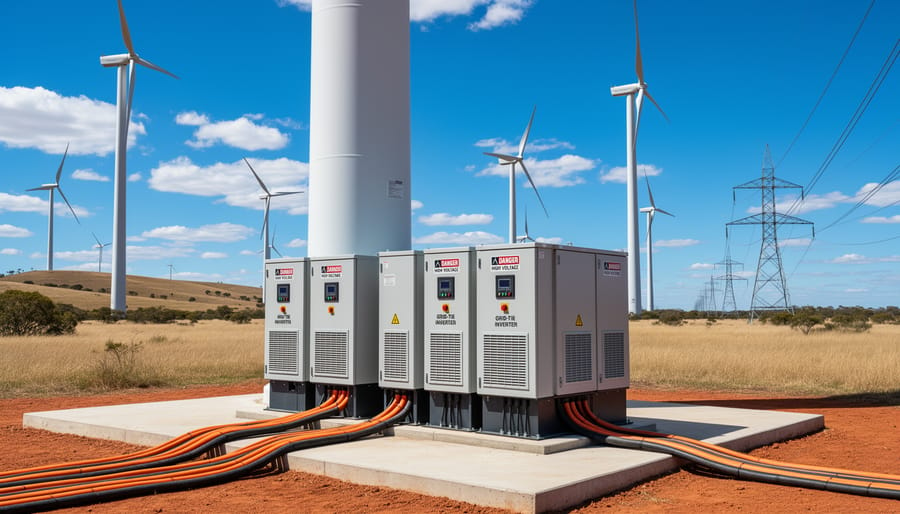
One of the most remarkable capabilities of wind grid tie inverters is their ability to smooth out the natural ebb and flow of renewable energy generation. When wind speeds drop or solar panels experience cloud cover, these intelligent devices work seamlessly with battery storage systems and the broader grid to maintain consistent power delivery to homes and businesses.
Think of inverters as conductors of an orchestra, coordinating multiple renewable sources to create harmonious energy supply. When wind turbines are generating abundantly, inverters can direct excess power to storage systems or adjust output to match grid demand. Conversely, during calm periods, they facilitate the smooth transition to alternative sources, whether that’s stored energy, utility-scale solar integration, or conventional backup generation.
Modern inverters employ sophisticated algorithms that predict weather patterns and adjust power output accordingly. This smart technology has proven essential at facilities like the Hornsdale Wind Farm in South Australia, where inverters work alongside battery systems to deliver reliable power despite variable conditions. The result is a stable, dependable grid that increasingly relies on clean energy sources.
For Australian communities transitioning to renewable energy, this balancing act isn’t just technical wizardry—it’s the foundation of energy security. By managing intermittency effectively, wind grid tie inverters demonstrate that we can embrace sustainable power without sacrificing reliability, making renewable energy a practical choice for our nation’s future.
Grid Stability and Frequency Control
Modern wind grid tie inverters are doing something remarkable that goes well beyond simply converting DC to AC power—they’re becoming active guardians of grid stability. As Australia races toward its renewable energy targets, these sophisticated devices play an increasingly vital role in maintaining the delicate balance that keeps our electricity supply reliable and secure.
Traditional power grids relied on the inherent stability of spinning turbines in coal and gas plants, which naturally regulate frequency through mechanical inertia. Wind inverters, however, use advanced control systems to mimic and even improve upon these functions. Through rapid frequency response capabilities, they can detect grid frequency deviations within milliseconds and adjust their power output accordingly, helping maintain the standard 50Hz frequency that Australian appliances depend on.
These inverters also provide crucial voltage support by injecting or absorbing reactive power, essentially acting as shock absorbers for the grid during sudden demand changes or supply disruptions.
The Hornsdale Wind Farm in South Australia demonstrates this brilliantly, where grid-forming inverters work alongside battery storage to provide essential grid services that were once the exclusive domain of fossil fuel generators. This technology addresses concerns about smart grid security while proving that renewable-dominated grids can be just as stable—if not more responsive—than conventional systems. It’s a game-changer for Australia’s clean energy future.
Real Success Stories: Wind Grid Tie Inverters in Action Across Australia
Across Australia, wind grid tie inverters are transforming renewable energy from an ambitious idea into everyday reality, powering homes and businesses while dramatically cutting emissions. These success stories demonstrate how the technology is delivering tangible benefits to communities from coast to coast.
In South Australia, the state has become a genuine trailblazer in wind energy integration. The Hornsdale Wind Farm near Jamestown, with its 309 MW capacity, uses sophisticated grid tie inverters to seamlessly feed clean electricity into the network. What makes this project particularly impressive is how it’s brought new life to regional communities. Local employment opportunities have flourished, from construction jobs to ongoing maintenance roles, while the farm generates enough power for approximately 180,000 homes annually. The impact on emissions reduction has been substantial, preventing over 560,000 tonnes of carbon dioxide from entering the atmosphere each year.
Victoria’s renewable energy journey includes the impressive Stockyard Hill Wind Farm near Ballarat, where grid tie inverters manage the conversion of 530 MW of wind power into grid-compatible electricity. This massive installation showcases how advanced inverter technology can handle large-scale operations while maintaining grid stability. The project has created over 200 jobs during construction and continues supporting the local economy through ongoing operations. For the surrounding community, this translates to reduced power costs and improved energy security.
In New South Wales, the Sapphire Wind Farm stands as the largest in the Southern Hemisphere, with 270 turbines generating 1,141 MW of clean energy. The grid tie inverters here perform the crucial task of synchronizing this enormous capacity with the existing network, demonstrating the technology’s scalability and reliability. The farm powers roughly 450,000 homes while offsetting approximately 2.4 million tonnes of greenhouse gases annually.
These projects prove that wind grid tie inverters aren’t just theoretical solutions but practical tools delivering measurable environmental and economic benefits. They’re creating jobs, strengthening regional economies, and making serious inroads against climate change. As more installations come online across Australia, these success stories inspire confidence that our renewable energy future is not just possible but already taking shape.
The Benefits Beyond Power Conversion
Wind grid tie inverters deliver remarkable advantages that extend well beyond their primary function of converting DC electricity to AC power. These devices are quietly reshaping Australia’s energy landscape while creating tangible benefits for communities, households, and the environment.
The renewable energy sector’s growth has sparked significant job creation across regional and urban Australia. Installing and maintaining wind grid tie inverter systems requires skilled technicians, electricians, and engineers. From the Macarthur Wind Farm in Victoria to the Hornsdale facility in South Australia, local workers are gaining expertise in cutting-edge technology while building sustainable careers. These aren’t temporary positions either – ongoing maintenance and system optimisation ensure steady employment for years to come.
Energy efficiency improvements represent another compelling advantage. Modern grid tie inverters achieve conversion efficiencies exceeding 98 percent, meaning minimal energy loss during the transformation process. This efficiency translates directly into cost savings for Australian consumers and businesses. As wholesale electricity prices fluctuate, wind farms equipped with advanced inverters can maximise their output value, ultimately contributing to more stable retail energy prices.
The environmental benefits are perhaps most significant. Every kilowatt-hour generated through wind power displaces electricity that would otherwise come from fossil fuels. Australia’s wind farms, supported by sophisticated grid tie inverter technology, collectively prevent millions of tonnes of carbon emissions annually. For environmentally conscious Australians, this represents measurable progress toward climate goals.
What makes these benefits particularly encouraging is their cumulative effect. Job creation strengthens local economies, which increases community support for renewable projects. Improved efficiency reduces costs, making clean energy more competitive. Lower emissions protect the environment we all share. Together, these advantages demonstrate that wind grid tie inverters aren’t merely technical components – they’re catalysts for positive change across Australian society.
Challenges and How They’re Being Overcome
While wind grid tie inverters are transforming Australia’s renewable energy landscape, they do come with genuine challenges that the industry is actively addressing through innovation and smart policy.
The upfront investment remains the most significant hurdle for many potential adopters. Quality grid tie inverters aren’t cheap, with costs varying from a few thousand dollars for residential systems to hundreds of thousands for commercial installations. However, this initial expense is increasingly offset by declining equipment prices—down nearly 40% over the past five years—and improved government incentives across Australian states. Many operators now find their systems paying for themselves within 6-8 years through energy savings and feed-in tariffs.
Grid compatibility presents another genuine challenge. Australian grid standards are rigorous, requiring inverters to meet strict AS/NZS 4777 regulations to ensure network stability. Some older inverters struggle with voltage fluctuations and frequency requirements, particularly in regional areas with weaker grid infrastructure. The good news? Modern inverters now incorporate sophisticated AI-powered grid management capabilities that actively stabilize the network rather than merely connecting to it. These smart systems can predict demand patterns and adjust output accordingly, actually strengthening grid resilience.
- Dramatically reduced equipment costs over recent years make systems more accessible.
- Modern inverters actively improve grid stability through intelligent monitoring.
- Long operational lifespans of 15-20 years deliver sustained returns.
- Minimal maintenance requirements once properly installed.
- Substantial upfront capital investment still required for quality systems.
- Strict grid compliance standards can complicate installation processes.
- Periodic firmware updates and professional servicing needed for optimal performance.
- Remote location installations may face additional compatibility challenges.
Maintenance concerns have also diminished considerably. Today’s inverters feature remote monitoring capabilities, alerting operators to potential issues before they become costly problems. Australian success stories abound—the Hornsdale Wind Farm in South Australia operates with over 99% inverter uptime, demonstrating that proper installation and monitoring virtually eliminate unexpected downtime.
What This Means for Australia’s Energy Future
Wind grid tie inverters are positioned to play a pivotal role in Australia’s clean energy transformation over the coming decades. As the nation accelerates toward its renewable energy targets, these sophisticated devices will become increasingly vital in managing the growing contribution of wind power to our electricity grid.
The Australian Energy Market Operator’s Integrated System Plan forecasts a dramatic expansion of wind capacity across the country, particularly in renewable energy zones throughout regional Victoria, New South Wales, and Queensland. This expansion will require thousands of advanced grid tie inverters, creating significant opportunities for local manufacturing, installation, and maintenance jobs while strengthening our energy independence.
Integration with energy storage systems represents the next frontier. By coupling wind farms with large-scale batteries, grid tie inverters will help smooth output variations and provide reliable power even when the wind isn’t blowing. This combination is already proving successful at facilities like the Hornsdale Power Reserve in South Australia, demonstrating how technology partnerships can deliver grid stability while maximizing renewable generation.
Communities and businesses have exciting opportunities to participate in this transition. Regional cooperatives can invest in local wind projects, while energy-intensive industries can secure long-term power agreements directly from wind farms. Forward-thinking agricultural operations are exploring on-farm wind installations to reduce costs and generate additional income.
The technology also supports emerging sectors like renewable hydrogen production, where wind-generated electricity powers electrolysers to create clean fuel for transport and industry.
As costs continue declining and technology advances, wind grid tie inverters will become increasingly accessible, enabling broader participation in Australia’s renewable energy future and helping create a cleaner, more resilient power system for generations to come.
Wind grid tie inverters stand as unsung champions in Australia’s renewable energy transformation, bridging the gap between the raw power of wind and the sophisticated demands of our electricity networks. As we’ve explored, these remarkable devices do far more than simply convert DC to AC power—they intelligently manage voltage, frequency, and grid stability while enabling wind farms to contribute reliably to our energy mix.
The success stories emerging from projects like Hornsdale Wind Farm and Kennedy Energy Park demonstrate that Australia is well-positioned to harness wind energy at scale. These inverters make it possible for remote wind resources to seamlessly integrate with our grid, bringing clean energy to homes and businesses across the continent. For those interested in how these technologies fit within broader renewable frameworks, exploring solar grid tie inverter systems reveals similar innovations transforming our energy landscape.
The future looks remarkably bright as advancements in hybrid renewable energy systems continue to improve efficiency and reliability. With supportive policies and ongoing technological innovation, wind grid tie inverters will play an increasingly vital role in achieving Australia’s ambitious clean energy targets.
Whether you’re a business considering renewable investments, a policymaker shaping energy futures, or simply someone passionate about sustainability, now is the time to engage. Support local wind energy initiatives, investigate community solar programs that demonstrate similar grid integration benefits, and advocate for continued investment in renewable infrastructure. Together, we’re building a cleaner, more resilient energy future for all Australians.