
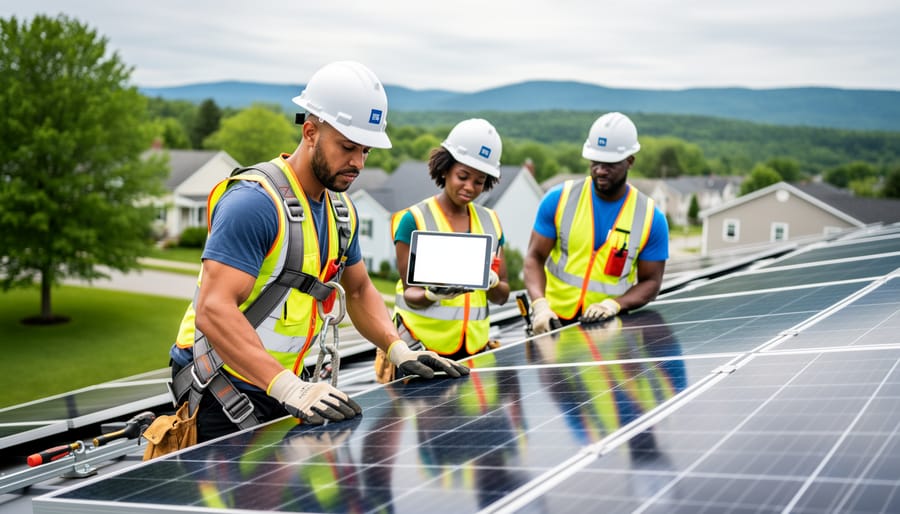
Vermont’s Energy Education Program demonstrates how community-based training transforms entire regions into renewable energy leaders by combining hands-on workforce development with practical energy solutions that reduce costs and emissions. Since its establishment, the program has trained thousands of Vermonters in energy efficiency, renewable installation, and building science through partnerships between technical colleges, utilities, and local businesses, creating a replicable model that’s catching attention from sustainable energy advocates worldwide, including here in Australia.
The program works because it addresses the critical gap between ambitious climate goals and the skilled workforce needed to achieve them. Rather than treating energy education as purely academic, Vermont embeds training in real community projects. Students learn weatherization by actually sealing homes. They study solar installation while mounting panels on community buildings. This approach delivers immediate benefits to residents through lower energy bills while simultaneously building the expertise regions need for long-term energy transitions.
For Australians exploring bioenergy and renewable pathways, Vermont’s success offers valuable lessons in scaling sustainable solutions through education. The program proves that smaller communities can lead energy transitions when training connects directly to local needs and economic opportunities. Vermont participants don’t just learn renewable energy theory; they become certified professionals who stay in their communities, install systems, and train the next wave of workers.
The results speak clearly. Communities participating in the program report measurable reductions in energy consumption, growing clean energy employment, and increased public understanding of renewable options. More importantly, the model shows how education programs can serve as catalysts for broader community transformation, turning energy challenges into opportunities for economic development and local resilience. This practical, place-based approach translates directly to Australian regions ready to develop their own renewable workforce while advancing bioenergy and sustainability goals.
What the Vermont Energy Education Program Does
The Vermont Energy Education Program operates as a multi-layered training system connecting community members directly with renewable energy career opportunities through hands-on learning, technical certification, and regional partnerships. At its core, the program runs three parallel tracks: workforce development courses that prepare individuals for employment in solar installation, energy efficiency retrofitting, and biomass system operation; community education workshops open to residents wanting to understand clean energy options for their homes and businesses; and specialized technical pathways leading to industry-recognized certifications in areas like building performance analysis and renewable energy system design.
The program’s workforce training component typically runs 8-16 week intensive courses covering renewable energy fundamentals, safety protocols, system installation techniques, and business skills for independent contractors. Participants gain practical experience through partnerships with local energy cooperatives, which provide real-world project sites where trainees can work alongside experienced technicians on actual installations. These partnerships create immediate employment pipelines, with many co-ops hiring program graduates directly or contracting them for ongoing maintenance work.
Community workshops take a different approach, offering evening and weekend sessions designed for homeowners, small business operators, and local government staff. These shorter programs cover topics like understanding your energy bill, evaluating solar proposals, weatherization strategies for Vermont’s climate, and navigating state incentive programs. The workshops build community literacy around energy issues, helping residents make informed decisions and creating grassroots demand for renewable projects.
Technical certification pathways represent the program’s most rigorous track, preparing students for credentials like Building Performance Institute certification, NABCEP solar installation credentials, or specialized biomass system operator licenses. These multi-month programs combine classroom instruction at partner community colleges with supervised field work, creating graduates qualified for higher-wage technical positions in Vermont’s growing clean energy sector. The program coordinates closely with Vermont’s state energy office and utility companies to ensure curriculum reflects current industry standards and emerging workforce needs.
The Community-Based Approach: Why It Works
Local Partnerships and Stakeholder Engagement
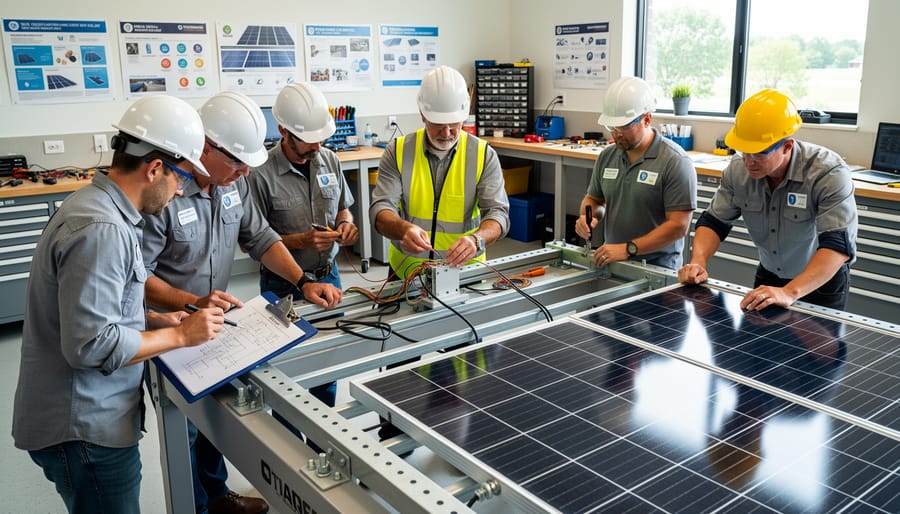
Vermont’s program succeeds because it treats partnerships as the foundation, not an afterthought. The state’s energy office convenes quarterly stakeholder meetings where utility representatives, workforce development boards, technical colleges, and nonprofit housing organizations sit at the same table to identify skills gaps and emerging job opportunities. This ongoing dialogue ensures curriculum reflects what employers actually need, not what educators assume they need.
Local councils play a critical role by embedding energy coordinators who connect program graduates with municipal efficiency projects, weatherization contracts, and renewable installations. One Vermont town hired three program graduates to audit public buildings, creating immediate employment while cutting the town’s energy costs by 18 percent. That’s local government support that builds tangible pathways from classroom to career.
Utilities contribute by offering paid apprenticeships for students pursuing grid-scale renewable certification, while regional businesses sponsor equipment donations and host job shadowing days. A biomass heating contractor in Montpelier now hires exclusively from the program because graduates arrive understanding system maintenance protocols specific to Vermont’s climate and fuel sources.
This multi-stakeholder model transforms community-based energy education from isolated training into an integrated workforce ecosystem. Students graduate knowing someone in the room at those quarterly meetings is actively looking to hire them, while employers gain workers trained for the region’s actual energy infrastructure rather than generic renewable theory.
Tailoring Training to Regional Energy Needs
Vermont’s energy education program doesn’t use a one-size-fits-all curriculum. Instead, trainers assess each region’s energy landscape first, what fuels are locally available, which industries dominate, where the grid struggles, then build training around those realities.
In the Northeast Kingdom, where forests cover 75% of the land and timber operations sustain hundreds of jobs, the program emphasizes biomass system installation and maintenance. Trainees learn to service wood pellet boilers, design district heating systems for schools and municipal buildings, and calculate fuel efficiency for different forest residues. The curriculum connects directly to existing logging operations, creating a natural pipeline from forestry work into energy careers.
Contrast that with Chittenden County, where solar adoption has grown rapidly among homeowners and businesses. Here, training focuses on photovoltaic installation, battery storage integration, and net metering systems. Students practice on actual rooftops through partnerships with local installers, often receiving job offers before completing certification.
Rural communities near agricultural operations receive weatherization and efficiency training alongside renewable installation, skills that address Vermont’s harsh winters and high heating costs while preparing workers for energy auditor roles with utility companies.
This regional customization means graduates enter the workforce with immediately applicable skills matched to actual local demand, not generic knowledge hoping for relevance. Employers report program graduates require minimal additional training because they’ve already worked with the specific systems and challenges their region faces.
Key Training Programs and Curriculum Areas
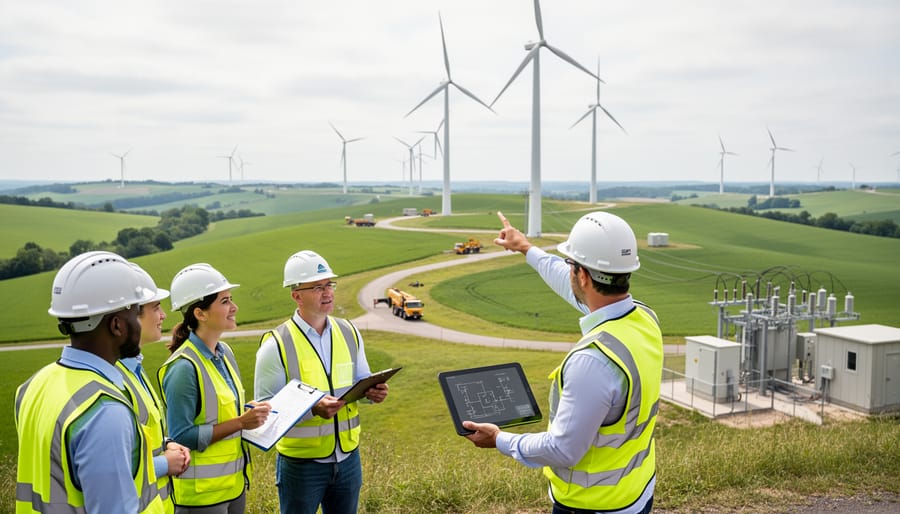
The Vermont Energy Education Program organizes its curriculum around five distinct training tracks, each designed to build practical skills that translate directly into employment opportunities in the state’s growing clean energy sector. These pathways reflect Vermont’s specific energy landscape while providing a comprehensive education model that addresses the full spectrum of renewable energy sources and efficiency strategies.
- Renewable Energy Installation: Solar photovoltaic system design, installation, and maintenance, with modules on grid-tied and off-grid configurations
- Biomass Systems Technology: Wood pellet and chip heating system installation, maintenance, and troubleshooting for residential and commercial applications
- Energy Auditing and Efficiency: Building energy assessment, thermal imaging, blower door testing, and efficiency measure specification
- Weatherization Specialist: Air sealing, insulation installation, moisture management, and building science fundamentals for residential retrofits
- Community Energy Planning: Project development, stakeholder engagement, financing mechanisms, and policy advocacy for local energy initiatives
Each track combines classroom instruction with hands-on field work, typically running 12 to 16 weeks with evening and weekend options for working adults. The biomass systems curriculum stands out as particularly relevant for regions with forestry sectors, covering everything from combustion theory and fuel quality assessment to ash handling and emissions monitoring. Students work with actual pellet boilers and wood chip systems, learning to diagnose common problems like bridging in fuel storage or incomplete combustion.
The energy auditing track produces graduates capable of conducting professional-grade assessments that meet utility program requirements. Trainees learn to use diagnostic equipment, calculate energy savings accurately, and present recommendations that homeowners and businesses actually implement. This practical focus means students emerge with portfolios of real audits completed under supervision.
Community energy planning appeals to a different audience, local leaders, nonprofit staff, and aspiring project developers who want to catalyze change in their regions. This track covers the soft skills and technical knowledge needed to navigate permitting, secure financing, build coalitions, and manage renewable energy projects from concept through operation. Graduates have launched community solar gardens, district heating networks, and energy efficiency programs that now serve thousands of Vermont households.
Success Stories: Real Impact in Vermont Communities
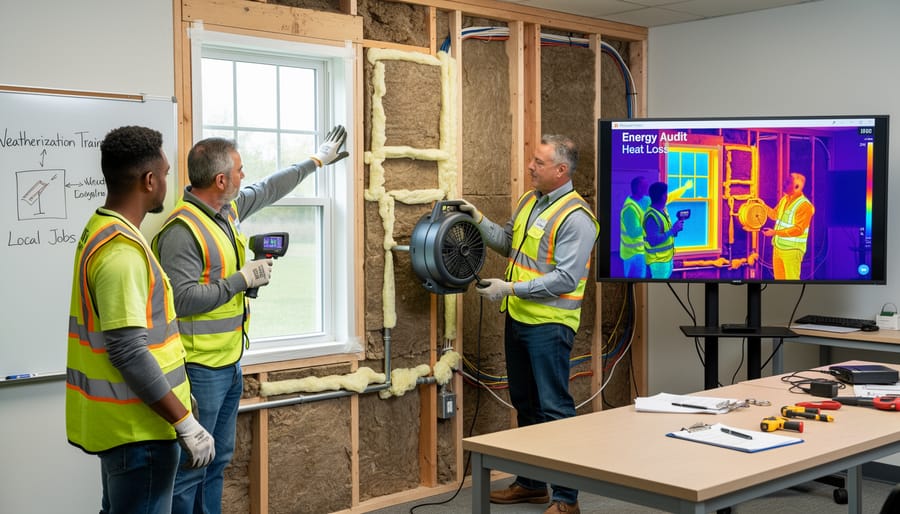
Vermont’s energy education program has created transformations that extend far beyond classroom walls, demonstrating how community-based training delivers tangible outcomes for people, towns, and local economies.
Sarah Mitchell’s story illustrates the personal impact. After Vermont’s timber industry contracted, she enrolled in the program’s biomass system technician course. Within eighteen months, she’d completed certification and secured employment maintaining wood pellet heating systems across three counties. She now earns competitive wages while helping homes and businesses transition away from fossil fuel heating, work that didn’t exist in her region a decade ago.
The town of Brattleboro achieved real energy impact through program-led initiatives. After twenty residents completed energy auditor training, they conducted assessments across 200 homes, identifying efficiency upgrades that collectively reduced the town’s heating emissions by 18% within three years. The program created local jobs while cutting energy costs for families, benefits that compound annually.
Green Mountain Heating exemplifies business growth through program partnerships. This small HVAC company partnered with the education program to train five apprentices in heat pump installation and biomass system maintenance. The skilled workforce allowed them to expand services, triple their renewable energy installations, and employ twelve people in stable, year-round positions. Owner Tom Hendricks credits the partnership for transforming his business model entirely.
The program’s community solar training track has proven particularly effective. Graduates have installed over forty community solar arrays across Vermont, bringing renewable electricity to 3,000 households, many of whom couldn’t afford rooftop systems. This creates energy savings for participants while building careers in solar project management and installation.
Rural cooperatives have also benefited. After completing the program’s community energy planning course, members of the Northeast Kingdom Co-op designed and implemented a district biomass heating system serving their village center, reducing heating costs by 35% while creating three permanent maintenance positions.
These outcomes demonstrate how community-based energy education creates multiplying effects: trained workers find meaningful employment, towns reduce emissions and costs, businesses develop new capabilities, and communities build capacity for ongoing renewable energy development, a cycle that strengthens with each graduating cohort.
Lessons for Australia: Adapting Vermont’s Model
Opportunities in Regional and Remote Areas
Australia’s vast distances and dispersed populations create unique challenges, and powerful opportunities, for community-based energy education. Regional and remote communities often face higher energy costs, grid instability, and limited access to skilled technicians, making them ideal candidates for localized renewable energy solutions and the training programs to support them.
Vermont’s model shows how place-based education can build local capacity rather than relying on distant expertise. In Australian regional areas, this approach could train community members to install and maintain solar systems, manage biomass facilities using agricultural waste, and optimize off-grid battery storage, skills that immediately benefit their own communities while creating viable career pathways.
Agricultural regions hold particular promise. Livestock farms, grain operations, and forestry areas generate substantial organic waste that could fuel bioenergy systems. Community training programs could teach farmers and agricultural workers to convert this waste into energy, transforming an expense into revenue while reducing reliance on diesel generators.
Remote Indigenous communities represent another critical opportunity. Many face energy poverty and grid unreliability, yet possess abundant solar resources and local organic materials. Community-led education that respects cultural knowledge and builds local technical capacity could support energy sovereignty, reduce costs, and create meaningful employment without requiring people to leave their communities.
The Vermont model proves that education delivered by and for communities creates lasting impact. Australia’s regional centres could become hubs for this training, supporting surrounding areas and building the distributed workforce that renewable energy transition genuinely requires.
Building on Existing Australian Initiatives
Australia already has a foundation of community energy initiatives that Vermont’s model can build upon. Programs like Community Power Agency’s training workshops, CORENA’s community-owned renewable energy projects, and various state-based solar and energy efficiency schemes demonstrate strong grassroots engagement across the country.
What Vermont adds to this landscape is a more structured approach to workforce certification and formalized pathways from community education to employment. While Australian programs excel at community mobilization and project development, many lack the systematic skills credentialing that connects learners directly to industry opportunities. Vermont’s integration of technical certification with community engagement creates a bridge between activism and profession.
The multi-stakeholder partnership model also offers fresh insights. Vermont brings together utilities, councils, educational institutions, and businesses in collaborative curriculum design, an approach that could strengthen existing Australian initiatives like the Clean Energy Council’s accreditation programs or regional TAFE offerings.
By combining Australia’s existing community energy enthusiasm with Vermont’s structured training frameworks, regional areas could develop comprehensive programs that both engage communities and create recognized career pathways, particularly in emerging sectors like agricultural bioenergy and regional microgrid management.
How to Access and Support Community Energy Education Programs
Australians don’t need to look to Vermont as just a distant example, you can actively participate in building similar community energy education capacity right here. Whether you’re an individual seeking training, a community group wanting to launch local initiatives, or an organization ready to invest in workforce development, practical pathways exist now.
Start by identifying existing programs in your region. Organizations like the Community Power Agency, Renew (formerly the Alternative Technology Association), and state-based Sustainability Victoria or the NSW Office of Energy and Climate Change often coordinate or fund community energy training. Regional TAFE institutes increasingly offer renewable energy certificates, while groups such as Hepburn Wind and other community energy cooperatives run workshops and mentorship programs. Check local council websites for energy transition plans, many include education components seeking community partners.
For those ready to take action, follow these steps to engage effectively:
- Research local community energy groups and renewable energy training providers, attend an introductory session or open house to understand their offerings and needs.
- Connect with your local TAFE or vocational education provider to inquire about renewable energy courses, expressing interest in community-based models if they don’t yet exist.
- Contact your local council’s sustainability office to ask about energy education initiatives and volunteer to help develop community programs.
- Join or form a community energy working group focused on education, use Vermont’s multi-stakeholder model as a framework for bringing together educators, employers, and residents.
- Advocate for dedicated funding by writing to state and federal representatives, highlighting the employment and emissions reduction benefits of community-led energy training.
Supporting program development requires more than enrollment. Communities can host energy education events, provide venues for training, or offer internship placements through local businesses. Organizations with technical expertise should consider partnering with education providers to shape curriculum that reflects real workforce needs, particularly in emerging areas like agricultural bioenergy systems or microgrid management.
First Nations communities have particular opportunities to design culturally appropriate energy education programs that support sovereignty and economic development. Existing models like the Indigenous Clean Energy Project demonstrate how training can integrate traditional knowledge with renewable technology skills.
The transition Vermont achieved through community-based education isn’t locked to one geography. It’s a replicable approach waiting for committed communities to adapt it to Australian conditions.
Frequently Asked Questions
Do I need prior experience to join a community-based energy education program?
Most programs welcome participants with varied backgrounds and offer foundational courses alongside advanced tracks. Basic literacy and numeracy skills are typically sufficient for entry-level training, while specialized certifications may require completion of prerequisite modules.
How long does training typically take?
Program duration varies widely depending on the certification level and learning pathway. Introductory workshops might run for a day or weekend, while comprehensive workforce development programs leading to technical certification can span six months to two years, often with flexible part-time options.
How are these programs funded?
Funding typically comes from a mix of government grants, utility ratepayer programs, philanthropic foundations, and participant fees. Many programs offer scholarships or income-based fee waivers to ensure accessibility, and some provide stipends for participants in workforce development tracks.
How do community programs differ from traditional vocational training?
Community-based programs emphasize local context, regional partnerships, and direct connections to employment opportunities within the community. They’re typically more flexible, responsive to local energy needs, and integrate hands-on learning with real community projects rather than classroom-only instruction.
These programs recognize that effective energy education happens when training meets learners where they are. Whether you’re a career changer, recent school leaver, or someone looking to upskill in the renewable sector, community-based models create multiple entry points and pathways suited to different life circumstances and career goals.
The emphasis on accessibility extends beyond admission requirements. Many programs schedule evening or weekend sessions to accommodate working adults, offer childcare support, and provide training in multiple locations to reduce travel barriers. This flexibility makes energy education feasible for people who might be excluded from rigid institutional programs.
Vermont’s community-based energy education model offers more than training programs, it demonstrates how grassroots, place-based approaches can fundamentally reshape regional energy transitions. By anchoring education in local needs, building partnerships across sectors, and creating clear pathways from classroom to career, Vermont has developed a framework that simultaneously builds technical capacity, strengthens community resilience, and accelerates renewable energy adoption.
The program’s success lies in recognizing that energy transitions aren’t purely technical challenges. They’re social processes requiring local knowledge, trusted relationships, and meaningful economic opportunities. When communities lead their own energy education efforts, they create solutions tailored to regional resources, whether biomass in forested areas, solar in sun-rich regions, or efficiency programs for aging building stock. They also build the social infrastructure necessary for sustained change: networks of trained workers, informed citizens, and engaged local businesses.
For Australia, these lessons carry particular weight. Regional communities facing coal transitions, remote areas pursuing energy independence, and First Nations groups seeking energy sovereignty all share Vermont’s need for education models that empower rather than impose. The technical details differ, Australian bioenergy programs will draw on different feedstocks, climates, and scales, but the fundamental principle remains: communities equipped with knowledge, skills, and agency become architects of their own energy futures.
Vermont proves that investing in people, not just technology, accelerates the renewable transition while creating lasting local benefits.