
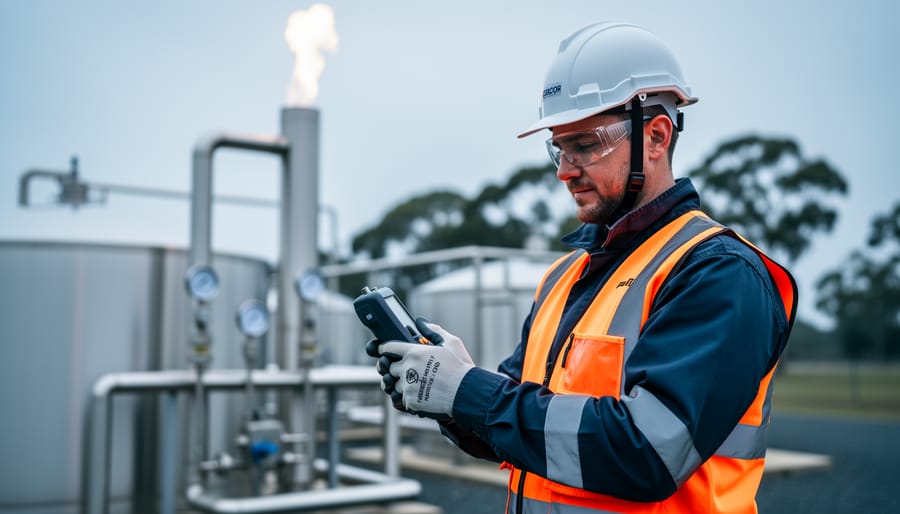
Measure every carbon credit with precision by ensuring your data meets six fundamental quality standards that transform raw measurements into trusted environmental currency. When Australian bioenergy producers report their emissions reductions or farmers document soil carbon sequestration, the difference between credible claims and questioned data lies in how rigorously they apply these dimensions.
Consider a recent Victorian biogas facility that initially struggled with investor confidence. Their carbon offset claims seemed impressive on paper, but inconsistent measurement methods and incomplete datasets raised red flags during verification. Once they restructured their data collection around the six quality dimensions, they secured AU$4.2 million in green financing within eight months. This isn’t unique—across Queensland sugarcane farms implementing bagasse-to-energy projects and Western Australian livestock operations capturing methane, data quality determines whether environmental efforts translate into recognized carbon credits.
The MRV framework demands more than just collecting numbers. It requires data that stands up to scrutiny from auditors, satisfies regulatory bodies, and convinces investors that your environmental claims reflect reality. Each of the six dimensions—accuracy, completeness, consistency, validity, timeliness, and uniqueness—serves as a checkpoint ensuring your monitoring systems produce defensible results.
Understanding these dimensions isn’t academic exercise; it’s the foundation for participating credibly in Australia’s expanding carbon markets. Whether you’re measuring biomass combustion efficiency, tracking agricultural emissions, or verifying renewable energy generation, applying these quality standards transforms your sustainability initiatives from well-intentioned projects into verified, valuable environmental assets. The following framework provides practical guidance for implementing each dimension within Australian environmental contexts, complete with real-world applications that demonstrate their impact on project success.
What MRV Really Means for Australian Bioenergy Projects
MRV stands for Measurement, Reporting, and Verification—three critical pillars that determine whether environmental projects deliver genuine results or simply good intentions. For Australian bioenergy projects, MRV acts as the foundation for proving that biomass facilities, agricultural waste-to-energy systems, and renewable fuel initiatives create real environmental benefits.
Think of MRV as the quality assurance certificate for your renewable energy project. Just as Australian consumers trust certified organic produce over unverified claims, investors, regulators, and carbon credit markets demand rigorous MRV processes before backing bioenergy ventures. Without robust measurement systems, even the most innovative project—whether it’s converting sugarcane bagasse to electricity in Queensland or transforming dairy farm waste into biogas in Victoria—struggles to attract funding or gain policy support.
Data quality standards matter because they transform projects from promising concepts into credible climate solutions. When a biomass facility in regional New South Wales accurately measures its carbon emissions reductions, reports them transparently, and undergoes independent verification, it opens doors to Australian Carbon Credit Units, private investment, and government incentives. Poor data quality, conversely, can derail projects entirely, wasting resources and undermining public confidence in renewable energy.
Consider how Dairyland Power’s biogas facility near Colac demonstrated this principle. By implementing rigorous data collection systems that tracked methane capture rates, energy output, and emissions reductions with precision, the project secured both community support and financial backing. The operators didn’t just estimate their environmental impact—they measured it consistently, reported it clearly, and verified it independently.
For bioenergy projects across Australia, MRV isn’t bureaucratic red tape—it’s the passport to legitimacy. Whether you’re planning a wood waste energy plant in Tasmania or a chicken litter power station in Western Australia, understanding MRV requirements from day one ensures your project contributes meaningfully to Australia’s renewable energy targets while building trust with stakeholders who make your success possible.
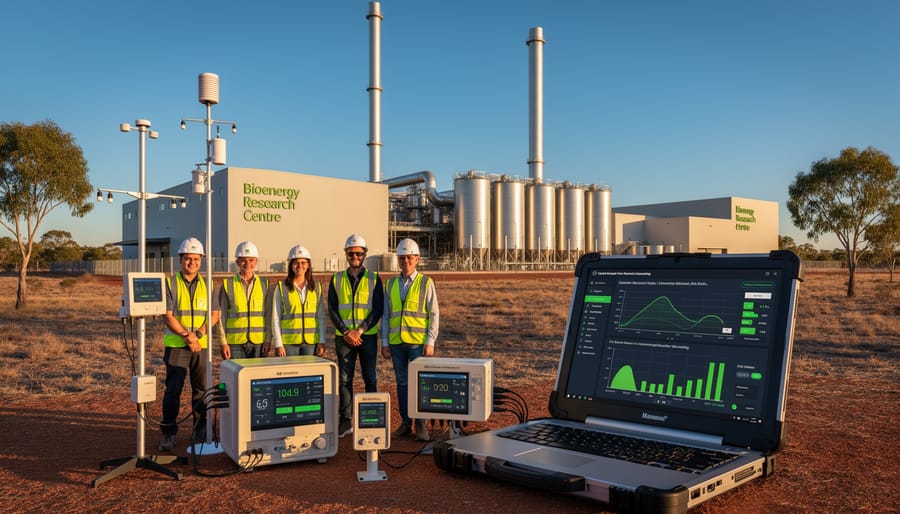
The Six Dimensions That Make or Break Your Data
When measuring the success of carbon reduction and renewable energy projects across Australia, knowing your data is spot-on matters more than ever. Think of data quality like the foundation of a building—if it’s shaky, everything built on top becomes questionable. That’s where the six dimensions of data quality come into play, forming a comprehensive framework that ensures your environmental data stands up to scrutiny.
These six dimensions—accuracy, completeness, consistency, timeliness, validity, and uniqueness—work together like members of a well-coordinated team. Each dimension examines data from a different angle, creating multiple checkpoints that catch potential issues before they undermine your reporting. For instance, a bioenergy facility in regional Queensland might collect accurate methane capture readings (ticking the accuracy box), but if some daily measurements go missing, the completeness dimension flags a problem that could affect emissions calculations.
Understanding how these dimensions interconnect gives you a powerful lens for evaluating the reliability of your Measurement, Reporting, and Verification (MRV) data. When all six dimensions align, you’re not just ticking compliance boxes—you’re building credibility, strengthening stakeholder confidence, and contributing meaningfully to Australia’s climate goals.
Dimension 1: Accuracy – Getting the Numbers Right
Getting the numbers right isn’t just about ticking boxes—it’s about building trust and creating real environmental impact. Accuracy measures how close your data comes to the true value, and in carbon accounting, even small errors can cascade into significant problems.
Consider what happened at a Queensland sugarcane farm that embarked on a bagasse-to-energy project in 2021. Their initial carbon calculations overstated emission reductions by 18 percent due to inaccurate moisture content measurements in the biomass feedstock. When auditors discovered the discrepancy, the project faced delayed carbon credit issuance and reputational damage with investors. The lesson? Accuracy matters from day one.
In Australian agricultural biomass projects, common accuracy pitfalls include estimating rather than measuring feedstock quantities, using outdated emission factors, and failing to calibrate equipment regularly. A Victorian grain producer learned this the hard way when uncalibrated scales led to biomass weight errors of nearly 200 tonnes annually—translating to miscalculated carbon offsets worth thousands of dollars.
The good news is that improving accuracy doesn’t require rocket science. Start by investing in properly calibrated measurement equipment and establishing regular maintenance schedules. Document your measurement protocols clearly, so anyone on your team can replicate results consistently. When possible, use direct measurement rather than estimation—actually weigh that wheat straw instead of guessing based on acreage.
Cross-checking data through multiple methods also strengthens accuracy. One South Australian olive processing facility now verifies biomass energy output using both heat sensors and fuel consumption records, catching discrepancies before they become problems.
Remember, accurate data creates credible carbon claims. It’s the foundation that allows your bioenergy project to stand proudly alongside Australia’s renewable energy success stories, demonstrating genuine environmental progress that stakeholders can believe in.
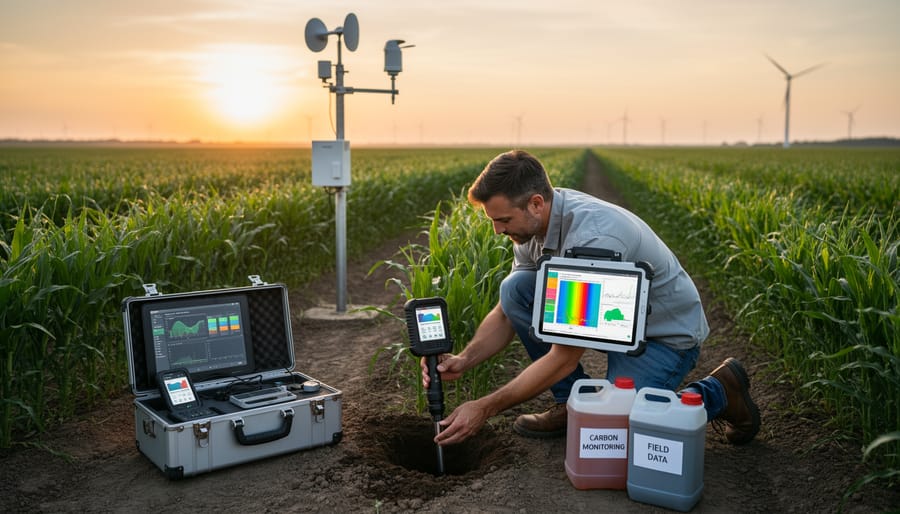
Dimension 2: Completeness – The Danger of Missing Data
Imagine spending months collecting environmental data for your sustainability project, only to discover critical gaps that invalidate your entire effort. This is the harsh reality of incomplete data collection, and it’s more common than you might think.
Completeness refers to whether all required data points have been captured across your monitoring period. Even a single missing measurement can create uncertainty that cascades through your entire dataset, making it impossible to verify your environmental claims with confidence. For carbon projects particularly, incomplete records can mean the difference between successful verification and outright rejection.
Take the inspiring example of a grain farm in regional New South Wales that transformed its approach to data quality. Initially, their biomass residue monitoring had significant gaps—missed weighing sessions, incomplete moisture readings, and sporadic energy output records. When they attempted to validate their carbon credit claims, auditors flagged the incomplete data as too uncertain to certify.
Rather than abandoning their efforts, the farm implemented a systematic daily checklist and automated sensors for continuous monitoring. They established backup procedures for equipment failures and trained multiple staff members to ensure no data point went unrecorded. Within six months, they achieved 98 percent data completeness across all required parameters.
The results were remarkable. Their uncertainty margins dropped dramatically, strengthening their verification reports and ultimately securing full certification for their carbon credits. The farm now serves as a regional model for thorough data collection practices.
The lesson is clear: incomplete data doesn’t just create gaps in your records—it undermines confidence in your entire project. By prioritizing complete data capture from day one, you’re building a foundation of credibility that pays dividends throughout your sustainability journey.
Dimension 3: Consistency – Making Sure Your Story Adds Up
Imagine tracking your household energy savings from solar panels, only to discover that your monitoring system changed halfway through the year. One month you’re measuring total kilowatt-hours, the next you’re recording peak usage times. Frustrating, right? That’s exactly what happens when data collection methods lack consistency—and in the carbon credit world, it can mean the difference between project approval and rejection.
Consistency means using the same measurement methodologies, equipment, and procedures throughout your project’s lifespan. It’s about creating a reliable baseline that regulators and investors can trust. When methods shift unexpectedly, your data becomes like a patchwork quilt—individual pieces might look fine, but the overall picture doesn’t quite make sense.
Consider a bagasse energy project at a Queensland sugar mill. If operators initially measure biomass moisture content using one device, then switch to a different calibration method midway through, comparing year-one results with year-three becomes problematic. Even small variations in how you collect samples or calculate emissions can create significant discrepancies that undermine your entire monitoring report.
The good news? Maintaining consistency doesn’t require complicated systems. Start by documenting your procedures clearly—think of it as writing a recipe that anyone on your team could follow. Schedule regular equipment calibrations, train all staff using identical protocols, and keep detailed records of any necessary methodology changes, including why they occurred and how you’ve adjusted historical data accordingly.
Australian bioenergy pioneers have found success by creating simple consistency checklists. These living documents ensure that whether measurements happen in January or July, in Darwin or Hobart, the data tells one coherent, trustworthy story about environmental impact.
Dimension 4: Timeliness – When Fresh Data Matters Most
Imagine checking your bioenergy facility’s methane production data only to discover the sensors haven’t uploaded readings for three weeks. You’re now scrambling to verify emissions reductions for your Australian Carbon Credit Units application, but the window for timely reporting has closed. This scenario highlights why timeliness is a critical dimension of data quality in environmental monitoring.
Timeliness refers to how current and up-to-date your data is when you need to make decisions. In agricultural waste-to-energy projects across regional Australia, fresh data makes all the difference. When a Queensland piggery’s biogas system experienced unexpected fluctuations, delayed reporting meant operators couldn’t quickly adjust feeding rates or identify equipment issues. By the time they reviewed week-old data, potential production had already been lost, and verification became complicated.
The challenge lies in balancing frequent monitoring with practical constraints. Continuous real-time monitoring sounds ideal, but it requires significant infrastructure investment. Most successful Australian bioenergy operations have found their sweet spot—daily automated readings for critical parameters like gas production and temperature, with weekly manual verification checks. This approach proved particularly effective for a South Australian dairy farm converting manure to electricity, where timely data helped them optimize operations and maintain credibility with carbon credit auditors.
For smaller operations, even establishing weekly data collection routines represents a substantial improvement. The key is consistency—regular, predictable data updates that allow you to spot trends, respond to problems quickly, and demonstrate reliable monitoring practices. Remember, outdated data isn’t just inconvenient; it can undermine your entire MRV framework and your project’s environmental integrity.
Dimension 5: Validity – Measuring What Actually Matters
Validity ensures you’re measuring what truly matters for your carbon project’s environmental impact. It’s not enough to collect accurate data—you need to be measuring the right indicators with methodologies that capture genuine outcomes rather than convenient proxies.
Consider a Queensland bioenergy facility that initially tracked only total biomass input as their key performance metric. While their data was accurate and complete, it didn’t reflect the project’s actual carbon benefit. After consultation with MRV experts, they refined their approach to measure the carbon intensity of different feedstock sources, capturing displacement of fossil fuels and avoided methane emissions from organic waste decomposition.
This validation process revealed that agricultural residues from sugarcane processing delivered three times the carbon benefit compared to purpose-grown energy crops, fundamentally reshaping their sourcing strategy. By measuring what actually mattered—net carbon displacement rather than simple volume metrics—the project could demonstrate genuine climate impact and attract premium carbon credits.
Validity connects closely with uncertainty quantification, as appropriate methodologies must account for measurement limitations and potential errors. Australian standards emphasize transparent documentation of why specific indicators were chosen and how they link to claimed environmental outcomes.
For bioenergy projects, this means going beyond simple input-output calculations to assess lifecycle impacts, including feedstock sourcing emissions, transportation, processing efficiency, and end-use applications. Valid measurement frameworks consider system boundaries carefully, ensuring no significant carbon flows are overlooked.
The Queensland facility’s experience highlights a crucial lesson: collecting mountains of data means little if you’re not measuring the right things. Validity requires stepping back regularly to ask whether your indicators genuinely reflect your project’s environmental purpose and stakeholder expectations.
Dimension 6: Integrity – Keeping Your Data Trustworthy
Integrity sits at the heart of trustworthy data quality, ensuring that information remains secure, transparent, and free from manipulation throughout its lifecycle. In Australia’s carbon markets, integrity determines whether stakeholders can confidently rely on reported emissions reductions and environmental outcomes.
Think of data integrity as the fortress protecting your measurements. When a Victorian dairy farm implements a biogas digester and reports carbon credits, the integrity dimension ensures those numbers haven’t been altered, either accidentally or deliberately. This means implementing robust security measures, maintaining clear audit trails, and establishing transparent documentation practices that allow anyone to trace data back to its source.
The Australian carbon market has embraced this principle through rigorous verification processes that involve independent third-party audits. These auditors examine everything from sensor calibrations to calculation methodologies, ensuring the data presented accurately reflects reality. Consider the success of Queensland’s sugarcane industry, where bagasse-fuelled cogeneration projects undergo regular independent verification. This scrutiny has built tremendous confidence among investors and policymakers alike, demonstrating how integrity safeguards market credibility.
Blockchain technology is emerging as a powerful integrity tool in Australian bioenergy projects. By creating immutable records of measurements and transactions, it prevents retrospective tampering while maintaining complete transparency. Several agricultural carbon projects across New South Wales are already piloting these systems with promising results.
When integrity is compromised, the consequences ripple outward, eroding stakeholder trust and potentially derailing policy support. However, when maintained diligently, integrity becomes your greatest asset, enabling projects to attract investment, secure premium pricing for carbon credits, and contribute meaningfully to Australia’s net-zero ambitions. Strong integrity practices transform data from mere numbers into powerful evidence that drives real environmental change.
Bringing It All Together: Your Data Quality Action Plan
Improving your MRV data quality doesn’t require a complete overhaul overnight. The most successful Australian bioenergy projects we’ve seen started with small, achievable steps and built their capacity progressively. Here’s your practical roadmap to get started.
Begin with a simple baseline assessment. Gather your project team for a half-day workshop and honestly evaluate your current data practices against each dimension. Where do you excel? Which areas need attention? A sugarcane farm in Queensland recently discovered through this process that while their accuracy was strong, their timeliness needed work, leading to simple workflow adjustments that made all the difference.
Next, prioritise your improvements. You don’t need to tackle everything at once. Focus first on dimensions that pose the greatest risk to your project’s credibility or compliance. For most agricultural and bioenergy projects, accuracy and completeness typically demand immediate attention, while refinements to consistency and uniqueness can follow.
Create straightforward protocols that your team can actually follow. Documentation doesn’t need to be elaborate. A Victorian dairy biogas project successfully improved their data quality using simple checklists and monthly team reviews. Keep it practical and relevant to your daily operations.
Invest in your people before expensive technology. Training your existing team to understand why data quality matters often delivers better results than sophisticated software they don’t know how to use properly. Build a culture where everyone understands their role in maintaining quality data.
Establish regular review cycles. Set quarterly checkpoints to assess progress across all six dimensions. Celebrate improvements, address challenges promptly, and adjust your approach as needed. Remember, data quality is a journey, not a destination.
The beauty of this approach is its flexibility. Whether you’re running a small composting operation or a large-scale bioenergy facility, these principles scale to your needs. Start where you are, use what you have, and build progressively towards excellence in MRV data quality.
High-quality data isn’t merely a box-ticking exercise for compliance—it’s the bedrock upon which Australia’s entire renewable energy transition depends. When bioenergy projects measure, report, and verify their environmental impact with precision across all six dimensions of data quality, they create something far more valuable than spreadsheets: they build trust. And trust is the currency that accelerates investment, strengthens community support, and transforms cautious interest into committed action.
Consider the ripple effect of getting data quality right. A landfill gas-to-energy project in regional Victoria that maintains complete, accurate, and timely emissions data doesn’t just satisfy regulators—it demonstrates genuine environmental integrity that attracts investors, secures carbon credits, and inspires neighbouring councils to follow suit. That’s the multiplier effect of credible data in practice.
The pathway to Australia’s sustainable energy future runs directly through the quality of information we collect and share. Every dimension—completeness, validity, accuracy, timeliness, consistency, and integrity—works together to paint an honest picture of our progress. When stakeholders can rely on this information, the bioenergy transition gains momentum, renewable solutions earn their deserved credibility, and our collective climate commitments become achievable realities rather than aspirational targets.
Now it’s your turn. Take stock of your organisation’s data practices. Where are the gaps? Which dimensions need strengthening? The journey toward impeccable data quality starts with honest assessment and commitment to continuous improvement. Australia’s clean energy future depends on it—and the time to act is today.