
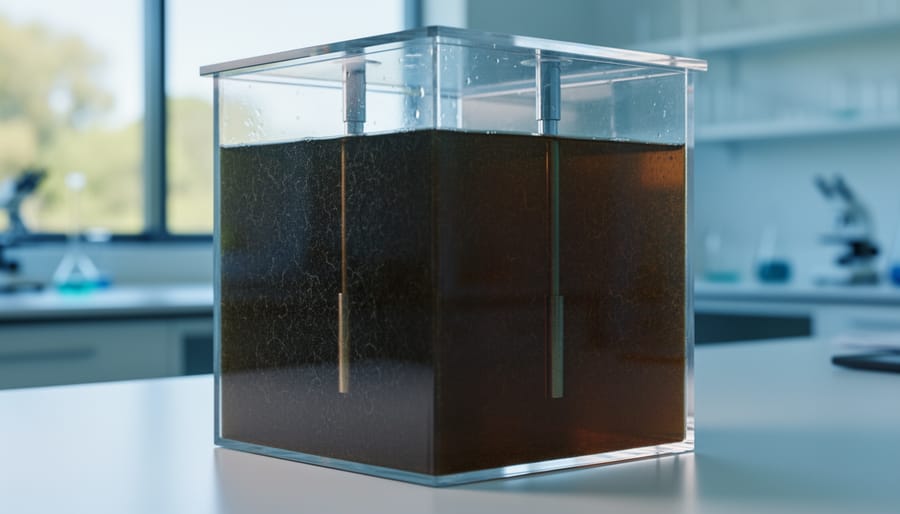
A bacteria fuel cell is a device that uses living microorganisms to convert organic matter directly into electricity. These biological power systems, also known as microbial fuel cells or MFCs, harness the natural metabolic processes of bacteria to generate clean, continuous energy from waste materials ranging from sewage and agricultural runoff to food scraps and industrial effluent.
The technology matters because it solves two problems simultaneously. First, it treats organic waste that would otherwise contribute to environmental pollution. Second, it produces usable electrical power without burning fossil fuels or requiring expensive chemical catalysts. For Australia, where remote communities often struggle with energy access and waste management costs run high, bacteria fuel cells offer a practical pathway to decentralised, sustainable power generation.
Think of it as putting bacteria to work as tiny power plants. As these microbes consume organic compounds, they release electrons that flow through an external circuit, creating electrical current. The process happens at room temperature, requires no external energy input once established, and produces minimal greenhouse gas emissions compared to conventional waste treatment methods.
This article explains how bacteria fuel cells function at a fundamental level, breaks down the key components that make them work, explores the different configurations suited to various applications, and examines where Australians are already putting this technology into practice. You’ll discover why researchers and industry professionals view microbial electrochemistry as a serious contender in the renewable energy landscape, particularly for situations where traditional solar or wind installations fall short.
What Is a Bacteria Fuel Cell?
A bacteria fuel cell is a device that harnesses the natural power of living microorganisms to convert organic matter into electricity. Think of it as a miniature power station where billions of bacteria work around the clock, breaking down waste materials like leftover food, sewage, or agricultural runoff and releasing electrons in the process. These electrons flow through a circuit, creating usable electrical current. Instead of burning fuel or relying on wind or sunlight, bacteria fuel cells tap into the metabolic activity of microscopic life.
The concept sounds futuristic, but it’s grounded in biology we encounter every day. When bacteria digest organic material, they naturally transfer electrons as part of their survival process. A bacteria fuel cell simply captures those electrons before they’re lost to the environment and puts them to work.
Bacteria fuel cells belong to a broader family called microbial electrochemical fuel cells, or MFCs. To understand the landscape, it helps to know a few key terms:
- Bacteria fuel cell
- A device using living bacteria to generate electricity from organic waste or substrates.
- Microbial electrochemical fuel cell (MFC)
- The broader category of technologies that use microorganisms to produce electrical energy through biochemical reactions.
- Electrochemically active bacteria
- Specific bacteria species capable of transferring electrons to external materials like electrodes, making electricity generation possible.
- Substrate
- The organic fuel source that bacteria consume, such as wastewater, plant matter, or food waste.
- Biofilm
- A thin layer of bacteria that forms on the electrode surface, creating an efficient electron transfer pathway.
Within the MFC family, bacteria fuel cells represent the most common and well-researched approach. They’re practical, adaptable, and increasingly relevant for Australia’s push toward renewable energy solutions that work with nature rather than against it. The beauty of this technology lies in its simplicity: give bacteria something to eat, and they’ll generate power as a byproduct.
How Bacteria Fuel Cells Work
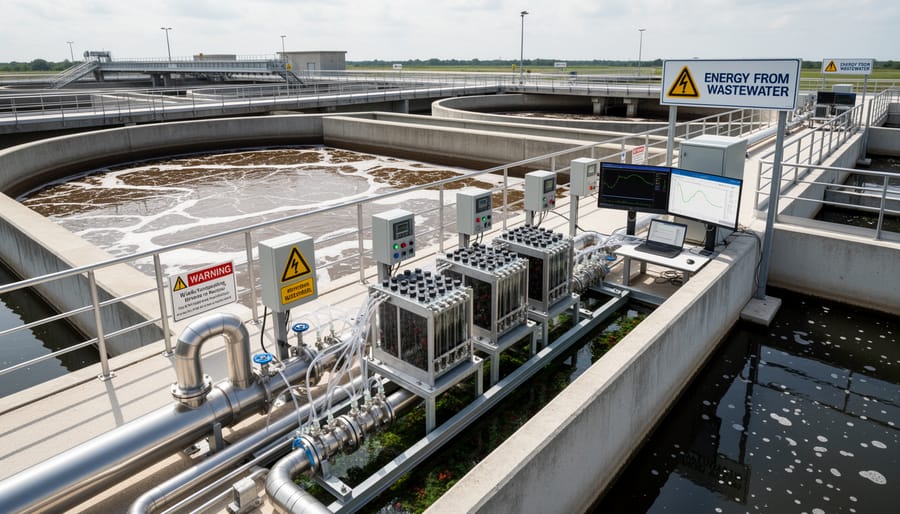
At the heart of a bacteria fuel cell is a surprisingly elegant natural process: hungry microbes eating organic material and, as a side effect, producing electricity. Think of it like a tiny biological battery where bacteria do the heavy lifting.
The process begins in the anode chamber, a sealed environment where bacteria attach themselves to a conductive electrode, forming what scientists call a biofilm. You can picture this as a thin layer of microorganisms clinging to the surface, much like algae growing on rocks in a stream. These bacteria aren’t picky eaters, they’ll happily consume various organic compounds found in wastewater, agricultural runoff, or even simple sugars.
As the bacteria break down this organic matter for food, they release electrons as a natural byproduct of their metabolism. Here’s where the magic happens: instead of those electrons dispersing uselessly, the bacteria transfer them directly to the anode electrode. Some species have evolved tiny protein “wires” called nanowires that shuttle electrons to the electrode surface. Others produce chemicals that act as electron ferries, carrying the charge from the bacterial cell to the metal.
These electrons then travel through an external circuit, creating an electrical current that can power small devices or sensors. Meanwhile, protons (positively charged hydrogen ions) produced during the same metabolic process need somewhere to go. They pass through a special barrier called a proton exchange membrane, a semi-permeable divider that lets protons through while keeping the bacteria and organic matter on the anode side.
On the other side sits the cathode chamber, where oxygen is typically present. The electrons that travelled through the external circuit arrive at the cathode electrode, meeting up with the protons that crossed the membrane and the oxygen in the chamber. Together, they combine to form water, completing the electrical circuit.
The whole system operates continuously as long as bacteria receive organic fuel and oxygen reaches the cathode. It’s a self-sustaining cycle: bacteria eat, electrons flow, electricity generates, and water forms. No combustion, no moving parts, just biology and chemistry working in tandem.
Main Components of a Bacteria Fuel Cell
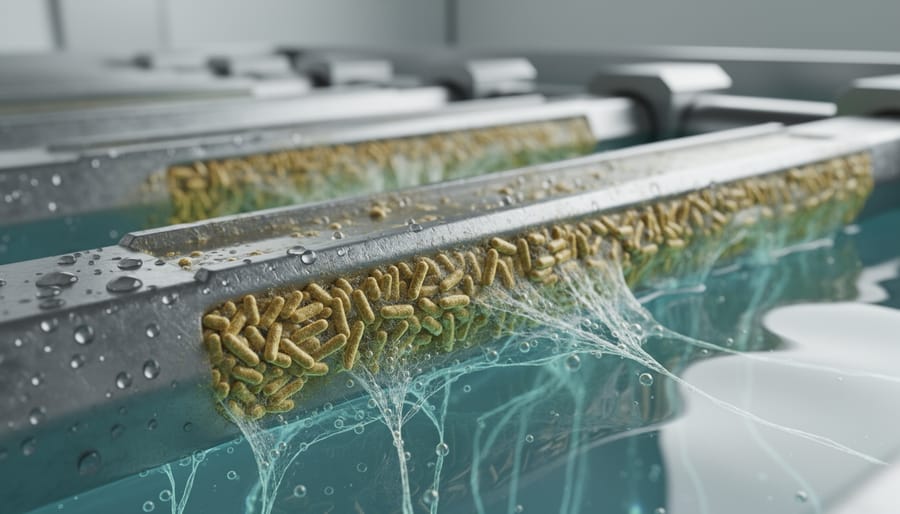
A bacteria fuel cell might sound complex, but it’s built from a handful of straightforward parts working together like a well-organized team. Each component plays a specific role in converting the bacteria’s metabolic activity into usable electricity. Understanding these pieces helps demystify the technology and shows why this approach to energy generation is both elegant and practical.
At the heart of the system, you’ll find these core components:
- Anode chamber, the bacteria’s home where they feed on organic waste and release electrons during their natural metabolism
- Cathode chamber, the oxygen-rich zone where chemical reactions complete the electrical circuit by accepting electrons
- Electrodes, conductive materials, often made from carbon or graphite, that capture and transfer the electrons produced by bacteria
- Proton exchange membrane, a selective barrier that lets positively charged protons pass through while keeping the anode and cathode chambers separate
- External circuit, the pathway where useful electricity flows, connecting the two electrodes and powering devices or storing energy
The anode chamber houses the bacterial colony attached to the electrode surface in what’s called a biofilm. Think of it as a living mat of microorganisms clinging to the electrode, constantly munching on organic matter from wastewater or other feedstock. As bacteria digest this fuel, they shed electrons that the anode electrode collects. Without a proper anode setup, the right materials and conditions for bacteria to thrive, the whole system stalls.
Meanwhile, the cathode chamber provides the complementary half of the reaction. Oxygen dissolved in water accepts the electrons that have travelled through the external circuit, combining with the protons that crossed the membrane. This cathode reaction is essential because it pulls electrons through the system, maintaining the flow of current. The cathode electrode needs to facilitate this oxygen reduction efficiently, which is why researchers experiment with different catalysts and materials.
The proton exchange membrane sits between these chambers like a selective gatekeeper. It’s crucial for keeping the bacterial environment separate from the oxygen-rich cathode side while still allowing charged particles to move where they’re needed. This separation prevents oxygen from reaching the bacteria too easily, which would short-circuit their electron-releasing process, and maintains the chemical gradient that drives electricity production.
Types of Bacteria Used and Fuel Cell Designs
Not all bacteria can power a fuel cell. Scientists have discovered that certain microorganisms excel at transferring electrons to electrodes, making them natural electricity generators.
Star Performers: Shewanella and Geobacter
Two bacteria species dominate research and applications. Shewanella oneidensis thrives in various conditions and readily attaches to electrode surfaces, making it reliable for different environments. Geobacter sulfurreducens produces some of the highest power outputs because it grows thick biofilms on anodes and transfers electrons efficiently. Australian researchers often work with these species when testing new fuel cell designs because they’re well understood and perform consistently.
Other bacteria show promise too. Pseudomonas species adapt to different organic materials, while some Clostridium varieties break down complex waste streams effectively.
Fuel Cell Configurations
The design of a bacteria fuel cell significantly affects its performance and application.
Dual-chamber systems keep bacteria separated from the oxygen-rich cathode using a membrane. This design generates more power but costs more and requires careful maintenance. Single-chamber systems simplify construction by exposing the cathode directly to air, making them cheaper and easier to deploy in field conditions, though they typically produce less electricity.
Sediment MFCs embed electrodes directly in river or ocean floor mud, where naturally occurring bacteria generate power without any added fuel. Plant-based fuel cells position electrodes around living plant roots, harvesting electricity from sugars the roots release into soil.
Each configuration suits different purposes. Wastewater treatment plants often use dual-chamber designs for maximum efficiency. Remote environmental sensors rely on sediment systems that need zero maintenance. Agricultural applications favour plant-based versions that integrate with existing crops, turning rice paddies or wetlands into gentle power sources.
Real-World Applications in Australia and Beyond
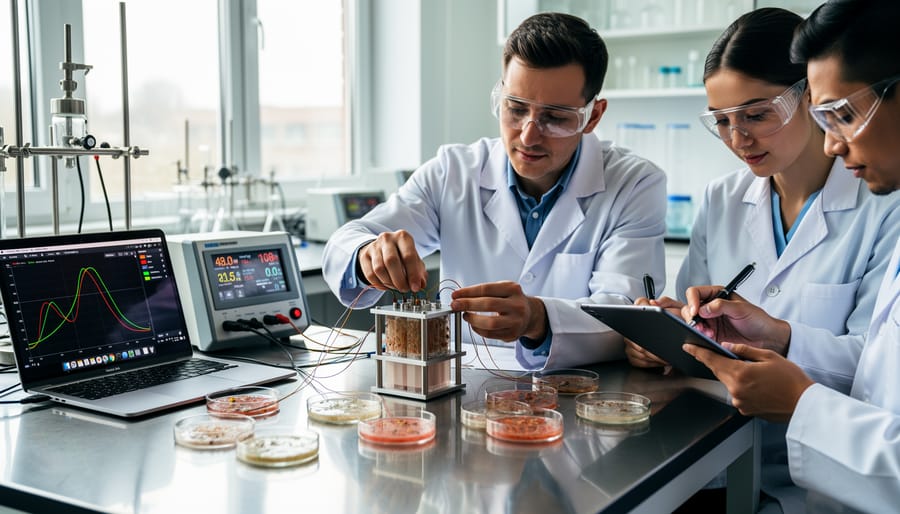
Bacteria fuel cells are moving from laboratory curiosities to practical tools that solve real problems. Wastewater treatment plants represent the most promising application. Facilities in Queensland and New South Wales have piloted systems that let bacteria generate electricity while breaking down sewage. The dual benefit is compelling: the plant treats waste and offsets some of its own energy costs. Brisbane’s Luggage Point facility has tested microbial fuel cells in treatment processes, demonstrating that organic-rich wastewater can become a power source rather than just an expense.
Remote monitoring offers another practical fit. In agricultural regions across Victoria and South Australia, researchers have deployed bacteria fuel cells to power sensors in irrigation channels and waterways. These systems run on naturally occurring organic matter in the water, eliminating the need for battery replacements in hard-to-reach locations. Farmers get continuous data on water quality without maintenance crews making regular trips to swap batteries.
Environmental monitoring benefits similarly. River systems can host self-powered sensors that track pollution levels, temperature, and flow using electricity generated from sediment bacteria. The University of Queensland and CSIRO have explored sediment microbial fuel cells for coastal and freshwater monitoring, creating sensor networks that operate indefinitely without external power.
Globally, the technology has gained traction in diverse settings. The Netherlands uses plant-based microbial fuel cells in wetlands, generating small amounts of power while purifying water. In India, bacteria fuel cells power LED lights in rural communities lacking grid access, running on local organic waste.
The scale remains modest, these systems produce watts rather than kilowatts, but they excel in niche applications where conventional power is impractical or expensive. The technology solves specific challenges: powering remote equipment, reducing treatment plant costs, and turning waste streams into resources. As efficiency improves, these practical applications will expand, making bacteria fuel cells a familiar part of Australia’s renewable energy landscape.
Benefits for Sustainable Energy and the Environment
Bacteria fuel cells tackle two environmental challenges at once: dealing with organic waste and generating clean energy. In wastewater treatment plants across Australia, this technology converts the very substances we need to remove, sewage, agricultural runoff, food processing residues, into usable electricity. Instead of spending energy to break down waste, facilities can actually harvest power from the process. That’s a fundamental shift in how we think about waste management.
The greenhouse gas benefits extend beyond the electricity produced. When organic matter decomposes in landfills or unmanaged waterways, it releases methane, a greenhouse gas roughly 25 times more potent than carbon dioxide. Bacteria fuel cells capture that carbon before it escapes as methane, channelling it into electrical current instead. For Australian agricultural operations managing animal waste or food manufacturers handling organic byproducts, this represents a tangible emissions reduction.
Decentralized energy generation is another strength. Unlike large solar or wind farms that require grid connection, bacteria fuel cells can operate wherever organic waste exists. Remote cattle stations, small coastal communities, or off-grid research stations can generate power on-site from their own waste streams. The technology doesn’t demand vast land areas or depend on weather conditions, bacteria work around the clock as long as they’re fed.
This aligns perfectly with Australia’s push toward a circular economy, where waste becomes feedstock. The National Waste Policy aims to recover more value from materials we currently discard. Bacteria fuel cells embody that principle: organic waste that once cost money to process now contributes to renewable energy targets while still being treated.
Current Limitations and Future Potential
Bacteria fuel cells aren’t yet competing with solar panels or wind power for large-scale electricity generation, but that’s not the goal. Right now, a typical MFC produces milliwatts to a few watts of power, enough for sensors and small devices, not enough to power homes. The bacteria work slowly compared to combustion or photovoltaics, and scaling up to industrial levels while maintaining efficiency remains a puzzle researchers are actively solving.
Cost presents another hurdle. Building MFCs with specialized electrodes and membranes isn’t cheap yet, and the return on investment makes sense mainly where the technology serves dual purposes: treating waste while generating power. For standalone electricity generation, the economics don’t stack up against established renewables.
Here’s where the opportunity lies. Australian researchers at universities and CSIRO are developing cheaper electrode materials from abundant resources like biochar and graphite. Others are engineering bacterial strains that transfer electrons faster, boosting power output by orders of magnitude. Advances in energy storage could pair with MFCs to smooth out their variable output, making them more practical for continuous applications.
The real promise isn’t replacing grid-scale renewables. It’s filling niches where bacteria fuel cells shine: remote monitoring stations that run for years on local waste, wastewater plants offsetting their energy costs, agricultural operations turning manure into power. As manufacturing costs drop and efficiency climbs, these applications expand.
Think of bacteria fuel cells as emerging technology, not mature infrastructure. The limitations are real, but they’re shrinking as innovation accelerates.
Common Questions About Bacteria Fuel Cells
Are bacteria fuel cells safe to be around?
Yes, bacteria fuel cells are perfectly safe for everyday use. The microorganisms are contained within sealed chambers and can’t escape or cause harm. The bacteria species used, like Shewanella and Geobacter, are naturally occurring environmental strains, not pathogens. They’re already present in soil, sediment, and water systems around you. The electricity generated is low voltage, similar to what you’d get from a small battery, making the technology safe for homes, schools, and workplaces.
How much power can they actually generate?
Current bacteria fuel cells produce modest amounts of electricity, typically enough to power small sensors, LED lights, or environmental monitoring devices. A single unit might generate anywhere from a few milliwatts to several watts, depending on its size and design. That’s nowhere near the output of solar panels or wind turbines, but it’s sufficient for niche applications where continuous, low-level power from waste streams is valuable. Research teams are steadily improving efficiency, and larger installations combining multiple units show more promise for practical energy generation.
Can I build a bacteria fuel cell at home?
You can create a simple experimental version with basic materials like graphite electrodes, a container, and muddy water containing bacteria. However, home-built systems won’t generate meaningful power for household use, they’re primarily educational demonstrations that help you understand the science behind the technology.
What happens to the bacteria over time?
The bacteria continue living and reproducing as long as they have organic matter to consume and suitable environmental conditions. In properly maintained systems, bacterial communities can function for months or years, naturally replenishing themselves as they break down waste materials.
How do bacteria fuel cells compare to solar or wind power?
They serve completely different purposes. Solar and wind generate substantial electricity for homes and grids, while bacteria fuel cells excel at turning waste into small amounts of continuous power where other renewables aren’t practical, like wastewater treatment plants or remote wetland sensors.
Do bacteria fuel cells work in cold Australian winters?
Bacterial activity slows in cold temperatures, reducing power output during winter months in southern regions. However, many systems can be designed with insulation or placed in naturally warmer environments like wastewater facilities where the liquid temperature remains relatively stable year-round.
The technology complements rather than competes with established renewables. While innovations like artificial photosynthesis and solar power capture energy from sunlight, bacteria fuel cells tap into a completely different resource: the chemical energy locked in organic waste. Think of them as part of Australia’s diverse energy toolkit, each technology suited to specific applications where its unique strengths shine.
Bacteria fuel cells represent a shift in how we think about waste and energy. Rather than viewing organic matter as something to dispose of, this technology reveals it as a valuable resource waiting to be tapped. For Australia, a country blessed with abundant renewable resources yet facing persistent waste management challenges, microbial electrochemical fuel cells offer a dual solution that addresses both.
The technology isn’t ready to replace solar panels or wind turbines. It doesn’t need to. Instead, bacteria fuel cells carve out their own niche in Australia’s renewable energy landscape, turning wastewater treatment plants into power generators, providing energy for remote sensors in the outback, and offering decentralized solutions where grid connection isn’t practical or cost-effective.
What makes this field particularly exciting is its trajectory. Research institutions across Australia are actively improving efficiency, exploring new bacterial strains, and finding innovative applications. Each advancement brings us closer to a future where waste streams become energy sources as a matter of course.
The real promise lies in changing perspectives. When we start seeing food scraps, agricultural runoff, and wastewater as potential fuel rather than problems to solve, we unlock possibilities that extend far beyond electricity generation. We build circular systems where nothing is truly wasted.
Australia’s path to a sustainable energy future won’t follow a single route. It’ll be paved with diverse technologies working together, each solving specific challenges. Bacteria fuel cells have earned their place on that path.