
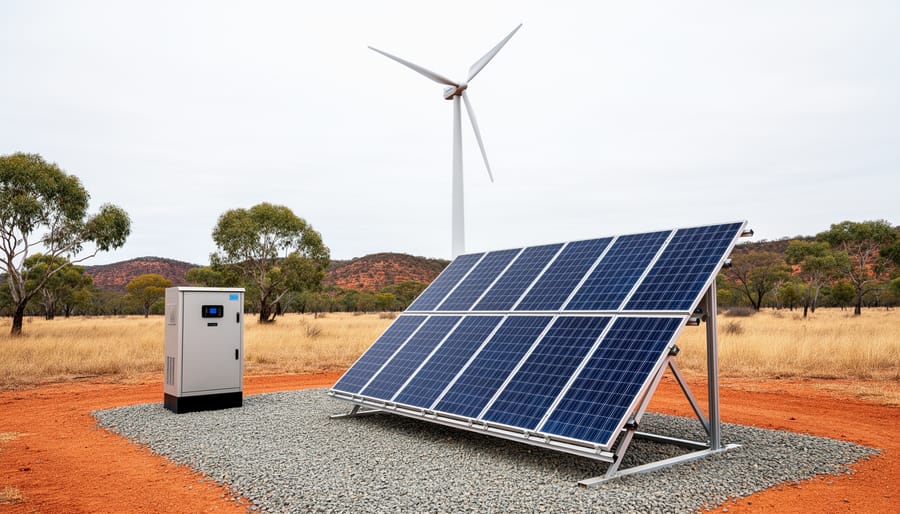
An off-grid solar wind hybrid system combines photovoltaic panels and wind turbines with battery storage to generate and supply electricity independently of the traditional power network. These systems harness two complementary renewable sources, capturing solar energy during sunny days and wind power during overcast or night conditions, creating a more reliable energy supply than either technology alone.
For Australian properties beyond the reach of transmission lines, these hybrid systems have become the practical solution to energy independence. Remote stations across Queensland’s outback, island communities off the Northern Territory coast, and telecommunications sites scattered throughout Western Australia now run entirely on locally generated clean power. The technology has matured significantly through 2026, with component costs dropping and efficiency climbing to the point where off-grid hybrid systems frequently outperform diesel generators on both reliability and lifetime cost.
The appeal extends beyond remote necessity. Growing numbers of regional landholders and eco-conscious homeowners are choosing to disconnect from the grid entirely, motivated by rising electricity prices, bushfire-season blackout risks, and the desire for genuine energy sovereignty. While utility-scale solar projects reshape the national grid, off-grid hybrid systems prove that renewable reliability works at every scale.
This article walks through how these systems function in practice, the core components you’ll need to understand, real installations delivering results across Australia, and the practical considerations for sizing a system that matches your energy needs without compromise.
What an Off-Grid Solar Wind Hybrid System Means for Energy Independence
An off-grid solar wind hybrid system is exactly what the name suggests: a standalone power setup that combines solar panels and wind turbines to generate electricity without any connection to the main electrical grid. These systems create their own miniature power network, storing excess energy in batteries and delivering it when you need it, whether that’s running a cattle station homestead in the Queensland outback or powering a research facility on Macquarie Island.
The “off-grid” part means complete energy independence. You’re not relying on poles and wires from the nearest town, and you’re certainly not waiting months for a grid connection that might cost hundreds of thousands of dollars to establish across remote terrain. Everything you need sits on your property: the generation equipment, the storage, and the control systems.
Here’s where the hybrid approach becomes brilliant. Solar panels produce their best output during sunny days, while wind turbines often generate more power at night and during cloudy, blustery weather. When you combine both sources, you’re hedging against the variability that makes single-source renewable systems less reliable. A still, overcast winter afternoon that would leave a solar-only system struggling might be exactly when your wind turbine delivers its strongest contribution.
- Off-grid
- Operating independently from the main electricity network, generating and storing all power on-site without connection to utility infrastructure.
- Hybrid system
- An energy setup combining two or more generation sources, typically solar and wind, to provide more consistent power than either source alone.
- Solar PV
- Photovoltaic panels that convert sunlight directly into electricity through semiconductor technology.
- Wind turbine
- A device with rotating blades that captures kinetic energy from moving air and converts it to electrical power.
- Battery storage
- Banks of batteries that store excess generated electricity for use when solar and wind production is low or demand exceeds generation.
- Inverter
- Equipment that converts DC electricity from panels, turbines and batteries into AC power suitable for standard appliances and equipment.
This complementary generation pattern is what separates hybrid systems from grid-connected setups. Grid-tied systems can afford to be intermittent because the network absorbs their surplus and supplies power when generation drops. Off-grid systems need to be self-sufficient every single day, which makes the reliability boost from combining solar and wind not just helpful but essential for consistent power supply.
How Off-Grid Solar Wind Hybrid Systems Work
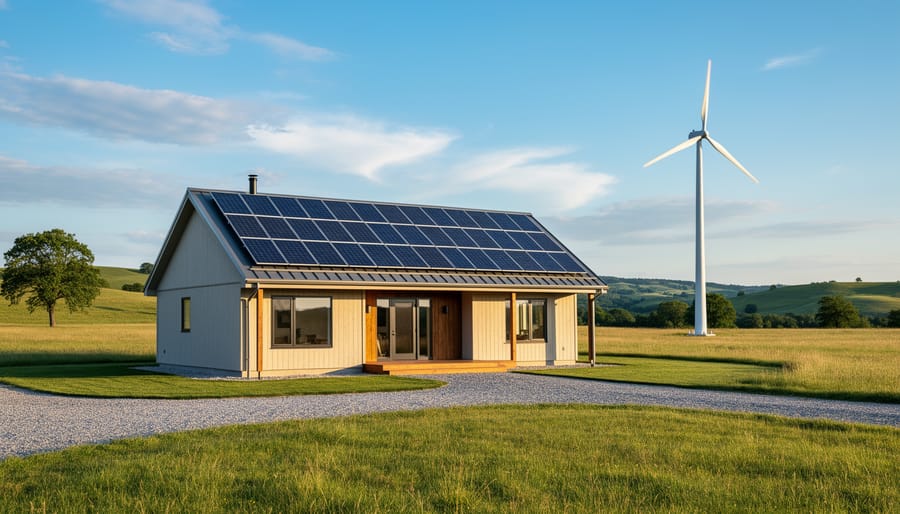
The Dance Between Sun and Wind
Solar panels peak during the middle of the day when the sun is strongest, then taper off as evening approaches. Wind turbines often pick up the slack during those very hours, across much of Australia, coastal breezes strengthen in the late afternoon and evening, and inland winds can gust overnight when solar output is zero. This natural rhythm means the two sources cover different parts of the day without overlap.
Seasonal patterns reinforce the pairing. Winter months bring shorter daylight hours and lower solar yield, but they also deliver stronger, more consistent wind across southern Australia. Summer reverses the balance: long days and intense sun drive solar generation while winds often slacken during calm, hot stretches. The mismatch rarely leaves you without some generation, and batteries store excess power from whichever source is running strong, smoothing the supply through lulls in both.
A remote property in western New South Wales might see wind turbines humming through cool winter nights while panels sit idle, then watch panels carry the load through blazing January afternoons when the air is still. Neither source runs at full capacity all the time, but together they rarely leave you in the dark.
The Battery Storage Backbone
Batteries are the unsung heroes of any off-grid hybrid system, quietly bridging the gap between when power is generated and when it’s needed. Without storage, you’d only have electricity when the sun shines or the wind blows, a recipe for frustration and cold showers.
Modern lithium battery banks store excess energy captured during peak generation periods, releasing it during calm nights or overcast days. Think of them as a buffer that smooths out the natural variability of renewable sources. A well-sized battery system typically holds enough charge to cover two to three days of typical household use, providing resilience during extended low-generation stretches.
The batteries also prevent energy waste. When your solar panels are pumping out maximum power at midday and your wind turbine catches a strong afternoon breeze, any generation exceeding immediate demand flows into storage rather than being lost. This stored energy becomes your overnight supply, your cloudy-day backup, and your insurance against the unexpected.
Battery management systems monitor charge levels and control discharge rates, protecting the batteries from damage while maximizing their lifespan, typically eight to fifteen years for quality lithium systems in Australian conditions.
Core Components of a Hybrid Off-Grid System
Building an off-grid solar wind hybrid system means assembling several distinct components that work together as an integrated energy plant. Each piece serves a specific purpose, and understanding what they do helps you appreciate why these systems deliver reliable power where the grid can’t reach.
Solar panels capture sunlight and convert it into direct current electricity. Modern panels typically deliver between 300 and 400 watts each under optimal conditions, though recent advances in higher solar efficiency mean you can generate more power from the same roof space. For off-grid applications, monocrystalline panels prove most practical because they perform better in Australia’s variable light conditions and maintain output across a wider temperature range.
Wind turbines complement solar generation by capturing kinetic energy from moving air. Small-scale turbines for off-grid systems range from 400 watts to 10 kilowatts, with blade diameters between one and seven metres. The turbine’s built-in generator produces electricity whenever wind speeds exceed the cut-in threshold, typically around three metres per second. Most models reach maximum output between 12 and 15 metres per second, making them well-suited to Australia’s gusty inland regions.
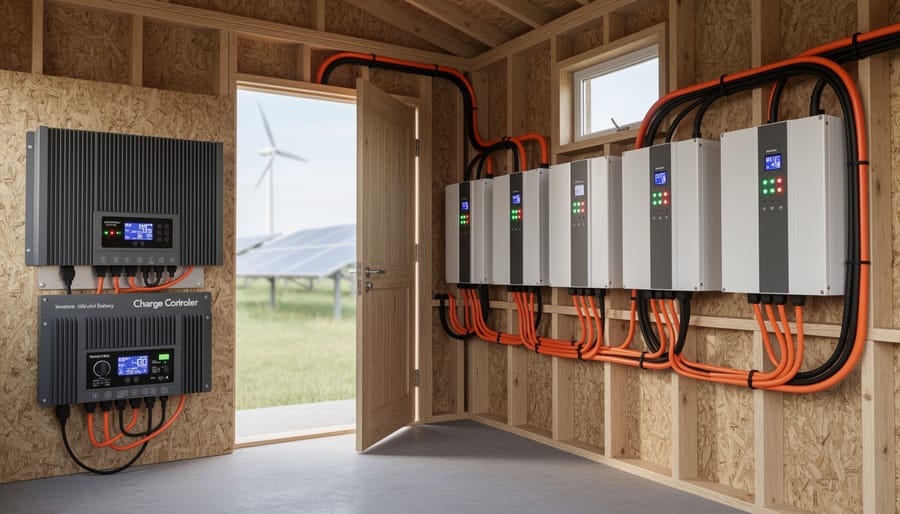
Battery banks store excess energy generated during peak production periods and release it when demand exceeds generation. Lithium iron phosphate batteries have become the standard for hybrid systems because they tolerate deep discharge cycles, charge efficiently, and last 10 to 15 years with proper management. A properly sized battery bank provides two to four days of autonomy, covering extended periods of low sun and calm winds.
Charge controllers regulate the flow of electricity from solar panels and wind turbines into the battery bank, preventing overcharging that would damage cells and ensuring batteries charge at optimal rates. Maximum power point tracking controllers squeeze the most energy from solar arrays by constantly adjusting voltage and current, while wind charge controllers incorporate dump loads to dissipate excess power during high winds when batteries reach full capacity.
Inverters transform the direct current stored in batteries into the alternating current that powers standard household appliances and equipment. Unlike wind grid tie inverters designed for feeding power back into the electricity network, off-grid inverters must create their own stable frequency and voltage reference. Quality models deliver pure sine wave output that safely runs sensitive electronics, with efficiency ratings above 95 percent.
Monitoring systems track generation, consumption, battery state, and system health in real time. These systems alert operators to potential problems before they cause outages, log performance data for optimisation, and provide the visibility needed to manage energy use intelligently. Modern monitors connect via WiFi or cellular networks, letting you check your system’s status from anywhere.
Where Off-Grid Hybrid Systems Shine: Real-World Applications
Remote Agriculture and Pastoral Operations
Across the vast stretches of rural Australia, hybrid solar-wind systems have become lifelines for pastoral operations that sit hundreds of kilometres from the nearest power line. Take a typical cattle station in western Queensland: a well-configured 5kW solar array paired with a 3kW wind turbine keeps water pumps running 24/7, powering electric fencing, refrigeration units, and workshop tools without burning through diesel. The wind component proves invaluable during winter months when overcast skies reduce solar output but steady westerlies keep turbines spinning.
These systems excel at powering bore pumps that draw from deep aquifers, where reliability matters more than anything, stock can’t wait three days for calm weather to pass. Battery banks sized for 48-72 hours of autonomy ensure water troughs stay filled even during poor generation periods. Remote homesteads benefit too, running everything from washing machines to communication equipment, with many properties now exploring heat pumps and electrification of previously gas-dependent systems. Operators report fuel cost savings of $15,000-$30,000 annually compared to diesel generators, with the added benefit of silent operation and minimal maintenance during busy mustering seasons.
Community Energy Solutions
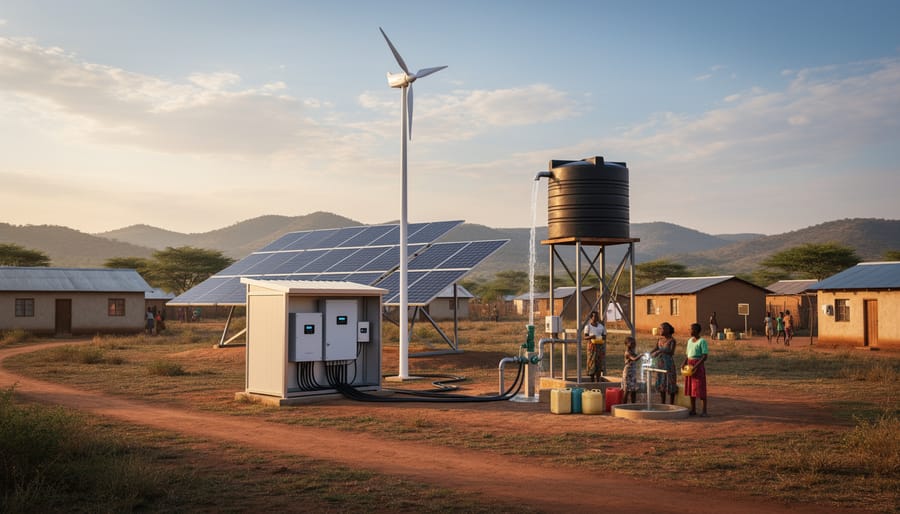
Remote Indigenous communities across Australia’s Northern Territory and Far North Queensland are leading the charge in hybrid energy adoption, demonstrating that off-grid systems can deliver genuine energy sovereignty. The Daly River community, 220 kilometres south of Darwin, replaced its diesel generators with a solar-wind-battery system in 2021, slashing fuel costs by 78% while eliminating the constant noise and fumes that once dominated the town centre.
What makes these projects transformative isn’t just the technology, it’s the operational control. Communities that once relied on irregular fuel deliveries now manage their own generation, with local technicians trained to maintain equipment and monitor performance. The Maningrida hybrid system, serving around 2,500 people, runs on 60% renewables year-round, with diesel generators operating only as backup during extended wet-season cloud cover.
These success stories prove the economic case beyond environmental benefits. While upfront costs remain substantial, remote communities avoid the escalating expense of trucking diesel across vast distances. The Yirrkala system in East Arnhem Land pays for itself within eight years through diesel savings alone, whilst providing cleaner, quieter power that supports community health and wellbeing.
Sizing Your System: What Determines the Right Fit
Getting the size right matters more than most people realise. Oversize the system and you’ve wasted capital on idle capacity; undersize it and you’ll run short during critical periods or wear out batteries cycling them too hard. The sweet spot sits where your energy needs, local resources, budget realities and growth plans intersect.
Start by measuring what you actually use, not what you think you use. Track your daily energy consumption over at least a month, noting which appliances run when and for how long. A remote cattle station running electric fencing, water pumps and a homestead will have very different demands than a small eco-lodge with guest cabins. Pay particular attention to peak periods, those morning and evening hours when multiple loads fire up at once, because your system must handle those spikes without browning out.
Several essential factors shape your system requirements:
- Daily energy consumption measured in kilowatt-hours, including all loads
- Peak demand periods when multiple appliances run simultaneously
- Local wind and solar resources based on actual site measurements or nearby weather data
- Backup requirements for extended low-wind, overcast periods
- Budget constraints balancing upfront costs against long-term reliability
- Maintenance access considering remoteness and technical expertise available
Seasonal swings hit harder in off-grid setups than most newcomers expect. Winter days deliver less solar output precisely when you might need more power for lighting and heating, though southern Australian sites often see stronger winter winds. Design for your leanest season, not your best. A system that works brilliantly in January sunshine but falters in July gloom hasn’t been sized properly.
Build in headroom for growth, but be realistic. Adding a cool room, workshop tools or extra accommodation down the track means planning those loads now, even if you don’t install them immediately. Battery capacity should match two to three days of autonomy, enough reserve to ride out a calm, cloudy stretch without generator backup. The upfront cost stings, but undersized storage means premature battery failure and reliability headaches that cost far more over time.
From Off-Grid to Grid-Scale: Lessons for Australia’s Energy Future
The lessons learned from managing off-grid solar wind hybrid systems apply directly to Australia’s challenge of integrating large-scale renewable energy into the national grid. Both scenarios wrestle with the same fundamental problem: matching intermittent renewable generation with consistent demand.
Off-grid systems have spent decades solving what the grid now faces. Battery storage, sophisticated charge controllers, and real-time load management weren’t theoretical concepts for remote operators, they were essential survival tools. A pastoral station 400 kilometres from the nearest power line couldn’t afford to get energy storage wrong. That same urgency now drives grid-scale operators as coal plants retire.
The parallels run deep. An off-grid system balances solar’s midday abundance against wind’s evening strength using batteries and smart switching. Grid-scale networks do the same thing, just with gigawatts instead of kilowatts. The principle remains identical: store excess generation when production exceeds demand, release it when the pattern reverses.
Australia’s distributed energy network increasingly mirrors a collection of coordinated off-grid systems rather than the traditional one-way power flow from central generators. Virtual power plants link thousands of household batteries and rooftop solar arrays, creating aggregated storage capacity that functions much like an oversized off-grid installation. The technology stack, inverters, controllers, monitoring systems, evolved directly from equipment proven in remote hybrid systems.
Weather forecasting matters equally at both scales. An off-grid operator checks tomorrow’s wind predictions before running high-load equipment. Grid operators do the same before scheduling coal plant shutdowns or approving maintenance windows. Both rely on anticipating renewable generation patterns days ahead.
The biggest lesson from off-grid systems: redundancy and diversity beat single-source dependence. Remote installations learned this through expensive failures, a week of cloudy, still weather taught hard lessons about backup capacity. Grid planners now apply that wisdom, mixing solar, wind, hydro, and storage rather than betting entirely on one technology.
Regional microgrids demonstrate this evolution clearly. Mining operations that once ran entirely on diesel now operate as sophisticated hybrid systems, seamlessly blending solar, wind, battery storage, and backup generators. They’ve become test beds for grid-scale solutions, proving technologies and control strategies that later scale up for metropolitan networks.
The trajectory is clear: Australia’s energy grid is learning to think like an off-grid system, flexible, resilient, and built around renewable diversity rather than fossil fuel certainty.
Common Questions About Off-Grid Solar Wind Hybrid Systems
Prospective buyers of off-grid hybrid systems often grapple with similar concerns before committing to a purchase. The answers depend on your specific circumstances, but understanding the general landscape helps clarify whether these systems align with your needs and budget.
How much does an off-grid solar wind hybrid system cost?
Initial investment typically ranges from $25,000 to $100,000+ depending on system size, component quality, and site complexity. A small residential system might start around $30,000, while larger properties with substantial energy needs can easily exceed $80,000.
How reliable are these hybrid systems?
When properly sized and maintained, hybrid systems deliver excellent reliability, often exceeding 95% uptime. The dual generation sources provide built-in redundancy that single-source systems can’t match.
What maintenance do solar wind hybrid systems require?
Wind turbines need annual inspections and bearing lubrication every few years, while solar panels require occasional cleaning and connection checks. Battery maintenance varies by type, with lithium systems needing minimal attention compared to lead-acid alternatives. Expect to dedicate a few hours annually to basic upkeep.
Can you expand the system later if your needs grow?
Most systems accommodate expansion if you plan ahead with adequate inverter and battery capacity. Adding panels or an extra turbine later is straightforward, though retrofitting a significantly undersized battery bank proves more challenging and expensive.
Component lifespan shapes long-term value calculations. Quality solar panels carry 25-year performance warranties and often produce power for 30+ years, while wind turbines typically deliver 20 years of service before major overhauls become necessary. Battery banks represent the shortest-lived component, lasting 5-15 years depending on chemistry and usage patterns, with lithium iron phosphate outperforming traditional lead-acid options. Inverters and charge controllers generally operate trouble-free for 10-15 years before replacement.
The grid-versus-hybrid calculation hinges on connection costs. Properties more than two kilometres from existing grid infrastructure usually find hybrid systems economically superior, as connection charges can reach $50,000-$100,000 per kilometre in rural Australia. Even properties within grid reach sometimes choose independence to avoid ongoing supply charges and to gain control over their energy future. Compared to diesel generators, hybrid systems typically achieve payback within 3-7 years through eliminated fuel costs, quieter operation, and reduced maintenance, while delivering cleaner, more reliable power for decades beyond that initial investment recovery.
Off-grid solar wind hybrid systems represent more than clever engineering, they’re working proof that reliable, clean energy independence is achievable right now across Australia. From cattle stations in the Kimberley to research outposts in Tasmania, these systems are already powering real operations, reducing diesel dependence, and cutting emissions without sacrificing reliability.
The lessons learned from thousands of off-grid installations inform how Australia approaches grid-scale integration. When a remote farm successfully balances solar and wind generation with battery storage, it demonstrates principles that apply to stabilising entire regional grids. Every hybrid system that replaces a diesel generator chips away at our national carbon footprint while building collective knowledge about managing variable renewable energy.
For landowners, communities, and businesses evaluating their energy options, the question isn’t whether hybrid systems work, it’s whether they fit your specific circumstances. The technology has matured. Australian suppliers understand local conditions. Government incentives often improve the economics. What remains is assessing your energy needs, understanding your solar and wind resources, and running the numbers against grid connection costs or ongoing fuel expenses.
Australia’s renewable energy transition happens both at utility scale and property scale. Off-grid hybrid systems offer a tangible path toward energy independence that aligns personal resilience with national sustainability goals. Whether you’re considering a system for your operation or simply understanding how distributed renewable energy works, you’re engaging with solutions that shape Australia’s energy future, one installation, one community, one informed decision at a time.