
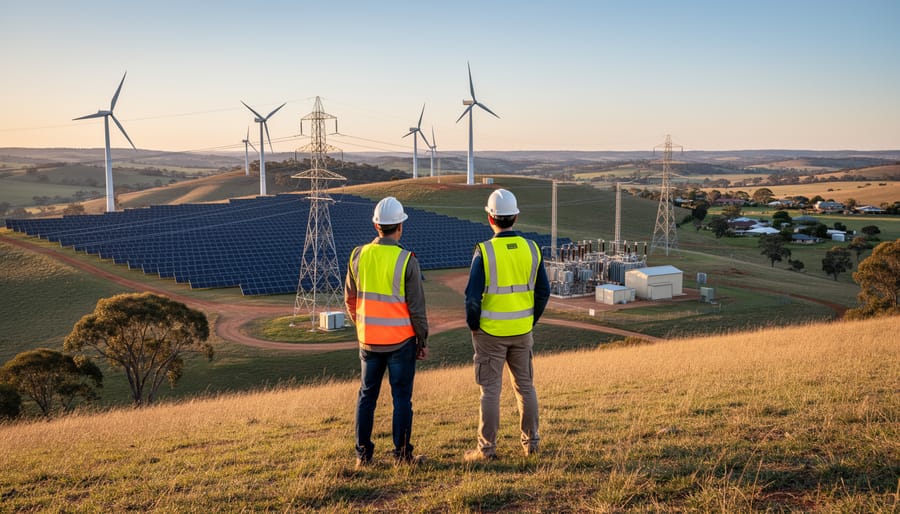
Identify suitable sites by mapping land availability against grid connection points, considering existing infrastructure, environmental constraints, and community proximity before initiating any project discussions. This upfront assessment saves months of delays and prevents costly missteps that derail renewable developments across regional Australia.
Engage local communities early through genuine consultation that addresses specific concerns about visual impact, noise, traffic, and land use changes. Projects that build trust from day one through transparency and shared benefits—such as community ownership models or local employment guarantees—achieve approval three times faster than those imposing solutions without dialogue.
Navigate the complex web of federal, state, and local approvals by understanding which regulations apply to your specific technology and location. Bioenergy facilities, for instance, face different permitting pathways than solar or wind farms, with agricultural waste-to-energy projects often benefiting from streamlined approvals when they demonstrate clear environmental improvements over current waste management practices.
Partner with established grid operators and transmission planners to align your project timeline with network upgrades, avoiding the 12-24 month delays that plague projects attempting connection without coordination. Australia’s renewable transition demands strategic thinking about where projects can connect efficiently rather than simply where resources exist.
The difference between renewable projects that stall indefinitely and those commissioned on schedule rarely comes down to technology or financing. Success hinges on mastering the siting and permitting process—a challenge that combines technical planning, regulatory navigation, and community engagement into one comprehensive strategy. Understanding this landscape transforms obstacles into opportunities, particularly for innovative solutions like bioenergy that can revitalize regional economies while delivering clean power exactly where communities need it most.
The Real Roadblock: Why Location Matters More Than You Think
What Makes a Good Site Go Bad
Even the most promising renewable energy project can stumble when location decisions overlook critical factors. Understanding these common pitfalls helps developers and policymakers avoid costly delays and community conflict.
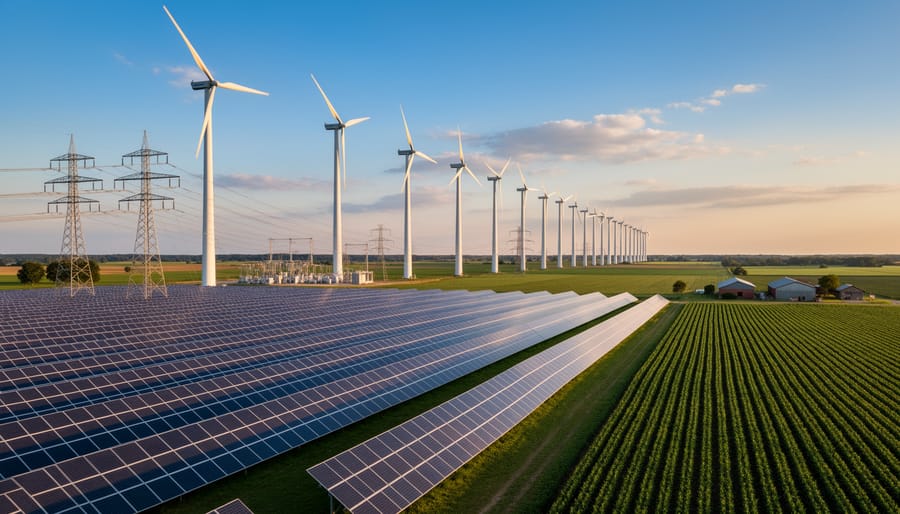
Distance from grid infrastructure remains one of the most frequent siting mistakes. A renewable facility generating clean energy is only valuable if that power can reach consumers. Projects located far from transmission lines face massive connection costs—sometimes millions of dollars per kilometre—that can render otherwise viable projects economically unworkable. This challenge affects solar projects and wind farms equally, though bioenergy facilities often have greater siting flexibility due to their smaller footprint and ability to locate near agricultural waste sources.
Agricultural land conflicts create another significant hurdle. Prime farming land represents food security and rural livelihoods, making it politically sensitive territory. When renewable projects compete directly with productive agriculture, they face legitimate opposition from farming communities and food security advocates.
Environmental sensitivities can derail projects quickly. Placing facilities near protected habitats, migratory bird routes, or culturally significant sites invites regulatory rejection and community backlash. These concerns aren’t mere bureaucratic obstacles—they reflect genuine environmental protection priorities that renewable energy should support, not undermine.
Community opposition often stems from poor consultation rather than inherent project problems. When locals feel bypassed or dismissed, resistance intensifies regardless of project merit.
Consider this contrast: A proposed wind farm in regional Victoria initially faced fierce opposition when developers prioritised maximum wind exposure over community concerns. After genuine engagement, the project relocated slightly, incorporated buffer zones, established a community benefit fund, and gained broad local support. The lesson? Smart siting involves listening before building, not just calculating optimal technical specifications.
The Permitting Maze: Navigating Australia’s Approval Process
Who Has a Say in Your Project
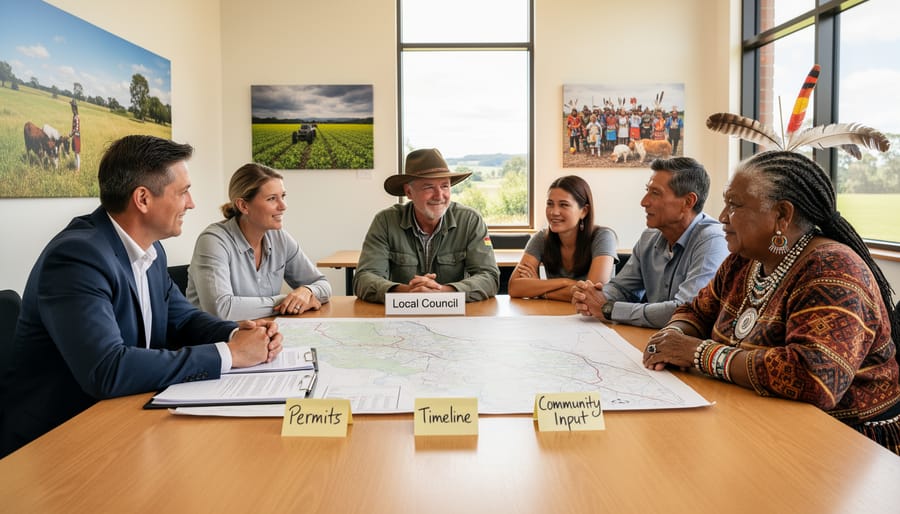
Successfully siting renewable energy projects requires navigating a complex web of stakeholders, each bringing valuable perspectives to the table. Getting them on board early can mean the difference between a project that thrives and one that stalls indefinitely.
Local councils are your first port of call, wielding considerable influence over land use decisions and development approvals. They’re deeply connected to community sentiment and understand local infrastructure constraints. State environmental agencies assess ecological impacts, ensuring projects meet environmental standards while protecting native habitats and waterways. Grid operators like the Australian Energy Market Operator evaluate how new generation capacity integrates with existing infrastructure, addressing technical requirements for grid stability.
Indigenous communities hold profound cultural knowledge and often possess native title rights over proposed sites. Their involvement isn’t merely procedural—it’s essential for respecting Country and can unlock innovative partnership opportunities that benefit everyone.
Affected residents living near proposed sites deserve genuine consultation, not token gestures. Their concerns about visual impact, noise, or land values need addressing through transparent dialogue.
The golden rule? Start conversations early, before plans are set in stone. A bioenergy facility in regional Victoria demonstrated this beautifully, holding community workshops before submitting applications. By incorporating local feedback on truck routes and operational hours, they secured approvals eighteen months faster than comparable projects. Early engagement transforms potential opponents into project champions, creating pathways for renewable developments that genuinely serve communities whilst advancing Australia’s clean energy transition.
Timeline Reality Check
Understanding project timelines helps set realistic expectations and reveals how strategic planning makes all the difference. In Australia, a typical solar farm application takes between 18 months to three years from submission to approval, depending on project scale and location. Wind farms often face longer timelines, averaging two to four years, particularly when navigating aviation authorities and community consultation requirements.
Bioenergy projects present unique opportunities for faster approvals. A well-sited biomass facility near agricultural areas can achieve development consent within 12 to 24 months, especially when co-locating with existing industrial infrastructure. One Queensland piggery successfully obtained approval for its biogas operation in just 16 months by demonstrating clear environmental benefits and strong community support from the start.
The game-changer? Comprehensive siting analysis before lodging applications. Projects that invest time upfront identifying optimal locations, conducting thorough environmental assessments, and engaging stakeholders early can reduce approval timelines by 30 to 40 percent. This front-loaded approach identifies potential roadblocks before they become expensive delays.
Consider this real-world comparison: two similar-sized solar projects in regional New South Wales. The first developer rushed their application without detailed siting analysis and faced 27 months of back-and-forth amendments. The second invested in comprehensive pre-application research, including cultural heritage surveys and grid connection studies, receiving approval in just 14 months.
The message is clear: thorough preparation dramatically accelerates outcomes. While patience remains essential, smart siting decisions transform lengthy processes into manageable timelines, getting clean energy projects operational sooner.
Bioenergy Siting: The Unique Australian Opportunity
From Waste to Watts: Location Strategy That Works
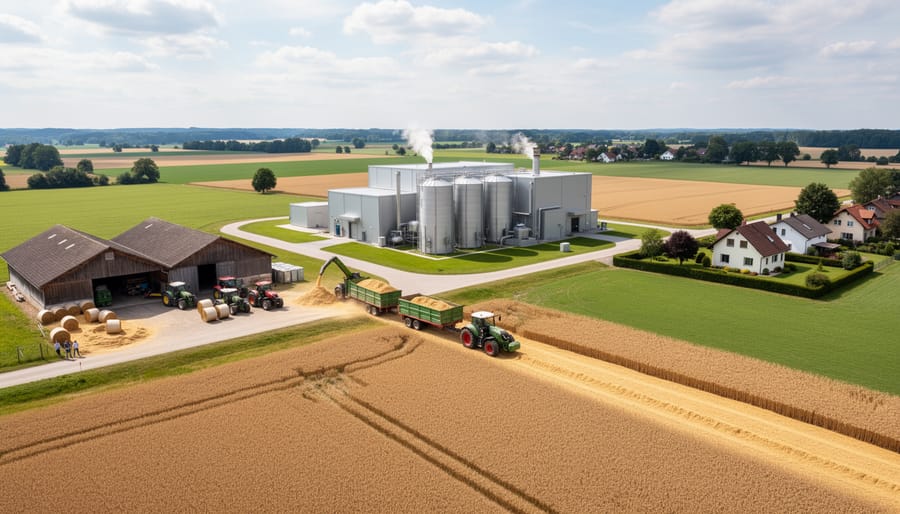
Smart location strategy transforms potential roadblocks into community victories, as demonstrated by several pioneering Australian bioenergy projects that turned waste streams into reliable power sources.
The Lismore Organic Processing Facility in northern New South Wales exemplifies how early community engagement can fast-track approvals. Facing initial concerns from nearby residents about odour and traffic, the project team organised monthly information sessions six months before lodging permits. They addressed concerns head-on, implementing odour control technology and scheduling waste deliveries outside peak hours. The facility now processes 20,000 tonnes of organic waste annually, generating enough electricity for 1,200 homes while diverting waste from landfill. The key lesson? Transparency builds trust faster than technical reports.
Queensland’s Darling Downs facility showcases strategic co-location benefits. By situating their biomass plant adjacent to existing agricultural operations and near transmission infrastructure, developers reduced both environmental impacts and regulatory hurdles. They worked directly with local councils to align their project with regional waste management goals, effectively positioning bioenergy as the solution to existing problems rather than introducing new ones. This alignment with established bioenergy policies helped secure permits in just 14 months, well below the state average.
Western Australia’s Rockingham biogas project demonstrates the power of partnership. Rather than going it alone, developers collaborated with local government, water utilities, and community groups from day one. They established a community benefit fund, employed local contractors, and offered educational tours. When unexpected archaeological findings delayed construction, their established community relationships meant stakeholders remained supportive rather than opposed.
The common thread across these successes? All three projects prioritised relationships over regulations, positioned themselves as community assets rather than industrial impositions, and invested time upfront to save years on the backend. They prove that with thoughtful planning and genuine engagement, the path from waste to watts doesn’t have to be a battle.
Five Siting Principles That Speed Up Approvals
Successfully siting renewable energy projects in Australia doesn’t have to be a lottery. Five strategic principles can dramatically reduce approval timeframes while building stronger community support and environmental outcomes. These aren’t theoretical concepts—they’re proven approaches already working across projects from Queensland cane fields to Victorian dairy regions.
Start with grid proximity assessment as your foundation. Projects located within 10 kilometres of existing transmission infrastructure typically navigate approvals 40% faster than those requiring extensive new connections. Before selecting a site, map out substations, transmission lines, and network capacity in your target region. In New South Wales, a biomass facility near Wagga Wagga received expedited approval partly because it connected to underutilised grid infrastructure originally built for decommissioned coal assets. This principle becomes especially crucial for bioenergy projects, which benefit from consistent baseload generation near existing network nodes.
Environmental sensitivity screening should happen early, not late. Use publicly available databases like the Protected Matters Search Tool to identify threatened species habitats, heritage sites, and waterway buffers before committing resources. Projects demonstrating proactive avoidance of sensitive areas move through environmental assessments with fewer objections and variations. A South Australian bioenergy developer saved eight months by initially screening five potential sites and selecting one with minimal ecological constraints, rather than pushing through with a problematic location.
Community benefit planning transforms opposition into partnership. Rather than treating community engagement as a box-ticking exercise, design tangible local benefits into your project from day one. This might include local employment guarantees, community ownership opportunities, infrastructure improvements, or direct energy cost reductions. A Queensland biogas facility processing agricultural waste created a community benefit fund supporting local schools and sporting clubs, which built genuine grassroots support that accelerated council approvals.
Agricultural land compatibility ensures your renewable project enhances rather than displaces food production. This principle proves particularly relevant for bioenergy, where projects can integrate with existing farming operations. Assess whether your facility can process agricultural residues, provide waste management solutions, or return nutrients to soil through digestate. Western Australian wheat farmers embraced a biomass project that converted stubble into energy while reducing fire risk and providing additional farm income—a win-win that streamlined approvals.
Transport infrastructure access often determines project viability. Evaluate road access for construction equipment, ongoing fuel supply logistics, and potential traffic impacts on local communities. Bioenergy facilities processing organic waste or agricultural residues need reliable routes for feedstock delivery without creating bottlenecks through town centres. Projects demonstrating minimal transport disruption and existing infrastructure utilisation consistently achieve faster approvals.
These five principles work together synergistically. A site scoring well across all five dimensions can progress through approvals in 18-24 months, while projects ignoring these fundamentals often face three to five-year timelines with uncertain outcomes. The message is clear: strategic site selection isn’t just about finding available land—it’s about choosing locations where renewable energy naturally fits within existing infrastructure, environmental values, and community aspirations.
What Policymakers Are Getting Right (And Wrong)
Australia’s renewable energy siting policies present a mixed picture, with genuine progress in some areas alongside persistent challenges that demand attention.
On the positive side, several states have taken meaningful steps forward. Victoria’s renewable energy zones represent a particularly smart approach, designating specific areas with strong renewable resources and existing grid connections while fast-tracking approval processes within these zones. New South Wales has followed suit, creating similar frameworks that acknowledge the reality that not all locations are equally suitable for renewable projects. These coordinated planning efforts have delivered streamlined processes that reduce approval times from years to months in some cases.
Queensland’s bioenergy-friendly policies deserve recognition too. The state has established clearer pathways for agricultural waste-to-energy projects, recognizing that bioenergy facilities often fit naturally into existing farming landscapes with minimal disruption. This approach has enabled several sugarcane and timber processing facilities to add renewable energy generation without facing the same regulatory hurdles as greenfield projects.
The federal government’s establishment of clearer environmental assessment criteria has also helped, particularly for projects that demonstrate genuine community benefit and minimal ecological impact. When developers know exactly what’s expected upfront, they can design better projects from day one.
However, significant barriers remain. The inconsistency between state and federal requirements continues to frustrate proponents, with overlapping approval processes creating unnecessary delays and costs. A bioenergy facility might secure state environmental approval only to face additional federal scrutiny under different criteria, essentially restarting the process.
Local council powers also vary dramatically, with some embracing renewable energy while others maintain restrictive planning controls that don’t distinguish between polluting industries and clean energy infrastructure. This postcode lottery makes it harder to plan strategic nationwide deployment of renewable capacity.
The biggest opportunity for improvement lies in adopting a more unified national framework that maintains environmental protections while eliminating redundant approval layers. We need policies that recognize the urgent climate imperative without sacrificing genuine community consultation or ecological safeguards. Several European countries have demonstrated this balance is achievable, completing comprehensive environmental assessments within twelve months while maintaining rigorous standards.
The foundation for better policy exists; we simply need the political will to build upon what’s working and fix what isn’t.
Your Next Steps: Making Siting Work For Your Project
Whether you’re a community group, landowner, or industry professional, getting started with renewable energy siting doesn’t have to be overwhelming. Here’s how to take those crucial first steps.
For community groups considering renewable projects, begin by tapping into free resources from organizations like the Clean Energy Council and your state’s renewable energy authority. The Australian Renewable Energy Agency (ARENA) offers excellent case studies showing how communities across the country have successfully navigated siting challenges. Start small – organize a community meeting to gauge interest, then reach out to councils early to understand local planning requirements. Remember the success of Hepburn Wind in Victoria, which began with just a few passionate locals and grew into Australia’s first community-owned wind farm.
Farmers exploring bioenergy options should first assess what resources you already have. Got crop residues, livestock waste, or marginal land? These could be perfect for bioenergy projects. The online Australian Biomass for Bioenergy Assessment (ABBA) tool provides preliminary siting analysis, helping you understand your property’s potential without upfront costs. Connect with your local Landcare group – they often have networks and knowledge about farmers who’ve already ventured into renewable energy.
For industry professionals, invest time in pre-feasibility studies before committing resources. Desktop tools like the Renewable Energy Integration Facility can help identify promising sites, but don’t skip the critical step of early community engagement. The projects that succeed are those that treat local consultation as partnership, not just a regulatory box to tick.
Regardless of your starting point, know when to bring in specialists. Environmental consultants, grid connection experts, and community engagement professionals become essential once you’ve identified a promising site. Their expertise typically pays for itself by avoiding costly mistakes down the track. The key is starting informed, staying flexible, and keeping your community at the heart of every decision.
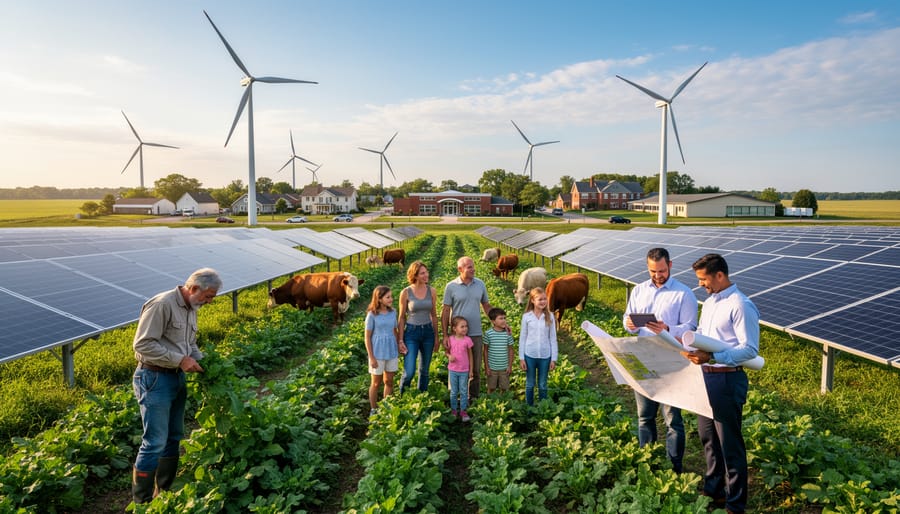
Australia stands at a pivotal moment in its renewable energy journey. The technical solutions exist, the economic case is compelling, and community support continues to grow. What remains is the challenge of implementation—and smart siting and permitting strategies hold the key to unlocking our nation’s remarkable renewable potential.
The good news is that we’re already seeing what’s possible when thoughtful planning meets political will. Communities across Australia are demonstrating that renewable projects can be delivered efficiently when stakeholders work together, when Indigenous knowledge guides land use decisions, and when environmental considerations are integrated from day one rather than treated as afterthoughts. These success stories prove that delays and conflicts aren’t inevitable—they’re symptoms of outdated processes that we can fix.
Bioenergy projects, in particular, showcase how renewable developments can align with agricultural communities, create local employment, and turn waste streams into valuable resources. When sited intelligently near existing infrastructure and agricultural operations, these facilities become assets rather than impositions, strengthening regional economies while advancing our clean energy goals.
The path forward requires action from all of us. Whether you’re a policymaker, industry professional, or concerned citizen, you have a role to play in advocating for streamlined, sensible siting policies. Push for regulatory reforms that maintain environmental protections while eliminating redundant processes. Support initiatives that prioritize early community engagement and Indigenous consultation. Champion projects that demonstrate best practice in balancing renewable development with agricultural productivity and ecological preservation.
Australia’s renewable future is within reach—if we commit to making the planning and approval processes work as efficiently as the technology itself. The time for action is now.