
Melanotan II peptide is a synthetic cyclic heptapeptide featuring seven amino acids arranged in a ring structure, with the sequence Ac-Nle-cyclo[Asp-His-D-Phe-Arg-Trp-Lys]-NH2. This unique molecular architecture makes it a potent melanocortin receptor agonist, capable of binding to multiple melanocortin receptor subtypes with significantly higher activity than the naturally occurring alpha-melanocyte stimulating hormone from which it was derived. The peptide’s defining structural feature is its lactam bridge connecting aspartic acid and lysine residues, creating a constrained cyclic form that enhances receptor binding stability and extends biological half-life.
Understanding this peptide’s properties requires examining how deliberate modifications to the natural hormone sequence transform its behaviour. The incorporation of norleucine at position four replaces methionine, preventing oxidative degradation. The substitution of D-phenylalanine, an unnatural stereoisomer, provides resistance to enzymatic breakdown. These changes have positioned Melanotan II at the centre of peptide research exploring structure-function relationships in melanocortin signalling.
The physical properties of this compound reflect its carefully engineered design. With a molecular weight of 1,024 daltons and a net positive charge at physiological pH, it demonstrates good water solubility while maintaining sufficient lipophilicity to cross biological membranes. The cyclic configuration restricts conformational flexibility, locking the peptide into a shape optimised for receptor interaction.
From a biochemical perspective, Melanotan II represents a milestone in understanding how subtle structural alterations can dramatically enhance biological activity, stability, and selectivity. The relationship between its compact cyclic architecture and its potent melanocortin receptor binding reveals fundamental principles applicable across peptide drug design, making this molecule both a research tool and a case study in rational peptide engineering.
What Makes Melanotan-II Unique: Core Peptide Properties
Melanotan-II stands apart from naturally occurring peptides through a combination of deliberate molecular modifications that fundamentally alter its behaviour in biological systems. As a synthetic analog of alpha-melanocyte stimulating hormone, this peptide was engineered specifically to overcome the limitations of its natural counterpart, resulting in a compound with markedly different characteristics that make it particularly interesting for research purposes.
The foundation of Melanotan-II’s distinctiveness lies in its enhanced stability. Natural α-MSH degrades rapidly in the body, with a half-life measured in minutes. Melanotan-II, by contrast, demonstrates substantially longer-lasting activity, a property directly attributable to structural modifications we’ll examine in detail later. This extended stability means the peptide maintains its structural integrity far longer under physiological conditions, making it more practical for controlled research investigations where consistent peptide presence matters.
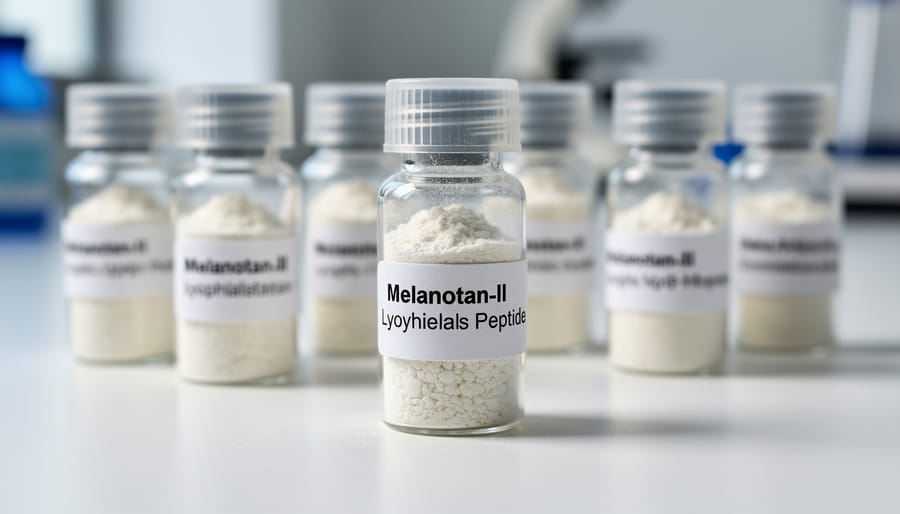
From a physical chemistry perspective, Melanotan-II presents as a relatively small peptide with a molecular weight of approximately 1,024 Daltons. This compact size contributes to its research utility, as smaller peptides generally exhibit better tissue penetration characteristics than larger protein structures. The peptide typically appears as a white to off-white lyophilized powder in its pure form, stable when stored properly as a solid.
Solubility represents another crucial property. Melanotan-II shows good solubility in water and common buffer solutions, though reconstitution requires attention to technique. Researchers working with this peptide typically use sterile water or bacteriostatic water for initial dissolution, achieving clear solutions at appropriate concentrations. The peptide’s behaviour in aqueous solution depends on pH, with stability varying across different acidic and neutral ranges.
The binding affinity profile adds further distinction. Melanotan-II exhibits strong interaction with melanocortin receptor subtypes, particularly MC1R and MC4R, though its selectivity pattern differs from that of natural α-MSH. This receptor binding characteristic stems directly from the peptide’s three-dimensional shape and the specific arrangement of amino acids that form the active binding surface.
Temperature sensitivity also defines handling requirements. While the lyophilized powder shows reasonable stability at room temperature for short periods, optimal long-term storage requires refrigeration or freezing. Once reconstituted, the peptide solution demands more careful temperature control to maintain structural integrity over time.
These fundamental properties, taken together, create a peptide tool with specific research advantages: predictable stability, manageable solubility, defined receptor interactions, and a molecular profile that facilitates controlled investigation of melanocortin pathways.
Breaking Down the Molecular Structure

The Amino Acid Sequence
The specific sequence Ac-Nle-cyclo[Asp-His-D-Phe-Arg-Trp-Lys]-NH2 represents each building block in Melanotan-II, and every component serves a defined structural or functional role.
The N-terminal acetyl group (Ac) caps the beginning of the sequence, protecting the peptide from enzymatic breakdown that would otherwise occur at free amino ends. This modification immediately enhances stability compared to unprotected peptides.
Norleucine (Nle) occupies the first position, replacing methionine found in natural α-MSH. This substitution prevents oxidation that would degrade the peptide, particularly during storage. The cyclic portion contains six amino acids arranged in a ring: aspartic acid (Asp), histidine (His), D-phenylalanine (D-Phe), arginine (Arg), tryptophan (Trp), and lysine (Lys).
The His-D-Phe-Arg-Trp segment forms what researchers call the “core tetrapeptide,” the critical sequence for binding to melanocortin receptors. Histidine and arginine carry positive charges that enable ionic interactions, while tryptophan’s large aromatic structure creates hydrophobic contacts with receptor binding pockets.
D-phenylalanine proves particularly interesting. The D-configuration (mirror image of the natural L-form) resists enzymatic degradation while maintaining binding function. This single modification dramatically extends the peptide’s active lifetime in biological environments.
Lysine connects back to aspartic acid through a disulfide bond that closes the ring, locking the active tetrapeptide into its functional shape. The C-terminal amide group (NH2) provides protection at the opposite end, matching the N-terminal capping strategy. Together, these seven residues and their modifications create a peptide optimized for stability and receptor interaction.
Structural Modifications from Natural α-MSH
Natural alpha-melanocyte stimulating hormone (α-MSH) consists of thirteen amino acids, while Melanotan-II contains just seven. This dramatic reduction isn’t random, researchers identified the core sequence responsible for melanocortin receptor binding and built Melanotan-II around these essential residues. The shortened structure eliminates amino acids that don’t contribute directly to receptor interaction, creating a more streamlined molecule focused on the active site.
The most significant modification involves substituting a D-phenylalanine residue where natural α-MSH contains L-phenylalanine. This mirror-image amino acid creates a crucial difference. Natural peptides composed entirely of L-amino acids face rapid degradation by enzymes that evolved specifically to break them down. The D-amino acid insertion disrupts this enzymatic recognition, substantially extending Melanotan-II’s stability in biological systems. Where natural α-MSH degrades within minutes, the modified structure resists breakdown for considerably longer periods.
Another key alteration replaces methionine with norleucine (Nle) at position four. Methionine contains sulfur atoms vulnerable to oxidation, which can compromise peptide integrity during storage or in oxidative environments. Norleucine provides similar hydrophobic properties without the oxidation risk, improving the peptide’s shelf stability and reliability in research settings.
The acetyl group (Ac) added to the N-terminus and the amide group (NH2) capping the C-terminus represent terminal modifications absent in natural α-MSH. These caps protect the peptide ends from exopeptidase enzymes that typically chew through peptides from their termini inward. Together with the cyclic disulfide bridge connecting positions four and ten, these modifications create a structure dramatically more resistant to degradation than its natural counterpart while maintaining the biological activity researchers need for melanocortin receptor studies.
How Structure Influences Biological Activity

The cyclic structure of Melanotan-II isn’t just a molecular curiosity, it’s the key to understanding why this synthetic peptide behaves so differently from its natural counterpart. Where alpha-MSH (the natural hormone) tends to degrade quickly in biological environments, Melanotan-II’s ring-shaped conformation creates a rigid, protected molecule that resists enzymatic breakdown. This stability translates directly into prolonged biological activity, making it particularly valuable for extended observation periods in lab research.
The cyclic formation does more than protect the peptide from degradation. It locks critical amino acid residues into a specific spatial arrangement that melanocortin receptors recognize with remarkable precision. Think of it like a key that’s been pre-shaped to fit a lock, the ring structure ensures that functional groups remain properly positioned to bind receptor sites. This contrasts sharply with linear peptides, which can fold into multiple conformations, only some of which effectively engage their target receptors.
Specific residues within the cycle play distinct roles in receptor interaction. The histidine-phenylalanine-arginine-tryptophan sequence forms what researchers call the “pharmacophore”, the essential structural pattern for melanocortin receptor binding. The D-phenylalanine, an unnatural amino acid configuration, enhances this binding while simultaneously making the peptide resistant to peptidases that would normally cleave natural L-amino acids. Meanwhile, the arginine residue provides a positively charged side chain crucial for electrostatic interactions with the receptor’s binding pocket.
Norleucine at the N-terminus replaces methionine found in natural α-MSH, preventing oxidative damage that would otherwise weaken receptor affinity over time. This substitution exemplifies how synthetic modifications address vulnerabilities in natural peptides without sacrificing biological function.
The disulfide bridge between cysteine residues (forming the cycle) creates additional stability benefits beyond structure. It raises the peptide’s melting point and increases resistance to pH fluctuations, meaning Melanotan-II maintains its active conformation across a wider range of experimental conditions than linear peptides would tolerate. Research contexts requiring extended incubation periods or varied environmental conditions particularly benefit from this resilience.
Ultimately, Melanotan-II’s structure demonstrates a fundamental principle in peptide chemistry: molecular architecture directly dictates biological behaviour. The relationship between its engineered rigidity and enhanced receptor selectivity offers insights applicable well beyond this single peptide, informing broader synthetic peptide design strategies.
Physical and Chemical Characteristics

When working with Melanotan-II in a laboratory setting, understanding its physical and chemical properties becomes essential for maintaining peptide integrity and ensuring reliable results. This synthetic peptide typically arrives as a lyophilized (freeze-dried) powder, appearing white to off-white in colour with a fine, crystalline texture. The powder form offers advantages for long-term storage and precise dosing in research applications.
The peptide’s physical characteristics directly influence how researchers handle and prepare it. Melanotan-II demonstrates good solubility in sterile water and bacteriostatic water, though complete dissolution may require gentle swirling rather than vigorous shaking, which can damage the delicate peptide bonds. Some researchers prefer using slightly acidic solutions to enhance solubility, as the peptide shows better stability in mildly acidic conditions.
| Property | Specification | Notes |
|---|---|---|
| Molecular Weight | 1024.2 g/mol | Relatively small for peptides |
| Solubility | Water: >1 mg/mL | Best in sterile or bacteriostatic water |
| Storage Temperature | -20°C (powder); 2-8°C (reconstituted) | Protect from light and moisture |
| pH Stability Range | 4.0-6.5 (optimal) | Degrades faster at higher pH |
| Shelf Life | 2+ years (powder); 30 days (solution) | Under proper storage conditions |
Storage requirements deserve particular attention. In powder form, Melanotan-II remains stable for extended periods when kept at -20°C in a desiccated environment, protected from light and moisture. Once reconstituted, the peptide becomes more vulnerable to degradation. Refrigeration at 2-8°C extends the useful life of solutions, though stability testing protocols suggest using reconstituted peptide within 30 days for optimal reliability.
Temperature fluctuations pose one of the biggest threats to peptide integrity. Freeze-thaw cycles break down the molecular structure, so researchers typically divide reconstituted solutions into single-use aliquots. Exposure to direct sunlight or UV light accelerates degradation, making amber vials or foil wrapping standard practice.
The pH environment significantly affects Melanotan-II’s stability. The peptide degrades more rapidly in alkaline conditions, with optimal preservation occurring in the pH 4.0-6.5 range. This sensitivity to pH means that the choice of reconstitution buffer matters, neutral pH bacteriostatic water provides a practical middle ground between stability and biological compatibility. Understanding these practical characteristics helps researchers maintain peptide quality throughout experimental protocols.
Research Applications and Study Contexts
Melanotan-II’s distinctive structural features, particularly its cyclic conformation and enhanced stability, position it as a valuable tool across several research domains. Scientists studying melanocortin receptor biology frequently select this peptide because its well-defined structure allows for controlled investigations into receptor-ligand interactions. Unlike natural α-MSH, which degrades rapidly in biological systems, Melanotan-II’s modified architecture maintains structural integrity throughout experimental protocols, enabling longer observation periods and more consistent data collection.
In receptor pharmacology studies, researchers use Melanotan-II to map how structural variations influence binding affinity and selectivity across melanocortin receptor subtypes. The peptide’s known three-dimensional shape serves as a reference point for structure-activity relationship investigations, helping scientists identify which molecular features trigger specific cellular responses. This becomes particularly relevant when developing new synthetic peptides, as understanding how cyclic structures interact with receptor sites informs broader peptide design principles.
Peptide chemistry laboratories value Melanotan-II as a model compound for examining cyclization techniques and the incorporation of non-natural amino acids. Its relatively simple seven-residue structure makes it manageable for synthesis studies, while the disulfide bond formation presents practical challenges that mirror those encountered in more complex peptide projects. Graduate students and researchers undergoing research training often work with similar cyclic peptides to develop technical skills in solid-phase synthesis and structural characterization methods.
The peptide also contributes to comparative endocrinology research, where scientists examine how synthetic analogs differ from natural hormones in cellular signaling pathways. By comparing Melanotan-II’s behaviour with that of endogenous α-MSH, researchers gain insights into how structural modifications alter biological activity patterns, knowledge that extends beyond this single peptide to inform broader understanding of hormone-receptor systems.
Chemical stability investigations represent another research context where Melanotan-II proves instructive. Studies examining how different storage conditions, pH levels, or temperature ranges affect peptide integrity provide data applicable to peptide preservation generally. These practical considerations matter for any laboratory working with synthetic peptides, making Melanotan-II a representative subject for stability testing protocols.
Common Questions About Melanotan-II Properties
Understanding the molecular details of Melanotan-II often raises questions about what distinguishes this synthetic peptide from natural hormones and related compounds. Following FAQ guidance principles, addressing these common queries helps clarify the fundamental properties that make this peptide distinct in research contexts.
Why does Melanotan-II have a cyclic structure?
The cyclic formation, created by a disulfide bond between cysteine residues, locks the peptide into a stable three-dimensional shape that resists enzymatic breakdown and maintains the active conformation needed to bind melanocortin receptors. This ring structure significantly extends the peptide’s functional lifespan compared to linear sequences.
How does Melanotan-II’s structure differ from natural α-MSH?
While natural α-MSH contains 13 amino acids in a linear chain, Melanotan-II consists of only seven residues arranged in a cyclic pattern. The synthetic version also incorporates D-phenylalanine (an unnatural amino acid isomer) and norleucine, modifications that enhance stability and receptor selectivity beyond what the natural hormone achieves.
What structural features give Melanotan-II enhanced stability?
The combination of cyclic conformation, D-amino acid substitution, and strategic sequence shortening protects the peptide from rapid degradation by proteolytic enzymes. These modifications create a molecule that maintains structural integrity far longer than natural peptides would under similar conditions.
How should Melanotan-II be stored to preserve its molecular structure?
In powdered form, the peptide remains stable when stored at -20°C in a dark, dry environment. Once reconstituted in solution, it requires refrigeration at 2-8°C and should be used within a limited timeframe, as the aqueous environment gradually reduces structural stability despite the peptide’s inherent resistance to degradation.
The structural differences between Melanotan-I and Melanotan-II warrant particular attention. Both are synthetic analogs of α-MSH, but Melanotan-I maintains a longer 13-amino-acid sequence closer to the natural hormone, while Melanotan-II’s seven-residue cyclic structure represents a more extensively modified design. This shorter sequence in Melanotan-II creates different receptor-binding characteristics and a distinct stability profile, making the two peptides suited to different research applications despite their common origin.
Another frequent question concerns what makes these peptides synthetic rather than natural. The designation reflects both their laboratory origin and the inclusion of amino acid modifications not found in biological systems. The D-phenylalanine residue and norleucine substitution are deliberate chemical alterations that wouldn’t occur through natural protein synthesis, clearly distinguishing these research compounds from endogenous hormones.
For researchers working with Melanotan-II, understanding these structural properties informs proper handling protocols. The peptide’s sensitivity to light, temperature fluctuations, and pH extremes means that maintaining optimal conditions preserves the molecular integrity essential for consistent experimental results. Recognizing how the cyclic structure provides stability while still requiring careful storage demonstrates the balance between engineered durability and inherent chemical vulnerability that characterizes even well-designed synthetic peptides.
Understanding the intricate relationship between Melanotan-II’s molecular architecture and its resulting properties offers valuable insights into synthetic peptide design. The deliberate modifications to the natural α-MSH sequence, the introduction of D-phenylalanine, the norleucine substitution, and the formation of a stable cyclic structure through disulfide bonding, demonstrate how targeted structural changes create peptides with enhanced stability and prolonged activity. These aren’t accidental features; they’re the product of systematic molecular engineering aimed at overcoming the limitations of naturally occurring peptides.
The peptide’s seven-residue cyclic formation exemplifies how compact molecular structures can retain biological functionality while gaining resistance to enzymatic degradation. This balance between structural stability and receptor interaction capability makes Melanotan-II a particularly instructive case study in peptide chemistry. Researchers examining melanocortin pathways or developing new peptide-based tools can draw lessons from how specific amino acid choices and conformational constraints influence both chemical properties and biological behaviour.
Beyond its specific applications, Melanotan-II represents broader principles in synthetic peptide development: that strategic structural modifications can significantly alter pharmacological characteristics, and that understanding these structure-property relationships advances our ability to design molecules with desired features. The peptide serves as a practical example of how molecular-level decisions, which amino acids to include, where to create bonds, how to protect vulnerable sites, translate into measurable differences in stability, solubility, and activity. For those engaged in peptide research, these connections between structure and function remain central to advancing the field.