
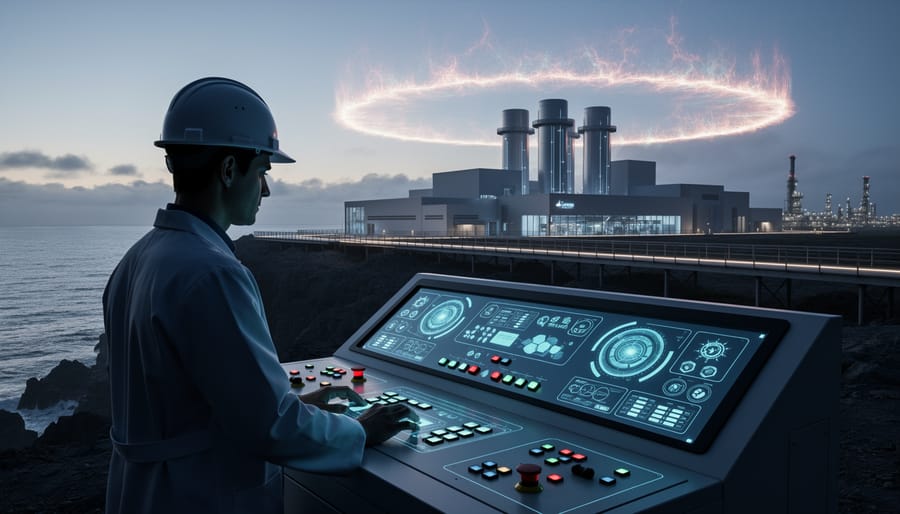
Nuclear fusion is not unlimited energy in the absolute sense, but it offers access to a fuel supply so abundant that it could power civilisation for millions of years.
The confusion is understandable. When scientists talk about fusion energy, they’re referring to the same process that powers the sun: fusing light atoms (typically hydrogen isotopes) together to release enormous amounts of energy. The fuel, deuterium and tritium, can be extracted from seawater and lithium, resources Earth has in staggering quantities. A single litre of seawater contains enough deuterium to produce energy equivalent to 300 litres of petrol. That’s the kind of scale that makes fusion sound unlimited.
But here’s the reality check. Fusion doesn’t break the laws of physics. It requires fuel, infrastructure, and sophisticated technology to maintain the extreme conditions needed (temperatures exceeding 100 million degrees Celsius). While the fuel is extraordinarily plentiful, calling it unlimited oversells the concept. More accurate? It’s practically inexhaustible for human purposes.
Recent breakthroughs have brought fusion closer to commercial reality than ever before. For Australians watching Australia’s fusion future unfold, the question isn’t whether fusion represents unlimited power, but whether it can deliver clean, safe, and sustainable energy at the scale we need. This article cuts through the hype to explain what fusion actually offers, how it works, where the technology stands in 2026, and what it could mean for Australia’s transition to clean energy.
What Nuclear Fusion Energy Actually Is
Nuclear fusion is the process of combining two light atomic nuclei to form a heavier nucleus, releasing massive amounts of energy in the process. It’s the same reaction that powers the sun and every star in the universe. When hydrogen atoms slam together under extreme heat and pressure, they fuse into helium and release energy, lots of it. This is fundamentally different from how we currently generate nuclear power, which relies on splitting atoms apart rather than joining them together.
To understand fusion properly, it helps to know a few key terms:
- Fusion vs Fission
- Fusion combines light atoms (usually hydrogen) to create energy, while fission splits heavy atoms (like uranium) apart. Fusion produces far less radioactive waste and can’t cause a runaway meltdown.
- Plasma
- The super-heated state of matter (hotter than the sun’s core) required for fusion to occur. At these temperatures, electrons separate from atoms, creating an electrically charged gas that must be carefully contained.
- Fusion Fuel (Deuterium and Tritium)
- Deuterium is a heavy form of hydrogen found abundantly in seawater, while tritium can be produced from lithium. Together, they’re the most practical fuel combination for fusion reactors.
- Ignition
- The critical point where a fusion reaction produces more energy than it consumes to keep running. Achieving ignition is the holy grail that makes commercial fusion viable.
What makes fusion a potential game-changer for Australia’s clean energy future is its promise of abundant, carbon-free power without the major downsides of traditional nuclear energy. Unlike coal or gas, fusion produces no greenhouse emissions. Unlike current nuclear fission plants, it generates minimal long-lived radioactive waste and carries virtually no risk of catastrophic failure. The fuel is so plentiful that a glass of seawater contains enough deuterium to match the energy in a barrel of oil. For a sun-drenched nation already embracing renewables, fusion represents another powerful tool in the transition to sustainable energy.
How Nuclear Fusion Creates Energy
Nuclear fusion generates energy by forcing lightweight atomic nuclei to merge together, releasing tremendous amounts of power in the process. Here’s how it works in practice.
The process starts with fuel: two isotopes of hydrogen called deuterium and tritium. These are variants of regular hydrogen with extra neutrons. Deuterium occurs naturally in seawater, about one in every 6,500 water molecules contains it. Tritium is rarer and typically produced from lithium, which is abundant in Earth’s crust and oceans.
To make fusion happen, you need to create conditions that would make a furnace seem freezing. The hydrogen fuel must be heated to around 100 million degrees Celsius, more than six times hotter than the sun’s core. At this temperature, the hydrogen becomes plasma, a supercharged state where electrons strip away from atoms.
This extreme heat gives the hydrogen nuclei enough energy to overcome their natural repulsion. Normally, atomic nuclei push each other away because they’re both positively charged. But at fusion temperatures, moving at incredible speeds, they collide with enough force to merge.
When deuterium and tritium nuclei successfully fuse, they form a single helium nucleus and release a spare neutron. This is where the magic happens: the combined helium nucleus weighs slightly less than the two separate hydrogen nuclei that formed it. That missing mass converts directly into energy, following Einstein’s famous E=mc² equation. Because the speed of light squared is such a massive number, even tiny amounts of mass release extraordinary energy.
The neutron that flies off carries most of this energy as kinetic energy, basically, it’s moving incredibly fast. In a fusion reactor, these speeding neutrons slam into a surrounding blanket material, generating heat that can be captured to produce electricity through conventional steam turbines.
What makes this process remarkably clean is what it doesn’t produce. There’s no carbon dioxide, no long-lived radioactive waste like fission reactors create, and no possibility of a runaway meltdown. The byproduct is helium, the same harmless gas used in party balloons. If something goes wrong, the plasma simply cools and the reaction stops. The fusion process produces no greenhouse gases and generates minimal waste compared to fossil fuels or even current nuclear fission plants, making it an exceptionally clean energy pathway worth pursuing.
Different Types of Fusion Reactors in Development
Magnetic Confinement Fusion (Tokamaks and Stellarators)
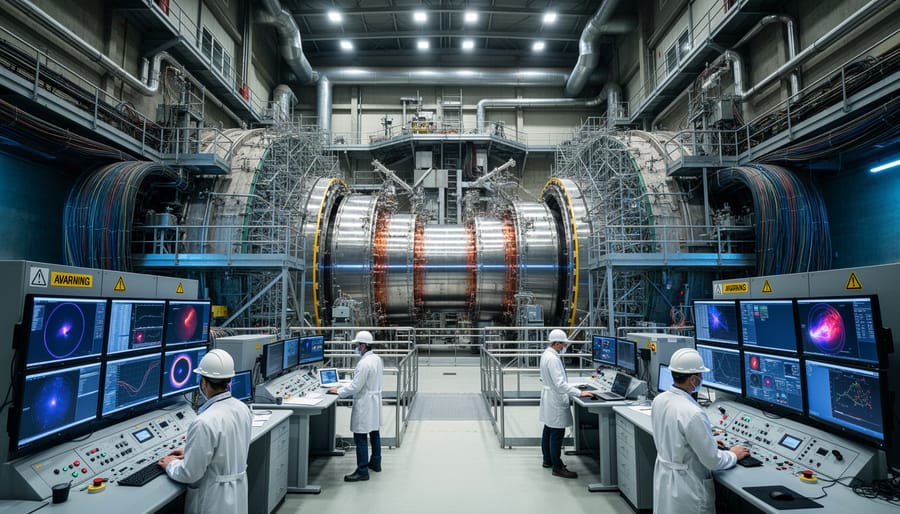
Magnetic confinement fusion tackles a fundamental challenge: plasma heated to 100 million degrees Celsius will melt any physical container. The solution? Suspend it in mid-air using powerful magnetic fields.
Tokamaks, the most developed design, use a doughnut-shaped chamber ringed with superconducting magnets. These magnets twist the plasma into a contained loop, preventing it from touching the walls. The International Thermonuclear Experimental Reactor (ITER) in France, currently under construction, represents the world’s largest tokamak. When operational, ITER aims to produce ten times more energy than it consumes, a crucial milestone for proving fusion’s viability.
Stellarators use a similar magnetic approach but with a more complex, twisted chamber shape that provides better plasma stability. Germany’s Wendelstein 7-X stellarator has demonstrated promising results since 2015.
Private companies are joining the race. Commonwealth Fusion Systems in Massachusetts is building SPARC, a compact tokamak using high-temperature superconducting magnets developed at MIT. Their smaller, more powerful design could reach net energy gain years before ITER.
The magnetic confinement approach has achieved plasma temperatures exceeding those in the sun’s core, bringing commercial fusion closer to reality.
Inertial Confinement Fusion
Inertial confinement fusion takes a different path than magnetic approaches. Instead of holding plasma in place with magnets, scientists use incredibly powerful lasers to compress a tiny fuel pellet, about the size of a peppercorn, filled with hydrogen isotopes. At the National Ignition Facility in California, 192 enormous lasers simultaneously fire at this target from all directions. The lasers don’t heat the fuel directly. They blast a capsule surrounding the pellet, creating an intense compression wave that squeezes the hydrogen to densities greater than the centre of the sun. Under this extreme pressure and heat, fusion occurs.
The December 2022 breakthrough at this facility made global headlines because it achieved net energy gain. The lasers delivered 2.05 megajoules of energy to the target, which then released 3.15 MJ from 2.05 MJ through fusion reactions, more energy out than in for the first time. This was repeated successfully in 2023, proving it wasn’t a fluke.
While this represents genuine scientific progress, it’s worth understanding the full energy picture. The 2.05 MJ represents laser energy hitting the target, but the facility’s lasers require about 300 MJ of electricity to operate. Commercial fusion power will need both higher energy gain and dramatically improved laser efficiency.
Alternative Fusion Approaches
Beyond the dominant tokamak and laser-driven approaches, researchers are testing several unconventional fusion methods that could offer simpler, cheaper pathways to commercial energy. Private companies are leading much of this experimentation, betting that different physics might solve fusion’s engineering challenges more elegantly.
Field-reversed configuration reactors compress plasma into compact shapes without massive superconducting magnets, potentially reducing construction costs dramatically. Some start-ups are revisiting older concepts like z-pinch fusion, using electric currents rather than lasers or magnetic fields to squeeze fuel to fusion conditions.
Other teams are exploring magnetised target fusion, which sits between magnetic and inertial confinement, or experimenting with alternative fuels like hydrogen-boron reactions that produce no neutrons. While these approaches remain further from commercialisation than mainstream methods, they represent the innovation diversity that could unexpectedly accelerate fusion’s arrival.
Why Nuclear Fusion Is Called ‘Unlimited’ (And What That Really Means)

The term “unlimited energy” gets tossed around with fusion, and there’s truth to it, but it needs unpacking. The fuel supply truly is staggering. Deuterium, one of the hydrogen isotopes needed for fusion, exists naturally in seawater at concentrations that give us enough to power civilisation for millions of years. One litre of seawater contains about 33 milligrams of deuterium, which doesn’t sound like much until you realise that amount could theoretically produce as much energy as 300 litres of petrol. Australia, surrounded by ocean, would have access to essentially inexhaustible fuel.
The second isotope, tritium, is trickier since it doesn’t occur naturally in useful amounts, but fusion reactors can breed it from lithium, another abundant element found in seawater and mineral deposits. Earth’s lithium reserves could supply fusion reactors for thousands of years at current energy consumption levels.
So yes, the fuel is unlimited for all practical human timescales. The energy output per reaction is also remarkable: fusing a gram of fusion fuel releases roughly the same energy as burning eleven tonnes of coal, with no carbon emissions.
But here’s where “unlimited” becomes oversimplified. Having unlimited fuel doesn’t mean unlimited energy right now. We’re still developing reactors that can sustain fusion reactions reliably, produce more energy than they consume by a commercially viable margin, and operate continuously rather than in brief experimental bursts. The engineering challenges, materials that can withstand extreme conditions, and economic viability all stand between the theoretical abundance and practical unlimited energy. Think of it this way: Australia has unlimited sunlight too, but we still needed decades to develop affordable solar panels. Fusion faces similar, though more complex, development hurdles before its unlimited fuel translates to unlimited electricity in Australian homes.
Recent Breakthroughs Bringing Fusion Closer to Reality
The last few years have marked a turning point in fusion research, with achievements that seemed decades away suddenly becoming reality. December 2022 saw the National Ignition Facility in California achieve the first-ever net energy gain from a fusion reaction, producing 3.15 megajoules of energy from a 2.05 megajoule input. This breakthrough proved that fusion could release more energy than required to trigger it, answering a question physicists had pursued for 70 years.
Since then, the pace has accelerated dramatically:
- February 2024: The National Ignition Facility replicated its success three more times, demonstrating the result was not a one-off fluke
- July 2024: Commonwealth Fusion Systems completed construction of the world’s strongest high-temperature superconducting magnet, bringing commercial tokamak reactors closer to reality
- November 2024: China’s EAST reactor sustained plasma for over 400 seconds at temperatures exceeding 70 million degrees, setting a new world record
- March 2025: ITER in France began plasma operations, with 35 nations collaborating on the world’s largest fusion experiment
- September 2025: JET in the United Kingdom achieved 69 megajoules of fusion energy in a five-second burst before its planned shutdown
- January 2026: TAE Technologies demonstrated sustained plasma stability for 30 seconds using their alternative approach, opening new pathways beyond traditional designs
Private investment has surged alongside these technical milestones. Companies like Helion Energy and Tokamak Energy have secured billions in funding and announced partnerships with tech giants to supply future data centres. Google has committed to purchasing fusion power from TAE Technologies once commercial operations begin.
These advances complement other clean energy innovations like solar-powered hydrogen and solid-state batteries creating a comprehensive toolkit for Australia’s sustainable energy future. While commercial fusion plants remain years away, the technical barriers are falling faster than most experts predicted just five years ago.
Practical Applications: How Fusion Energy Could Be Used
Once fusion power plants become operational, they’ll reshape how we generate and use energy across multiple sectors. The most straightforward application is base-load electricity generation, fusion reactors would run continuously, providing stable power that complements the intermittent nature of solar and wind power. Unlike coal or gas plants, fusion facilities produce no carbon emissions during operation and require minimal fuel, making them ideal partners for renewable grids that need reliable backup when the sun isn’t shining or winds aren’t blowing.
Industrial applications represent another significant opportunity. High-temperature processes in steel manufacturing, cement production, and chemical processing currently rely on fossil fuels. Fusion reactors could supply the intense heat these industries need while eliminating their carbon footprint. For Australian manufacturers competing globally, access to clean, abundant thermal energy could prove transformative.
Hydrogen production through fusion deserves particular attention. Clean hydrogen requires enormous amounts of electricity to split water molecules. Fusion plants could generate this power around the clock, producing green hydrogen at scale for export markets, heavy transport, and energy storage. This aligns perfectly with Australia’s hydrogen ambitions and our abundant renewable resources.
The real power of fusion lies in integration, not replacement. Imagine Australia’s energy system in 2050: solar farms and wind power installations provide the bulk of daytime electricity, bioenergy facilities convert agricultural waste to fuel, and fusion reactors fill the gaps, running continuously to ensure grid stability. Each technology plays to its strengths, creating a genuinely sustainable energy ecosystem that leverages our natural advantages while securing reliable power for generations.
The Challenges Still Facing Fusion Energy
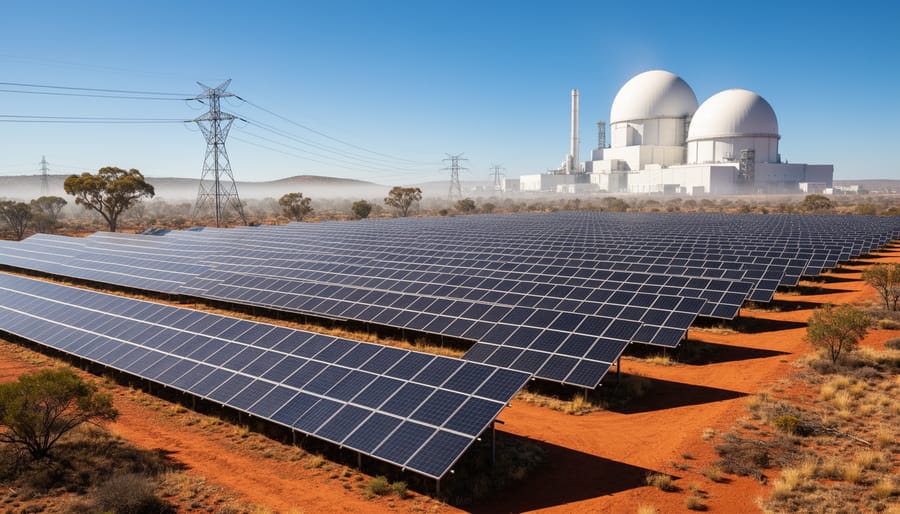
Despite the remarkable progress, fusion energy still faces significant hurdles before it can power Australian homes and businesses. The gap between laboratory breakthrough and commercial power plant remains substantial, requiring patience and continued investment.
The engineering challenges are formidable. Reactors must contain plasma heated to 150 million degrees Celsius, ten times hotter than the sun’s core, while the surrounding structure stays cool enough to function. No material can directly touch this plasma without instantly vaporizing, which is why magnetic fields or laser pulses must do the containment work. The materials that line reactor walls endure constant bombardment from neutrons, gradually degrading and needing replacement. Scientists are developing advanced alloys and self-healing materials, but creating components that survive decades of this punishment remains an active research area.
Cost presents another reality check. ITER, the world’s largest fusion experiment in France, carries a price tag exceeding AU$30 billion. While private ventures aim for leaner designs, building the first commercial reactors will require massive capital investment. The economic equation must eventually compete with increasingly affordable solar, wind, and bioenergy solutions that are already delivering clean hydrogen and reliable power across Australia.
Timeline expectations need honest framing. Most experts project the 2040s for the first commercial fusion plants, with widespread deployment not expected until mid-century. That’s not pessimism, it’s the reality of transforming a scientific achievement into industrial-scale infrastructure. The encouraging news? Each technical problem solved brings us closer, and the global effort continues accelerating with both public and private sector commitment.
What Fusion Means for Australia’s Sustainable Energy Future
Australia’s path to net-zero emissions by 2050 doesn’t hinge on waiting for fusion energy. While commercial fusion reactors may arrive in the 2040s or 2050s, if development continues at current pace, our renewable energy transition needs to accelerate now. That’s precisely why fusion fits perfectly into Australia’s long-term strategy: as a future complement to the solar, wind, and bioenergy infrastructure we’re building today.
Think of fusion as the potential baseload partner for our renewables-dominant grid. Solar and wind excel at daytime and seasonal generation, bioenergy provides dispatchable power from agricultural waste, and fusion could eventually deliver constant, weather-independent electricity for heavy industry and population centres. This layered approach maximizes energy security without putting all our eggs in one basket.
For Australian investors and innovators, fusion research presents opportunities in materials science, advanced manufacturing, and energy systems integration. Several Australian universities already collaborate on international fusion projects, developing expertise that will prove valuable regardless of when commercial plants come online.
The critical point: every solar panel installed, every bioenergy facility commissioned, and every wind farm connected strengthens our grid and reduces emissions today. Fusion’s promise doesn’t diminish these investments, it validates them. We’re building the renewable foundation that fusion will one day join, creating a truly sustainable energy ecosystem that draws from multiple clean sources rather than depending on any single technology.
Common Questions About Fusion and Unlimited Energy
The questions Australians ask about fusion reveal both excitement and healthy scepticism about this emerging technology. Here’s what you need to know.
Is nuclear fusion safe, or does it carry the same risks as fission reactors?
Fusion is fundamentally safer than fission because the reaction requires precise conditions that stop immediately if anything goes wrong, there’s no chain reaction to control. The fuel amounts are tiny (grams, not tonnes), and fusion produces no long-lived radioactive waste like fission plants generate.
When will fusion power actually be available in Australia?
Commercial fusion electricity is realistically decades away, with most experts pointing to the 2040s or 2050s for grid-scale deployment. That’s why continuing to invest in solar, wind, and bioenergy remains crucial for Australia’s near-term climate goals.
Will fusion energy be cheaper than current renewables?
Initially, fusion will likely cost more than mature renewable technologies, but costs should decrease as the technology scales. The real value lies in fusion’s ability to provide constant baseload power that complements variable renewables rather than replacing them.
Should we stop investing in solar and bioenergy if fusion is coming?
Absolutely not. We need renewable energy solutions working now to meet climate targets, and fusion’s long development timeline means every solar panel and bioenergy project installed today plays a vital role in Australia’s sustainable transition.
These answers highlight an important truth: fusion and current renewables aren’t competitors but partners in creating a diversified, resilient energy system. The environmental benefits of fusion, zero carbon emissions, minimal waste, abundant fuel, make it an exciting addition to Australia’s clean energy toolkit, not a reason to slow down today’s renewable rollout. For Australians committed to sustainability, the message is clear: support fusion development while actively pursuing the proven renewable technologies that are already delivering results across the country.
So, is nuclear fusion unlimited energy? In theory, yes. The fuel is abundant enough to power civilization for millions of years, and the energy output dwarfs anything we currently use. But in practical terms, fusion is more accurately described as extraordinarily abundant rather than truly unlimited. Physical constraints, engineering challenges, and the realities of building and maintaining fusion plants mean there will always be some limits, even if those limits are vastly higher than anything fossil fuels or current renewables can offer.
The breakthroughs we’ve seen through 2026 are genuinely exciting. Net energy gain has moved from theoretical possibility to demonstrated reality. Commercial fusion plants could begin contributing to grids in the 2030s, with broader deployment following in subsequent decades. That’s remarkable progress.
But here’s what matters most for Australia right now: fusion’s future promise doesn’t diminish the urgent need for today’s renewable solutions. Solar, wind, and bioenergy are working technologies delivering clean power now, reducing emissions now, and creating jobs now. These are the tools driving our transition to a sustainable energy future while fusion matures.
Stay informed about fusion developments, absolutely. Support research and innovation in all clean energy technologies. But don’t wait for fusion to make sustainable choices. Every solar panel installed, every bioenergy project supported, and every shift away from fossil fuels moves Australia closer to the clean energy future we need. The best time to act on renewable energy is always now.